
Industrial Ginger Drying Systems: From Fresh Ginger to Dried Products
Ginger is one of the most important spice and food ingredients used across the food, beverage, seasoning, nutraceutical, herbal and ingredient industries. However, converting fresh ginger into a stable, high-quality dried product requires much more than simply removing moisture.
An industrial ginger drying system must manage moisture removal, drying uniformity, product temperature, residence time, airflow, hygiene, aroma retention, colour, final moisture and energy consumption.
For processors in India and international markets, the challenge is therefore not simply:
“How do I dry ginger?”
The more important question is:
“How can I dry ginger consistently at commercial scale while achieving the required quality, moisture and production capacity?”
GTI Dryers, an Indian industrial dryer manufacturer, designs and manufactures customized drying and dehydration systems for food, spices and agricultural products. Its food-drying portfolio includes systems for ginger, turmeric, chilli and other spice-processing applications.
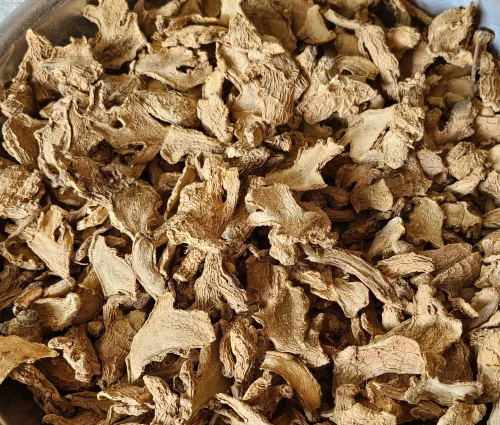
Quick Answer: What Is an Industrial Ginger Drying System?
An industrial ginger drying system is a controlled dehydration process designed to reduce the moisture content of fresh or partially processed ginger to a specified final level.
Depending on the product and final application, the process may include:
Fresh Ginger → Washing → Sorting → Peeling/Scraping → Slicing → Feeding → Industrial Drying → Cooling → Grading → Grinding/Powdering → Packaging
The exact process depends on whether the final product is:
- Dried ginger
- Dry ginger pieces
- Dried ginger slices
- Ginger flakes
- Ginger granules
- Ginger powder
- Ginger extract feedstock
- Herbal or functional ingredient
There is therefore no single “best ginger dryer” for every factory.
The correct system depends on the product form, moisture content, production capacity, final moisture requirement, heat sensitivity and downstream process.
Why Ginger Drying Is a Critical Processing Step
Fresh ginger contains substantial moisture and is vulnerable to deterioration if it is not handled and processed appropriately.
Drying converts a highly perishable agricultural raw material into a more stable ingredient that can be stored, transported, processed and marketed over a longer period.
Industrial dehydration can help processors:
- Reduce moisture
- Improve storage stability
- Extend usable shelf life
- Reduce transportation weight
- Produce consistent dried ginger
- Prepare ginger for grinding
- Support ginger powder manufacturing
- Improve process control
- Reduce dependence on weather
- Support year-round commercial processing
ICAR has documented Indian ginger-processing communities where drying is used to improve marketability, shelf life and economic value. Its work on traditional ginger processing also demonstrates the transition from agricultural production toward value-added dried ginger products.
For a commercial processor, the major difference is process consistency.
Natural sun drying can be influenced by:
- Rain
- Humidity
- Ambient temperature
- Solar intensity
- Drying duration
- Handling conditions
- Contamination
- Labour availability
An enclosed industrial drying system provides significantly greater control over the drying environment.
Ginger Drying in India: Why the Opportunity Matters
India has a particularly important position in the global spice-processing industry.
The country’s spice ecosystem includes cultivation, aggregation, cleaning, processing, dehydration, grinding, extraction, seasoning, packaging and export.
Ginger is produced and processed across multiple Indian regions, creating opportunities for decentralized processors as well as larger industrial food and spice manufacturers.
Important ginger-processing regions and sourcing belts can include:
Northeast India
- Assam
- Meghalaya
- Arunachal Pradesh
- Nagaland
- Mizoram
- Sikkim
Eastern & Himalayan Region
- West Bengal
- Sikkim
- Uttarakhand
Southern India
- Kerala
- Karnataka
Other Agricultural Processing Regions
Ginger can also enter industrial processing networks through traders, aggregators and spice-processing companies outside the primary cultivation areas.
This means a ginger dryer manufacturer serving India should not think only in terms of ginger-growing states.
The actual buyer may be located near:
Farm → Collection Centre → Processor → Spice Mill → Ingredient Manufacturer → Exporter
GTI Dryers can therefore engineer drying systems according to the processor’s actual plant location and raw-material supply chain.
The Ginger Processing Problem: Fresh Ginger to Stable Ingredient
A typical industrial ginger processing line can be visualized as:
Fresh Ginger
↓
Cleaning & Washing
↓
Sorting / Grading
↓
Peeling or Scraping — where required
↓
Slicing / Cutting
↓
Controlled Industrial Drying
↓
Cooling
↓
Grading
↓
Dried Ginger
↓
Grinding / Milling
↓
Ginger Powder
↓
Packaging / Further Processing
The drying stage sits at the centre of this value chain.
If drying is inconsistent, problems can occur downstream.
For example:
Uneven drying → inconsistent moisture → inconsistent grinding → variable powder quality
Similarly:
Excessive thermal exposure → undesirable colour/aroma changes → reduced product quality
Therefore, dryer design should begin with the final product specification, not simply the available dryer.
What Should an Industrial Ginger Dryer Solve?
A properly engineered ginger drying system should address several processing problems simultaneously.
1. Uneven Moisture
Different pieces or slices can dry at different rates.
The system therefore needs controlled airflow, material distribution and residence time.
2. Over-Drying
Removing more moisture than necessary can increase energy consumption and potentially affect product characteristics.
The target should be based on the required final product specification.
3. Under-Drying
Insufficient moisture removal can compromise storage stability and downstream processing.
4. Variable Feed Thickness
Ginger slices may vary in thickness.
This affects drying time and moisture migration.
5. Heat Sensitivity
Ginger contains important aroma and flavour compounds.
The drying profile therefore needs to be developed according to the product and quality target rather than applying an arbitrary high temperature.
6. Seasonal Processing
During harvest periods, processors may need to handle large volumes within limited time.
A continuous industrial dryer can help increase processing consistency and reduce dependence on outdoor drying conditions.
7. Labour-Intensive Drying
Manual spreading, turning and sun-drying operations can create variations in production.
Mechanized feeding, conveying and drying can improve process control.
Ginger Dryer Machine Selection: Which Technology Is Suitable?
There is no universal answer because ginger can enter the dryer in different forms.
Possible industrial drying technologies include:
- Tray dryers
- Cabinet dryers
- Conveyor dryers
- Band dryers
- Mesh belt dryers
- Multi-stage belt drying systems
- Heat-pump drying systems
- Specialized hot-air drying systems
- Other customized drying technologies
For continuous processing of prepared ginger slices or pieces, a tray-type belt or band-style drying system can be evaluated where the required product and process conditions are compatible.
GTI’s existing industrial band-dryer technology is designed for continuous drying applications involving products such as ginger, onion, garlic, turmeric and chilli.
For heat-sensitive or high-value applications, lower-temperature drying approaches can also be considered. GTI’s industrial heat-pump drying technology is positioned for controlled low-temperature dehydration of food and agricultural materials.
Important:
The dryer should be selected after evaluating the actual ginger-processing requirement.
A machine suitable for ginger slices may not necessarily be the right configuration for whole ginger, grated ginger, granules or another feed form.
How Does an Industrial Ginger Dryer Work?
A typical continuous hot-air ginger drying system operates through controlled heat and airflow.
Step 1 — Product Feeding
Prepared ginger is introduced into the dryer at a controlled feed rate.
Step 2 — Product Distribution
The ginger is distributed across the drying surface to promote consistent exposure to drying air.
Step 3 — Hot-Air Circulation
Controlled heated air passes through or across the ginger.
Step 4 — Moisture Migration
Heat transfers energy to the product, allowing internal moisture to migrate toward the surface and evaporate.
Step 5 — Exhaust
Moisture-laden air is removed from the drying chamber.
Step 6 — Multi-Zone Drying
Where required, different drying zones can provide controlled conditions during different stages of dehydration.
Step 7 — Cooling
After reaching the desired moisture condition, the dried ginger can be cooled before further handling or packaging.
The actual airflow pattern, temperature profile, residence time and number of zones should be determined during process engineering.
Ginger Drying System Design: The Parameters That Matter
One of the biggest mistakes in selecting an industrial ginger dryer is asking only:
“What is the capacity of the machine?”
Capacity is important, but it is only one part of the calculation.
GTI recommends evaluating the complete process:
Product → Feed Form → Initial Moisture → Final Moisture → Throughput → Slice Thickness → Drying Profile → Residence Time → Heat Source → Plant Conditions
Key parameters include:
| Parameter | Why It Matters |
| Ginger variety | Can influence physical and drying characteristics |
| Feed form | Whole, sliced, chopped, grated, etc. |
| Initial moisture | Determines water evaporation requirement |
| Final moisture | Defines the drying endpoint |
| Slice thickness | Directly influences drying time |
| Feed rate | Determines dryer loading |
| Production capacity | Determines equipment size |
| Heat sensitivity | Influences drying profile |
| Residence time | Determines exposure duration |
| Airflow | Controls heat and mass transfer |
| Heating source | Affects operating economics |
| Plant location | Influences ambient conditions and utilities |
| Final application | Determines required product quality |
This is why two factories producing dried ginger at the same nominal capacity may require different dryer configurations.
From Dried Ginger to Ginger Powder: Where Industrial Drying Creates Value
Drying is often not the final stage.
For many processors, it is the beginning of a higher-value processing chain.
Value Chain 1 — Dried Ginger
Fresh Ginger → Cleaning → Slicing → Drying → Dried Ginger → Packaging
Value Chain 2 — Ginger Powder
Fresh Ginger → Cleaning → Slicing → Drying → Milling → Sieving → Ginger Powder → Packaging
Value Chain 3 — Ingredient Manufacturing
Fresh Ginger → Processing → Controlled Drying → Milling / Further Processing → Food Ingredient
Value Chain 4 — Export-Oriented Processing
Fresh Ginger → Cleaning → Grading → Dehydration → Quality Control → Packaging → Export
The drying system therefore becomes an important part of the processor’s value-addition strategy.
Ginger Dryer for Different Product Forms
Ginger Slices
Suitable for processors producing dried ginger slices for food, spice and ingredient markets.
The dryer should provide consistent air distribution and controlled residence time.
Ginger Pieces
Larger pieces can require different drying behaviour compared with thin slices.
The dryer design should account for particle size and thickness.
Ginger Flakes
Flake production requires careful material handling to prevent excessive breakage.
Ginger Granules
Granular products may be compatible with different drying configurations depending on particle size, bulk density and flow characteristics.
Ginger Powder
Powder is generally processed differently from sliced ginger.
If the objective is powder manufacturing, the overall process should be considered as:
Drying + Milling + Classification + Packaging
rather than selecting the dryer in isolation.
Industrial Ginger Dehydration vs Sun Drying
Traditional sun drying remains relevant for small-scale and agricultural processing.
However, commercial processors may require greater control.
| Factor | Sun Drying | Industrial Drying |
| Weather dependence | High | Low |
| Process control | Limited | High |
| Production consistency | Variable | More controllable |
| Labour requirement | Higher | Can be reduced through automation |
| Production scheduling | Weather dependent | Planned |
| Hygiene control | More challenging | Enclosed process possible |
| Large-scale production | Difficult to control | Better suited |
| Moisture control | Variable | Precisely engineered |
| Continuous operation | No | Possible |
The objective is not necessarily to eliminate traditional processing.
Instead, industrial drying provides an option for processors who need repeatability, throughput and controlled product quality.
Energy Efficiency in Ginger Drying
Drying can be energy-intensive because water must be evaporated from the product.
Therefore, energy efficiency should be considered during system design.
Potential approaches include:
- Optimized airflow
- Controlled temperature zones
- Heat recovery
- Proper insulation
- Variable-speed drives
- Efficient heating systems
- Exhaust-air management
- Process automation
- Optimized residence time
- Appropriate moisture endpoint
GTI’s industrial drying approach includes consideration of energy efficiency, airflow and process-specific equipment design.
However, energy consumption should not be quoted as a universal number.
Actual energy demand depends on:
Water Evaporation + Product Load + Initial Moisture + Final Moisture + Ambient Conditions + Heat Source + Dryer Efficiency
Hygienic Ginger Drying System for Food Processing
For food-grade ginger processing, hygienic engineering is critical.
Depending on the application and applicable standards, the drying system can be designed with considerations such as:
- Food-grade product-contact surfaces
- Stainless-steel construction
- Cleanable surfaces
- Controlled air circulation
- Appropriate filtration
- Accessible inspection areas
- Moisture monitoring
- Temperature monitoring
- Controlled product handling
- Dust management
- Hygienic feeding and discharge
The exact material specification should be determined according to the product, cleaning regime, process environment and applicable food regulations.
Automation for Industrial Ginger Drying
A modern ginger drying system can incorporate automation to reduce process variation.
Depending on project requirements, automation may include:
- PLC control
- HMI interface
- Temperature monitoring
- Fan control
- VFD-based speed control
- Conveyor-speed adjustment
- Heating control
- Alarm systems
- Data monitoring
- Recipe-based operation
- SCADA integration
Automation can allow operators to monitor critical process parameters rather than manually controlling every stage.
GTI’s industrial dryer portfolio supports PLC/SCADA and smart monitoring options depending on project requirements.
Ginger Dryer Manufacturer in India: Why Local Engineering Matters
For an Indian spice processor, purchasing a dryer is not simply an equipment transaction.
The system has to fit the factory.
That means considering:
Raw Material + Process + Utilities + Plant Layout + Labour + Energy + Production Target + Final Product
An Indian manufacturer can provide closer alignment with the country’s spice-processing ecosystem while also engineering systems for international projects.
GTI Dryers is an India-based industrial dryer manufacturer providing customized drying systems for food, pharmaceutical, chemical and process industries. The company states that it has more than 40 years of engineering experience and provides customized and turnkey drying solutions.
For international buyers, an India-based engineering partner can also provide a route to customized equipment manufacturing for projects outside India.
Ginger Drying Systems for Global Markets
Although India is the primary geographic focus of this page, ginger drying is a global processing requirement.
Potential markets for industrial ginger dehydration equipment include:
Asia
- India
- China
- Bangladesh
- Indonesia
- Vietnam
- Sri Lanka
- Thailand
Africa
- Nigeria
- Ethiopia
- Tanzania
- Kenya
- Uganda
- Ghana
Middle East
- UAE
- Saudi Arabia
- Oman
- Qatar
Europe
- Germany
- Netherlands
- United Kingdom
- France
- Italy
North America
- USA
- Canada
- Mexico
The exact market opportunity varies by local ginger cultivation, imports, processing infrastructure and downstream demand.
For GTI, the objective is not to sell one standard ginger dryer globally.
It is to develop a process-specific industrial dehydration solution around the customer’s raw material and production target.
Regional Ginger Dryer Opportunities in India
For Indian search visibility, a national page can be supported by regional landing pages targeting actual processing clusters.
North & Northeast India
Ginger Dryer Machine in Assam
Ginger Drying System in Meghalaya
Industrial Ginger Dryer in Sikkim
Ginger Dehydration Machine in Arunachal Pradesh
Eastern India
Ginger Dryer Machine in West Bengal
Industrial Ginger Dryer in North Bengal
Ginger Drying System in Darjeeling
South India
Ginger Dryer Manufacturer in Kerala
Industrial Ginger Dryer in Karnataka
North India
Ginger Drying Machine in Uttarakhand
Industrial Ginger Dryer in Himachal Pradesh
Pan-India B2B Search Terms
- Ginger Dryer Manufacturer India
- Ginger Dryer Machine Manufacturer
- Industrial Ginger Dryer
- Ginger Drying System
- Ginger Dehydration Machine
- Ginger Dehydrator Machine
- Dried Ginger Processing Machine
- Ginger Slice Dryer
- Ginger Powder Processing Plant
- Industrial Spice Dryer
- Food Dehydration Machine India
- Continuous Ginger Dryer
- Ginger Dryer Supplier India
- Ginger Drying Equipment
- Ginger Processing Machinery
These should be developed into supporting pages only where the page offers genuinely useful location-specific or application-specific information rather than simply repeating the same content with a different city name.
Common Ginger Drying Problems and Engineering Solutions
Problem: Ginger Is Drying Unevenly
Possible causes: inconsistent slice thickness, poor product distribution or uneven airflow.
Engineering direction: evaluate feed distribution, bed depth, airflow and residence time.
Problem: Drying Takes Too Long
Possible causes: high initial moisture, excessive product loading, inadequate heat transfer or unsuitable airflow.
Engineering direction: calculate actual water evaporation and review the complete drying profile.
Problem: Product Becomes Too Dark
Possible causes: excessive thermal exposure, unsuitable drying conditions or prolonged residence time.
Engineering direction: evaluate temperature profile, airflow and residence time against the required product quality.
Problem: Final Moisture Varies Between Batches
Possible causes: variable feed moisture, inconsistent feeding or inadequate process control.
Engineering direction: introduce controlled feeding and monitor critical drying parameters.
Problem: Sun Drying Cannot Meet Production Demand
Possible causes: weather dependence, limited drying area and labour constraints.
Engineering direction: evaluate continuous or batch industrial dehydration according to throughput requirements.
Problem: Dryer Capacity Is Not Matching Production
Possible causes: capacity estimated without calculating actual moisture evaporation.
Engineering direction: determine:
Feed Rate × Initial Moisture × Final Moisture × Operating Hours
and use the calculated water-removal requirement to engineer the dryer.
How to Select the Right Ginger Dryer Machine
Before purchasing an industrial ginger dryer, prepare the following information:
1. Product
Fresh ginger, sliced ginger, dried ginger, flakes, granules or another form.
2. Feed Form
Whole / sliced / chopped / grated / other.
3. Initial Moisture
Actual moisture content of the incoming material.
4. Target Moisture
Required final moisture specification.
5. Production Capacity
kg/hour, tonnes/day or tonnes/batch.
6. Slice Thickness
Important for calculating drying behaviour.
7. Operating Hours
Number of production hours per day.
8. Heating Source
Steam, thermic fluid, hot water, electrical heating, gas, biomass or another available source.
9. Final Product
Dried ginger, flakes, powder or ingredient.
10. Plant Location
Important for ambient conditions, utilities, layout and installation planning.
This information allows the manufacturer to move from a generic machine quotation toward a process-engineered drying solution.
Why GTI Dryers for Ginger Drying Systems?
GTI Dryers approaches industrial drying as a process-engineering problem rather than simply supplying a catalogue machine.
For ginger applications, the engineering evaluation can consider:
Product → Moisture → Feed Form → Capacity → Drying Profile → Heat Source → Residence Time → Final Product
Depending on the application, GTI can evaluate and engineer suitable drying technologies such as:
- Tray-type belt dryers
- Band dryers
- Mesh belt dryers
- Food dehydration systems
- Heat-pump drying systems
- Customized continuous drying systems
- Integrated drying and handling systems
GTI’s existing food-drying and spice-drying portfolio specifically includes ginger among the products considered for industrial dehydration.
The final equipment configuration should always be determined from actual product and process data.
From Indian Ginger to Global Food Ingredients
The future opportunity in ginger processing is not limited to selling dried ginger.
A well-designed processing plant can create multiple value-added products:
Fresh Ginger
→ Dried Ginger
→ Ginger Flakes
→ Ginger Powder
→ Food Ingredient
→ Seasoning Ingredient
→ Further Extraction / Processing
This creates opportunities for:
- Spice processors
- Food ingredient manufacturers
- Seasoning companies
- Herbal product manufacturers
- Nutraceutical companies
- Exporters
- Contract processors
- Agricultural entrepreneurs
- Integrated food-processing plants
For these businesses, the drying system becomes one of the critical technologies connecting agricultural raw material with commercial value-added products.
Frequently Asked Questions About Ginger Drying Systems
What is a ginger drying system?
A ginger drying system is industrial equipment used to remove moisture from fresh or processed ginger under controlled temperature, airflow and residence-time conditions.
Which dryer is best for ginger?
There is no universal best dryer. The suitable technology depends on ginger form, initial moisture, final moisture, capacity, slice thickness, heat sensitivity and final application.
Can ginger be dried continuously?
Yes. Continuous drying systems can be evaluated for commercial ginger slices, pieces and other suitable feed forms where continuous operation is required.
Can a ginger dryer produce dried ginger for powder?
Yes. Ginger can be dried before milling into powder. The drying system should be designed around the moisture requirement of the subsequent grinding and packaging process.
Can one dryer process ginger and other spices?
Potentially, depending on product characteristics, hygiene requirements, feed form, drying profile and cleaning requirements. A multi-product system should be engineered around the compatibility of the products rather than assuming identical drying conditions.
What information is required to design a ginger dryer?
The most useful starting information is:
Product + Feed Form + Initial Moisture + Final Moisture + Capacity + Slice Thickness + Operating Hours + Heat Source + Plant Location + Final Product
Is an industrial ginger dryer suitable for India?
Yes. Industrial drying can be evaluated for Indian ginger processors ranging from commercial agricultural processors and spice manufacturers to ingredient producers and exporters.
Does GTI Dryers manufacture ginger drying equipment in India?
GTI Dryers is an India-based industrial dryer manufacturer that designs and manufactures customized drying systems for food, spices and other process industries.
Ginger Dryer Machine Manufacturer in India — Request a Technical Evaluation
If you are planning a:
- Ginger processing plant
- Ginger dehydration unit
- Dried ginger production line
- Ginger powder manufacturing plant
- Spice processing facility
- Food ingredient plant
- Ginger drying capacity expansion
- Industrial dryer replacement project
GTI Dryers can evaluate the drying requirement based on your actual process data.
Send these details:
Product:
Fresh ginger / sliced ginger / pieces / flakes / other
Feed Rate:
_____ kg/hour
Initial Moisture:
_____ %
Required Final Moisture:
_____ %
Slice Thickness:
_____ mm
Production Hours:
_____ hours/day
Heating Source:
Steam / thermic fluid / electric / gas / biomass / other
Final Product:
Dried ginger / flakes / powder / ingredient
Plant Location:
City, State, Country
With these inputs, the drying requirement can be evaluated around:
Water Evaporation → Dryer Capacity → Drying Profile → Energy Requirement → Equipment Configuration
GTI Dryers
Industrial Ginger Dryer & Spice Drying System Manufacturer in India
Engineered in India. Designed for the World.
For ginger drying, spice dehydration and industrial food-processing projects, start with the process requirement—not just the machine name.