Why Industrial Flash Drying Is Becoming Important in Saudi Arabia & UAE
Saudi Arabia and the UAE are rapidly developing their downstream manufacturing capabilities, creating opportunities for advanced industrial drying technologies.
Saudi Arabia’s industrial strategy emphasizes moving beyond basic petrochemicals toward specialty chemicals, plastics and rubber conversion, and downstream value-added manufacturing. The UAE is similarly promoting manufacturing, energy-efficient production and priority sectors including petrochemicals, chemical products, plastics, pharmaceuticals, food and machinery.
This creates a strong process requirement for drying slurries, pastes, filter cakes, wet powders, pigments, chemical intermediates and other moisture-containing materials.
For these applications, conventional long-residence-time drying may not always provide the required combination of:
Rapid moisture removal + controlled residence time + compact equipment + consistent powder quality + energy efficiency
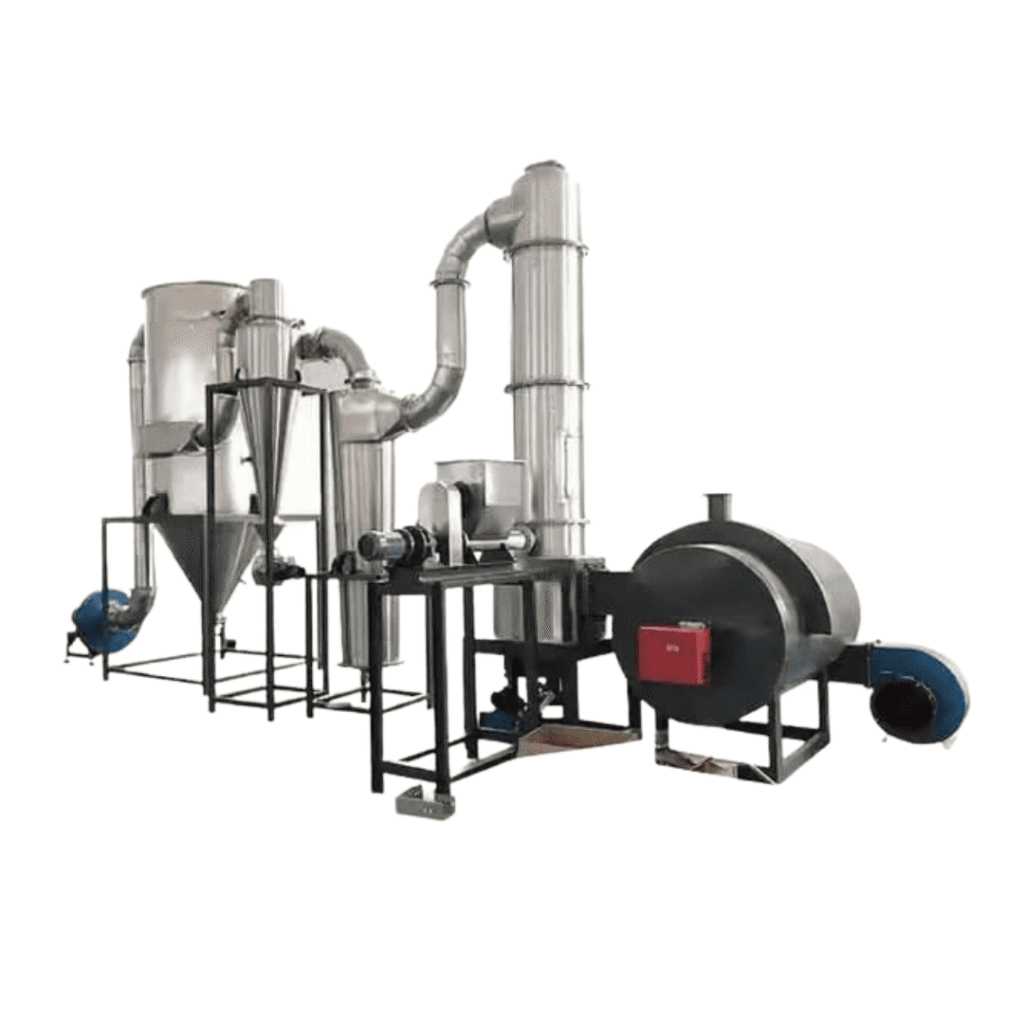
This is where a properly engineered industrial flash dryer or spin flash dryer can become an important process option.
Saudi Arabia & UAE: Where Is Flash Drying Used?
The opportunity is not limited to one industry. Different industrial clusters across the GCC can require different drying configurations.
1. Petrochemical & Downstream Chemical Processing
Saudi Arabia has a particularly strong petrochemical base and is actively targeting greater downstream value addition. Its chemical-sector strategy identifies specialty chemicals, plastics & rubber conversion and inorganic chemicals as important growth areas.
Potential drying applications include:
- Chemical intermediates
- Polymer-related materials
- Specialty chemicals
- Pigments and additives
- Wet filter cakes
- Chemical slurries
- Fine powders
- Inorganic compounds
A spin flash dryer can be evaluated when the feed enters the process as a paste, slurry, filter cake or wet solid and needs rapid conversion into a dry, manageable powder.
2. Plastics, Polymers & Rubber-Related Materials
The development of downstream plastics and polymer conversion is another important opportunity.
Saudi Arabia’s industrial strategy specifically targets expansion in plastics and elastomer conversion, while the UAE’s industrial strategy identifies rubber and plastics and petrochemicals as priority manufacturing sectors.
Depending on the material characteristics, industrial flash drying may be considered for:
- Polymer intermediates
- Additives
- Pigments
- Fillers
- Chemical compounds
- Wet powders
- Specialty plastic-processing materials
The exact dryer selection depends on whether the material is free-flowing, sticky, pasty, heat-sensitive or prone to agglomeration.
What Makes a Spin Flash Dryer Different?
A spin flash dryer is designed for rapid drying of materials that may be difficult to handle in conventional pneumatic or rotary systems.
The process generally involves feeding wet material into a drying chamber where mechanical dispersion and hot air create intensive heat and mass transfer.
A simplified process is:
Wet Feed → Mechanical Dispersion → Hot Air Contact → Rapid Moisture Evaporation → Classification → Dry Powder
The short residence time can be useful when manufacturers want to minimize prolonged exposure to elevated temperatures.
Modern flash-drying systems can also integrate drying with deagglomeration and classification, depending on the configuration.
Flash Dryer Applications for Saudi Arabia & UAE Industries
Petrochemicals
For large chemical complexes, flash drying can be evaluated for suitable wet intermediates, specialty chemicals and downstream products.
Specialty Chemicals
Saudi Arabia’s push toward specialty chemical formulations creates potential demand for drying systems capable of handling complex chemical feeds.
Pigments & Dyestuffs
Flash drying can be suitable for certain pigment and dye slurries where rapid moisture removal and powder formation are required.
Fertilizers & Agrochemicals
Suitable wet chemical formulations, filter cakes and granular intermediates may require rapid industrial drying.
For appropriate pharmaceutical materials, controlled flash drying can provide rapid moisture removal. Hygienic construction, containment, material compatibility and GMP requirements must be incorporated into the equipment specification.
Desalination & Water-Treatment Byproducts
The GCC’s extensive water infrastructure generates concentrated streams and solids requiring careful downstream management.
Depending on the feed characteristics, flash drying may be evaluated for suitable concentrated solids, fine materials and filter cakes as part of an integrated water-treatment or resource-recovery process.
Why Saudi Arabia & UAE Need Energy-Efficient Drying Technology
Drying high-moisture materials is inherently energy intensive because thermal energy is required to evaporate water.
Therefore, the question for a GCC plant is not simply:
“Which dryer can remove the moisture?”
It should be:
“Which dryer can achieve the required moisture reduction at the lowest practical lifecycle cost while maintaining product quality?”
A modern industrial drying system can be engineered around:
- Optimized air circulation
- Heat recovery
- Proper insulation
- Controlled residence time
- Variable-frequency drives
- Automated temperature control
- Optimized feed rate
- Exhaust-air management
- Suitable heat-source selection
This approach is particularly relevant to plants operating continuously at high utilization.
Flash Dryer vs Rotary Dryer: Which Is Better?
There is no universal winner. The correct technology depends on the feed.
| Requirement | Spin Flash Dryer | Rotary Dryer |
| Wet paste/filter cake | Excellent candidate | Possible depending on feed |
| Fine wet powder | Excellent candidate | Generally less suitable |
| Rapid drying | Very strong | Moderate |
| Large bulk solids | Possible | Excellent candidate |
| Short residence time | Yes | Longer |
| Mineral/aggregate drying | Application dependent | Strong choice |
| Compact footprint | Advantage | Larger |
| Sticky/pasty materials | Strong candidate | Requires appropriate design |
For a fine, wet, dispersible feed, a spin flash dryer may be more appropriate. For large quantities of free-flowing bulk solids such as minerals or sand, a rotary drum dryer may be more suitable.
The decision should be based on actual material testing rather than the industry name alone.
What Should GCC Buyers Consider Before Purchasing a Flash Dryer?
Before requesting a quotation, plant engineers should prepare the following information:
Feed Characteristics
- Feed rate
- Initial moisture
- Final moisture
- Solids concentration
- Particle size
- Bulk density
- Stickiness
- Feed temperature
- Thermal sensitivity
Process Requirements
- Required evaporation capacity
- Desired powder characteristics
- Available heat source
- Operating hours
- Required automation
- Dust-collection requirements
- Exhaust temperature
- Emission-control requirements
Site Conditions
For Saudi Arabia and UAE projects, engineers should also consider:
- High ambient temperatures
- Dust exposure
- Continuous operation
- Available utilities
- Installation environment
- Maintenance accessibility
- Local safety requirements
How GTI Dryers Can Support Saudi Arabia & UAE Projects
GTI Dryers can develop customized industrial drying solutions according to the material, moisture load, throughput and final product requirement rather than simply supplying a standard machine.
Potential technologies include:
Spin Flash Dryer | Flash Dryer | Rotary Dryer | Spray Dryer | Fluid Bed Dryer | Paddle Dryer | Band Dryer
For a flash-drying project, GTI Dryers can evaluate:
Feed Material → Moisture Content → Required Evaporation → Heat Requirement → Airflow → Residence Time → Dryer Configuration
This engineering-first approach helps determine whether flash drying is actually the right solution for the application.
Pilot Testing: Reduce Risk Before Buying a Flash Dryer
Industrial flash-dryer performance depends heavily on feed behavior.
A material that appears suitable on paper may behave differently when exposed to high-velocity hot air and mechanical dispersion.
Pilot testing can help evaluate:
- Drying rate
- Final moisture
- Powder characteristics
- Feed behavior
- Energy requirement
- Residence time
- Product temperature
- Potential agglomeration
- Overall process feasibility
For Saudi Arabia and UAE projects, pilot testing can therefore be an important step before final equipment sizing and investment.
Drying Calculation for Saudi Arabia & UAE Flash Dryer Projects
A preliminary engineering calculation should consider:
Feed Capacity × Initial Moisture → Water Evaporation → Heat Duty → Airflow → Outlet Conditions → Dryer Capacity
For example, if a plant needs to process a high-moisture chemical filter cake, the required dryer capacity cannot be determined from feed tonnage alone.
Engineers need to know:
How much water enters the dryer?
How much water must leave?
What final moisture is acceptable?
What heat source is available?
What is the required production rate?
These parameters form the foundation of proper industrial flash dryer sizing, energy estimation and operating-cost analysis.
Saudi Arabia & UAE: A Growing Market for Advanced Industrial Drying
The industrial landscape of the GCC is moving toward greater localization, downstream processing and higher-value manufacturing.
Saudi Arabia’s National Industry Strategy is designed around industrial diversification, investment and higher-value manufacturing, while the UAE’s industrial strategy emphasizes manufacturing growth, sustainability, innovation and energy-efficient production.
For drying-equipment suppliers, this creates opportunities beyond conventional bulk drying.
The next generation of projects may increasingly require compact, automated and energy-conscious drying systems for specialty chemicals, petrochemical derivatives, plastics, pharmaceuticals, food ingredients and industrial byproducts.
Why Choose GTI Dryers for Industrial Flash Drying?
When evaluating an industrial flash dryer manufacturer for Saudi Arabia or UAE, buyers should look beyond equipment price.
Look for a supplier capable of providing:
- Material-specific dryer selection
- Drying calculations
- Pilot testing
- Customized engineering
- Energy-efficiency optimization
- Automated process control
- Dust and exhaust management
- Appropriate material-of-construction selection
- Installation and commissioning support
- Technical assistance and after-sales support
GTI Dryers focuses on developing drying systems around the actual process requirement.
Looking for a Flash Dryer in Saudi Arabia or UAE?
If your facility in Riyadh, Jeddah, Dammam, Jubail, Dubai, Abu Dhabi, Sharjah or the wider GCC processes chemical slurries, wet filter cakes, pigments, specialty chemicals, polymer materials or suitable industrial byproducts, a spin flash dryer may offer a practical route to rapid moisture removal.
GTI Dryers can evaluate your material and recommend the appropriate drying technology based on feed moisture, throughput, final moisture, heat source and product characteristics.
Submit your material details to GTI Dryers for a preliminary drying assessment, capacity calculation and pilot-testing discussion.