Why Indonesia Is Becoming an Important Market for Industrial Flash Dryers
Indonesia is developing rapidly across agriculture, food processing, chemicals, minerals and battery-material manufacturing. Government policy has also emphasized downstream processing to increase the value of domestic raw materials rather than exporting them in less-processed forms. Nickel is one of the most prominent examples, with the country developing integrated processing and EV-battery supply chains.
This industrial expansion creates demand for drying systems capable of handling slurries, pastes, wet filter cakes, fine powders and chemical intermediates.
For these materials, a conventional dryer may not always provide the required combination of rapid moisture removal, controlled residence time and consistent final moisture.
That makes industrial flash dryers and spin flash dryers an important technology to evaluate for suitable Indonesian applications.
Three Indonesian Industries Creating Flash-Dryer Opportunities
Rather than looking at Indonesia as a single market, it is useful to examine the specific industries generating drying requirements.
1. Palm Oil Processing & Byproducts
Indonesia’s large palm-oil industry creates substantial quantities of processing residues and byproducts.
Depending on their physical and moisture characteristics, some palm-oil-related materials may require drying or moisture reduction before:
- Further processing
- Storage
- Transport
- Conversion into value-added products
- Biomass utilization
- Resource recovery
For suitable fine, fibrous or dispersible materials, a flash dryer or other continuous industrial dryer can be evaluated.
The actual technology should be selected based on feed consistency, moisture content, particle size and final-product requirements.
2. Tapioca Starch & Food Processing
Indonesia has an established agricultural and starch-processing sector, creating opportunities for industrial drying systems.
Tapioca starch, starch derivatives and other wet food-processing materials may enter downstream processing as slurries or wet solids.
A Flash Dryer can be considered where the material can be effectively dispersed and requires rapid moisture removal.
Potential applications include:
- Tapioca starch
- Modified starch
- Food ingredients
- Wet starch intermediates
- Agricultural powders
- Fine food-processing materials
For food applications, equipment selection should additionally consider hygienic construction, product temperature, contamination control and cleaning requirements.
Why Use a Spin Flash Dryer in Indonesia?
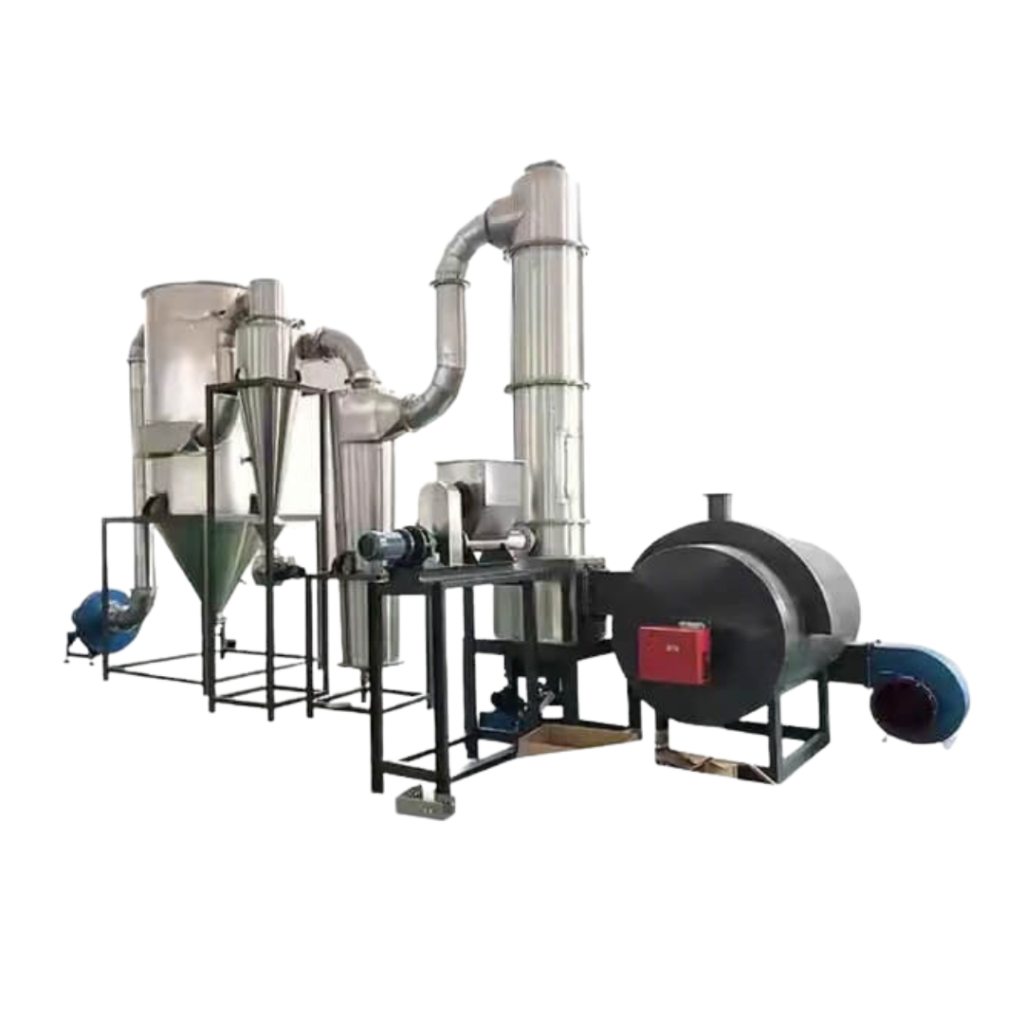
A spin flash dryer is designed for rapid drying of suitable wet materials such as pastes, slurries, filter cakes and fine solids.
The basic process can be represented as:
Wet Feed → Mechanical Dispersion → Hot Air Contact → Rapid Moisture Evaporation → Classification → Dry Product
The combination of mechanical dispersion and high-velocity drying air can provide intensive heat and mass transfer.
This can make flash drying particularly attractive when manufacturers need:
- Rapid moisture removal
- Short residence time
- Continuous operation
- Controlled final moisture
- Powder production
- Reduced equipment footprint
- Integrated deagglomeration/classification
However, flash drying is not automatically the best solution for every wet material. Feed behavior is critical.
Flash Dryer Applications Across Indonesian Industrial Hubs
Indonesia’s industrial geography creates several potential regional markets.
Java
Important manufacturing and processing centers around Jakarta, West Java, Banten and East Java provide opportunities in food, chemicals, pharmaceuticals and industrial manufacturing.
Sumatra
The island’s major palm oil and agricultural-processing activities create potential demand for drying technologies for suitable wet byproducts and value-added materials.
Sulawesi
Central Sulawesi and North Maluku are particularly important for Indonesia’s nickel-processing expansion. Morowali has become a major center of integrated nickel processing, while current government projects continue to expand the battery-material ecosystem.
Kalimantan
Mineral processing, agriculture and resource-based industries can create additional opportunities for bulk and fine-material drying.
Flash Dryer or Rotary Dryer: Which Is Better for Indonesia?
The answer depends on the material—not simply the industry.
| Application | Spin Flash Dryer | Rotary Dryer |
| Wet slurry | Strong candidate | Application dependent |
| Filter cake | Strong candidate | Possible |
| Fine chemical material | Strong candidate | Possible |
| Tapioca/starch material | Possible | Application dependent |
| Large bulk solids | Application dependent | Excellent candidate |
| Minerals & ores | Possible | Strong candidate |
| Rapid drying | Excellent | Moderate |
| Long residence time | Less suitable | Advantage |
For fine, wet, dispersible materials, flash drying may be attractive.
For high-volume, coarse or free-flowing bulk solids, a rotary drum dryer may be more appropriate.
What Should Indonesian Buyers Check Before Selecting a Flash Dryer?
Before requesting a commercial quotation, provide the dryer manufacturer with accurate process data.
Material Information
- Material name
- Feed rate
- Initial moisture
- Required final moisture
- Solids concentration
- Particle size
- Bulk density
- Stickiness
- Feed temperature
- Thermal sensitivity
Process Information
- Required evaporation capacity
- Operating hours
- Desired production rate
- Available heat source
- Product temperature limitations
- Exhaust requirements
- Dust-collection requirements
- Automation requirements
Site Information
For Indonesian installations, engineers should also evaluate:
- Available utilities
- Ambient conditions
- Plant layout
- Fuel availability
- Electrical supply
- Corrosion considerations
- Maintenance access
- Environmental requirements
Energy Efficiency: A Key Consideration for Indonesian Flash Drying
When drying a high-moisture feed, a significant portion of the thermal requirement goes toward evaporating water.
Therefore, an energy-efficient dryer should be designed around the complete thermal system rather than the dryer chamber alone.
Potential energy-saving measures include:
Heat Recovery
Recovering useful heat from exhaust streams where technically and economically practical.
Optimized Airflow
Matching air volume and temperature to the actual moisture-removal requirement.
Variable Frequency Drives
VFDs can regulate fan, feeder and other drive speeds according to operating conditions.
Thermal Insulation
Proper insulation reduces heat loss from chambers, ducts and heated surfaces.
Automated Control
PLC-based monitoring can help maintain consistent:
Feed Rate → Inlet Temperature → Airflow → Outlet Temperature → Residence Time → Final Moisture
The actual energy performance should be established through engineering calculations and testing, rather than assumed from the dryer type alone.
How GTI Dryers Can Approach Indonesian Flash-Dryer Projects
For Indonesian customers, GTI Dryers can evaluate the complete process before recommending a dryer configuration.
The engineering approach can follow:
Material Characterization
↓
Moisture & Solids Analysis
↓
Water Evaporation Calculation
↓
Heat-Duty Calculation
↓
Dryer Technology Selection
↓
Pilot Testing
↓
Commercial Dryer Design
This approach is especially valuable for nickel chemicals, battery materials, starches and complex industrial slurries, where feed behavior can strongly influence dryer performance.
Pilot Testing Before Commercial Flash Dryer Selection
Pilot testing can help answer important questions before capital investment:
- Can the material be dispersed effectively?
- What drying temperature is required?
- What final moisture can be achieved?
- How much water must be evaporated?
- What is the approximate thermal requirement?
- Does the product agglomerate?
- What powder characteristics are obtained?
- Is flash drying actually more suitable than rotary, fluid-bed or another technology?
For a high-value chemical or battery-material project, these tests can significantly reduce uncertainty during equipment selection.
Industrial Flash Dryer Capacity Calculation
A preliminary calculation starts with the moisture balance.
Feed Rate → Initial Moisture → Final Moisture → Water Evaporation → Heat Duty → Airflow → Dryer Capacity
For example, a plant processing wet chemical filter cake cannot size its flash dryer based only on tonnes of feed per hour.
The engineering team needs to determine the actual kilograms of water entering the dryer every hour and the quantity that must be removed.
Other important variables include:
- Inlet air temperature
- Outlet air temperature
- Feed temperature
- Humidity
- Specific heat
- Latent heat
- Residence time
- Product temperature
- Heat losses
This forms the technical foundation for industrial flash dryer sizing and energy estimation in Indonesia.
Why Indonesia Is a Strategic Market for GTI Dryers
Indonesia’s downstreaming strategy is creating opportunities across multiple raw-material value chains. The government has identified priority downstream commodities including nickel, copper, bauxite, palm oil, coconut, fisheries, seaweed and other resources.
At the same time, nickel downstreaming is moving further into battery materials and integrated EV manufacturing. In 2026, the Indonesian government continued to emphasize the development of an integrated battery ecosystem.
This means the market opportunity for industrial drying is broader than traditional food processing.
Potential applications can span:
Palm Oil → Starch → Food Ingredients → Chemicals → Nickel → Battery Materials → Industrial Byproducts
Choosing an Industrial Flash Dryer Manufacturer in Indonesia
When comparing flash dryer manufacturers in Indonesia, buyers should evaluate more than equipment specifications.
Look for an engineering partner that can provide:
- Material-specific dryer selection
- Drying calculations
- Pilot testing
- Customized equipment design
- Energy-efficiency evaluation
- Automated process control
- Dust and exhaust management
- Appropriate construction materials
- Installation and commissioning support
- Technical and after-sales assistance
GTI Dryers focuses on designing drying systems around the actual feed material and process requirement.
Looking for a Flash Dryer in Indonesia?
If your facility in Jakarta, Surabaya, Medan, Bandung, Palembang, Balikpapan, Makassar, Morowali, Central Sulawesi or another Indonesian industrial region processes palm-oil byproducts, tapioca starch, chemical slurries, wet filter cakes, nickel chemicals or battery-material intermediates, an industrial flash dryer may be worth evaluating.
GTI Dryers can assess your:
Material + Feed Rate + Moisture + Final Moisture + Heat Source + Product Requirement
and recommend whether a Spin Flash Dryer, Flash Dryer, Rotary Dryer, Fluid Bed Dryer, Paddle Dryer or another drying technology is technically appropriate.
Request a Drying Assessment
Send GTI Dryers your material specification, feed capacity, initial moisture and desired final moisture to begin a preliminary drying evaluation and discuss pilot testing, dryer capacity and energy requirements for your Indonesian project.