Industrial Flash Dryer USA: Why High-Speed Drying Matters for American Process Industries
The United States has a highly developed manufacturing base across pharmaceuticals, specialty chemicals, food processing, biotechnology, pigments, agrochemicals and advanced materials. These industries frequently handle wet powders, slurries, pastes, filter cakes and moisture-sensitive intermediates that require controlled and efficient moisture removal.
For these applications, drying is not simply about removing water. Manufacturers increasingly need to balance:
Drying Speed + Product Quality + Energy Efficiency + Emissions Control + Process Reliability
This creates an important opportunity for modern industrial flash dryers and spin flash dryers in the USA.
Flash drying is particularly attractive for suitable materials because it can provide rapid moisture removal with relatively short residence times. The exact dryer configuration, however, must be engineered around the material and process rather than selected solely by industry.
Why Is the Demand for Flash Dryers Growing in the USA?
Three major industrial sectors create strong application opportunities for flash drying technology.
1. Pharmaceutical Manufacturing
U.S. pharmaceutical manufacturing includes API production, pharmaceutical intermediates, biological products and finished medicines. The EPA identifies pharmaceutical manufacturing as a distinct industrial sector with requirements covering air emissions, waste and wastewater, while FDA CGMP requirements address the methods, facilities and controls used in drug manufacturing.
Drying may be required for suitable:
- Pharmaceutical intermediates
- API intermediates
- Wet powders
- Crystalline products
- Botanical materials
- Fine chemical intermediates
For pharmaceutical applications, equipment selection must consider cleanability, containment, product temperature, material compatibility and applicable GMP requirements.
2. Specialty Chemicals
The U.S. specialty chemical sector processes a wide range of materials including:
- Pigments
- Dyes
- Resins
- Polymers
- Agricultural chemicals
- Chemical intermediates
- Performance additives
- Inorganic and organic chemicals
The U.S. Department of Energy identifies chemicals and petrochemicals as major energy-intensive industries, making process-energy optimization an important manufacturing consideration.
Flash drying can be evaluated where the feed is suitable for rapid dispersion and drying.
3. Food & Beverage Processing
The U.S. food and beverage industry includes dairy, grain and cereal processing, fruit and vegetable processing, sugar, beverages and other food products. The U.S. Department of Energy notes that food and beverage manufacturing is one of the country’s energy-intensive industries and that process heating represents a substantial portion of manufacturing energy use.
Potential applications for suitable flash-drying configurations include:
- Starches
- Food ingredients
- Fine powders
- Agricultural derivatives
- Certain slurries
- Process residues
What Is a Spin Flash Dryer?
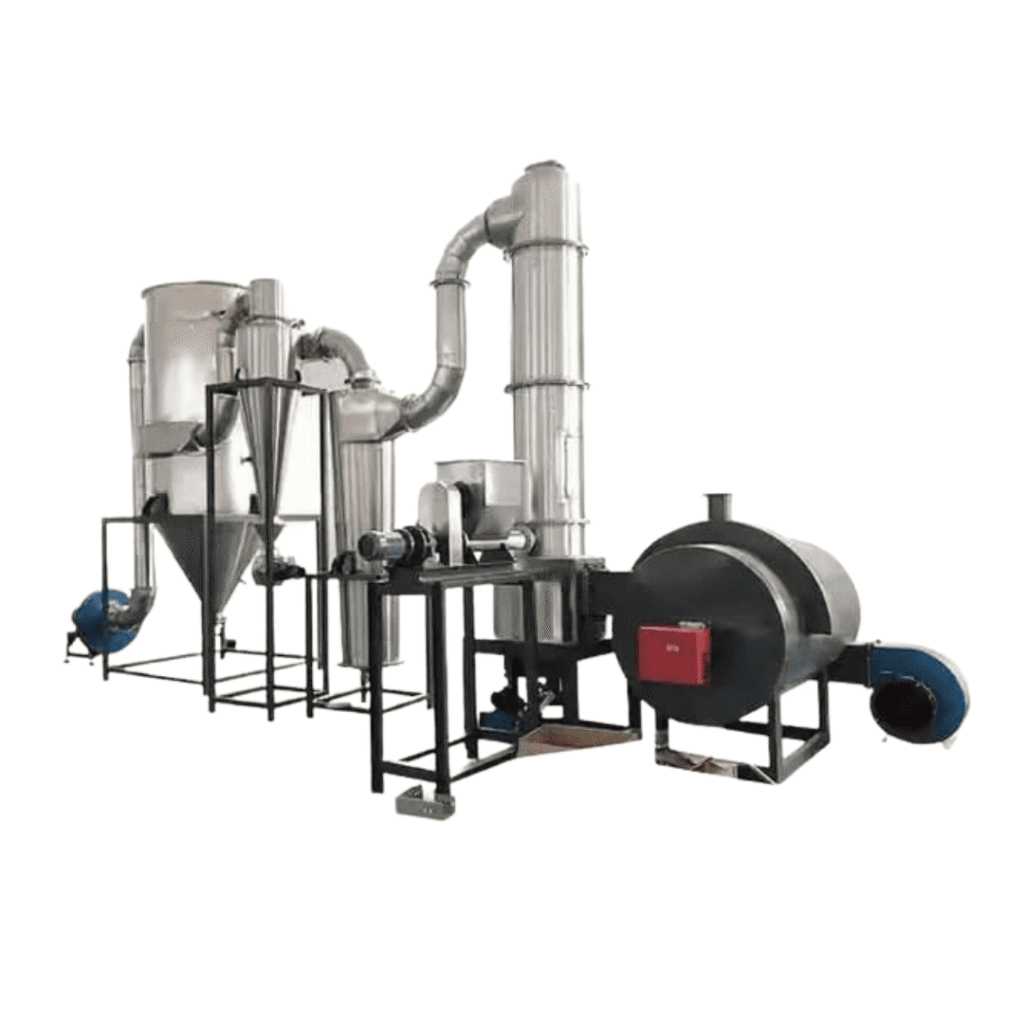
A spin flash dryer is a continuous drying system designed for materials that can be mechanically dispersed into a hot-air stream.
A simplified process looks like this:
Wet Feed
↓
Controlled Feeding
↓
Mechanical Dispersion
↓
Hot-Air Contact
↓
Rapid Moisture Evaporation
↓
Particle Separation
↓
Cyclone / Filter
↓
Dry Product
The mechanical dispersing action can help break down wet agglomerates and expose a larger surface area to the drying air.
This makes the technology worth evaluating for certain pastes, filter cakes, wet powders and other difficult-to-handle solids.
Spin Flash Dryer vs Conventional Flash Dryer
The terms flash dryer and spin flash dryer are sometimes used interchangeably, but the equipment configuration and feed-handling mechanism can differ.
Spin Flash Dryer
Often considered for:
- Wet filter cakes
- Pastes
- Agglomerated powders
- Fine chemicals
- Pigments
- Certain pharmaceutical intermediates
- Moisture-rich solids
Conventional Flash Dryer
Can be suitable where the feed can be effectively dispersed and transported through a high-velocity hot-air stream.
The correct choice depends on:
Feed Rheology → Moisture → Particle Size → Stickiness → Thermal Sensitivity → Required Final Moisture
Where Can Industrial Flash Dryers Be Used in the USA?
The opportunity is not restricted to one region. Major U.S. manufacturing clusters create different application opportunities.
Northeast & Mid-Atlantic
New Jersey, Pennsylvania, New York
Strong presence of pharmaceutical, specialty chemical and life-science manufacturing.
Midwest
Illinois, Indiana, Ohio, Michigan
Important manufacturing and food-processing regions with opportunities for chemical, agricultural and food-related drying.
Southeast
North Carolina, Georgia, Tennessee, South Carolina
Strong pharmaceutical, biotechnology, food and advanced manufacturing activity.
Texas & Gulf Coast
Texas, Louisiana
Major chemical and petrochemical manufacturing centers with potential applications for chemical intermediates, specialty chemicals and process materials.
California
Large food-processing, biotechnology, pharmaceutical and specialty-material manufacturing ecosystem.
This makes searches such as industrial flash dryer Texas, pharmaceutical flash dryer New Jersey, chemical flash dryer California, and industrial drying equipment North Carolina valuable GEO opportunities.
Energy Efficiency: A Major Consideration for U.S. Dryer Buyers
Energy consumption is a major consideration when selecting industrial drying equipment.
Recent U.S. research estimates that thermal drying represents approximately 10% of energy consumption in the food sector studied and identifies energy efficiency, heat-related improvements and lower-carbon technologies as important pathways for reducing drying costs and emissions.
For this reason, U.S. manufacturers should evaluate more than the initial equipment price.
Important parameters include:
- Specific energy consumption
- Exhaust heat recovery
- Airflow optimization
- Heat-source efficiency
- Insulation
- Residence time
- Product temperature
- Moisture removal rate
- Fan power
- Automation
A properly engineered dryer can therefore help manufacturers pursue lower operating costs without compromising product quality.
How to Reduce Industrial Flash Dryer Energy Consumption
Optimize Airflow
Excessive airflow can increase fan power and exhaust losses. Airflow should be matched to the material and evaporation requirement.
Recover Waste Heat
Where technically and economically appropriate, exhaust heat can potentially be recovered and reused.
Control Residence Time
Rapid moisture removal can reduce unnecessary exposure to elevated temperatures for suitable products.
Use Variable Frequency Drives
VFDs can provide better control over:
- Fans
- Feeders
- Dispersers
- Conveyors
- Other rotating equipment
Improve Thermal Insulation
Proper insulation helps minimize heat losses from the drying chamber, ducts and associated hot surfaces.
Match the Heat Source to the Plant
Possible configurations may include:
Steam | Natural Gas | LPG | Thermal Oil | Electricity | Biomass | Waste Heat
The optimum choice depends on local utilities, process requirements and economics.
Flash Dryer Selection: What Should U.S. Engineers Calculate?
Before requesting a quotation for a flash dryer USA, plant engineers should establish the basic material and process data.
Feed Information
- Feed rate
- Initial moisture
- Solids concentration
- Particle size
- Bulk density
- Stickiness
- Feed temperature
- Rheology
Product Requirements
- Final moisture
- Product temperature
- Particle size
- Bulk density
- Flowability
- Thermal stability
Operating Requirements
- Required evaporation rate
- Available heat source
- Operating hours
- Required automation
- Dust collection
- Exhaust conditions
- Applicable environmental requirements
A basic engineering sequence is:
Feed Rate → Water Evaporation → Heat Duty → Airflow → Residence Time → Dryer Capacity → Product Recovery
Regulatory & Compliance Considerations for U.S. Industrial Dryers
A U.S. industrial drying project may need to consider federal, state and local requirements depending on the application.
For chemical manufacturing, EPA regulations include requirements addressing hazardous air pollutants across several chemical categories, including pharmaceutical production and inorganic pigment manufacturing.
For pharmaceutical manufacturing, FDA CGMP requirements cover manufacturing methods, facilities and controls.
Therefore, a dryer project should evaluate:
- Dust collection
- Exhaust treatment
- VOC control where applicable
- Hazardous material handling
- Containment
- Product-contact materials
- Cleaning requirements
- Applicable GMP requirements
- Local/state environmental permits
Compliance requirements vary by material, process, location and facility.
Pilot Testing Before Buying an Industrial Flash Dryer
A major mistake in industrial dryer selection is choosing equipment based only on:
“We need 1,000 kg/hour.”
Two materials with the same throughput can require completely different dryer designs.
GTI Dryers can evaluate drying requirements based on:
Material → Moisture → Feed Rate → Target Moisture → Water Evaporation → Temperature → Heat Source → Product Characteristics
Pilot testing can help determine:
- Drying rate
- Final moisture
- Product quality
- Energy requirement
- Feedability
- Residence time
- Product recovery
- Suitable dryer configuration
For high-value pharmaceutical and specialty chemical products, this validation can be especially valuable before commercial-scale investment.
How Much Does an Industrial Flash Dryer Cost in the USA?
There is no single standard price for an industrial flash dryer.
Equipment cost depends on:
- Capacity
- Water evaporation rate
- Material characteristics
- Construction material
- Heating system
- Dryer size
- Dust-collection system
- Automation
- Explosion-protection requirements
- Pharmaceutical/GMP requirements
- Installation requirements
For this reason, a useful quotation should be based on process data rather than a generic catalogue price.
A preliminary budgetary evaluation can start with:
Material + Feed Rate + Moisture + Final Moisture + Heat Source + Operating Hours
Why Choose GTI Dryers for a U.S. Flash Drying Project?
GTI Dryers focuses on application-specific industrial drying solutions rather than treating every material with the same dryer configuration.
Depending on the application, GTI Dryers can evaluate:
- Spin Flash Dryers
- Flash Dryers
- Rotary Dryers
- Spray Dryers
- Fluid Bed Dryers
- Band Dryers
- Paddle Dryers
- Customized drying systems
The engineering objective is to achieve the right balance between:
Drying Performance + Energy Efficiency + Product Quality + Automation + Maintainability
For U.S. projects, the system can also be evaluated around applicable environmental, safety, containment and product-quality requirements.
Frequently Asked Questions
What is an industrial flash dryer used for?
Industrial flash dryers are used for rapid drying of suitable wet solids, powders, pastes, filter cakes and other materials where rapid heat and mass transfer is desirable.
What industries use flash dryers in the USA?
Major application areas include pharmaceuticals, specialty chemicals, food processing, pigments, agrochemicals and other process industries.
Is a spin flash dryer suitable for pharmaceutical products?
It can be considered for suitable pharmaceutical intermediates or materials, but the final equipment design must account for product characteristics, containment, cleanability and applicable GMP requirements.
Is flash drying energy efficient?
Flash drying can provide rapid moisture removal, but actual energy performance depends on feed moisture, evaporation load, heat source, airflow, exhaust conditions and system design.
How do I select the right flash dryer?
Start with feed moisture, feed rate, final moisture, material characteristics, thermal sensitivity and available heat source. Pilot testing can then help validate the appropriate technology.
Final Takeaway: The U.S. Opportunity for Industrial Flash Drying
The United States offers a strong application environment for industrial flash dryers and spin flash dryers, particularly across pharmaceutical manufacturing, specialty chemicals and food processing.
The combination of high-value manufacturing, energy-efficiency priorities and environmental requirements makes dryer optimization increasingly important. U.S. federal programs also specifically identify energy efficiency and process-oriented improvements as opportunities for manufacturing industries.
For manufacturers, the objective should not simply be to purchase the fastest dryer.
It should be to select a system that delivers:
Fast Moisture Removal
- Consistent Product Quality
- Controlled Energy Consumption
- Reliable Operation
- Appropriate Environmental & Process Controls
Looking for an Industrial Flash Dryer in the USA?
If your U.S. facility processes pharmaceutical intermediates, specialty chemicals, pigments, food ingredients, wet powders, slurries or filter cakes, GTI Dryers can evaluate your material and recommend an appropriate drying configuration.
Send your feed material, feed rate, initial moisture, target moisture and available heat source to GTI Dryers for a preliminary drying assessment, drying calculation and pilot-testing discussion.