Japan’s Drying Market Is About Precision, Not Just Evaporation
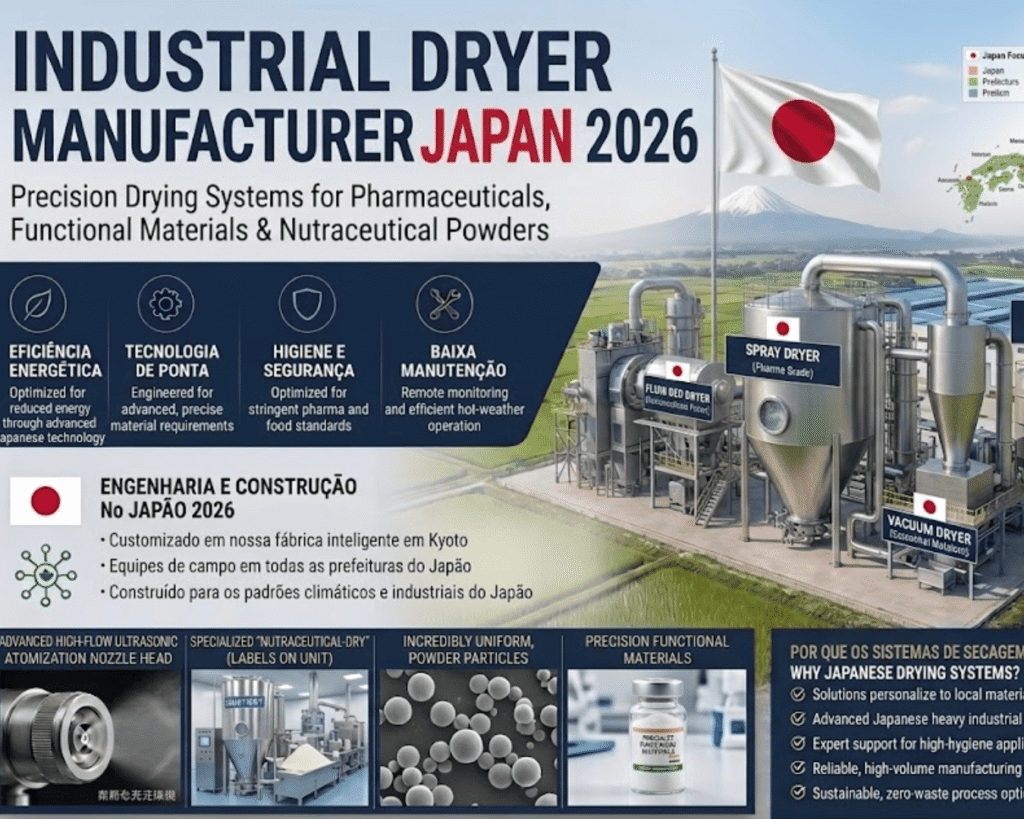
Japan is a particularly interesting market for advanced industrial drying technology because many of its high-value manufacturing applications require tight process control rather than simply high evaporation capacity.
Pharmaceuticals, APIs, excipients, functional food ingredients, nutraceuticals, specialty chemicals and advanced materials may require carefully controlled:
- Temperature
- Moisture content
- Residence time
- Particle size
- Bulk density
- Flowability
- Powder morphology
- Product stability
For these applications, the question is not simply:
“How much water can the dryer remove?”
It is:
“Can the dryer consistently produce the required product quality while controlling energy consumption and thermal exposure?”
That distinction creates an opportunity for application-specific industrial drying equipment in Japan.
GTI Dryers approaches such requirements through dryer selection, process calculations, pilot testing and customized engineering.
Where Is the Opportunity for Industrial Dryers in Japan?
Instead of looking at Japan as one single market, GTI can target several interconnected industrial clusters.
| Japanese Industrial Area | Potential Dryer Applications |
| Tokyo | Pharmaceuticals, nutraceuticals, specialty materials |
| Osaka | Chemicals, pharmaceuticals, food processing |
| Kanagawa / Yokohama | Pharmaceuticals, chemicals, advanced manufacturing |
| Aichi / Nagoya | Chemicals, food, industrial materials |
| Hyogo / Kobe | Pharmaceuticals, chemicals, specialty manufacturing |
| Chiba | Chemicals, petrochemicals, industrial processing |
| Shizuoka | Food, pharmaceutical and chemical manufacturing |
industrial dryer Japan → pharmaceutical dryer Tokyo → spray dryer Osaka → drying equipment Yokohama → fluid bed dryer Aichi
The Four High-Value Japanese Applications GTI Should Target
01 — Pharmaceutical Manufacturing
Pharmaceutical drying is one of the most technically demanding applications because product quality can be affected by excessive temperature, moisture, contamination or uncontrolled residence time.
Potential applications include:
APIs | Pharmaceutical Intermediates | Excipients | Granules | Fine Powders | Nutraceutical Ingredients
Depending on the material and process, suitable technologies may include:
For suitable pharmaceutical granules and free-flowing particles.
Vacuum Dryers
For products requiring controlled low-temperature drying.
For appropriate sticky, pasty or difficult-to-handle materials.
For converting suitable solutions, emulsions and suspensions into controlled powders.
Pharmaceutical projects must additionally consider GMP, cleanability, containment, material compatibility and process documentation.
Japan’s PMDA conducts GMP inspections of manufacturing facilities and quality-control systems, making regulatory and quality considerations important when designing pharmaceutical drying equipment.
02 — Spray Drying for Functional Ingredients
Japan’s high-value food, ingredient and nutraceutical sectors create opportunities for industrial spray drying systems.
A spray dryer can transform:
Liquid Feed → Atomization → Hot-Air Contact → Moisture Removal → Powder Separation → Finished Powder
Potential materials include:
- Functional food ingredients
- Protein ingredients
- Botanical extracts
- Nutraceutical formulations
- Pharmaceutical ingredients
- Specialty chemicals
- Encapsulated ingredients
For GTI, the commercial opportunity is not simply selling a “spray dryer.”
The stronger proposition is:
A spray drying system engineered around the feed concentration, thermal sensitivity, particle characteristics and required final moisture of the customer’s product.
03 — Micro-Encapsulation & Sensitive Ingredients
One of the more specialized opportunities in Japan is micro-encapsulation drying.
Micro-encapsulation processes may involve:
- Vitamins
- Flavors
- Oils
- Botanical compounds
- Functional ingredients
- Nutraceutical compounds
- Bioactive materials
Spray drying can be used in suitable encapsulation processes to convert a liquid formulation into a stable powder while incorporating an appropriate carrier or wall material.
The drying process must be carefully controlled because excessive thermal exposure can affect sensitive ingredients.
The critical variables are:
Feed Formulation
↓
Atomization
↓
Droplet Size
↓
Drying Temperature
↓
Residence Time
↓
Final Moisture
↓
Powder Characteristics
This makes micro-encapsulation spray dryer Japan and nutraceutical spray drying Japan valuable long-tail search opportunities.
04 — Functional Materials & Specialty Powders
Japan’s advanced manufacturing ecosystem also creates opportunities outside pharmaceuticals.
Potential applications include:
- Functional materials
- Specialty chemicals
- Fine chemicals
- Ceramic-related materials
- Pigments
- Polymer materials
- Battery-related materials
- High-value powder intermediates
Here, the dryer may need to control much more than moisture.
The process objective could involve:
Moisture + Particle Structure + Bulk Density + Flowability + Purity + Temperature Exposure
Therefore, industrial dryer selection must be based on material characteristics and final-product specifications.
Which Dryer Technology Fits Which Application?
Rather than promoting one universal dryer, GTI can position different technologies according to the process.
Spray Dryer
Best suited for: liquids, solutions, emulsions and suspensions requiring powder production.
Fluid Bed Dryer
Best suited for: suitable wet granules and free-flowing particles.
Vacuum Dryer
Best suited for: heat-sensitive materials requiring controlled low-temperature processing.
Paddle Dryer
Best suited for: selected pasty, sticky or difficult-to-handle materials.
Best suited for: rapid drying of suitable wet powders, pastes and particulate materials.
Best suited for: high-volume bulk solids, minerals, chemicals and other robust materials.
Best suited for: continuous drying of appropriate food, botanical and heat-sensitive solid materials.
The correct dryer should be selected after evaluating the material—not simply by industry name.
A Simple Dryer Selection Framework for Japanese Manufacturers
Before selecting an industrial dryer, GTI can evaluate seven key parameters:
1. What is the feed material?
Liquid, slurry, granule, powder, paste or solid?
2. How much moisture enters the dryer?
Initial moisture directly affects thermal duty.
3. What final moisture is required?
The target determines the drying requirement.
4. How temperature-sensitive is the product?
This can determine whether spray, vacuum, belt or other technology is appropriate.
5. What production capacity is required?
kg/h, tonnes/day or batch size?
6. What heat source is available?
Steam, gas, thermal oil, hot water, electricity or recovered heat?
7. What product characteristics must be preserved?
Particle size, flowability, bulk density, color, nutrients or active ingredients?
This application-first approach is particularly valuable for pharmaceutical dryer Japan and functional material dryer Japan projects.
Energy Efficiency: The Japanese Buyer Is Buying Operating Performance Too
A dryer with a lower purchase price is not necessarily the lowest-cost dryer over its operating life.
The total economic picture includes:
CAPEX + Energy + Maintenance + Product Loss + Downtime + Lifetime
GTI can evaluate energy-saving opportunities such as:
- Heat recovery
- Optimized airflow
- Variable-frequency drives
- Multi-zone drying
- Exhaust-air optimization
- Process heat integration
- Automated temperature control
- Appropriate insulation
Rather than promising a fixed percentage of energy savings for every application, the more credible approach is to calculate the expected thermal requirement from the customer’s actual material and operating conditions.
“How Much Does an Industrial Dryer Cost in Japan?”
This is an important pre-purchase search query and should be addressed directly.
There is no universal industrial dryer price because the equipment configuration can vary substantially.
The final project cost can depend on:
- Dryer type
- Capacity
- Water evaporation rate
- Material properties
- Stainless-steel grade
- Product-contact requirements
- Automation
- Dust collection
- Powder recovery
- Explosion protection
- GMP requirements
- Heat source
- Installation
- Commissioning
Therefore, Japanese buyers should compare total cost of ownership, not simply equipment purchase price.
How to Calculate Industrial Dryer Capacity
A preliminary calculation normally starts with the moisture balance.
For example:
Feed Rate + Initial Moisture + Final Moisture
determines approximately:
Water to Evaporate
The engineering calculation can then estimate:
Water Evaporation → Thermal Duty → Air Requirement → Residence Time → Dryer Capacity
For a real project, GTI should calculate the requirement from the customer’s actual process data rather than relying on a generic capacity chart.
Industrial Dryer Energy Consumption: What Should Buyers Measure?
A useful metric is the specific energy consumption, such as the energy required per kilogram of water evaporated.
The result depends on:
- Initial moisture
- Final moisture
- Product temperature
- Ambient conditions
- Heat source
- Dryer efficiency
- Exhaust temperature
- Airflow
- Heat recovery
- Production rate
This makes industrial dryer energy consumption Japan another strong informational keyword for GTI’s content strategy.
Spray Dryer vs Fluid Bed Dryer: Which One Should You Choose?
A simple distinction is:
If your feed is a liquid:
Consider a Spray Dryer
If your feed is a wet granule:
Consider a Fluid Bed Dryer
However, product formulation, particle properties, temperature sensitivity and final specifications must also be considered.
For pharmaceutical and nutraceutical manufacturing, GTI can assess the complete process before recommending a technology.
| English | Japanese |
| Industrial Dryer | 産業用乾燥機 |
| Industrial Drying Equipment | 工業用乾燥設備 |
| Spray Dryer | スプレードライヤー |
| Fluid Bed Dryer | 流動層乾燥機 |
| Rotary Dryer | ロータリードライヤー |
| Vacuum Dryer | 真空乾燥機 |
| Pharmaceutical Dryer | 医薬品乾燥機 |
| Powder Dryer | 粉体乾燥機 |
| Drying Equipment | 乾燥設備 |
Capture the Buyer Before They Search “Manufacturer”
“Industrial Dryer Manufacturer Japan”
GTI should also answer the questions buyers ask weeks or months before contacting a supplier.
Recommended supporting articles:
- How Much Does an Industrial Dryer Cost in Japan?
- How to Calculate Industrial Dryer Capacity
- Industrial Dryer Energy Consumption: How to Reduce Operating Costs
- Spray Dryer vs Fluid Bed Dryer for Pharmaceutical Products
- What Is the Best Dryer for Heat-Sensitive Nutraceuticals?
- How Does Spray Drying Work for Micro-Encapsulation?
- Industrial Dryer Maintenance Checklist
- How to Select a GMP Pharmaceutical Dryer
- Spray Dryer Particle Size: What Manufacturers Need to Know
- How to Reduce Moisture in Pharmaceutical Powders
These informational pages can internally link back to the main Industrial Dryers Japan commercial page.
This creates a stronger topic cluster rather than relying on one article to rank for every keyword.
GTI Dryers: From Material Testing to Industrial Scale
For the Japanese market, GTI should position itself around a process-engineering approach.
MATERIAL
What exactly needs to be dried?
↓
LAB / PILOT TESTING
How does the material behave during drying?
↓
DRYING CALCULATION
How much water must be removed?
↓
TECHNOLOGY SELECTION
Spray? Fluid Bed? Vacuum? Flash? Rotary? Belt?
↓
EQUIPMENT DESIGN
Capacity + heat source + airflow + automation
↓
INDUSTRIAL INSTALLATION
Scale-up and commissioning
This approach gives potential customers a clear path from material evaluation to commercial equipment.
Pilot Testing: Reduce Risk Before Equipment Investment
For specialized pharmaceutical, nutraceutical and functional-material applications, pilot testing can be especially valuable.
Testing can help evaluate:
- Drying behavior
- Final moisture
- Product quality
- Thermal exposure
- Energy requirement
- Powder characteristics
- Suitable dryer configuration
- Scale-up considerations
Instead of asking customers to purchase equipment based solely on theoretical calculations, GTI can use material-specific testing and engineering calculations to support the equipment recommendation.
Drying Calculations for Japanese Industrial Projects
GTI can develop preliminary calculations based on:
Feed Material
Feed Rate
Initial Moisture
Final Moisture
Temperature Limit
Available Heat Source
Required Production Capacity
Batch or Continuous Operation
From this information, the engineering process can establish the approximate:
Water Evaporation → Thermal Duty → Air Requirement → Dryer Configuration → Energy Requirement
Why GTI Dryers Should Target Japan
Japan gives GTI an opportunity to move beyond commodity drying equipment and compete in high-value, application-specific drying projects.
The strongest opportunities include:
Pharmaceuticals
APIs & Excipients
Nutraceuticals
Functional Food Ingredients
Micro-Encapsulation
Specialty Chemicals
Advanced Functional Materials
Fine Powders
The commercial message should therefore be:
Precision drying engineered around your material and product requirements.
Looking for an Industrial Dryer in Japan?
Whether your manufacturing facility is located in Tokyo, Osaka, Yokohama, Kanagawa, Nagoya, Aichi, Kobe, Hyogo or another Japanese industrial region, the right drying technology should be selected according to the material and process—not simply the industry.
GTI Dryers can evaluate applications involving:
Spray Dryers | Fluid Bed Dryers | Vacuum Dryers | Flash Dryers | Paddle Dryers | Rotary Dryers | Belt & Band Dryers
for suitable:
Pharmaceutical | API | Nutraceutical | Functional Material | Food | Chemical | Specialty Powder
applications.
Start With Your Material
Send GTI:
Material + Feed Rate + Initial Moisture + Final Moisture + Temperature Limit + Heat Source + Product Requirement
and the project can begin with:
Drying Calculation → Technology Selection → Pilot Testing → Preliminary Design → Industrial Dryer Proposal
Explore GTI Dryers
GTI Dryers – Industrial Drying Systems
Suggested CTA:
Request a Japan Industrial Dryer Consultation → Submit Your Material & Drying Requirements → Get a Preliminary Drying Assessment