Industrial Dryers China: High-Performance Drying Solutions for Infant Formula, Dairy, Biopharmaceuticals & Battery Chemicals
China remains one of the world’s most important manufacturing markets for food processing, dairy, infant nutrition, pharmaceuticals, biopharmaceuticals and advanced battery materials.
For these industries, industrial drying is much more than moisture removal. Drying directly affects powder quality, particle size, residual moisture, flowability, solubility, thermal stability, energy consumption and production efficiency.
This creates a strong opportunity for advanced industrial drying equipment in China, particularly for manufacturers producing infant formula, milk powders, nutritional ingredients, pharmaceutical products, APIs, biopharmaceutical intermediates and lithium-based battery materials.
China’s food-processing sector also operates within an increasingly detailed national food-safety framework. In 2025, China’s National Health Commission and State Administration for Market Regulation issued 50 new or updated national food-safety standards, including standards covering dairy products and infant formula foods.
For equipment suppliers, this makes hygienic construction, controllable drying conditions, repeatability and process-specific engineering increasingly important.
Why China Is a High-Potential Market for Industrial Dryers
Chinese manufacturing plants increasingly require drying systems that can provide:
- High production capacity
- Consistent final moisture
- Controlled product temperature
- Uniform powder characteristics
- High thermal efficiency
- Automated process control
- Hygienic and cleanable construction
- Reliable continuous operation
- Reduced energy consumption
- Integration with complete production lines
The requirements are particularly demanding for infant nutrition, dairy and pharmaceutical products, where product quality and process control are critical.
At the same time, China’s advanced-materials industry creates a different drying challenge: battery chemical powders and precursor materials often require precise moisture control without compromising particle properties or material chemistry.
1. Infant Formula & Baby Food Drying in China
One of the most important opportunities for industrial drying technology is the infant formula and specialized infant nutrition sector.
Infant formula production requires highly controlled processing because the final powder must meet defined nutritional, microbiological and quality requirements.
China’s national standard GB 10765-2021 covers infant formula for infants aged 0–6 months and specifies requirements including raw materials, nutrients and product characteristics.
China has also updated standards for infant foods and special-medical-purpose infant formula. In 2025, new standards including GB 25596-2025 were issued for infant formula food for special medical purposes.
Recommended Dryer Technology
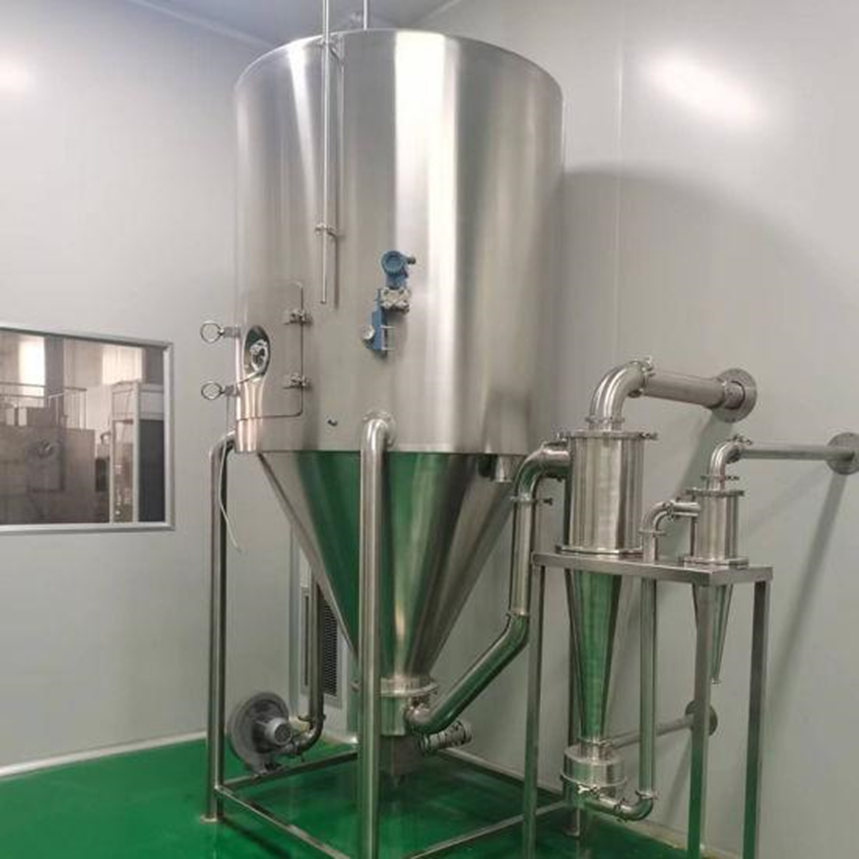
For liquid infant formula feeds, spray drying is generally the key technology to evaluate.
A modern infant formula spray drying system can integrate:
Feed Preparation → Filtration → Atomization → Spray Drying → Powder Separation → Fluid Bed Finishing → Cooling → Powder Handling
The final system depends on the formulation, solids content, heat sensitivity, powder specifications and production capacity.
Why Spray Drying?
Spray drying can provide:
- Rapid moisture removal
- Controlled particle formation
- Continuous operation
- Powder production directly from liquid feed
- Integration with fluid-bed finishing
- Controlled outlet moisture
For Chinese infant nutrition manufacturers, the dryer should therefore be considered as part of the complete powder-processing system, rather than as an isolated machine.
2. Dairy Powder & Milk Processing Dryers
China’s large-scale dairy processing industry creates another major application for industrial drying.
Potential products include:
- Milk powder
- Whey powder
- Lactose
- Dairy ingredients
- Nutritional powders
- Protein concentrates
- Functional food ingredients
Spray Dryer for Dairy Powder
Spray dryers are particularly relevant when converting liquid dairy feeds into powders.
A properly engineered system can control:
Feed Concentration → Atomization → Inlet Temperature → Outlet Temperature → Residence Time → Powder Moisture
For high-capacity plants, spray drying can be combined with a fluid bed dryer/cooler to improve final moisture control and powder handling.
3. Biopharmaceutical & Pharmaceutical Drying in China
China’s pharmaceutical and biopharmaceutical manufacturing sector requires drying technologies capable of handling temperature-sensitive and high-value materials.
Applications may include:
- APIs
- Pharmaceutical intermediates
- Biological materials
- Nutraceutical ingredients
- Fine chemicals
- Pharmaceutical granules
- Specialty formulations
Depending on the material, manufacturers may evaluate:
Vacuum Dryers
Useful for materials requiring lower-temperature drying under reduced pressure.
Suitable for many free-flowing pharmaceutical granules and particulate materials.
Suitable for converting appropriate liquid pharmaceutical or biological feeds into controlled powders.
Useful for certain pasty, sticky or difficult-to-handle materials where indirect heating is advantageous.
For pharmaceutical applications, equipment selection should be based on the specific product, containment requirements, cleaning strategy, validation requirements and applicable Chinese regulatory framework.
4. Battery Chemicals & Lithium Precursor Drying
One of the most technically interesting opportunities in China is the battery-materials sector.
Battery-material production can involve materials such as:
- Lithium compounds
- Nickel-cobalt-manganese precursors
- Cathode-material intermediates
- Battery-grade salts
- Specialty inorganic powders
Drying becomes particularly important after wet chemical processing.
For example, precursor production can involve dissolution/reaction followed by dehydration and drying before subsequent synthesis steps.
Which Dryer Should Be Considered?
Depending on material properties, particle size and required moisture, engineers may evaluate:
Spray Dryers → Flash Dryers → Fluid Bed Dryers → Vacuum Dryers → Rotary Dryers → Paddle Dryers
For high-value battery materials, the dryer must be designed around the specific chemistry and powder characteristics, rather than selecting equipment based only on throughput.
5. Why Moisture Control Is Critical for Battery Materials
Battery chemical manufacturers may require extremely controlled moisture levels.
Excess moisture can affect:
- Powder handling
- Downstream processing
- Material stability
- Product consistency
- Storage
- Final battery-material performance
Therefore, an industrial dryer for battery chemicals may require:
- Controlled drying atmosphere
- Precise temperature control
- Low final moisture
- Closed-loop operation
- Dust collection
- Automated monitoring
- Appropriate material-of-construction selection
This creates opportunities for custom-engineered drying systems rather than standard commodity dryers.
Most Suitable Industrial Dryers for the Chinese Market
| Application | Dryer Technology |
| Infant formula | Spray Dryer + Fluid Bed |
| Milk powder | Spray Dryer |
| Whey & dairy ingredients | Spray Dryer / Fluid Bed |
| Pharmaceutical granules | Fluid Bed Dryer |
| Heat-sensitive pharmaceutical products | Vacuum Dryer |
| Liquid biopharmaceutical feed | Spray Dryer |
| Sticky pharmaceutical intermediates | Paddle / Vacuum Dryer |
| Lithium precursor powders | Spray / Fluid Bed / Specialty Dryer |
| Battery chemical powders | Fluid Bed / Vacuum / Specialty Dryer |
| Bulk inorganic materials | Rotary / Flash Dryer |
The final dryer selection should always be confirmed through material testing and engineering calculations.
How Much Does an Industrial Dryer Cost in China?
A common commercial search is:
“Industrial dryer price China”
But there is no meaningful universal price.
The total investment depends on:
- Dryer type
- Feed capacity
- Water evaporation
- Final moisture
- Material characteristics
- Heating source
- Material of construction
- Automation level
- Dust collection
- Powder recovery
- Hygienic requirements
- Installation requirements
- Utility requirements
For pharmaceutical, infant formula and battery-material projects, total cost of ownership is often more important than simply choosing the lowest equipment price.
How to Calculate Industrial Dryer Capacity
A preliminary dryer calculation begins with the water evaporation requirement.
Basic calculation:
Water to Remove = Water in Feed − Water Remaining in Final Product
For an actual industrial system, engineers also need:
- Feed rate
- Initial moisture
- Target moisture
- Product temperature limit
- Specific heat
- Bulk density
- Particle size
- Drying temperature
- Residence time
- Heat source
- Required operating hours
GTI Dryers can use these parameters to determine an appropriate dryer configuration and preliminary thermal requirement.
Industrial Dryer Energy Consumption in China
Energy efficiency is becoming increasingly important for large-scale Chinese processing plants.
A dryer should therefore be evaluated according to:
kg of water evaporated per unit of energy consumed
Potential energy-saving strategies include:
- Heat recovery
- Optimized airflow
- Proper insulation
- Variable-frequency drives
- Exhaust-air optimization
- Multi-stage drying
- Fluid-bed finishing
- Waste-heat utilization
- Optimized heat-source selection
Possible heat sources include:
Steam • Natural Gas • LPG • Thermal Oil • Electricity • Biomass • Waste Heat
The goal is to achieve the required final moisture without unnecessary thermal consumption.
China-Specific Industrial Dryer Searches
Build location + industry + application combinations.
Shanghai
- Industrial dryer Shanghai
- Pharmaceutical dryer Shanghai
- Spray dryer Shanghai
- Food powder dryer Shanghai
Jiangsu
- Industrial dryer Jiangsu
- Pharmaceutical drying equipment Jiangsu
- Chemical dryer Jiangsu
Guangdong
- Industrial dryer Guangdong
- Food processing dryer Guangdong
- Pharmaceutical dryer Guangzhou
Zhejiang
- Industrial drying equipment Zhejiang
- Pharmaceutical dryer Zhejiang
- Spray dryer Hangzhou
Shandong
- Dairy powder dryer Shandong
- Chemical dryer Shandong
- Industrial dryer Qingdao
Sichuan
- Pharmaceutical dryer Sichuan
- Biopharmaceutical drying equipment Chengdu
Beijing
- Pharmaceutical drying equipment Beijing
- Biopharma dryer China
This creates a stronger Country → Province → City → Industry → Material → Dryer Type GEO structure.
High-Intent Search Topics GTI Should Target
To attract potential customers before they are ready to contact a supplier, create supporting articles around:
How Much Does a Spray Dryer Cost in China?
Explain capacity, atomization, heating system, powder recovery and automation factors.
How to Calculate Spray Dryer Capacity
Target engineers searching for feed rate, solids content and evaporation calculations.
Spray Dryer vs Fluid Bed Dryer for Dairy Powder
Capture dairy and infant-nutrition buyers comparing technologies.
What Is the Best Dryer for Infant Formula?
Target high-value infant-food search intent.
What Is the Best Dryer for Lithium Precursor Powder?
Target China’s rapidly developing battery-materials sector.
How to Reduce Spray Dryer Energy Consumption
Capture energy-efficiency searches before the customer reaches the purchasing stage.
Industrial Dryer Maintenance Checklist
Target plant engineers responsible for existing drying equipment.
Spray Dryer vs Vacuum Dryer for Pharmaceutical Products
Target pharmaceutical and biopharmaceutical engineers.
Why GTI Dryers Can Target the Chinese Market
For China, GTI Dryers should position itself around application engineering and customized drying performance, rather than competing only on equipment price.
A strong project workflow is:
Material Data → Laboratory/Pilot Testing → Drying Calculation → Dryer Selection → Thermal Design → Equipment Engineering → Manufacturing → Testing → Commissioning
GTI can evaluate technologies including:
- Spray Dryers
- Fluid Bed Dryers
- Vibratory Fluid Bed Dryers
- Vacuum Dryers
- Paddle Dryers
- Flash Dryers
- Rotary Dryers
- Band/Belt Dryers
- Specialty Drying Systems
Pilot Testing for Chinese Pharmaceutical, Food & Battery Projects
Pilot testing is particularly valuable when the material is expensive or sensitive.
Testing can establish:
- Drying rate
- Final moisture
- Product temperature
- Energy requirement
- Powder characteristics
- Residence time
- Product recovery
- Suitable dryer configuration
This can help reduce technical uncertainty before investing in a commercial-scale system.
Drying Calculations Before Equipment Selection
For a Chinese project, GTI can evaluate:
Feed Rate + Initial Moisture + Final Moisture + Product Properties + Temperature Limit + Heat Source
to estimate:
Water Evaporation → Thermal Duty → Dryer Capacity → Air Requirement → Dryer Configuration
This provides a technical basis for comparing equipment options and estimating operating costs.
Ready to Explore Industrial Dryer Opportunities in China?
If your plant in Shanghai, Jiangsu, Guangdong, Zhejiang, Shandong, Sichuan, Beijing or another Chinese industrial region requires drying equipment for infant formula, dairy powders, pharmaceuticals, biopharmaceuticals, APIs, lithium precursors or battery chemicals, GTI Dryers can evaluate the application.
Send GTI Your Process Information:
Material Name + Feed Rate + Initial Moisture + Final Moisture + Product Temperature Limit + Batch/Continuous Requirement
GTI can then evaluate:
Water Evaporation → Dryer Capacity → Thermal Requirement → Dryer Type → Energy Requirement → Equipment Configuration
Request a China Industrial Dryer Evaluation
GTI Dryers offers customized industrial drying solutions for dairy, infant nutrition, pharmaceutical, biopharmaceutical, chemical and advanced-material applications.
Request a preliminary drying calculation and discuss your China industrial dryer project with GTI Dryers.