
Combining Spray, Fluid Bed, Belt, Vacuum, Flash, Rotary & Other Drying Technologies
Industrial drying is rarely just a question of removing water.
For many products, the real challenge is to achieve several objectives at the same time:
- Reduce moisture to a precise final level
- Protect heat-sensitive components
- Control particle size
- Improve flowability
- Increase bulk density
- Prevent sticking or agglomeration
- Maintain colour, flavour or active ingredients
- Reduce energy consumption
- Recover heat
- Control dust and emissions
- Integrate drying with upstream and downstream processes
In these situations, using a single dryer for the entire process may not always be the most effective engineering solution.
A Hybrid or Multi-Stage Drying System combines two or more drying, conditioning, granulation, cooling or concentration technologies so that each stage performs the part of the process it is best suited for.
For example:
Milk Concentrate → Spray Dryer → Fluid Bed Dryer → Cooling
or:
Wet Product → Belt Dryer → Fluid Bed → Final Conditioning
or:
Concentrated Extract → Spray Dryer → Fluid Bed → Cooling
The objective is not to use more equipment.
The objective is to use the right technology at the right stage of moisture removal and product transformation.
What Is a Hybrid Drying System?
A hybrid drying system is an integrated process in which two or more different drying or thermal-processing technologies work together to achieve a final product specification that may be difficult to achieve economically or consistently with one dryer alone.
Depending on the application, a system can combine:
- Spray Dryer
- Fluid Bed Dryer
- Vibratory Fluidized Bed Dryer
- Band / Belt Dryer
- Vacuum Dryer
- Flash Dryer
- Ring Dryer
- Rotary Dryer
- Paddle Dryer
- Contact Dryer
- Vacuum Belt Dryer
- Cooling system
- Evaporator or concentrator
- Screening
- Milling
- Product recycle
- Heat recovery
The combination is determined by the material, moisture profile, product sensitivity, particle characteristics and final specification.
Why Does a Product Need More Than One Drying Stage?
This is the question that should be answered before selecting equipment.
Consider a liquid feed.
A spray dryer can remove a large amount of moisture very quickly by atomizing the feed into hot drying air.
But the final product may still require:
- Secondary drying
- Cooling
- Agglomeration
- Particle-size control
- Moisture equalization
- De-dusting
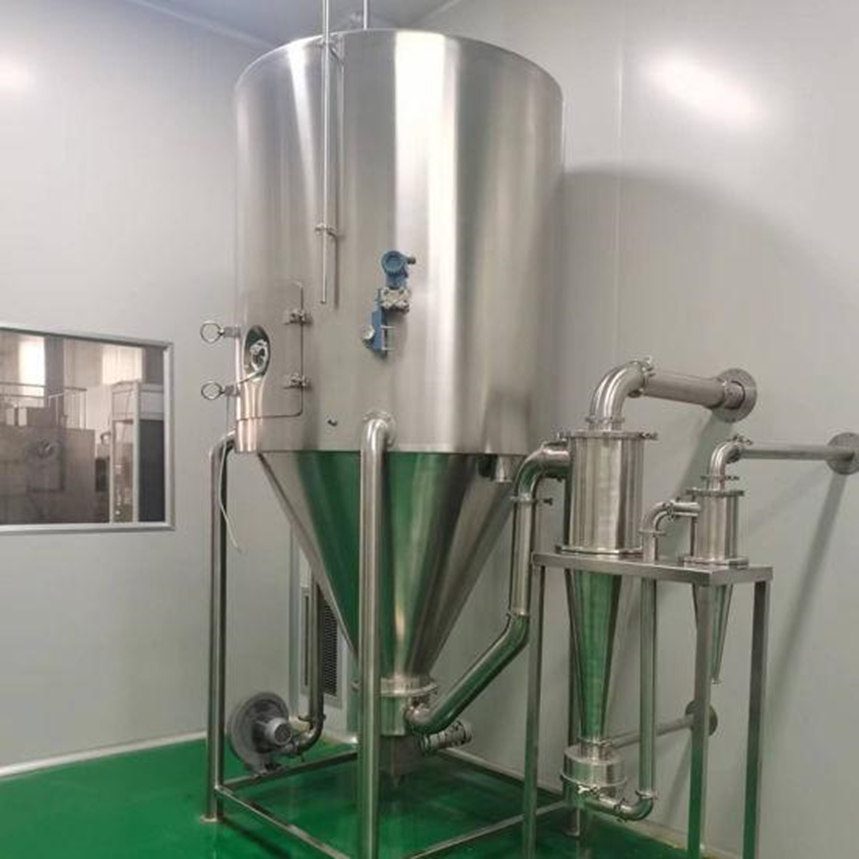
A fluid bed can then perform the appropriate secondary operation.
Similarly, a wet solid may require gentle initial drying in a belt dryer followed by fluid-bed conditioning.
A heat-sensitive pharmaceutical product may require vacuum drying followed by a controlled secondary drying or conditioning step.
Therefore, the moisture-removal curve and product behaviour should determine the process sequence.
Single-Stage vs Multi-Stage Drying
Single-Stage Drying
A single dryer performs most or all of the required moisture removal.
Advantages
- Simpler process
- Lower equipment count
- Easier material flow
- Potentially lower initial capital cost
- Smaller control architecture
Limitations
A single dryer may have to compromise between:
- Drying rate
- Product temperature
- Residence time
- Energy consumption
- Particle characteristics
- Final moisture
- Product quality
Multi-Stage Drying
A multi-stage system divides the process into controlled stages.
For example:
Stage 1 → Rapid Moisture Removal
Stage 2 → Controlled Secondary Drying
Stage 3 → Cooling / Conditioning
This allows each stage to be optimized for a different objective.
A multi-stage system can therefore provide greater process flexibility when product quality and energy performance are both important.
The Basic Principle of Multi-Stage Drying
A useful way to understand the concept is to divide drying into three zones:
Stage 1 — High Moisture Removal
The product contains significant free moisture.
The process focuses on:
- High evaporation rate
- Efficient heat transfer
- Rapid moisture removal
- Stable feed handling
Technologies such as spray, flash, rotary or belt drying may be suitable depending on the feed.
Stage 2 — Controlled Secondary Drying
The product now contains less moisture and may become more sensitive to temperature or sticking.
The process can shift toward:
- Lower thermal exposure
- Controlled residence time
- Uniform moisture distribution
- Better particle handling
Fluid-bed, vacuum, belt or contact technologies may be considered depending on the product.
Stage 3 — Final Drying / Cooling / Conditioning
The final stage may focus on:
- Final moisture adjustment
- Cooling
- De-dusting
- Stabilization
- Product conditioning
- Packaging temperature
A fluid bed, vibratory fluid bed or dedicated cooling stage may be appropriate for suitable particulate products.
Hybrid Drying Is About Process Matching
The strongest reason to use a hybrid system is simple:
Different dryers are good at different parts of the drying process.
For example:
| Technology | Particularly useful for |
|---|---|
| Spray Dryer | Liquid → Powder |
| Fluid Bed Dryer | Granules, powders and particles |
| Belt / Band Dryer | Continuous gentle drying of solids |
| Vacuum Dryer | Low-temperature drying under reduced pressure |
| Flash Dryer | Rapid drying of dispersed wet solids |
| Ring Dryer | Rapid drying with particle recirculation/classification |
| Rotary Dryer | Robust bulk solids |
| Paddle Dryer | Indirect drying of wet, sticky or pasty materials |
| Contact Plate Dryer | Controlled indirect drying of suitable bulk solids |
| Vacuum Belt Dryer | Heat-sensitive extracts and liquid-to-solid applications |
| Vibratory Fluid Bed | Drying, cooling and conditioning of particulate products |
The engineering challenge is determining where each technology belongs in the process.
Example 1: Milk Powder
One of the clearest examples of multi-stage drying is dairy powder processing.
A typical conceptual route can be:
Milk → Evaporation / Concentration → Spray Drying → Fluid Bed Drying → Cooling → Screening → Packing
The spray dryer performs the initial conversion of concentrated liquid into powder.
The fluid-bed stages can then perform further drying and cooling.
Multi-stage spray systems are commercially used to combine spray and fluid-bed technologies, with separate stages for drying and cooling and, depending on configuration, agglomeration.
Why use multiple stages?
Because the process can separate:
Rapid evaporation
from:
Final moisture control + cooling
This can provide greater control over powder properties than forcing the entire moisture load through one stage.
Example 2: Coconut Processing
Coconut products can have very different drying requirements depending on whether the product is:
- Coconut flakes
- Coconut powder
- Desiccated coconut
- Coconut milk solids
- Coconut protein
- Coconut fibre
- Coconut residue
A possible process route for particulate material may be:
Pre-treatment → Band Dryer → Fluid Bed / Conditioning → Cooling
For liquid or concentrated coconut products, another route may involve:
Concentration → Spray Drying → Fluid Bed → Cooling
The correct combination depends on the feed form and final product.
Why this matters
Coconut products can be affected by:
- Fat content
- Moisture
- Particle size
- Thermal exposure
- Colour
- Aroma
- Microbial requirements
- Final storage stability
The process therefore needs to be designed around the actual product rather than selecting a generic “coconut dryer.”
Example 3: Pharmaceutical Products
Pharmaceutical drying is particularly sensitive to:
- Product temperature
- Residual moisture
- Active ingredient stability
- Solvent removal
- Residence time
- Containment
- Cleaning
- Cross-contamination
A conceptual process may be:
Wet Pharmaceutical Material → Vacuum Drying → Secondary Drying / Conditioning → Cooling → Milling / Screening
For another formulation, the route could involve:
Liquid Formulation → Spray Drying → Fluid Bed → Final Conditioning
The actual route depends on the formulation and required product properties.
Why hybrid processing can help
Instead of exposing the product to one aggressive drying condition, the process can be divided into stages that provide greater control over thermal exposure and moisture removal.
For pharmaceutical applications, equipment selection should also consider containment, GMP requirements, cleanability, validation and product-contact materials.
Example 4: Herbal Extract
Herbal extracts often present a combination of challenges:
- Heat sensitivity
- Sticky solids
- Hygroscopicity
- Aroma preservation
- Low final moisture
- Poor powder flow
- Wall deposition
- Product degradation
A conceptual route could be:
Herbal Material → Extraction → Filtration → Concentration → Spray Dryer → Fluid Bed → Cooling → Packaging
The concentration stage reduces the water load before spray drying.
The spray dryer then converts the concentrated liquid into powder.
A secondary fluid-bed stage can provide further drying and cooling where suitable.
This type of process design can be particularly valuable when the final product must be a stable, free-flowing powder.
Example 5: Vegetables
Vegetable products often require gentle handling and controlled moisture removal.
A possible route is:
Washing → Cutting → Pre-treatment → Belt / Band Drying → Final Conditioning → Cooling
The first drying stage performs the majority of moisture removal.
The final conditioning stage can help achieve a more uniform moisture profile.
Depending on the product, a fluid-bed or other conditioning technology may be evaluated.
Important variables
- Slice thickness
- Initial moisture
- Product loading
- Air temperature
- Air velocity
- Residence time
- Final moisture
- Colour retention
- Rehydration characteristics
The dryer should therefore be selected around the product geometry and required final characteristics.
Example 6: Chemicals
Chemical solids can require very different drying strategies.
A possible process may be:
Wet Cake → Flash Dryer → Fluid Bed → Cooling → Screening
The flash dryer can provide rapid initial moisture removal from a suitably dispersed feed.
The fluid bed can then provide controlled secondary drying and cooling.
Another chemical application may be better suited to:
Wet Cake → Paddle Dryer → Cooling → Packaging
or:
Liquid Feed → Spray Dryer → Fluid Bed → Classification
The correct route depends on the material’s:
- Particle size
- Moisture
- Stickiness
- Solubility
- Thermal stability
- Bulk density
- Feed form
Example 7: Fertilizer Products
Fertilizer processing can involve:
Solution / Suspension → Spray / Granulation → Fluid Bed Drying → Cooling → Screening → Recycle
or:
Wet Granules → Fluid Bed Dryer → Cooler → Screening → Recycle
The choice depends heavily on whether the feed enters the process as a liquid, slurry, wet granule or particulate material.
Important final-product requirements may include:
- Granule size
- Moisture
- Crushing strength
- Bulk density
- Flowability
- Dust level
- Storage stability
This is why a fertilizer dryer should not be selected without understanding the complete granulation and recycle process.
Example 8: Food Ingredients
Food ingredients may benefit from:
Liquid Concentrate → Spray Dryer → Fluid Bed → Cooling → Screening
The spray stage performs rapid liquid-to-powder conversion.
The fluid bed can then support secondary drying, cooling or agglomeration depending on the process.
Multi-stage spray and fluid-bed systems are widely used for food and dairy powders where properties such as particle size, flowability, dispersibility and bulk density need to be controlled.
Hybrid Drying for Heat-Sensitive Products
One of the biggest advantages of process staging is the ability to manage thermal exposure.
A product may tolerate:
High drying rate at high moisture
but become much more temperature-sensitive as its moisture content falls.
Therefore, the process can potentially use:
Higher drying intensity → Lower drying intensity → Cooling
rather than applying one drying condition throughout the process.
This principle is especially relevant to:
- Pharmaceuticals
- Herbal extracts
- Food ingredients
- Proteins
- Vitamins
- Nutraceuticals
- Flavors
- Specialty chemicals
However, heat sensitivity is product-specific. Actual product temperature, degradation kinetics and allowable exposure must be established from process and product data.
Hybrid Drying and Energy Efficiency
A multi-stage system is not automatically more energy efficient.
The engineering objective is to make each stage perform the task for which it is most efficient.
Energy analysis should consider:
1. Feed Concentration
If an upstream evaporator or concentration step can increase solids before thermal drying, the dryer may need to evaporate less water.
2. Drying Air
Air temperature, flow rate, humidity and exhaust conditions affect energy demand.
3. Secondary Drying
A fluid bed can be useful as a secondary drying stage for suitable particulate products.
4. Heat Recovery
Waste heat from one part of the plant may potentially be recovered for:
- Inlet air heating
- Feed preheating
- Hot-water generation
- Other process duties
5. Insulation
Good insulation reduces unnecessary heat loss.
6. Process Control
Maintaining the correct:
- Feed rate
- Air temperature
- Airflow
- Moisture
- Residence time
can prevent over-drying and unnecessary energy consumption.
The actual energy performance should always be calculated from the complete mass and energy balance.
Hybrid Drying vs One Large Dryer
A common assumption is:
“One larger dryer must be cheaper and simpler.”
Not necessarily.
A single dryer may require compromises because one machine has to handle the entire moisture-removal curve.
A staged system can separate the functions.
Single Dryer
Wet Feed → Dryer → Final Product
Multi-Stage
Wet Feed → Primary Dryer → Secondary Dryer → Cooling → Final Product
The second configuration can provide additional process control, although it may require more equipment, instrumentation and capital.
The right decision should therefore be based on total cost of ownership and product requirements, not equipment count alone.
How to Decide Whether You Need a Hybrid Drying System
Ask these questions:
Question 1
Is the feed liquid, slurry, wet cake, granule or powder?
Question 2
Does the product become more heat-sensitive as it dries?
Question 3
Is the final moisture specification tight?
Question 4
Does the product require cooling after drying?
Question 5
Is particle size important?
Question 6
Is bulk density important?
Question 7
Does the product become sticky during drying?
Question 8
Is dust generation a concern?
Question 9
Is agglomeration required?
Question 10
Can upstream concentration reduce the evaporation load?
Question 11
Does the process require solvent recovery?
Question 12
Does the product need a separate final conditioning stage?
If several answers are “yes,” a multi-stage drying study may be worthwhile.
Technology Selection Matrix
| Process Requirement | Technologies to Evaluate |
|---|---|
| Liquid → Fine Powder | Spray Dryer |
| Liquid → Granules | Spray Fluidizer / Spray Granulation |
| Wet Granules → Dry Granules | Fluid Bed Dryer |
| Powder → Dry + Cool | Fluid Bed / Vibratory Fluid Bed |
| Wet Slices / Pieces | Band / Belt Dryer |
| Wet Dispersed Solids | Flash / Ring Dryer |
| Sticky Wet Solids | Paddle / Contact Dryer |
| Heat-Sensitive Extracts | Vacuum / Vacuum Belt / Spray + Fluid Bed |
| Robust Bulk Solids | Rotary Dryer |
| Final Product Cooling | Fluid Bed / Vibratory Fluid Bed / Cooler |
| Particle Classification | Screen / Cyclone / Classifier |
| High-TDS Concentrate | Evaporation + Appropriate Dryer / Crystallization Route |
This is a starting framework—not a substitute for process testing.
Combining Spray Dryer + Fluid Bed Dryer
This is one of the most established hybrid concepts.
The basic process is:
Liquid Feed
↓
Atomization
↓
Spray Drying
↓
Fluid Bed Drying
↓
Final Drying / Cooling
The spray stage handles the rapid evaporation.
The fluid-bed stage handles the remaining moisture and can, depending on the design, support agglomeration or cooling.
This configuration is particularly relevant to:
- Dairy powders
- Food ingredients
- Nutraceuticals
- Proteins
- Chemicals
- Specialty powders
Industrial multi-stage spray systems demonstrate how spray drying and fluid-bed processing can be integrated into one plant.
Combining Belt Dryer + Fluid Bed
For products entering the process as pieces, flakes, slices or other solids:
Wet Product → Belt Dryer → Fluid Bed → Cooling
The belt dryer can provide controlled continuous drying.
The fluid bed can then provide:
- Final moisture adjustment
- Uniform drying
- Cooling
- Conditioning
This can be evaluated for:
- Fruits
- Vegetables
- Herbs
- Spices
- Biomass
- Agricultural products
- Selected food ingredients
The suitability depends strongly on particle size, geometry and fluidization behaviour.
Combining Flash Dryer + Fluid Bed
For suitable wet particulate materials:
Wet Cake / Dispersed Feed → Flash Dryer → Fluid Bed → Cooling
The flash dryer provides rapid moisture removal from appropriately dispersed feed.
The fluid bed can then complete drying and cool the product.
This approach can be considered for selected:
- Chemicals
- Starch products
- Minerals
- Food materials
- Fine powders
- Filter cakes
The feed must be capable of being dispersed and transported through the pneumatic drying section.
Combining Vacuum Dryer + Secondary Drying
For heat-sensitive or solvent-containing products:
Wet Product → Vacuum Drying → Secondary Drying → Cooling
Vacuum drying can lower the boiling temperature of volatile components and can be useful where reduced-pressure operation is required.
A secondary stage may then provide controlled final moisture adjustment or conditioning.
This type of process needs careful consideration of:
- Vacuum level
- Product temperature
- Solvent properties
- Condensation
- Vapour handling
- Explosion protection
- Product stability
Combining Evaporation + Spray Drying
For liquid products with a high water load:
Dilute Feed → Evaporation / Concentration → Spray Dryer → Fluid Bed
This is an important process-engineering concept.
The evaporator removes a large portion of the water before the spray dryer.
The spray dryer then handles the concentrated feed.
This can reduce the amount of water entering the final thermal drying stage.
For products where concentration is practical, the complete evaporation + drying energy balance should be evaluated rather than optimizing the dryer alone.
Multi-Stage Drying for Product Quality
A drying process should not be evaluated only on:
“How many kilograms of water per hour can it evaporate?”
The final product may require:
- Specific moisture
- Specific particle size
- Specific bulk density
- Specific colour
- Specific solubility
- Specific flowability
- Specific thermal history
Therefore:
Drying Capacity ≠ Product Quality
A properly engineered process balances both.
Moisture Profile Is More Important Than Final Moisture Alone
Two products can have the same final moisture but completely different drying histories.
For example:
Product A:
Rapid high-temperature drying
Product B:
Controlled staged drying
Both could reach the same final moisture.
But their:
- Particle structure
- Porosity
- Colour
- Flowability
- Solubility
- Bulk density
- Thermal degradation
may be different.
This is why multi-stage drying can be valuable for applications where product structure matters as much as moisture removal.
Process Control in Hybrid Drying Plants
A multi-stage system requires coordinated control.
Typical parameters may include:
Feed Control
- Feed flow
- Feed temperature
- Feed concentration
Drying Control
- Inlet temperature
- Outlet temperature
- Airflow
- Humidity
Product Control
- Moisture
- Bed temperature
- Residence time
- Product flow
Exhaust Control
- Pressure
- Dust loading
- Filter differential pressure
- Exhaust temperature
Safety Control
- High-temperature alarms
- Pressure protection
- Explosion protection where required
- Oxygen monitoring where relevant
- Emergency shutdown
The control strategy should reflect the material and process hazards.
Dust Collection and Product Recovery
Hybrid drying systems often generate fine particles that must be recovered and managed.
Depending on the process, equipment may include:
- Cyclones
- Bag filters
- Scrubbers
- Product recovery systems
- Fines recycle
- Exhaust treatment
Fines may sometimes be returned to the process when product properties and process design permit.
For powders with combustible-dust characteristics, appropriate dust and explosion-risk assessment is essential.
Hygienic Design for Food and Pharma
For food and pharmaceutical applications, drying technology alone is not enough.
The complete system may need:
- Appropriate product-contact materials
- Hygienic equipment design
- Cleanability
- CIP/SIP where applicable
- Controlled product transfer
- Minimized dead zones
- Containment
- Inspection access
- Validated cleaning procedures
The required standard depends on the application, product and applicable regulations.
Material Selection
Different stages may require different construction materials.
Selection can depend on:
- Corrosion
- Product chemistry
- Temperature
- Abrasion
- Cleaning chemicals
- Solvent exposure
- Hygienic requirements
Possible materials may include suitable grades of stainless steel or other alloys selected according to process conditions.
For chemical applications, material compatibility should be evaluated before final equipment design.
Hybrid Drying for Global Industries
Hybrid and multi-stage drying is relevant across many industrial markets.
Food & Dairy
- Milk powder
- Whey
- Proteins
- Food ingredients
- Flavors
- Coffee
- Fruit products
Pharmaceuticals
- APIs
- Excipients
- Formulations
- Extracts
- Nutraceuticals
Chemicals
- Salts
- Specialty chemicals
- Intermediates
- Pigments
- Minerals
Fertilizers
- Granules
- Fertilizer solutions
- Fertilizer suspensions
- Specialty fertilizer products
Agriculture
- Herbs
- Vegetables
- Fruits
- Spices
- Agricultural residues
Biomass
- Biomass solids
- Sawdust
- Wood chips
- Agricultural residues
The correct combination depends on the product rather than the country or industry name alone.
Why Process Engineering Matters More Than Dryer Selection
A buyer may initially search for:
“Industrial Dryer Manufacturer”
But the actual requirement may be:
“How do I convert this wet feed into a stable, free-flowing product at the required moisture and particle size with acceptable energy consumption?”
That is a process-engineering question.
The answer could involve:
One Dryer
or:
Two Dryers
or:
Concentration + Dryer + Fluid Bed + Cooler
or:
Dryer + Recycle + Classification
or an entirely different process.
This is why GTI Dryers approaches drying projects from the feed-to-final-product perspective.
GTI Dryers: From Dryer Selection to Complete Process Design
GTI Dryers can evaluate drying requirements based on:
Feed
- Physical form
- Moisture
- Solids
- Temperature
- Viscosity
- Particle size
- Bulk density
- Stickiness
- Thermal sensitivity
Final Product
- Moisture
- Particle size
- Bulk density
- Flowability
- Temperature
- Colour
- Solubility
- Product stability
Production
- Feed capacity
- Production capacity
- Operating hours
- Batch or continuous operation
Utilities
- Steam
- Thermic fluid
- Hot water
- Gas
- Electricity
- Compressed air
Plant
- Available space
- Installation height
- Existing equipment
- Automation
- Exhaust arrangement
- Environmental requirements
This information helps determine whether the project should use a single dryer or a hybrid / multi-stage drying system.
Can GTI Design a Complete Drying Line?
A complete drying project may involve much more than the main dryer.
Depending on the application, the process can include:
Feed Preparation
↓
Concentration / Pre-treatment
↓
Primary Drying
↓
Secondary Drying
↓
Cooling
↓
Screening / Classification
↓
Recycle
↓
Dust Collection
↓
Final Product Handling
The exact configuration depends on the process.
The goal is to create a coordinated process line rather than a collection of independent machines.
What Information Should You Send GTI for a Hybrid Drying Project?
For an initial process assessment, provide:
- Product name
- Industry/application
- Feed form
- Feed capacity
- Initial moisture
- Final moisture
- Solids concentration
- Feed temperature
- Feed viscosity
- Particle size
- Desired particle size
- Bulk density
- Heat sensitivity
- Stickiness
- Solvent content, if applicable
- Desired production capacity
- Available heat source
- Existing upstream equipment
- Existing downstream equipment
- Installation location
- Available space
- Required automation level
- GMP/hygienic requirements
- Dust or explosion-safety requirements
The more accurately the process is defined, the more accurately the drying system can be engineered.
Frequently Asked Questions
What is a hybrid industrial drying system?
A hybrid drying system combines two or more drying, cooling, concentration, granulation or conditioning technologies to achieve a final product specification.
Why use a multi-stage drying system?
A multi-stage system allows different stages of moisture removal and product conditioning to be handled using technologies suited to each stage.
Is a hybrid dryer more energy efficient?
Not automatically. Energy performance depends on the complete process, including feed concentration, evaporation load, heat recovery, drying temperatures, airflow, residence time and final moisture.
Can a spray dryer and fluid bed dryer work together?
Yes. Spray drying and fluid-bed drying are commonly combined in multi-stage systems for suitable liquid-to-powder processes, with the fluid bed performing secondary drying, cooling and, depending on configuration, agglomeration.
What is the advantage of spray dryer + fluid bed?
The spray dryer can perform rapid primary moisture removal while the fluid bed can provide controlled secondary drying and cooling. This can help manage final powder properties.
Can belt drying and fluid-bed drying be combined?
Yes, for suitable particulate or piece-form products. A belt dryer can perform primary continuous drying while a fluid bed can provide final drying or conditioning where the product can be fluidized.
Can vacuum drying be part of a multi-stage process?
Yes. Vacuum drying can be integrated with other stages when reduced-pressure drying is required for heat-sensitive or solvent-containing products.
Can GTI provide customized multi-stage drying systems?
GTI Dryers can evaluate customized drying configurations based on feed characteristics, final product requirements, capacity, utilities and plant conditions.
How do I know whether I need one dryer or multiple dryers?
The decision should be based on the complete moisture-removal curve, product sensitivity, final moisture, particle properties, energy requirements and downstream process—not simply on the amount of water to be evaporated.
Is pilot testing required?
Not for every application, but it can be valuable for difficult, high-value, heat-sensitive, sticky or new products where drying and product-property behaviour is uncertain.
Hybrid Drying System Selection: Start With the Product, Not the Machine
The best industrial drying system is not necessarily the biggest dryer or the most sophisticated machine.
It is the system that can reliably achieve the required:
Feed Handling → Moisture Removal → Product Transformation → Final Moisture → Particle Properties → Cooling → Product Recovery
For some applications, that may be a single dryer.
For others, the optimum solution may be:
Concentration + Spray Dryer + Fluid Bed + Cooling
or:
Band Dryer + Fluid Bed + Cooling
or:
Flash Dryer + Fluid Bed + Classification
or:
Vacuum Dryer + Secondary Drying + Cooling
The correct configuration should be established from the process data.
Talk to GTI Dryers About Your Complete Drying Process
If you are unsure whether your application requires a Spray Dryer, Fluid Bed Dryer, Band Dryer, Vacuum Dryer, Flash Dryer, Rotary Dryer or a combination of technologies, start with the process rather than the equipment name.
Share your:
Feed → Capacity → Initial Moisture → Final Moisture → Product Form → Heat Sensitivity → Particle Requirement → Available Heat Source → Application
GTI Dryers can evaluate the process route and identify whether a single-stage, hybrid or multi-stage drying system is appropriate.
GTI Dryers — Engineered Drying & Process Solutions from India for Industrial Applications Worldwide.