
A single dryer is not always enough. High inlet moisture, strict residual-moisture limits, particle morphology requirements and heat sensitivity often push plants toward hybrid multi-stage drying systems — lines that combine two or more principles such as spray + fluid bed, spray + belt, or fluid bed + belt in sequence.
This guide explains when multi-stage drying is justified, what each stage typically does, how spray, fluid bed and belt dryers complement each other, and what buyers should define before investing in an integrated line.
Quick answer: Hybrid multi-stage drying assigns each technology the job it does best: spray for turning liquids/slurries into particles, fluid bed for efficient finish drying and agglomeration control of granules, belt for gentle layered drying of pieces or heat-sensitive solids. It pays when one machine would be oversized, thermally harsh or wrong for the feed form.
1. What Is Hybrid Multi-Stage Drying?
Hybrid multi-stage drying means two or more dryer types in series (sometimes with intermediate cooling, screening or conditioning), each handling a defined portion of the moisture removal or product transformation.
Examples:
- Spray dryer → fluid bed (instantising / finish drying)
- Spray dryer → belt dryer (gentle finish for sensitive powders or sheets)
- Fluid bed → belt (granules then layered product forms)
- Pre-dryer (e.g. spin-flash or belt) → finish dryer of another type
The aim is lower total energy, better quality or higher capacity than forcing the entire duty into one principle.
2. Why Single-Stage Drying Sometimes Fails
| Limitation of single stage | Multi-stage response |
|---|---|
| Spray dryer: high energy if feed is dilute; outlet temperature may stress product | Concentrate upstream; finish moisture in fluid bed or belt at milder conditions |
| Fluid bed: cannot accept non-fluidisable cakes or liquids | Use spray or spin-flash first to create granules |
| Belt dryer: not suited to true liquids; long for very high moisture | Remove bulk water in another stage; belt for controlled finish |
| One high temperature throughout | Early stage for bulk evaporation; late stage for quality-safe finish |
| Morphology needs (agglomerates, low dust, piece shape) | Different stages create and then protect structure |
3. Role of Each Technology in a Hybrid Line
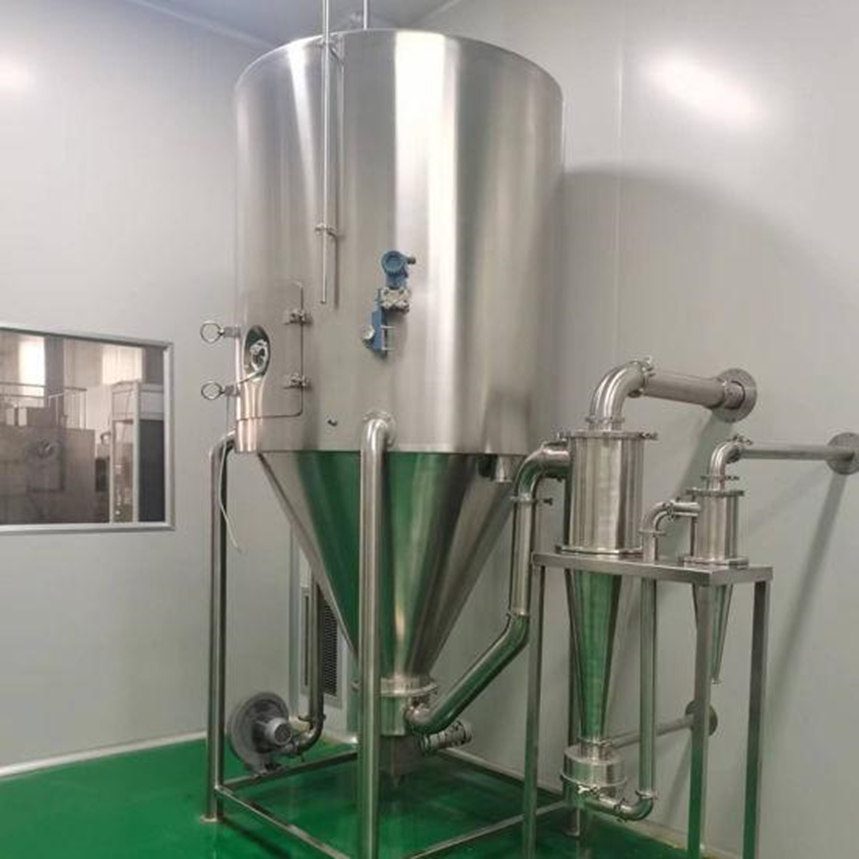
Spray dryer
- Role: Convert pumpable liquid or slurry into powder or droplets that solidify in flight
- Strength: One-step powder from solution; particle formation
- Limit: Feed must be atomisable; thermal history and wall deposits must be managed; not for solid pieces or sticky cakes without re-slurry
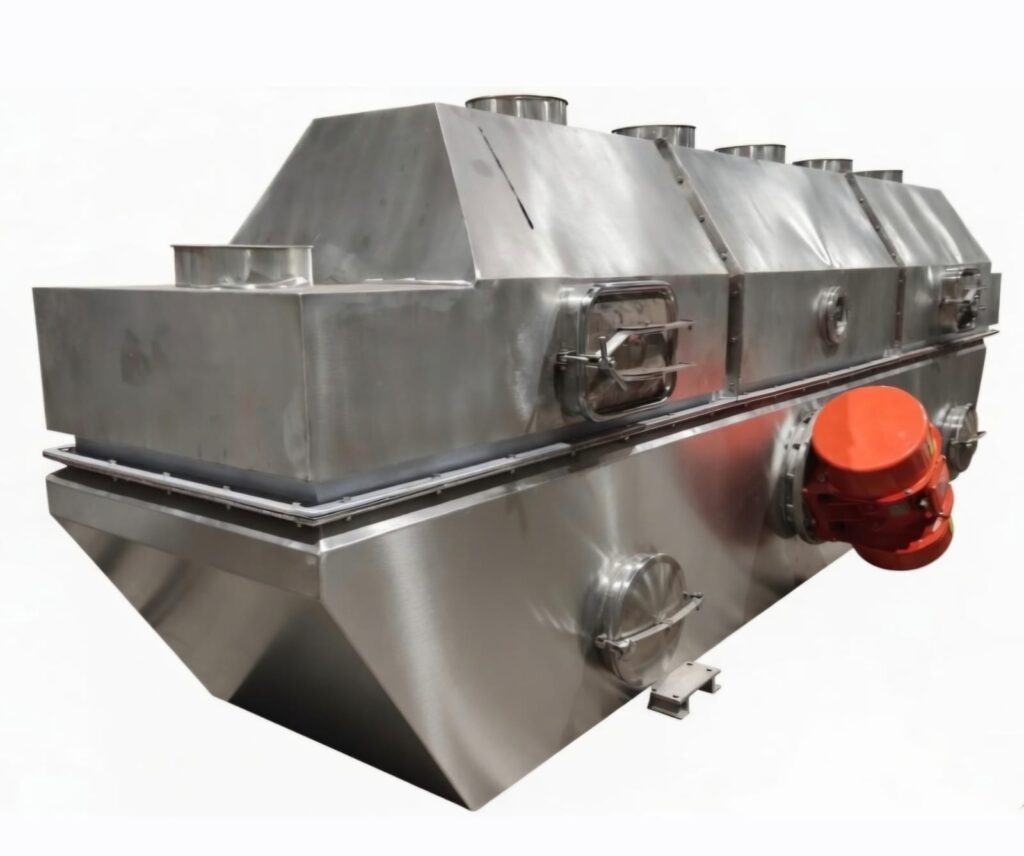
Fluid bed / vibratory fluid bed (VFBD)
- Role: Efficient finish drying, cooling, or agglomeration of free-flowing granules
- Strength: High heat/mass transfer; good moisture uniformity when fluidization is stable
- Limit: Feed must fluidise; cohesive cakes and large fragile slices do not belong here
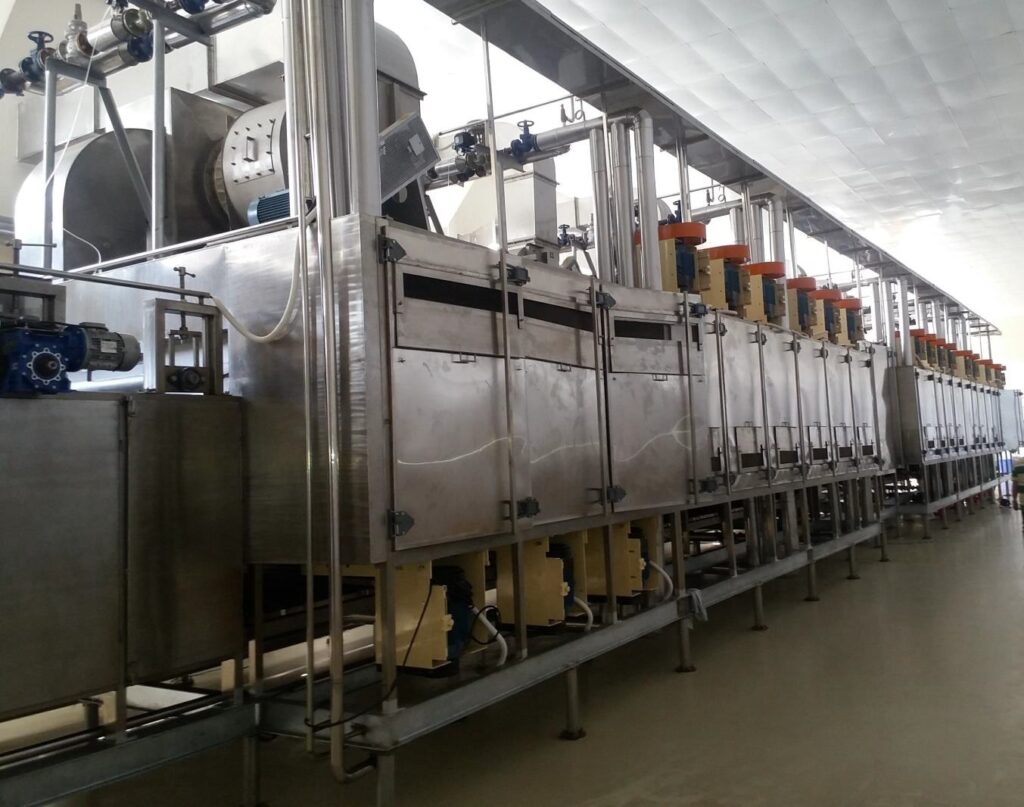
Band / mesh-belt dryer
- Role: Gentle, zoned drying of pieces, flakes, extrudates or layered beds
- Strength: Shape retention, multi-zone temperature profiling, continuous industrial capacity
- Limit: Needs a permeable layer; not a liquid atomisation device
Spin-flash / contact stages (when relevant) may replace spray as the first stage for wet cakes that should not be re-slurried.
4. Common Hybrid Configurations
| Configuration | Typical use case |
|---|---|
| Spray → fluid bed | Milk powders, instant foods, detergents, chemical powders needing lower final moisture or agglomeration |
| Spray → belt | Heat-sensitive powders or products that need long, gentle finish without aggressive fluidization |
| Spin-flash → fluid bed | Cake to powder, then finish/classify in fluid bed |
| Belt → belt (multi-pass / multi-stage zones) | Already a staged band system for spices, onion, coconut, herbs |
| Fluid bed → belt | Less common; used when product form changes or gentle final drying is required |
Not every plant needs three families. Many high-performing lines use two stages carefully balanced.
5. Decision Guide: Do You Need a Hybrid System?
Consider multi-stage when:
- Inlet moisture is very high and final moisture is very low
- Product is heat-sensitive in the late drying phase
- You need a specific particle structure (agglomerate, low fines, piece shape)
- A single dryer would require extreme temperatures or huge residence time
- You can measure intermediate moisture and control intermediate handling
Stay single-stage when:
- Feed form and moisture path fit one technology cleanly
- Intermediate transfer would cause breakage, contamination or cost without quality gain
- Operators and maintenance cannot support a more complex line
- Budget and footprint cannot absorb two heat sources and two control systems
Complexity is only justified by process need.
6. Integration Challenges Buyers Must Plan For
| Challenge | Mitigation |
|---|---|
| Intermediate moisture control | Defined target after stage 1; sampling and control loops |
| Conveying and buffering | Hygienic transfer, minimal hold-up for sensitive products |
| Different utilities | Steam/gas/electric balance across stages |
| Capacity matching | Stage 1 evaporation vs stage 2 finish rate — avoid bottleneck |
| Cleaning and changeover | CIP/access design for each stage and transfer path |
| Control philosophy | One supervisory view of moisture and temperature across the line |
| Dust and explosion zoning | Consistent hazardous-area design across connected equipment |
7. Energy Logic of Multi-Stage Systems
Multi-stage drying can reduce energy when:
- Bulk water is removed under conditions that maximise driving force
- Final moisture is removed at lower temperature (protecting quality and sometimes allowing recovery)
- Re-slurrying is avoided (e.g. cake → spin-flash instead of cake → slurry → spray)
It can increase energy or cost when:
- Intermediate product is cooled and reheated unnecessarily
- Stages are poorly matched and one runs far from design point
- Heat recovery opportunities between stages are ignored
Always compare total specific energy for the line against a realistic single-stage alternative.
8. What to Specify When Requesting Hybrid System Proposals
- Feed form at plant entry (liquid, slurry, cake, granules, pieces)
- Moisture at entry and required residual moisture
- Any intermediate moisture or morphology targets
- Maximum product temperature by stage if known
- Capacity (continuous kg/h) and peak
- Preferred heat sources and emission limits
- Hygiene / material of construction
- Whether agglomeration, cooling or classification is required after drying
- Available footprint and operator skill level
Ask each bidder to state evaporation load per stage and assumptions.
9. How GTI Dryers Approaches Multi-Stage Concepts
GTI Dryers designs and manufactures band/mesh-belt, fluid-bed/VFBD, rotary, flash/spin-flash and spray-related continuous drying solutions. For hybrid enquiries we:
- Map moisture and product form stage by stage
- Recommend the minimum number of stages that meet quality and capacity
- Avoid combining technologies only for brochure appeal
- Align intermediate handling and controls with Indian plant operating practice
- Provide assumption-based concepts before detailed engineering
A hybrid line is proposed only when process data show a clear gain over a well-designed single technology.
Geographic Note
Integrated spray–fluid bed lines are common in dairy and chemical plants worldwide. Belt-based multi-zone systems are widespread in Indian spice, vegetable and agro drying. Hybrid thinking is growing where export quality and energy cost both matter. Local fabrication and service support for each stage improve uptime during peak seasons.
Frequently Asked Questions
What is a hybrid multi-stage drying system?
A drying line that uses two or more dryer types in sequence so each stage handles the moisture and product form it is best suited for.
Is spray + fluid bed always better than spray alone?
No. It helps when final moisture, agglomeration or thermal history requires a milder finish stage. If spray alone meets specification efficiently, adding a fluid bed may not pay.
Can belt dryers be part of a hybrid with spray?
Yes, when a gentle, long finish or a specific layered product form is needed after powder formation — subject to intermediate handling design.
What is the biggest risk in multi-stage projects?
Mismatched capacities, unclear intermediate moisture targets and under-designed transfer systems.
What data should I send GTI?
Feed form, full moisture path, capacity, temperature limits and quality goals (particle form, colour, etc.).
Next Step
If a single dryer is struggling with moisture, quality or capacity — or you are planning a new line that may need spray, fluid bed and belt stages — share your process data. GTI can help determine whether a hybrid multi-stage concept is justified and outline a practical stage-by-stage approach.
Request a hybrid multi-stage drying assessment with your process data.
Contact the GTI Technical Team:
Website: gtidryers.com
Email: mktg@gtidryers.com
Phone / WhatsApp: +91 9330077417