Industrial dryers are often among the largest energy consumers in a process plant. Fuel or steam cost per kilogram of water evaporated directly affects operating margin, especially for high-moisture feeds and continuous 24×7 lines.
Many plants attempt to “buy efficiency” through a new machine while leaving the largest savings on the table: process control, residual-moisture discipline, airflow and temperature matching, and basic heat recovery. This guide organises the practical levers in the order that usually delivers results.
1. Why Dryer Energy Use Is High
Drying is fundamentally the supply of latent heat to evaporate water (or solvent) plus the sensible heat to raise the temperature of solids, water and air, plus losses.
Energy demand rises when:
- Inlet moisture is high or highly variable
- Final residual moisture is driven far below the real specification
- Exhaust air leaves still hot and relatively dry (unused driving force)
- Airflow is excessive for the actual evaporation load
- Insulation, leakage and poor sealing increase losses
- The dryer is oversized or run at unnecessarily high temperature
Specific energy consumption (kWh or kcal per kg of water evaporated) is the most useful comparison metric — not a generic “efficiency percentage”.
2. Energy-Reduction Hierarchy (What to Do First)
| Priority | Lever | Typical impact | Effort / investment |
|---|---|---|---|
| 1 | Process control & residual-moisture discipline | Often large | Low–medium |
| 2 | Temperature, airflow and loading optimisation | Significant | Low–medium |
| 3 | Insulation, sealing, maintenance | Moderate | Low |
| 4 | Heat recovery from exhaust | Moderate–high | Medium |
| 5 | Hybrid or alternative energy integration | Variable | Medium–high |
| 6 | Technology change (dryer type) | Can be large | High |
Start at the top. Capital projects deliver more when the process is already under control.
3. Best Practices That Reduce Energy Without New Capital
A. Stop over-drying
Every extra percentage point of moisture removed below the real specification costs energy and often raises product temperature (risking quality). Set and enforce a residual-moisture target; verify with regular measurement.
B. Match temperature profile to the drying curve
Early stages can use higher driving force while the product is still wet (evaporative cooling protects the solid). Final stages should use lower temperature to finish moisture without unnecessary heat input. Multi-zone dryers make this practical.
C. Control airflow to the actual load
Excess air carries heat out of the system. Balance supply and exhaust; avoid “open damper” operation that was set once and never revisited.
D. Maintain stable feed moisture and rate
Large swings in inlet moisture force operators to run conservatively (higher temperature or longer residence time). Upstream dewatering, consistent centrifugation/filtration and steady feed rate improve dryer energy use.
E. Keep the dryer clean and sealed
Fouled heat exchangers, blocked perforations, leaking doors and damaged insulation increase fuel use and reduce capacity. Planned cleaning and inspection pay back quickly.
F. Cool product efficiently
If cooling is required, do not use the main dryer as an inefficient cooler. Separate cooling with ambient or tempered air is usually cheaper.
4. Heat Recovery Options
Heat recovery captures energy that would otherwise leave in the exhaust and returns it to the process.
Common approaches
- Air-to-air heat exchangers: Preheat incoming fresh air with hot exhaust (subject to fouling and condensation limits).
- Air-to-water or run-around coils: Transfer heat to a water or glycol loop for use elsewhere or for preheating.
- Indirect recovery from jacket or condenser streams: Where indirect heating or vacuum systems produce useful hot streams.
- Recirculation of a portion of exhaust: Within product-quality and humidity limits; more common in some belt and chamber systems than in once-through high-temperature dryers.
Practical limits
- Fouling from dust, sticky particles or condensable organics
- Condensation and corrosion if exhaust is cooled below dew point without proper materials
- Cross-contamination risk in food and pharma if recovery streams are not isolated
- Diminishing returns when exhaust is already relatively cool or saturated
Heat recovery should be evaluated with actual exhaust temperature, humidity and dust load — not assumed as a fixed percentage saving.
5. Hybrid and Alternative Energy Approaches
Hybrid thinking means combining heat sources or drying stages so that the most expensive energy is used only where it is needed.
Examples
- Waste-heat or low-grade heat for pre-drying or early zones; higher-grade heat for final moisture removal
- Biomass or process-gas heat where fuel logistics and emissions allow
- Mechanical dewatering maximised before thermal drying (filtration, centrifugation, pressing)
- Two-stage systems (e.g., mechanical + thermal, or belt + fluid-bed) sized so each stage operates near its efficient region
- Integration with combined heat and power (CHP) or plant steam balance where available
Hybrid systems add control and integration complexity. They pay when the energy price difference or waste-heat availability is real and continuous.
6. Dryer Type and Inherent Energy Characteristics
| Dryer family | Energy-related characteristics | Energy-relevant design points |
|---|---|---|
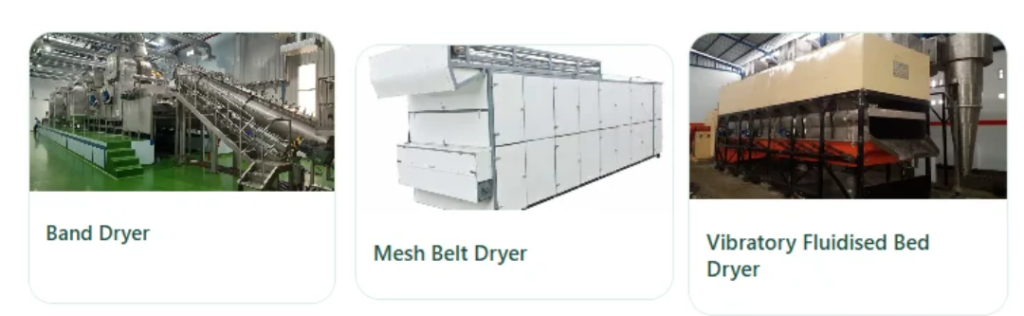
| Belt / mesh-belt / band | Good for staged profiles; exhaust may still be recoverable | Multi-zone control, recirculation where quality allows, insulation |
| Fluid bed / VFBD | High heat-transfer rates; can be efficient at correct fluidisation | Avoid excess air velocity; control bed depth and temperature |
| Rotary | Robust for bulk solids; can have higher exhaust loss if once-through | Flight design, seal condition, co- vs counter-current, possible recovery |
| Flash / spin-flash | Short residence time; high gas volumes | Gas recycle options, inlet temperature control, feed dispersion |
| Spray | High energy per kg water for dilute feeds | Higher feed solids, exhaust heat recovery, correct outlet temperature |
| Contact / paddle / vacuum | Can use lower temperature heat; vacuum reduces boiling point | Jacket temperature, condenser load, vacuum efficiency |
Technology change should follow a mass-and-energy balance and product-quality constraints, not a brochure claim of “high efficiency”.
7. How to Quantify and Prioritise Savings
- Measure current specific energy (fuel/steam/electricity per kg water evaporated) over representative production.
- Record inlet/outlet moisture, feed rate, air temperatures and exhaust condition.
- Identify the largest losses (over-drying, excess air, hot exhaust, poor insulation).
- Estimate savings from process changes first (often low cost).
- Then evaluate heat recovery with real exhaust data and fouling risk.
- Only then compare hybrid or new-dryer options on a total-cost-of-ownership basis.
Without measurement, “energy-saving” projects frequently under-deliver.
8. Buyer Checklist — What to Ask Manufacturers and Engineers
- What residual-moisture target is the system designed for (and how is it controlled)?
- How many independent temperature/airflow zones are provided?
- What is the expected specific energy consumption for our moisture and capacity data?
- Is exhaust heat recovery included or optional? What fouling/condensation provisions are made?
- Can the system use waste heat or alternative fuels available on our site?
- How is loading/airflow balanced to avoid excess air?
- What insulation, sealing and maintenance access are provided?
- Can pilot or audit data be used to validate energy estimates?
9. How GTI Dryers Approaches Energy-Conscious Design
GTI Dryers designs continuous drying systems (band/mesh-belt, fluid-bed/VFBD, rotary, combination and related configurations) with process data as the starting point. Energy-conscious engineering includes:
- Sizing for the real residual-moisture specification, not arbitrary over-drying
- Multi-zone temperature and airflow control where it improves both quality and energy use
- Evaluation of heat-source options against site utilities
- Consideration of heat-recovery and integration opportunities where exhaust conditions allow
- Clear statement of assumptions behind any energy estimate
GTI does not publish universal energy-saving percentages. Savings depend on the starting point, product and how the system is operated.
Geographic Note
Energy cost and fuel mix vary widely (natural gas, coal, biomass, electricity, steam from process). In regions with high fuel prices or carbon constraints, heat recovery and residual-moisture discipline deliver faster payback. In regions with low-cost biomass or waste heat, hybrid integration may dominate. The measurement-and-hierarchy approach above remains valid in every market.
Frequently Asked Questions
What is the single biggest energy waste in many dryers?
Over-drying past the real specification and running excess air or temperature “to be safe”.
Does heat recovery always pay back?
Only when exhaust is hot enough, fouling is manageable, and the recovered heat has a continuous useful sink. Evaluate with site data.
Can I reduce energy without changing the dryer?
Often yes — through residual-moisture control, zone optimisation, airflow balance, insulation and stable feed.
Are hybrid systems worth it?
When a low-cost or waste heat source can handle a large fraction of the evaporation load and the integration is reliable.
What data does GTI need for an energy-focused assessment?
Dryer type, capacity, heat source, inlet and target moisture, current fuel/steam use if known, and any exhaust temperature/humidity data.
Next Step
If dryer energy cost is a priority, share your current dryer type, capacity, heat source and moisture data. GTI can review the process and outline practical options — from operating discipline and heat recovery to system configuration — without generic savings claims.
Request an energy-focused industrial dryer assessment with your process data.
Contact the GTI Technical Team:
Website: gtidryers.com
Email: mktg@gtidryers.com
Phone / WhatsApp: +91 9330077417