
A fluid bed dryer suspends solid particles in an upward flow of gas so that the bed behaves like a fluid. Hot gas contacts the particles intensely, moisture evaporates, and the material moves continuously from feed to discharge when the unit is designed as a plug-flow or well-mixed continuous dryer.
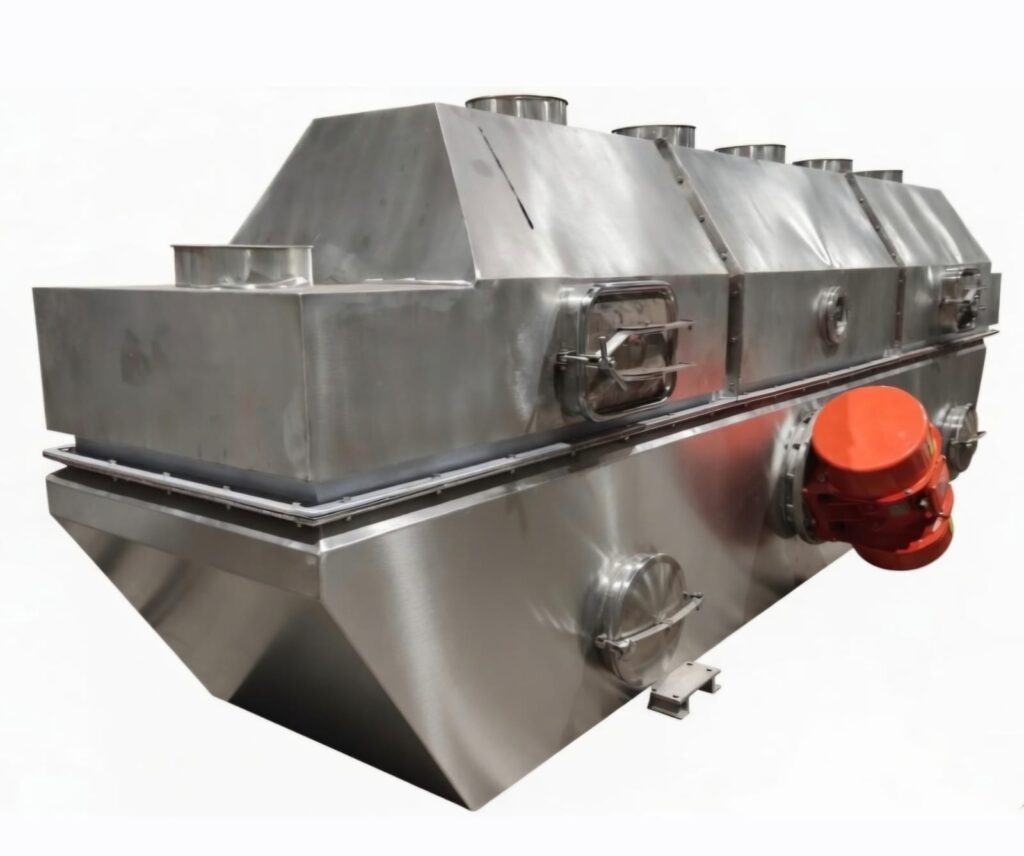
This page explains the working principle, the difference between conventional (static) fluid beds and vibratory fluid bed dryers (VFBD), when each is used, and what buyers should check before selecting the technology.
1. Working Principle in One Paragraph
Gas is pushed through a perforated distributor plate at a velocity high enough to support the weight of the particles (above minimum fluidization velocity) but not so high that the entire bed is blown out of the vessel. Particles separate, mix and move freely. Heat transfers rapidly from gas to solids; moisture leaves with the exhaust gas. In continuous designs, solids travel along the bed length under the influence of gas flow, weirs, slight deck slope and — in vibratory units — directed vibration.
2. Process Flow (Text Schematic)
text
[Wet feed] → [Inlet weir / feed zone]
                    ↓
        [Fluidised bed on distributor plate]
         ↑                         ↓
[Hot gas + fan]              [Product weir → dry product]
         ↓
[Exhaust] → [Cyclone / bag filter] → [Fan / stack]
Vibratory units: Mechanical vibration is applied to the deck/body to assist particle mobility, especially for cohesive or difficult-to-fluidise materials.
(On the published page, place a side-view diagram: plenum, distributor plate, fluidised bed, freeboard, exhaust, feed and discharge weirs; optional vibration motors on VFBD.)
3. Engineering Principles
Minimum fluidization velocity (Umf)
Below Umf the bed remains packed; gas finds preferential paths (channeling). At and above Umf the bed expands, particles move and pressure drop levels off. Operating velocity is chosen above Umf for mixing and heat transfer, but below the point of excessive elutriation of fines.
Distributor plate
The plate creates a pressure drop and spreads gas across the full bed area. Hole size, open area and design must match particle size so that:
- Gas distribution is even
- Particles do not block or weep through the holes
- Dead zones are minimised
A dirty, damaged or poorly designed plate is a leading cause of channeling and moisture variation.
Heat and mass transfer
Once fluidised, each particle is surrounded by gas. Heat transfer rates are high compared with static beds or poorly cascading systems. Drying rate depends on gas temperature, humidity, velocity and particle size/moisture.
Residence time in continuous beds
Controlled by bed length, weir heights, feed rate, gas velocity and (for VFBD) vibration parameters. Multi-zone decks allow different temperatures along the dryer length.
4. Conventional Fluid Bed vs Vibratory Fluid Bed (VFBD)
| Aspect | Conventional (static) fluid bed | Vibratory fluid bed dryer (VFBD) |
|---|---|---|
| Particle motion | Driven mainly by gas fluidization | Gas fluidization + mechanical vibration |
| Best with | Free-flowing, relatively uniform particles that fluidise cleanly | Cohesive, slightly sticky, or wider size-range products that need help to stay mobile |
| Channeling risk | Higher if feed is cohesive or plate is uneven | Lower when vibration is correctly set — vibration breaks bridges and dead zones |
| Attrition | Depends on velocity and particle strength | Can be similar or slightly different depending on amplitude; still gentler than rotary cascading for many granules |
| Typical use | Crystals, pellets, uniform granules, many chemical and food particles | Granules that tend to stick, some food and chemical products, duties where stable conveying of difficult beds is required |
| Mechanical complexity | Lower (no vibration drive) | Higher (motors, springs, isolation) |
Selection rule of thumb
If the material fluidises easily in a simple test and stays free-flowing as it dries, a conventional fluid bed is often sufficient. If it forms lumps, channels or refuses to move at the wet end, a VFBD or a different technology (e.g. spin-flash for cakes, band for slices) should be evaluated.
5. Main Components
| Component | Function |
|---|---|
| Plenum | Distributes gas under the plate |
| Distributor plate | Creates even gas entry into the bed |
| Bed / deck | Holds the fluidised layer; may be multi-zone |
| Weirs | Control bed depth and residence time |
| Vibration system (VFBD) | Motors, springs, structure to convey and mobilise solids |
| Heater | Steam coil, gas burner, thermic fluid, etc. |
| Exhaust path | Freeboard, ducts, cyclone and/or bag filter |
| Fan(s) | Supply and/or exhaust airflow |
| Controls | Temperatures, airflow, feed rate, vibration settings |
6. Key Operating Variables
| Variable | Effect |
|---|---|
| Gas velocity | Must stay above Umf across the bed; too low → channeling; too high → elutriation |
| Bed depth | Affects residence time and pressure drop; excessive depth encourages channeling |
| Inlet gas temperature | Capacity driver; limited by product sensitivity |
| Zone temperatures (multi-zone) | Allow progressive drying and lower finish temperature |
| Feed rate and moisture | Set evaporation load; wetter or stickier feed may defluidise |
| Vibration amplitude/frequency (VFBD) | Mobility of cohesive particles; incorrect settings reduce benefit or increase wear |
7. When Fluid Bed Dryers Fit — and When They Do Not
Strong fit when:
- Particles are free-flowing or can be kept mobile (with vibration if needed)
- Size distribution is not extremely wide
- High heat-transfer rate and continuous operation are required
- Product tolerates fluidization velocities without excessive breakage
Poor fit when:
- Feed is a sticky non-permeable filter cake or paste → prefer spin-flash or contact dryers
- Product is large fragile slices/flakes (onion, garlic chips) → prefer band/mesh-belt
- Material liquidises or forms a plastic mass in the sticky moisture range and cannot be fluidised even with vibration
8. Common Problems (Linked to How the Dryer Works)
| Problem | Link to principle | First checks |
|---|---|---|
| Channeling | Gas bypasses through preferred paths; rest of bed stagnant | Velocity, plate condition, bed depth, feed cohesion |
| Poor fluidization | Below Umf or particles bound together | Actual airflow, particle size/moisture vs design, vibration (VFBD) |
| Moisture variation | Uneven contact time or dead zones | Fluidization quality first, then weirs, zoning, feed spread |
| Excessive fines in exhaust | Velocity too high or product attrition | Velocity, baffle/freeboard design, particle strength |
| Distributor blinding | Fines or sticky matter block holes | Cleaning, feed conditioning, plate design |
(See also GTI’s dedicated troubleshooting guidance on channeling, poor fluidization and moisture variation.)
9. What Buyers Should Specify
- Product name, particle size range and bulk density
- Inlet and target residual moisture (state basis)
- Continuous capacity and peak
- Stickiness or cohesion observed in plant
- Maximum product temperature
- Preference for conventional vs vibratory if already known
- Heat source and emission requirements
- Multi-zone or single-zone need
Ask the manufacturer how Umf and operating velocity were estimated for your particle size, and how the distributor is designed to limit channeling.
10. How GTI Dryers Approaches Fluid Bed and VFBD Systems
GTI Dryers designs fluid-bed and vibratory fluid-bed systems with emphasis on:
- Distributor and airflow design for stable fluidization
- Vibration parameters where cohesion requires it
- Multi-zone temperature control when product quality needs a profile
- Honest screening of feeds that will not fluidise (redirecting to spin-flash, band or other options)
Selection starts from particle behaviour, not from a single standard machine.
Geographic Note
Fluid-bed and VFBD systems are used worldwide in chemical, food, pharma and mineral plants. Ambient conditions and fuel type affect heater design; fluidization physics remain the same. Indian fabrication and support are common for domestic projects; the same vibratory vs conventional logic applies to export duties.
Frequently Asked Questions
How does a fluid bed dryer work in simple terms?
Air blows up through a perforated plate hard enough to lift and mix the particles like a fluid. Hot air dries them as they move toward the discharge.
When do I need a vibratory fluid bed instead of a conventional one?
When the product is cohesive, tends to channel, or does not stay mobile with gas flow alone — especially at higher inlet moisture.
Can a fluid bed dry a sticky filter cake?
Usually not reliably. Cakes often need mechanical dispersion (e.g. spin-flash) rather than fluidization.
What is the role of the distributor plate?
It spreads gas evenly and maintains a pressure drop so the whole bed fluidises instead of forming a few channels.
What data should I send for an assessment?
Particle size, bulk density, inlet and target moisture, capacity, any stickiness issues and temperature limits.
Next Step
If you are evaluating a fluid bed or vibratory fluid bed dryer — or comparing them with band, rotary or spin-flash options — share your product and moisture data. GTI can indicate whether conventional fluidization, VFBD or another technology matches your feed behaviour.
Request a fluid bed / VFBD suitability assessment with your process data.
Contact the GTI Technical Team:
Website: gtidryers.com
Email: mktg@gtidryers.com
Phone / WhatsApp: +91 9330077417