
Herbal extracts and botanical powders are high-value ingredients used in nutraceuticals, dietary supplements, traditional medicines, functional foods and cosmetics. After extraction and concentration, the material often exists as a liquid extract, viscous paste, wet cake or damp powder that must be dried to a stable residual moisture (or residual-solvent level) before milling, blending or encapsulation.

Many of the valuable constituents — polyphenols, glycosides, essential-oil components, vitamins and other marker compounds — are heat-sensitive and oxygen-sensitive. Conventional high-temperature hot-air drying can cause thermal degradation, oxidation, colour darkening and loss of bioactivity. This page focuses on low-temperature and vacuum drying options that help protect product quality while achieving the required final moisture or solvent specification.
It complements GTI’s broader herbal-extracts and nutraceutical drying content by concentrating specifically on the technologies and process decisions that matter most for heat-sensitive botanical materials.
Why Conventional Drying Often Fails for Herbal Extracts
Common problems observed when heat-sensitive extracts are dried under aggressive conditions include:
- Degradation or isomerisation of marker compounds
- Loss of volatile aroma constituents
- Oxidative darkening or colour change
- Formation of hard agglomerates or skin on the surface of pastes
- Residual solvent above specification
- Poor powder flow or hygroscopic behaviour after drying
- Batch-to-batch variability in assay or activity
The root cause is almost always excessive product temperature, prolonged exposure to oxygen, or inadequate control of the drying environment. Low-temperature and vacuum systems address these issues by lowering the boiling point of water or solvent and by limiting thermal and oxidative stress.
What Is Actually Being Dried?
The correct dryer depends first on the physical form of the feed:
| Feed form | Typical origin | Primary drying challenge |
|---|---|---|
| Liquid / dilute extract | After extraction | Conversion to powder; possible need for carriers |
| Concentrated extract / paste | After evaporation | High viscosity, stickiness, heat sensitivity |
| Wet cake or damp solids | After precipitation or filtration | Residual moisture + possible solvent |
| Pre-granulated or powder intermediate | After preliminary processing | Final moisture control without degradation |
A single technology does not suit every form. Selection begins with the feed state and the thermal sensitivity of the target constituents.
Low-Temperature and Vacuum Drying Options
1. Vacuum Tray / Shelf Dryer
Batch drying under reduced pressure on heated shelves or trays.
Why it is widely used
- Product temperature can be kept low because water/solvent boils at reduced temperature under vacuum
- Excellent for small-to-medium batches of high-value extracts
- Closed system limits oxidation and solvent emissions
- Simple to clean and validate for regulated applications
Limitations
- Batch operation; longer cycle times than continuous systems
- Manual loading/unloading unless automated
2. Vacuum Paddle / Agitated Vacuum Dryer
Indirect heating with mechanical agitation under vacuum.

Strengths
- Handles sticky pastes and wet cakes that would be difficult on trays
- Continuous mixing improves heat and mass transfer
- Still operates at low product temperature under vacuum
- Good solvent recovery potential
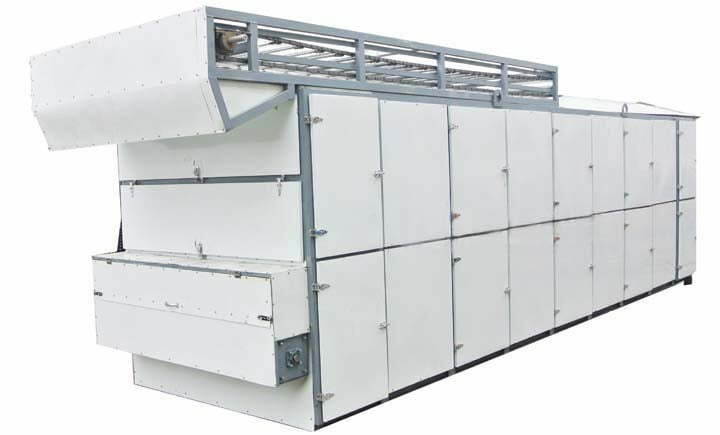
3. Vacuum Belt Dryer
Continuous drying of liquid or pasty extracts spread as a thin layer on a moving belt inside a vacuum chamber.
Strengths
- Continuous operation
- Very gentle thermal profile
- Suitable for viscous concentrates that are hard to atomise
- Low product temperature and limited oxygen exposure
4. Low-Temperature Spray Drying (with care)
Spray drying can be used for liquid extracts when the process is engineered for lower outlet temperatures, suitable carriers and short residence time. It is not inherently “low-temperature” but can be optimised for moderately sensitive botanicals.
5. Other Supporting Technologies
- Fluid-bed dryers for granulated or free-flowing botanical powders (final moisture adjustment)
- Freeze dryers for extremely heat-sensitive, high-value materials (higher cost, excellent retention)
The choice among these options is driven by feed rheology, batch size, required residual moisture/solvent, and the thermal sensitivity of the active constituents.
Critical Process Variables
| Variable | Why it matters | Practical control |
|---|---|---|
| Product temperature | Directly affects degradation rate of actives | Monitor product (not just shelf or gas) temperature; use vacuum to lower boiling point |
| Vacuum level | Determines boiling temperature of water/solvent | Match vacuum to the desired product temperature |
| Oxygen exposure | Causes oxidation of polyphenols and colour change | Closed systems, nitrogen blanketing where beneficial |
| Residence time | Cumulative thermal load | Optimise cycle time or belt speed; avoid over-drying |
| Residual solvent | Regulatory and stability requirement | Vacuum + appropriate condenser/recovery system |
| Final moisture | Affects flow, stability and downstream processing | Reliable endpoint determination |
Common Problems and Engineering Responses
| Problem | Typical causes | Practical response |
|---|---|---|
| Loss of marker assay or activity | Excessive product temperature or long exposure | Lower temperature via vacuum; shorten cycle; verify actual product temperature |
| Darkening / oxidation | Oxygen contact at elevated temperature | Closed vacuum system; optional inert gas |
| Sticky or hard crust | Surface drying too fast relative to internal diffusion | Improve mixing (paddle) or use thin-layer continuous vacuum belt |
| Residual solvent above limit | Incomplete evaporation or poor condenser performance | Optimise vacuum, temperature and condenser capacity |
| Agglomerates or poor flow | Uneven drying or hygroscopic behaviour | Controlled final moisture; possible post-milling or conditioning |
| Long cycle times | Overloaded trays or insufficient heat-transfer area | Optimise fill depth; consider agitated or continuous vacuum systems |
Key Data Required for Technical Assessment
- Exact botanical source and target marker compounds
- Feed form (liquid, concentrate, paste, wet cake)
- Solvent system (water, ethanol, other) and residual-solvent specification
- Target residual moisture
- Maximum allowable product temperature
- Batch size or required continuous capacity
- Sensitivity to oxygen or light
- Downstream process (milling, blending, encapsulation)
- Any GMP or regulatory expectations
Geographic Considerations & Market Evaluation
- India — Large and growing herbal, Ayurvedic and nutraceutical industry; strong demand for vacuum and low-temperature systems that protect actives for domestic and export markets.
- Europe & North America — Emphasis on documented process control, residual-solvent compliance and retention of standardised marker compounds.
- Southeast Asia & other botanical-rich regions — Expanding extract production; evaluation of cost-effective vacuum and low-temperature packages matched to local utilities.
GTI evaluates each project from the actual thermal sensitivity, feed form and residual-moisture/solvent targets rather than applying a single standard dryer.
How GTI Dryers Approaches Herbal Extract and Botanical Powder Drying
GTI Dryers designs low-temperature and vacuum drying systems for heat-sensitive herbal extracts, phytochemicals and nutraceutical ingredients. The engineering approach is:
- Identify the true thermal and oxidative sensitivity of the target constituents
- Match vacuum tray, vacuum paddle, vacuum belt or complementary technologies to the feed form
- Control product temperature and oxygen exposure
- Integrate solvent recovery and vapour handling where required
- Support process-data review and, where appropriate, laboratory or pilot evaluation
This focused page complements GTI’s existing herbal-extracts and nutraceutical drying content by concentrating on the low-temperature and vacuum options that matter most for quality-critical botanical materials.
Frequently Asked Questions
Why use vacuum for herbal extracts?
Under vacuum the boiling point of water and many solvents is reduced, allowing evaporation at lower product temperatures and thereby protecting heat-sensitive constituents.
What residual moisture is typically required?
It depends on the product and packaging, but many botanical powders and dry extracts target low single-digit residual moisture for stability and flow.
Can sticky concentrated extracts be dried under vacuum?
Yes. Vacuum paddle dryers and vacuum belt dryers are specifically suited to viscous or pasty feeds that are difficult to handle in conventional tray or spray systems.
Is spray drying suitable for heat-sensitive botanicals?
It can be used when the process is carefully engineered (lower temperatures, short residence time, suitable carriers). For highly sensitive materials, vacuum options are often preferred.
What information does GTI need for an assessment?
Feed form, solvent system, target residual moisture or solvent, maximum product temperature, capacity and any marker-compound retention requirements.
Contact the GTI Technical Team:
Website: gtidryers.com
Email: mktg@gtidryers.com
Phone / WhatsApp: +91 9330077417