Brazil’s bioenergy sector is expanding, driven by the Fuel of the Future Law (Lei do Combustível do Futuro), national biomethane blending mandates, and a massive agricultural waste stream. With a theoretical production capacity exceeding 85 billion $ of biogas per year, the nation holds one of the world’s largest potentials for renewable natural gas (RNG) and decarbonized thermal energy.
However, project developers, livestock cooperatives, sugar-energy conglomerates, and municipal operators face a critical operational bottleneck: the management of wet anaerobic digestate.
Exiting anaerobic biodigesters and solid-liquid separators at 80% to 90% moisture content, raw digestate is heavy, structurally unstable, and expensive to transport beyond a narrow radius around the processing plant. Un-dried digestate creates storage liabilities, risks nutrient leaching, and undergoes unwanted secondary anaerobic fermentation.
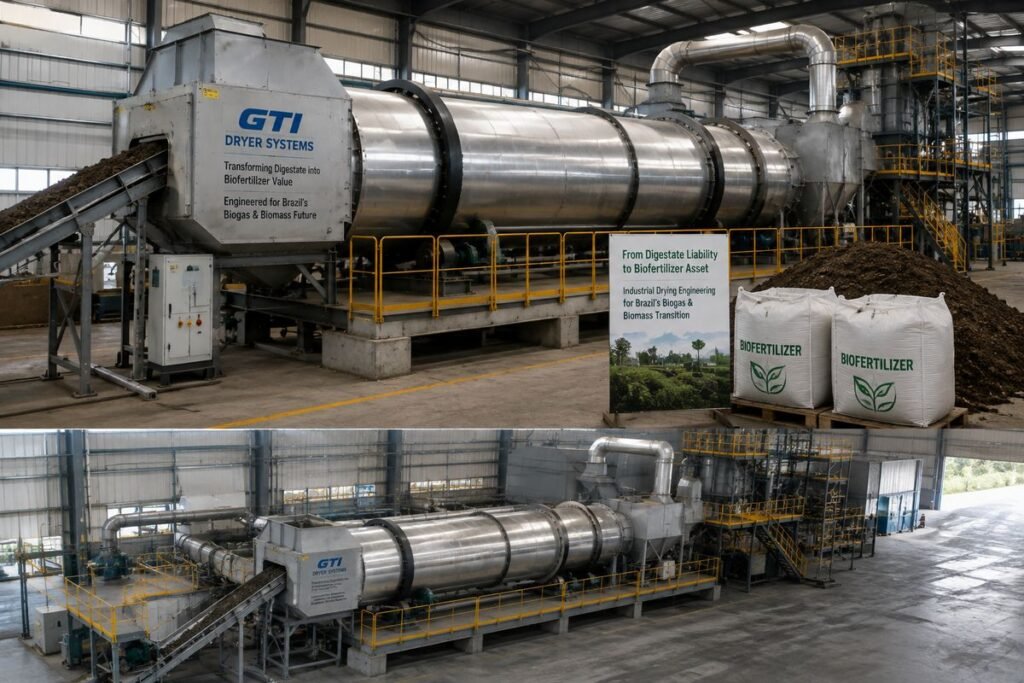
Converting this wet residue into a shelf-stable, granular, high-value organomineral biofertilizer (at 10%–15% moisture) solves this operational challenge. This transformation addresses a major macroeconomic challenge: Brazil currently imports over 80% of its chemical fertilizers. Removing water converts a costly waste handling stream into a transportable, revenue-generating agricultural asset.
As industry stakeholders assemble for the 13th Biogas Forum (Fórum do Biogás 2026) at the São Paulo Expo in São Paulo, Brazil (11th–12th August 2026)—organized by the Brazilian Biogas Association (ABiogás)—thermal drying and digestate valorization will take center stage.
Important Visitor Announcement: Genex Tech Industries LLP (GTI) local partners in Brazil and South America are attending the 13th Biogas Forum 2026 (11–12 August 2026, São Paulo Expo, SP, Brazil) as visitors only and are not exhibitors (no display booth). GTI’s technical representatives and regional partners will be present on-site across both event days to meet directly with biogas producers, organomineral fertilizer manufacturers, livestock cooperatives, sugar mill operators, biomass processors, project consultants, EPC contractors, distributors, and technology integrators. To explore industrial thermal drying systems or schedule an on-site technical discussion, visit the official GTI Main Platform or the specialized GTI Biomass & Palm Drying Systems or thehttps://gtidryers.com/digestate-drying-solutions/ platform.
Part 1: Industry Landscape, Event Context & GTI Thermal Processing Overview
Brazil Biogas Forum 2026: Event Overview & Strategic Context
The 13th Biogas Forum (Fórum do Biogás 2026) brings together renewable gas developers, agricultural leaders, equipment manufacturers, and policymakers to accelerate the decarbonization of Brazil’s energy and fertilizer matrices.
| Event Parameter | Technical Details |
| Event Name | 13th Biogas Forum (Fórum do Biogás 2026) |
| Organizer | Brazilian Biogas Association (ABiogás) |
| Dates | 11th – 12th August 2026 |
| Venue | São Paulo Expo, São Paulo, SP, Brazil |
| Core Themes | Biomethane (RNG), Anaerobic Digestate Upgrading, Organomineral Biofertilizers, Waste Heat Integration, Waste-to-Energy |
| GTI Participation Status | Visitor Only (GTI local partners are attending as visitors; no display booth) |
| GTI Core Technologies | Continuous band/apron/mesh belt dryers, indirect hollow paddle dryers, industrial rotary drum dryers, fluid bed dryers, pomace dryers, CHP waste heat recovery loops |
| Official Platforms | GTI Main Platform | GTI Biomass & Palm Drying Systems |
Macroeconomic Drivers: The Brazil Digestate-to-Fertilizer Economics
Brazil’s National Fertilizer Plan (Plano Nacional de Fertilizantes – PNF) seeks to reduce external dependency on nitrogen, phosphorus, and potassium (NPK) imports over the coming decades. Anaerobic digestate contains the primary, secondary, and micronutrients present in raw agricultural feedstocks.
When raw organic waste is processed through anaerobic digestion, volatile organic solids are converted into methane ($CH_4$) and carbon dioxide ($CO_2$), while the mineralized NPK nutrients remain in the digestate.
                               ┌──► Liquid Phase (1-3% TS) ──► Local Fertigation
Raw Organic Waste ──► Digester ┼──► Dewatered Digestate Cake ─► Moisture: 80-85% ──► GTI Thermal Dryer
 (Manure, Vinasse,                 (Centrifuge / Screw Press)                         │
  Filter Cake, POME)                                                                  ▼
                                                                            Organomineral Biofertilizer
                                                                             (< 10-12% Moisture / Granular)
- Volume & Mass Reduction: Evaporating water from 80% moisture down to 10% moisture reduces total bulk mass by approximately 78%, dramatically slashing freight and logisitical costs.
- Nutrient Stabilization: Thermal drying at controlled temperatures halts bacterial decay, eliminates pathogenic organisms (achieving Class A biosolid status), and preserves ammonium nitrogen ($NH_4^+-N$) and organic phosphorus.
- Granulation & Blending Capability: Dried digestate serves as a rich organic base that can be enriched with mineral salts to produce customized organomineral fertilizers tailored for soybean, corn, sugarcane, and coffee crops.
GTI Overview: Genex Tech Industries LLP
Genex Tech Industries LLP (GTI) is an international thermal processing engineering firm specializing in heavy-duty industrial dryers, indirect heat exchangers, material handling systems, and environmental safety equipment. GTI designs equipment on its main engineering platform to process challenging, high-moisture, sticky, or abrasive organic feedstocks.
By engineering indirect steam, thermal oil, hot water, and direct waste gas drying configurations, GTI enables bioenergy plants to capture unutilized thermal energy from combined heat and power (CHP) gas engines, boiler exhaust ducts, or process steam systems.
Why Meet GTI Local Partners at the Brazil Biogas Forum 2026?
Because GTI local partners in Brazil are attending the Brazil Biogas Forum 2026 (as well as PALMEX Thailand 2026 and POMREQ 2026) as visitors only, they offer direct, unbiased technical consultations across the venue without the demands of managing an exhibition booth. Meeting GTI delegates provides plant developers, cooperatives, and engineering firms with actionable technical insights:
- Mass & Energy Balance Calculations: Evaluate real-time evaporation requirements, steam/hot water consumption, and dryer sizing tailored to plant throughput.
- CHP Waste Heat Utilization: Formulate recovery strategies to capture 80°C–90°C engine jacket cooling water or 450°C engine exhaust gas to dry digestate at minimal operational fuel cost ($OPEX$).
- Sticky Phase Engineering Solutions: Solve mechanical plugging and wall fouling during the critical 40%–60% moisture transition zone.
- EPC & System Integrator Collaboration: Establish B2B partnerships for turnkey equipment supply, local fabrication integration, and regional project execution across Latin America and global markets.
Biogas & Digestate Drying Systems Overview
Drying organic sludge, digestate, and agricultural residues requires equipment engineered for sticky material behavior, temperature-sensitive nutrients, and variable particle sizes.
GTI’s Industrial Drying Solutions feature multi-zone temperature regulation, continuous mechanical agitation, automated moisture control feedback loops, and integrated fire suppression.
[Raw Dewatered Digestate] ──► [Continuous Feeder / Granulator] ──► [GTI Band / Paddle Dryer] ──► [Cyclone / Scrubber]
  (75% - 85% Moisture)                                               ▲ (CHP Waste Heat / Steam)  │
                                                                     └───────────────────────────┘
                                                                        [Dried Biofertilizer Pellets]
                                                                            (10% - 12% Moisture)
Featured Snippets: Key Thermal Processing Q&A
Why is drying digestate essential for Brazil’s biogas sector?
Dewatered digestate contains 80% water, making transport beyond 10–15 kilometers economically unviable. Thermal drying reduces total mass by ~78%, transforms a messy residue into a transportable commodity, and supports the Plano Nacional de Fertilizantes by replacing imported chemical NPK with domestic organomineral fertilizers.
Which dryer type is best for continuous digestate drying using CHP waste heat?
Continuous Band / Apron / Mesh Belt Dryers are ideal. They operate effectively with low-temperature waste heat (60°C–90°C hot water from CHP engine jackets), maintain a static material bed to minimize dust, offer multi-zone thermal control, and preserve volatile nitrogen compounds.
How does GTI handle sticky digestate and oily pomace during thermal drying?
GTI utilizes Indirect Hollow Paddle Dryers and specialized GTI Digestate Dryers equipped with intermeshing, self-cleaning dual shafts. The continuous wiping action breaks up sticky agglomerates, prevents wall-pasting, and maintains heat transfer rates.
Primary Applications of Industrial Thermal Drying
                       ┌──► Commercial Organomineral Fertilizer Pellets (Dried Digestate)
                       ├──► Boiler Co-Firing Biomass Fuel (Filter Cake, Bagasse, PPF, EFB)
Dried Biomass & Waste  ┼──► Protein-Rich Animal Feed Supplements (Dried Fruit & Citrus Pomace)
 (GTI Thermal Systems) ├──► Pyrolysis & Bio-Char Feedstock (Stabilized Solid Biomass)
                       └──► Class A Biosolids for Agricultural Land Application
Part 2: Comprehensive Industrial Dryer Portfolio
                           ┌──► Continuous Band / Apron / Mesh Belt Dryers (Highest Relevance for Digestate)
                           ├──► Indirect Hollow Paddle Dryers (Sticky digestate, sludge, decanter cake)
GTI Dryer Portfolio ───────┼──► Heavy-Duty Rotary Drum Dryers (High-volume bagasse, filter cake, EFB)
                           ├──► Vibratory Fluid Bed Dryers (Granular biofertilizer, bio-char, PKS)
                           ├──► Pneumatic Flash Dryers (Rapid surface moisture removal for fine biomass)
                           └──► Dedicated Pomace & Cake Dryers (Oily pomace, citrus pulp, spent grains)
1. Band / Apron / Mesh Belt Dryers (Primary Technology Focus)
Continuous Band (Apron/Mesh Belt) Dryers represent the most efficient and scalable technology for transforming wet digestate, sewage sludge, and organic residues into stable biofertilizer granules.
                    ┌────────────────────────────────────────────────────────┐
  Wet Digestate ──► │  [==================================================]  │ (Layer 1 Mesh Belt)
  Warm Air In   ──► │  [==================================================]  │ (Layer 2 Mesh Belt) ──► Exhaust Air
  (From CHP Heat)   │  [==================================================]  │ (Layer 3 Mesh Belt) ──► Dried Pellets Out
                    └────────────────────────────────────────────────────────┘
Mechanical & Thermal Architecture
The system consists of single or multi-tier perforated stainless steel wire mesh belts enclosed within an insulated drying tunnel. Dewatered digestate cake—often extruded or pre-formed into noodles/pellets—is distributed uniformly onto the top belt. Hot air is forced vertically through the porous material bed as it moves sequentially through multiple heating zones.
Key Operational Advantages for Brazilian Biogas Plants:
- Utilization of Low-Grade CHP Waste Heat: Efficiently operates using 70°C–90°C hot water derived directly from biogas engine cooling jackets, eliminating the need for fossil fuel burners.
- Preservation of NPK Nutrients: Operating at lower air temperatures (60°C–85°C) prevents the thermal volatilization of ammonium nitrogen ($NH_4^+-N$), keeping organic nitrogen bound within the fertilizer matrix.
- Low Dust Entrainment & High Structural Integrity: Because the material bed remains static relative to the moving belt, particle attrition is minimal, significantly reducing dust carryover and simplifying exhaust air filtration.
- Multi-Zone Moisture Control: Independent temperature and airflow control in each belt tier allows precise adjustment of final moisture levels (e.g., 10%–12%).
2. Indirect Hollow-Paddle Dryers
For sticky, pastelike, or high-moisture digestates and industrial sludges, GTI Indirect Hollow-Paddle Dryers deliver high heat transfer efficiency within a compact physical footprint.
Operating Mechanism
Dual parallel shafts fitted with intermeshing wedge-shaped hollow paddles rotate inside a jacketed trough. Heating media—such as saturated steam, thermal oil, or high-pressure hot water—circulates through both the outer jacket and the hollow paddle interiors.
- Conduction Heat Transfer: Material is heated directly through contact with hot metal surfaces, requiring minimal carrier gas flow through the dryer chamber.
- Self-Cleaning Mechanical Action: As the dual shafts counter-rotate, the wedge paddles wipe adjacent surfaces, breaking up sticky agglomerates during the 40%–60% moisture transition phase and preventing wall fouling.
- Emissions Reduction: Low airflow requirements reduce exhaust gas volume, simplifying condensation, odor abatement, and scrubbers.
3. Heavy-Duty Industrial Rotary Drum Dryers
For high-capacity agricultural biomass processing ($10 \text{ to } 50+ \text{ MTPH}$), GTI Rotary Drum Dryers provide robust, continuous moisture removal. Available in single-pass and triple-pass configurations, these systems process bulk materials including sugarcane bagasse, filter cake (torta de filtro), shredded EFB, and crop residues.
GTI rotary drums feature custom internal lifting flights designed to lift and shower biomass through a hot gas stream, maximizing convective heat transfer.
4. Vibratory Fluid Bed Dryers (VFBD)
GTI Vibratory Fluid Bed Dryers process granular materials, bio-char, and uniform organic pellets. Directional mechanical vibration combined with hot air forced through a perforated deck fluidizes particles, ensuring uniform residence time and drying.
5. Pneumatic Flash Dryers
GTI Flash Dryers offer rapid moisture removal for fine, homogeneous, or heat-sensitive agricultural fibers and starches. High-velocity hot air conveys material up a vertical drying duct, evaporating surface moisture within seconds.
6. Specialized GTI CBG Digestate Dryers
GTI CBG Digestate Dryers incorporate heavy-duty agitator shafts and indirect thermal heating jackets. The continuous mechanical wiping action prevents sugar caramelization and oil-coating build-up on interior heating surfaces, turning raw pomace into a stable animal feed supplement or solid bio-fuel base.
Comparative Dryer Selection Matrix
| Dryer Technology | Compatible Substrates | Primary Heat Source | Thermal Efficiency | Key Advantage for Biogas/Biomass Plants |
| Band / Apron / Mesh Belt Dryer | Dewatered digestate, extruded pellets, sewage sludge | CHP Jacket Hot Water (80°C–90°C), Waste Steam | High | Operates on low-temp waste heat; preserves NPK; minimal dust |
| Indirect Hollow Paddle Dryer | Sticky digestate, centrifuge cake, municipal sludge, wet pomace | Saturated Steam, Thermal Oil, Hot Water | Very High | Self-cleaning paddles eliminate caking; compact footprint |
| Rotary Drum Dryer | Sugarcane filter cake, bagasse, shredded EFB, PPF, wood chips | Boiler Flue Gas, CHP Exhaust, Hot Air Burner | Medium-High | Large capacity ($>20 \text{ MTPH}$); handles high bulk density variations |
| Vibratory Fluid Bed Dryer | Granular digestate pellets, bio-char, palm kernel shells | Hot Air via Steam Heat Exchanger | High | Precise moisture control; gentle handling prevents pellet breakage |
| Pneumatic Flash Dryer | Fine starch residues, sawdust, pulverized agricultural fiber | Direct Gas / Oil Fired Air Heater, High-Temp Flue Gas | Medium | Rapid drying (seconds); low initial capital cost ($CAPEX$) |
| GTI Pomace Dryer | Wet citrus pulp, palm pomace, olive pomace, spent grains | Indirect Steam, Thermal Oil, Hot Air | High | High-torque agitators prevent sticky sugar/oil wall fouling |
Part 3: Digestate Valorization, Heat Recovery & Engineering Principles
Strategic Sector Applications in Brazil
                       ┌──► Livestock (Swine, Cattle, Poultry Digestate in South Region)
                       ├──► Sugar-Energy (Sugarcane Vinasse Solids & Filter Cake / Torta de Filtro)
Key Sectors in Brazil  ┼──► Agro-Industry & Slaughterhouses (Meat Processing Sludge / Residues)
 (GTI Thermal Systems) ├──► Sanitation & Municipal Waste (Sewage Sludge / Class A Biosolids)
                       └──► Organomineral Fertilizer Commercialization (NPK Enriched Pellets)
1. Livestock Sector (Swine, Cattle & Poultry in SC, PR, RS)
Southern Brazil (Santa Catarina, Paraná, Rio Grande do Sul) hosts a high concentration of intensive swine and poultry farming. Anaerobic digesters process massive volumes of manure, yielding nutrient-rich digestate. GTI Band and Paddle Dryers transform this wet digestate into compact organomineral biofertilizer pellets, allowing agricultural cooperatives to distribute surplus nutrients out of saturated watersheds to grain-producing regions.
2. Sugar-Energy Sector (Sucroenergético)
Brazil’s sugarcane mills generate massive quantities of vinasse and filter cake (torta de filtro). Concentrated vinasse solids and filter cake carry 65%–75% moisture. Thermal drying using boiler flue gas or low-pressure process steam converts these residues into a concentrated potassium and phosphorus biofertilizer, reducing field application hauling costs.
3. Agro-Industry & Slaughterhouses (e.g., Meat Processors)
Industrial slaughterhouses and food processing plants produce oily organic sludges from dissolved air flotation (DAF) and biological wastewater treatment. GTI Indirect Paddle and Pomace Dryers process these sticky bio-solids into nutrient-dense soil amendments or industrial fuel feeds.
4. Sanitation & Municipal Urban Waste
Municipal wastewater treatment plants across Brazil are increasingly turning to anaerobic digestion. Drying dewatered sewage sludge from 80% to <10% moisture produces pathogen-free Class A biosolids suitable for agricultural forestry and land reclamation, supporting Zero Liquid Discharge (ZLD) operational mandates.
Heat Recovery & Utility Energy Efficiency Integration
Evaporating water requires significant thermal energy ($\approx 2,260 \text{ kJ/kg}$ of water evaporated). To achieve long-term profitability, GTI drying systems integrate directly with available waste heat loops:
[Biogas CHP Engine Exhaust (450°C)] ──┐
[Engine Jacket Hot Water (85°C)]    ──┼──► [GTI Waste Heat Exchanger] ──► [GTI Band / Paddle Dryer]
[Boiler Exhaust Flue Gas (180°C)]   ──┘
By tapping 85°C cooling water or 450°C exhaust gas from a 1 MW to 10 MW biogas generator, a facility can dry its entire digestate output without burning additional natural gas or grid power.
Thermodynamic Engineering Calculations & Mass Balances
Industrial thermal drying design is governed by strict heat and mass transfer equations.
Total Thermal Energy Input Duty
The total heat required accounts for sensible heating of moisture and dry solids, latent heat of vaporization, and system thermal losses:
+-----------------------------------------------------------------------------------+
|              DIGESTATE & AGRO-BIOMASS MASS BALANCE SPECIFICATIONS                 |
+-------------------+-----------------+-------------------+-------------------------+
| Substrate Feed    | Inlet Moisture %| Output Moisture % | Water Evaporated / Ton  |
+-------------------+-----------------+-------------------+-------------------------+
| Swine Digestate   | 80% – 88%       | 10% – 12%         | 775 – 860 kg            |
| Cattle Digestate  | 82% – 88%       | 10% – 12%         | 800 – 860 kg            |
| Filter Cake (*Torta*)| 65% – 75%      | 10% – 12%         | 610 – 720 kg            |
| POME Sludge Cake  | 80% – 85%       | 10% – 12%         | 770 – 830 kg            |
| Fruit/Citrus Pomace| 60% – 70%      | 10% – 12%         | 550 – 660 kg            |
| Shredded EFB Fibre| 60% – 68%       | 10% – 12%         | 550 – 640 kg            |
+-------------------+-----------------+-------------------+-------------------------+
Automation, Exhaust Gas Recirculation & Fire Safety
GTI drying systems integrate advanced process controls to ensure consistent, safe operation:
- Exhaust Gas Recirculation (EGR): Recirculates warm, unsaturated exhaust air back into the primary heating chamber, conserving thermal energy and keeping oxygen concentrations below combustion thresholds.
- Automated Feed Modulation: Adjusts feeder speed dynamically based on continuous exhaust air temperature and microwave/infrared moisture sensor readings.
- Spark Detection & Automatic Misting: Optical sensors detect glowing particles in real-time, activating high-pressure water fogging systems in milliseconds to prevent fire hazards.
Part 4: Turnkey Solutions, Global Markets, FAQs & Call to Action
Turnkey Biogas Dehydration & Digestate Upgrading Solutions
GTI delivers complete process engineering packages, taking material from initial solid-liquid separation through final biofertilizer packaging:
[Decanter Centrifuge / Screw Press] ──► [GTI Pre-Feeder / Granulator] ──► [GTI Continuous Dryer]
                                                                                │
[Bulk Bagging / Storage Silos]     ◄── [Granule Cooling & Screening] ◄──────────┘
Target Industries
GTI thermal drying solutions support a wide range of industrial sectors:
- Biogas & Biomethane (RNG) Plants: Digestate drying, volume reduction, and biofertilizer pelletization.
- Organomineral Fertilizer Manufacturers: Upgrading organic sludges with NPK mineral fortification.
- Sugar & Ethanol Mills (Usinas): Drying filter cake (torta de filtro), vinasse solids, and bagasse.
- Palm Oil Mills & Refineries: Drying EFB, PPF, PKS, decanter cake, and palm pomace (supported via GTI Palm Systems).
- Agro-Industrial Food Processors: Thermal processing for fruit pomace, citrus pulp, spent grains, and slaughterhouse sludge.
Global Market Delivery Capabilities
Genex Tech Industries LLP fabricates equipment in compliance with international engineering standards (ASME, CE, ISO). GTI serves major agricultural and industrial regions worldwide:
- Latin America: Brazil, Colombia, Argentina, Mexico, Guatemala, Chile, Ecuador.
- Southeast Asia: Malaysia, Indonesia, Thailand, Vietnam, Philippines.
- South Asia & Middle East: India, Sri Lanka, UAE, Saudi Arabia.
- Africa & Europe: Nigeria, Ivory Coast, Ghana, Kenya, Spain, Italy.
GTI Global Footprint ──► Latin America | Southeast Asia | South Asia | Africa | Europe
Why Choose Genex Tech Industries LLP (GTI)?
- Heavy-Gauge Engineering Construction: Built with thick carbon steel or stainless steel alloys designed for continuous ($24/7$) industrial operation.
- Custom Thermal Integration: Engineered to operate on waste heat sources—including engine jacket water, exhaust gas, boiler flue gas, and process steam—minimizing operational costs.
- Anti-Caking Agitator Designs: Specialized paddle and flight geometries prevent wall pasting and clogging during sticky material transitions.
- Integrated Safety Controls: Built-in spark detection, explosion relief panels, and oxygen monitoring protect processing facilities.
Frequently Asked Questions (FAQs)
1. Will GTI local partners operate an exhibition booth at the Brazil Biogas Forum 2026?
No. Genex Tech Industries LLP (GTI) local partners in Brazil are attending the 13th Biogas Forum 2026 as visitors only. GTI technical specialists will be present on-site across both days at the São Paulo Expo to conduct direct B2B meetings and project consultations.
2. How can I schedule an on-site technical meeting with GTI local partners during the event?
You can reserve a meeting time by emailing mktg@gtidryers.com, messaging via WhatsApp at +91-9330077417, or submitting a request through the official GTI Website.
3. How does GTI drying technology preserve nitrogen in digestate biofertilizers?
GTI Multi-Tier Band Dryers use low-temperature hot water loops (60°C–85°C) from CHP engines. Keeping process temperatures controlled prevents thermal decomposition and volatilization of ammonium nitrogen binding organic nitrogen within the dried fertilizer matrix.
4. Can GTI dryers handle sticky sugarcane filter cake (torta de filtro) or oily pomace?
Yes. GTI Indirect Hollow-Paddle Dryers and dedicated GTI Pomace Dryers feature dual-shaft intermeshing agitators that continuously wipe internal heating walls, preventing sugar caramelization and material caking.
5. What transport savings result from drying digestate from 80% down to 10% moisture?
Drying reduces total digestate mass by approximately 78%. A plant producing 100 tons of wet cake daily reduces its output to just 22 tons of dry biofertilizer, dramatically lowering freight, handling, and storage costs.
Multilingual Keyword Index
| Language / Region | Key Technical Search Terms |
| Portuguese (Brasil) | Secador de digestato, secador de biogás, secador de esteira, secador de torta de filtro, secador de vinhaça, adubo organomineral, Fórum do Biogás 2026 São Paulo, Lei do Combustível do Futuro. |
| Spanish (LatAm) | Secador de digestato de biogás, secador de banda, secador de orujo, biofertilizante organomineral, aprovechamiento de calor residual, secado de lodos. |
| English (Global) | Biogas digestate dryer, continuous band dryer, hollow paddle dryer, organomineral biofertilizer, CHP waste heat recovery, fruit pomace dryer, GTI dryers. |
| Bahasa Malaysia / Indo | Mesin pengering kelapa sawit, pengering ampas sawit, pengering janjang kosong (EFB), pengering lumpur POME, pengering pomace. |
Connect with GTI Local Partners at the Brazil Biogas Forum 2026
Are you attending the 13th Biogas Forum (Fórum do Biogás 2026) at the São Paulo Expo in São Paulo, Brazil (11th–12th August 2026)?
Whether you are a biogas plant developer evaluating digestate drying, a livestock cooperative looking to produce commercial organomineral fertilizers, a sugar mill engineer addressing filter cake processing, or an EPC contractor seeking waste heat recovery integration, Genex Tech Industries LLP (GTI) invites you to meet with our regional technical team during the conference.
Plan Your Technical Session:
- Explore Our Main Platform: GTI Main Engineering Portal
- Explore Biomass Processing Systems: GTI Biomass & Palm Drying Systems and https://gtidryers.com/digestate-drying-solutions/
- Pre-Book an On-Site Session in São Paulo: Email mktg@gtidryers.com or message via WhatsApp at +91-9330077417 to reserve a discussion with GTI technical representatives during the forum.
- Request a Custom Mass & Heat Balance Evaluation: Share your wet feed capacity, inlet moisture, target final moisture, and available thermal utilities (CHP hot water, exhaust gas, or steam) for a tailored system proposal.