
Crystalline xanthine and related fine-chemical solids are typically dried after crystallisation and solid–liquid separation. The dryer must hit residual moisture (and residual solvent, where relevant) without degrading the crystal, creating excess fines or violating temperature limits.
Buyers usually shortlist:
- Fluid bed dryers (atmospheric or conditioned gas) for free-flowing crystals
- Vacuum paddle dryers for agitated contact drying under vacuum
- Rotary cone vacuum dryers (RCVD / RCVD-type) for gentle tumbling vacuum batch drying
This guide explains when each fits crystalline xanthine-type duties and how to specify the system.
Quick answer: If crystals fluidise cleanly and residual solvent can be managed at allowable product temperature with gas flow, a fluid bed is often efficient. If the product is heat-sensitive, holds solvent that needs vacuum-assisted removal, or requires closed, low-oxygen / contained drying, vacuum paddle or rotary cone vacuum dryers are the stronger shortlist.
1. What “Drying Crystalline Xanthine” Really Requires
| Requirement | Why it matters |
|---|---|
| Target residual moisture | Stability, downstream processing, specification |
| Residual solvent limits | Pharma/fine-chemical release criteria where solvents are used |
| Maximum product temperature | Protect crystal quality and impurities profile |
| Particle integrity | Avoid over-attrition of crystals |
| Cleanability / containment | Cross-contamination and operator exposure control |
| Batch identity | Traceability for regulated or high-value products |
Xanthine is treated here as a crystalline organic solid model: always validate limits with your grade’s specifications and safety data.
2. Fluid Bed Dryers for Crystalline Xanthine
How they fit
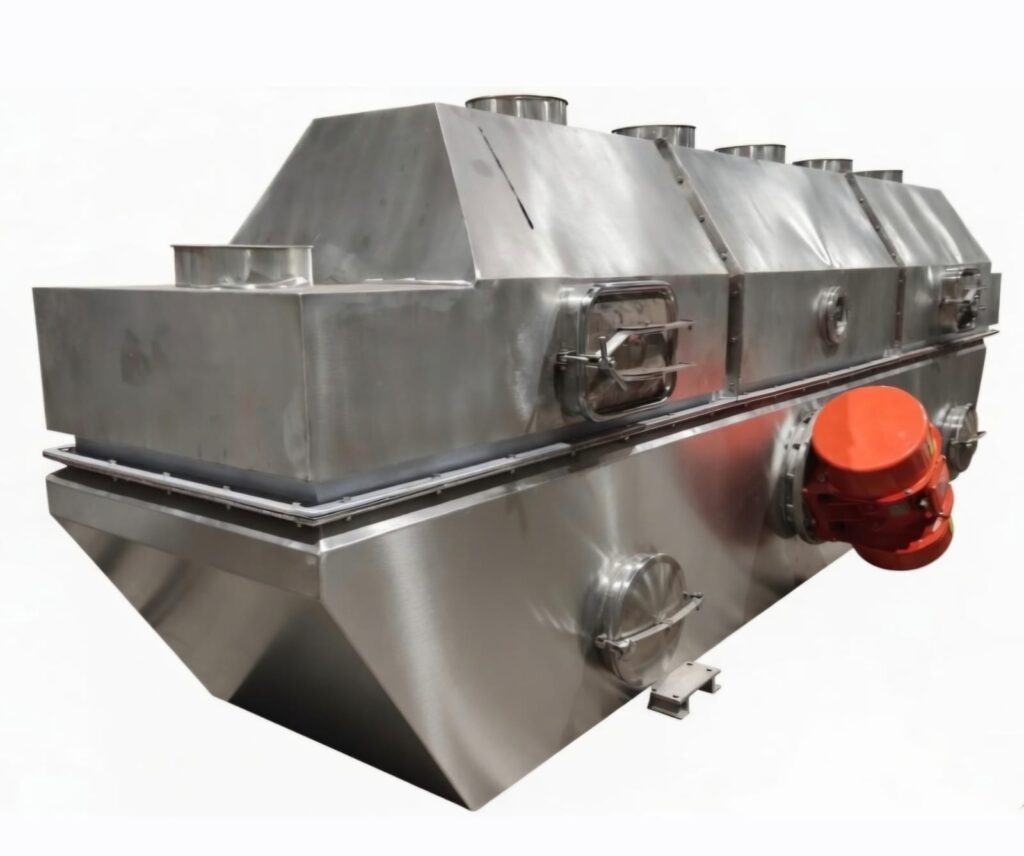
A fluid bed suspends crystals in upward gas flow so each particle contacts drying gas. Heat and mass transfer are high when the bed fluidises uniformly.
Best when
- Crystals are free-flowing with a suitable size range
- Stickiness is low across the moisture trajectory
- Atmospheric or conditioned-gas drying meets residual solvent/moisture specs
- Continuous or semi-continuous capacity is needed
Limits and risks
| Risk | Mitigation |
|---|---|
| Channeling / poor fluidization | Particle characterisation; vibration assistance (VFBD) if borderline |
| Attrition and fines | Lower velocity; shorter aggressive phase; gentler distributor design |
| Residual solvent not meeting limit | May need lower temperature + longer time, inert gas, or switch to vacuum |
| Thermal stress | Control inlet gas and product temperature; staged profiles |
Vibratory fluid bed (VFBD) variants help mildly cohesive crystals by combining air flow with mechanical vibration — useful when static fluid beds channel.
3. Vacuum Paddle Dryers
How they fit
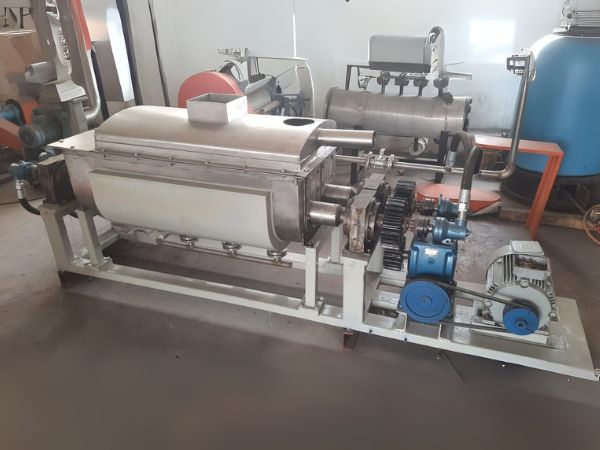
A jacketed trough with heated agitator paddles dries solids by contact heat under vacuum. Lower pressure reduces boiling temperature of water/solvents; agitation renews the contact surface.
Best when
- Product is heat-sensitive relative to atmospheric drying time
- Solvent removal benefits from vacuum and condensation recovery
- Feed is crystalline but can be mildly cohesive when wet
- Closed system and low gas volume are preferred
Limits and risks
| Risk | Mitigation |
|---|---|
| High torque when sticky | Correct fill, paddle design, staged vacuum/temperature |
| Crystal breakage from agitation | Optimise speed; compare with gentler RCVD |
| Long cycle if heat transfer is limited | Adequate jacket area; realistic batch size |
| Cleaning complexity | Hygienic design, access, validated CIP/WIP where required |
4. Rotary Cone Vacuum Dryers (RCVD)
How they fit
A rotating double-cone jacketed vessel tumbles the batch under vacuum while the shell is heated. Mixing is gentler than many paddle geometries; widely used for pharma powders and crystals.
Best when
- Gentle blending + vacuum drying is required
- Batch integrity and contained operation matter
- Product should not see intense shear
- Moderate batch sizes fit plant planning
Limits and risks
| Risk | Mitigation |
|---|---|
| Limited throughput vs continuous fluid bed | Multiple units or scheduling; or continuous alternative if validated |
| Poor mixing if fill level wrong | Respect design fill range |
| Solvent recovery design | Proper condenser/vacuum skid sizing |
| Cycle time | Validated temperature/vacuum recipe — do not rush with excess heat |
5. Side-by-Side Comparison for Buyers
| Criterion | Fluid bed | Vacuum paddle | Rotary cone vacuum |
|---|---|---|---|
| Typical operation | Continuous or batch FB | Batch (some continuous contact designs exist) | Batch |
| Heat mode | Convective gas | Contact + vacuum | Contact + vacuum |
| Best crystal state | Free-flowing | Wet-to-dry crystals, some cohesion | Free-flowing to moderately cohesive |
| Solvent removal | Possible with gas/inert; vacuum FB is specialised | Strong fit | Strong fit |
| Shear | Gas + particle collisions | Agitator shear | Generally lower shear tumble |
| Containment | Needs careful dust design | Inherently closed | Inherently closed |
| Scale-up style | Gas velocity, bed depth, residence | Area, torque, vacuum recipe | Geometry, fill, rpm, vacuum recipe |
6. Decision Guide for Crystalline Xanthine
| Situation | Lean toward |
|---|---|
| Free-flowing crystals, moisture-only, good temp margin | Fluid bed / VFBD |
| Residual solvent hard to strip at safe atmospheric temperature | Vacuum paddle or RCVD |
| Minimum crystal breakage required | RCVD (or very gentle FB settings) |
| Sticky intermediate moisture phase | Vacuum paddle (agitation) or pre-condition feed |
| High continuous tonnage, stable crystals | Fluid bed |
| Pharma-style batch documentation and containment | RCVD or vacuum paddle |
7. Critical Specification Items (Do Not Skip)
- Maximum product temperature
- Residual moisture target and method
- Residual solvent list and limits (if any)
- Crystal size distribution and breakage allowance
- Batch size or continuous kg/h
- Need for inerting (nitrogen)
- Vacuum level capability (for vacuum dryers)
- Materials of construction and surface finish
- Cleaning / containment / operator exposure requirements
- Solvent recovery and emission controls
8. Common Problems and Fixes
| Problem | Likely cause | Direction |
|---|---|---|
| Residual solvent high | Insufficient vacuum/time or wrong temperature | Vacuum recipe; condenser capacity |
| Crystal attrition | High gas velocity or aggressive agitation | Gentler FB settings or RCVD |
| Lumping in FB | Cohesive phase, poor fluidization | VFBD, back-mix, or vacuum contact route |
| Long vacuum cycles | Overfill, low jacket ΔT, poor vacuum | Batch size and utilities review |
| Cross-contamination | Poor cleanability | Hygienic design, validated cleaning |
9. How GTI Dryers Supports Xanthine-Type Duties
GTI Dryers supplies continuous and engineered drying systems including fluid bed / VFBD and contact / paddle-type approaches for chemicals and heat-sensitive solids. For crystalline organic products such as xanthine-type materials we:
- Start from temperature, solvent and crystal integrity limits
- Compare atmospheric fluid-bed feasibility vs vacuum contact needs
- Recommend pilot trials when solvent or stickiness behaviour is uncertain
- Document assumptions on capacity, residual moisture and utilities
Where a specialised pharma rotary cone vacuum dryer package is mandatory, GTI can help frame the process requirements and drying-stage integration even if part of the line is sourced as dedicated pharma equipment.
Geographic Note
Crystalline fine chemicals and pharma intermediates are dried in India, Europe, China and other regulated markets. Validation expectations differ by market, but the engineering choice — fluid bed vs vacuum contact — follows the same physics: particle behaviour, solvent, and allowable product temperature.
Frequently Asked Questions
Can crystalline xanthine be dried in a fluid bed?
Yes when crystals fluidise and residual moisture/solvent targets are achievable within the allowed product temperature. Confirm with particle data and trials.
When do we need a vacuum paddle or RCVD?
When vacuum-assisted solvent removal, lower product temperature, closed processing or gentler handling is required.
What is the difference between vacuum paddle and rotary cone vacuum dryers?
Paddle dryers use agitated contact surfaces; rotary cone dryers tumble the batch in a rotating jacketed cone — typically lower shear, batch-oriented.
What residual moisture should we target?
Use your product specification and analytical method. Include solvent limits if crystallisation used organic solvents.
What should I send GTI?
Crystal size, wet cake/crystal moisture, residual solvent list, max product temperature, batch or continuous capacity, and cleaning/containment needs.
Next Step
If you are selecting a dryer for crystalline xanthine, share your solvent, temperature and particle constraints. GTI will help evaluate fluid bed / VFBD versus vacuum paddle (and RCVD-style vacuum batch requirements) on process data rather than a single default machine.
Request a crystalline xanthine drying assessment with your process data.
Contact the GTI Technical Team:
Website: gtidryers.com
Email: mktg@gtidryers.com
Phone / WhatsApp: +91 9330077417