
In a granulated urea plant, product quality is not finished at the granulator. Granules are often still warm and may carry residual moisture that causes caking, dusting and handling problems in storage and bagging. A fluid bed cooler/conditioner — sometimes with auxiliary drying — stabilises temperature and moisture before screening, coating and storage.
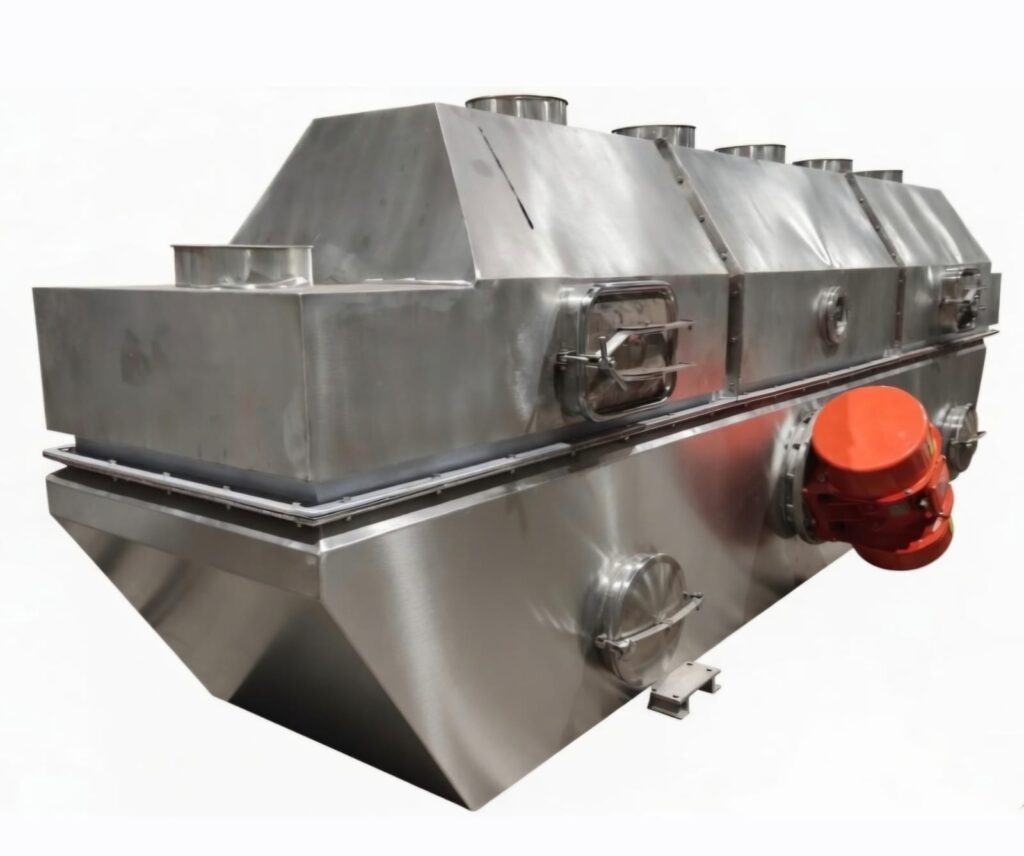
This page explains what the unit does, when auxiliary drying is required, how to specify it, and what buyers should check when selecting equipment.
Quick answer: A fluid bed cooler for granulated urea fluidises granules in controlled air to reduce product temperature for storage and packaging. If residual moisture is still above specification, the same machine (or a dedicated zone) provides light after-drying. Conditioning may include residence time and air humidity control to improve handling before anti-caking treatment.
1. Where the Cooler/Conditioner Sits in the Urea Line
Typical granulated urea path:
Text
Granulation → Primary drying (if used) → Screening
        ↓
Fluid bed cooler / conditioner (± auxiliary drying)
        ↓
Final screen → Coating / anti-caking → Storage / bagging
Exact arrangement varies by process (e.g. drum granulation, fluidised granulation systems), but the cooler duty remains: deliver granules at a safe temperature and moisture for downstream handling.
2. What the Fluid Bed Cooler/Conditioner Must Achieve
| Duty | Why it matters for urea |
|---|---|
| Lower product temperature | Hot urea cakes more readily in bins and bags |
| Uniform temperature | Avoids hot cores that cake later |
| Auxiliary (finish) drying | Polish residual moisture to specification when primary dryer leaves a gap |
| Controlled attrition | Limit dust generation while fluidising |
| Stable feed to coating | Better anti-caking distribution on cooler granules |
| Continuous capacity | Match granulation train peak rate |
3. Cooling vs Conditioning vs Auxiliary Drying
| Term | Meaning in urea service |
|---|---|
| Cooling | Remove sensible heat — drop granule temperature with air |
| Auxiliary drying | Remove a small remaining moisture load after main drying |
| Conditioning | Controlled hold at defined temperature/humidity/residence to stabilise granule surface and handling behaviour before coating or storage |
Many plants combine cooling and light after-drying in one fluid bed with zoned airflow and temperature. Conditioning parameters should follow your process recipe — not a generic “standard urea” setting copied from another site without validation.
4. Why Fluid Bed Technology Fits Granulated Urea
Fluid beds provide:
- High gas–solid contact for fast, even cooling
- Adjustable residence time via bed length/weirs and feed rate
- Ability to stage warm dry air then cooler air in successive zones
- Continuous industrial capacity matching fertilizer tonnages
Vibratory fluid beds may be considered when gentler conveying or specific particle ranges are needed; conventional fluid beds are common for robust urea granules when fluidization is clean.
5. Critical Design and Operating Variables
| Variable | Effect |
|---|---|
| Inlet air temperature (by zone) | Cooling duty vs residual drying duty |
| Airflow / fluidization velocity | Mixing and heat transfer vs dust elutriation |
| Bed depth and residence time | Final temperature and moisture uniformity |
| Inlet air humidity | Especially important in humid climates for both drying and re-wetting risk |
| Granule size distribution | Fines fluidise and elutriate differently from coarse product |
| Feed temperature from upstream | Sizes the cooler’s heat-removal load |
Ambient design conditions matter: a cooler that works in dry season may struggle if air is not properly conditioned in monsoon conditions.
6. Problem–Solution Map for Urea Plants
| Problem | Likely cause | Direction |
|---|---|---|
| Caking in silo / bags | Product too hot and/or moisture high | Increase cooling; verify auxiliary drying; review coating |
| Moisture above spec at packing | Primary dryer shortfall; wet air in cooler | Auxiliary drying zone; check air dehumidification needs |
| Excess dust after cooler | Velocity too high; weak screening of fines | Optimise fluidization; improve dedusting |
| Uneven granule temperature | Poor distribution, short-circuiting, unstable feed | Plate design, weirs, steady feed rate |
| Capacity bottleneck at cooler | Sized on average, not peak granulation rate | Redesign on peak t/h and peak feed temperature |
| Re-wetting in cooler | Humid inlet air, over-long contact | Air conditioning; shorter cool zone strategy |
7. Integration with Anti-Caking and Coating
Cooling and conditioning improve the effectiveness of anti-caking agents and coatings:
- Coating onto hot, moist granules can give uneven films and later caking
- Coating onto over-cooled, dusty granules can waste additive and still leave fines
Specify the target temperature window at coating in the cooler RFQ, not only “cool as much as possible.”
8. What Buyers Should Specify (RFQ Checklist)
- Granulated urea capacity — continuous and peak (t/h)
- Product size range (e.g. on-size cut after screens)
- Inlet product temperature range from upstream dryer/granulator
- Target outlet product temperature
- Inlet and target residual moisture (if auxiliary drying is required)
- Ambient design conditions (dry bulb / humidity)
- Need for zoned drying + cooling
- Dust emission limits and dedusting scope
- Layout: after which screen, before which coating system
- Materials of construction and cleaning access
- Utilities: fans, possible air heating/cooling/dehumidification
9. Scope Definition — Avoid Missing Packages
| Item | Include in discussion |
|---|---|
| Fluid bed body and distributor | Core machine |
| Fans and ducts | Pressure balance with dust system |
| Dedusting (cyclone/bag filter) | Yield and emissions |
| Air heating for auxiliary drying zone | If finish drying required |
| Air cooling / dehumidification | Climate-dependent |
| Instrumentation | Product temp, air temp, ΔP |
| Controls interlocks | Feed stop on high temperature/moisture policy |
A “cooler” quote without air-handling and dedusting clarity is incomplete for fertilizer duty.
10. How GTI Dryers Supports Urea Cooler/Conditioner Projects
GTI Dryers designs fluid bed and vibratory fluid bed systems for continuous solids cooling, conditioning and finish drying duties in chemical and fertilizer-related applications.
For granulated urea projects we focus on:
- Heat-removal and optional auxiliary drying from your real inlet temperature/moisture
- Zone arrangement for cool vs light-dry duties
- Dust control and integration with screening/coating
- Capacity basis on peak granulation rate
- Clear assumptions for ambient conditions
Geographic Note
Granulated urea plants in India, Middle East, Africa and other fertilizer regions face different ambient humidity and cooling-water/air constraints. Cooler performance must be guaranteed against stated ambient design points. Local service support is valuable for continuous fertilizer operations.
Frequently Asked Questions
What is a fluid bed cooler for granulated urea?
A continuous unit that fluidises urea granules in controlled air to reduce product temperature — and optionally polish residual moisture — before coating and storage.
Is auxiliary drying always required?
Only if product leaving the primary dryer is still above moisture specification. Many coolers are designed with a small drying capability for margin.
Can the cooler replace the main urea dryer?
No. It is a finish and temperature-stabilisation stage, not the primary evaporation unit for wet granules from granulation.
Why do we still get caking after installing a cooler?
Possible causes: outlet temperature still high, moisture variation, coating issues, or humid storage air. Check the whole chain, not only the cooler nameplate.
What should I send GTI?
t/h capacity, inlet product temperature and moisture, target outlet temperature and moisture, granule size, ambient design conditions and layout constraints.
Next Step
If you are specifying a fluid bed cooler/conditioner for granulated urea with or without auxiliary drying, share your granulation rate and product temperature/moisture targets. GTI will help define a zoned cooling and finish-drying concept matched to your line.
Request a granulated urea fluid bed cooler/conditioner assessment with your process data.
Contact the GTI Technical Team:
Website: gtidryers.com
Email: mktg@gtidryers.com
Phone / WhatsApp: +91 9330077417