
Industrial drying is energy-intensive. For many plants in food, chemical, mineral, sludge and agro processing, the dryer is among the largest consumers of fuel or steam. Improving dryer efficiency therefore cuts operating cost and supports India’s green manufacturing goals — lower specific energy use, better fuel flexibility and reduced emissions intensity per tonne of product.
This page is a practical buyer guide: what drives dryer energy use, which measures deliver results, how technology choice fits sustainability targets, and what to demand from manufacturers.
Quick answer: Energy-efficient drying starts with residual-moisture discipline and correct technology for the feed, then adds multi-zone control, heat recovery and appropriate heat sources (including biomass or waste heat where viable). Sustainability is measured in kJ or kWh per kg of water evaporated and in reliable operation — not in slogans.
1. Why Dryer Energy Matters for Green Manufacturing in India
| Link to green manufacturing | What it means on the shop floor |
|---|---|
| Lower specific energy | Less fuel or power per kg water removed |
| Fuel flexibility | Ability to use steam, gas, biomass or waste heat where available |
| Emission intensity | Less combustion per unit product when efficiency rises |
| Resource efficiency | Less over-drying, less rework, less waste heat dumped |
| Competitiveness | Energy cost is a direct margin lever for export and domestic markets |
India’s manufacturing policy direction increasingly rewards efficiency, cleaner fuels and measurable improvement. Dryers are a concrete place to act because the physics are clear: evaporating water requires energy, and every avoidable inefficiency multiplies fuel use.
2. Energy Hierarchy for Industrial Dryers (What to Do First)
| Priority | Lever | Sustainability effect |
|---|---|---|
| 1 | Stop over-drying — enforce real residual-moisture targets | Immediate cut in evaporation load and fuel |
| 2 | Match technology to feed form | Avoids re-slurry, clogging and chronic inefficiency |
| 3 | Multi-zone temperature & airflow control | Less thermal damage, better use of heat |
| 4 | Insulation, sealing, stable feed | Reduces losses and “safety margin” over-firing |
| 5 | Heat recovery from exhaust | Reuses energy that would be wasted |
| 6 | Heat source choice (biomass, waste heat, efficient steam, heat pump where suited) | Lowers carbon and/or cost intensity of the heat supplied |
| 7 | Hybrid or staged systems | Uses expensive energy only where needed |
Capital projects deliver more when the process is already under control.
3. How Different Dryer Families Support Efficiency Goals
| Dryer family | Efficiency-relevant traits | Best sustainability fit when |
|---|---|---|
| Band / mesh-belt | Multi-zone profiling, recirculation, optional recovery | Pieces, flakes, spices, foods needing gentle controlled drying |
| Fluid bed / VFBD | High heat transfer if fluidization is stable | Free-flowing granules with clean fluidization |
| Rotary | High tonnage; efficiency depends on seals, flights, co-/counter-current design | Robust biomass, minerals, bulk solids |
| Flash / spin-flash | Short residence; good for cakes without re-slurry | Sticky filter cakes (avoids evaporating extra water) |
| Spray | Efficient only if feed solids are maximised | True pumpable liquids/slurries |
| Heat pump assisted | Recovers latent heat at low/moderate temperature | Heat-sensitive products within temperature limits |
| Contact / paddle | Low carrier-gas volume; good for solvents | Pastes, cakes, solvent recovery duties |
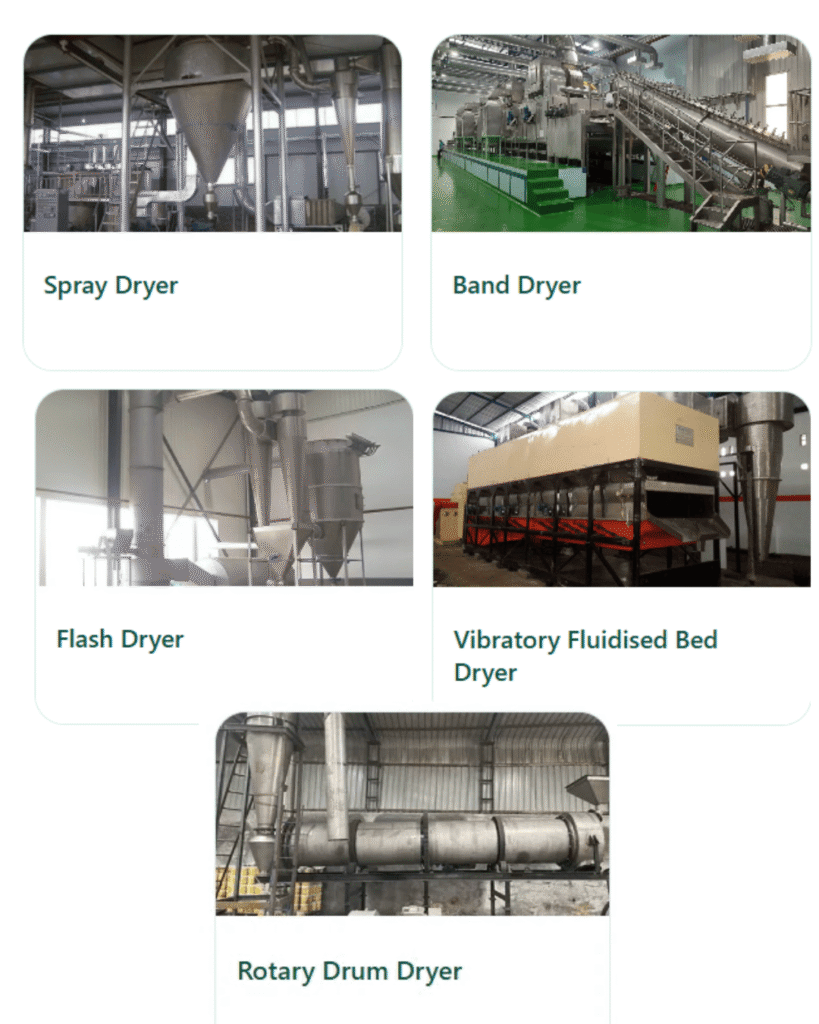
No single dryer is “the greenest.” The sustainable choice is the one that removes the required water with the least total energy and waste for your feed.
4. Practical Measures That Cut Energy and Emissions
Process measures (often lowest cost)
- Set and control residual moisture to specification — not “as dry as possible”
- Stabilise feed rate and inlet moisture
- Balance airflow; avoid excess air
- Maintain clean heat exchangers, filters and seals
Design measures
- Multi-zone control so finishing zones run cooler
- Adequate insulation and tight doors/ducts
- Exhaust heat recovery (air-to-air or run-around) when temperature and fouling allow
- Correct specific energy discussion (kJ/kg water) with stated conditions
Utility measures
- Integrate waste heat from other plant streams where continuous and clean enough
- Biomass or agricultural-residue heat where logistics and emissions controls are sound
- Heat pump loops for suitable low-temperature duties
- High-efficiency burners and properly controlled steam systems
5. Measuring What Matters (Avoid Greenwash)
Use transparent metrics:
- Specific energy consumption — energy in / kg water evaporated (state fuel type and test conditions)
- Residual moisture — average and variation
- Availability — unplanned downtime from clogging or trips also wastes energy and product
- Baseline vs after — measure before projects so claims are verifiable
Be cautious of:
- Percentage savings without a baseline
- “Eco dryer” labels with no moisture or capacity basis
- Comparing different products or different outlet moistures as if equal
6. India’s Operating Context
| Factor | Implication for dryer projects |
|---|---|
| Diverse fuel mix | Gas, coal, biomass, electricity, steam — design for what the site can sustain |
| High ambient humidity in many regions | Affects open-circuit dryers; closed or controlled loops help some duties |
| Seasonal agro feeds | Peak moisture often sizes the dryer |
| SME and large-plant mix | Solutions must be operable and maintainable, not only theoretically efficient |
| Export quality pressure | Efficiency and quality (colour, moisture uniformity) rise together when profiling is correct |
Green manufacturing here means reliable, measurable efficiency under Indian utility and feedstock conditions.
7. Buyer Checklist — Energy-Efficient & Sustainable Dryer Projects
| Check | Question to ask |
|---|---|
| Moisture basis | Is capacity defined at stated inlet/outlet moisture? |
| Over-drying | Does the design target our real specification? |
| Zones / control | Can temperature and airflow be staged? |
| Heat recovery | Is recovery offered with fouling and hygiene considered? |
| Heat source | Can the system use our steam, biomass, gas or waste heat? |
| Specific energy | Are estimates given with assumptions? |
| Technology fit | Is this the right family for our feed form? |
| Maintenance | Can we keep seals, plates and exchangers effective in operation? |
| Scope | Are fans, ducts, filters and controls included for a fair comparison? |
8. How GTI Dryers Supports Efficient Drying Projects
GTI Dryers designs and manufactures continuous industrial drying systems (band/mesh-belt, fluid-bed/VFBD, rotary, flash/spin-flash and related configurations) with process data as the starting point.
For energy and sustainability-oriented projects we focus on:
- Correct technology for feed form (avoiding energy-wasting mismatches)
- Multi-zone control and residual-moisture discipline
- Heat-source options aligned with site utilities
- Evaluation of recovery and low-temperature options where they fit
- Clear assumptions on capacity and energy discussion — not generic saving percentages
GTI Dryers — Engineered Drying Solutions from India for Global Industries.
Geographic Note
Efficiency priorities differ by region: high fuel-price locations favour recovery and tight moisture control; biomass-rich locations favour well-designed solid-fuel heat; export-oriented food plants favour quality-preserving low-temperature profiles. The hierarchy — process first, then recovery, then capital — applies across India and in export projects.
Frequently Asked Questions
What makes an industrial dryer energy-efficient?
Removing only the required water, with good heat transfer, minimal losses, appropriate technology and, where viable, heat recovery — verified by specific energy per kg water evaporated.
Can a dryer support India’s green manufacturing goals?
Yes, by lowering specific energy, enabling cleaner or local fuels, and reducing waste from over-drying and rejects — when designed and operated on real process data.
Is a heat pump always the most sustainable option?
Only within suitable temperature and capacity limits. High-temperature or high-tonnage duties often need other efficient designs.
What data should I share for an efficiency assessment?
Dryer type (or product form), inlet and target moisture, capacity, current fuel/steam use if known, and heat source constraints.
Does GTI guarantee a percentage energy reduction?
No. Estimates depend on your baseline and duty. GTI works from measured or stated process data and documents assumptions.
Next Step
If energy cost and sustainability targets are driving a dryer upgrade or new line, share your product, moisture range and utility situation. GTI can review technology fit and outline practical efficiency measures — from operating discipline to system design — aligned with your green manufacturing priorities.
Request an energy-efficient dryer assessment with your process data.
Contact the GTI Technical Team:
Website: gtidryers.com
Email: mktg@gtidryers.com
Phone / WhatsApp: +91 9330077417