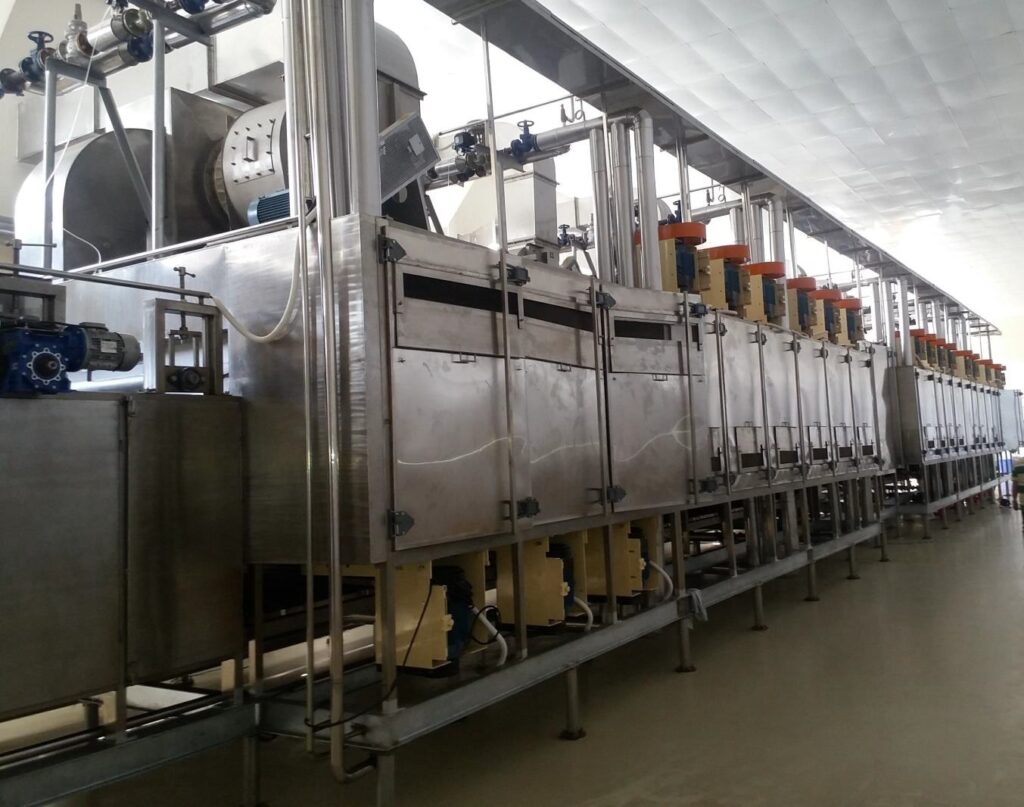
Continuous band (mesh-belt) dryers are widely used for onion, garlic, ginger, spices, herbs, coconut and other layered food products. Energy is often one of the largest operating costs. The same dryer can run efficiently or wastefully depending on temperature profile, residual-moisture discipline, airflow and whether exhaust heat is recovered.
This guide explains the practical levers that reduce energy use in band dryers for food and spice plants — without treating any percentage saving as a universal guarantee.
Important note on savings claims
Published figures such as “30–50% lower operating cost” appear in marketing material across the industry. Real savings depend on the starting point (how inefficient the current line is), product moisture, fuel price, exhaust conditions and how tightly residual moisture is controlled. Treat any percentage as an illustrative range that must be verified with site data and measurement, not as a promised result for every plant.
1. Where Energy Goes in a Band Dryer
Energy is consumed to:
- Evaporate water (latent heat — the largest useful load)
- Heat solids, residual water and air (sensible heat)
- Overcome losses through exhaust, radiation, leakage and poor insulation
Energy waste increases when:
- Product is dried below the real specification
- A single high temperature is used for the entire dryer length
- Excess air is pushed through the system
- Hot exhaust leaves without preheating incoming air
- Loading is uneven or the dryer is oversized for the actual evaporation duty
Specific energy consumption (fuel or steam energy per kg of water evaporated) is the metric that matters for comparison and improvement.
2. Energy-Reduction Hierarchy for Band Dryers
| Priority | Lever | Why it matters for food & spice lines |
|---|---|---|
| 1 | Residual-moisture discipline | Stops over-drying; protects colour and flavour while cutting unnecessary evaporation |
| 2 | Multi-zone temperature profiling | Higher driving force early, lower temperature later — less thermal damage and often less total heat input |
| 3 | Airflow and loading balance | Avoids excess air and wet/dry zones |
| 4 | Insulation and sealing | Reduces standing losses |
| 5 | Exhaust heat recovery | Returns useful heat to incoming air when exhaust is hot enough and fouling is manageable |
| 6 | Heat-source and hybrid options | Matches available low-cost or waste heat to part of the load |
Process control usually delivers the first and most reliable gains. Heat recovery and hardware upgrades build on that foundation.
3. Low-Temperature and Multi-Zone Drying
Food and spice products (onion, garlic, ginger, herbs, many spices) are sensitive to peak product temperature and time at temperature. Colour darkening, flavour loss and case-hardening are common when a single high air temperature is applied from inlet to outlet.
Multi-zone band dryers allow:
- Higher temperature and airflow in early zones while the product is still wet (evaporative cooling limits product temperature)
- Progressively lower temperatures in later zones to finish residual moisture without scorching
- Better matching of heat input to the actual drying rate along the belt
This approach supports both quality retention and energy discipline: heat is not applied at maximum level for the full residence time.
Low-temperature operation is not “no heat”. It means controlled product temperature limits and staged profiles rather than a uniform high-temperature tunnel. Residence time and belt length must still be adequate for the required moisture removal.
4. Heat Recovery on Band Dryers
Heat recovery captures energy in the exhaust and returns it to the process, most often by preheating fresh inlet air.
Common options
- Air-to-air heat exchangers
- Run-around coil systems (air-to-water/glycol-to-air)
- Partial recirculation of exhaust within product-quality and humidity limits
Conditions for useful recovery
- Exhaust still carries meaningful temperature above the required inlet-air preheat level
- Dust and condensable load are manageable (fouling and corrosion risk)
- Hygiene design is acceptable for food and spice duty
- There is a continuous need for the recovered heat
Recovery is not automatic. Plants with already cool or saturated exhaust, or with heavy dust, see smaller or less reliable gains. Fouling must be designed for (access, cleaning, materials).
5. Operating Practices That Cut Energy Cost
- Set and enforce residual moisture — Do not dry “as hard as possible”. Over-drying costs energy and often raises product temperature.
- Stabilise feed moisture and rate — Large swings force conservative (higher-energy) set points.
- Balance zone dampers and fans — Excess air in any zone increases fuel use.
- Maintain belt loading — Under-loading reduces capacity utilisation; over-loading creates wet cores and forces longer residence or higher temperature.
- Keep heat exchangers, coils and filters clean — Fouling raises fuel consumption and can cut capacity.
- Insulate and seal — Doors, joints and ducting leaks are visible energy losses.
- Cool product outside the main drying zones — Do not use expensive heated zones as a cooler.
6. When Band Dryers Are a Good Fit for Energy + Quality Goals
Band/mesh-belt dryers suit products that form a permeable layer and benefit from long, controlled residence time:
- Onion, garlic, ginger slices and flakes
- Many spices and herbs
- Coconut chips, flakes and similar
- Other vegetables and agro products with similar structure
They are less suitable as a first choice for sticky non-permeable cakes or free-flowing fine powders that fluidise well — those usually point to spin-flash, contact or fluid-bed systems.
Energy efficiency on a band dryer is maximised when multi-zone control, residual-moisture discipline and (where viable) heat recovery are combined with correct loading.
7. How to Evaluate Real Energy Improvement
- Measure current specific energy (fuel/steam per kg water evaporated) over representative production.
- Record inlet/outlet moisture, capacity, zone temperatures and exhaust condition.
- Implement residual-moisture and zone-profile improvements; re-measure.
- Evaluate heat recovery with actual exhaust temperature, humidity and dust data.
- Compare any new equipment option on a total-cost-of-ownership basis using verified numbers, not brochure percentages.
Without baseline measurement, “30–50%” claims cannot be validated for a specific plant.
8. Buyer Checklist — What to Ask Manufacturers
- How many independent temperature and airflow zones are provided?
- What residual-moisture target is the design based on?
- Can the system run a progressive low-temperature finish profile for colour- and flavour-sensitive products?
- Is exhaust heat recovery included or available as an option? How is fouling handled?
- What specific energy estimate is offered for our moisture and capacity data — and what assumptions does it use?
- How is belt loading and air distribution controlled for uniformity?
- What insulation, access and cleaning provisions are included?
- Can pilot or site data be used to refine energy and quality expectations?
9. How GTI Dryers Approaches Energy-Conscious Band Systems
GTI Dryers designs continuous band, belt and mesh-belt dryers for food, spice and related applications with:
- Multi-zone temperature and airflow control for quality retention and staged heat input
- Sizing against real residual-moisture specifications rather than arbitrary over-drying
- Evaluation of heat-source options and heat-recovery opportunities where exhaust conditions support them
- Process-data review before capacity and energy estimates are finalised
GTI does not guarantee a fixed percentage reduction in operating cost. Savings are estimated from the customer’s baseline, product and operating discipline, and should be confirmed in operation.
Geographic Note
Fuel cost, steam availability and biomass or waste-heat options vary by region. In high-fuel-cost locations, residual-moisture control and heat recovery pay back faster. In locations with low-cost biomass or process waste heat, hybrid integration may dominate. The same measurement-and-hierarchy approach applies in every market.
Frequently Asked Questions
Can a band dryer really cut energy use by 30–50%?
Some plants see large improvements when moving from uncontrolled single-zone operation and over-drying to multi-zone profiles, tight residual-moisture control and heat recovery. Others see smaller gains if they are already well optimised. Verify with your own baseline.
Does low-temperature drying always use less energy?
Not always. Lower temperature can increase required residence time or dryer size. The efficient approach is a staged profile: adequate driving force early, lower temperature later, and no over-drying.
Is heat recovery suitable for spice and vegetable dryers?
Often yes, if exhaust temperature is useful and dust/fouling are managed. Food-grade hygiene design must be maintained.
What is the first step if we already have a band dryer?
Measure specific energy and residual-moisture variation; then optimise zones, loading and moisture targets before investing in recovery hardware.
What data should we send for an energy-focused assessment?
Product type, capacity, inlet and target moisture, heat source, current fuel or steam use if known, and any exhaust temperature data.
Next Step
If energy cost and product quality are both priorities on a food or spice drying line, share your product, capacity, heat source and current operating data. GTI can review multi-zone band dryer options, residual-moisture strategy and heat-recovery potential based on your actual conditions.
Request an energy-focused band dryer assessment with your process data.
Contact the GTI Technical Team:
Website: gtidryers.com
Email: mktg@gtidryers.com
Phone / WhatsApp: +91 9330077417