
CTC Tea Dryer Machine Manufacturer in India – VFBD Technology for Modern Tea Processing
India is not only one of the world’s largest tea-producing countries—it is also one of the world’s most important tea-consuming and tea-processing markets.
From the tea gardens of Assam and West Bengal to the plantations of Tamil Nadu and Kerala, India’s tea industry operates across very different geographical and climatic conditions.
Assam alone contributed approximately 687.76 million kg of tea in 2025, while West Bengal produced about 411.18 million kg, according to India’s Ministry of Commerce and Industry. Tamil Nadu and Kerala were also major producing states.
Among India’s different tea-processing methods, CTC (Crush, Tear, Curl) tea occupies a particularly important position.
CTC processing produces small, granular tea particles that require carefully controlled drying after oxidation.
This makes the drying stage one of the most important parts of the production process.
A modern Vibratory Fluid Bed Dryer (VFBD) can provide the controlled airflow, vibration, residence time and moisture removal required for continuous industrial tea drying.
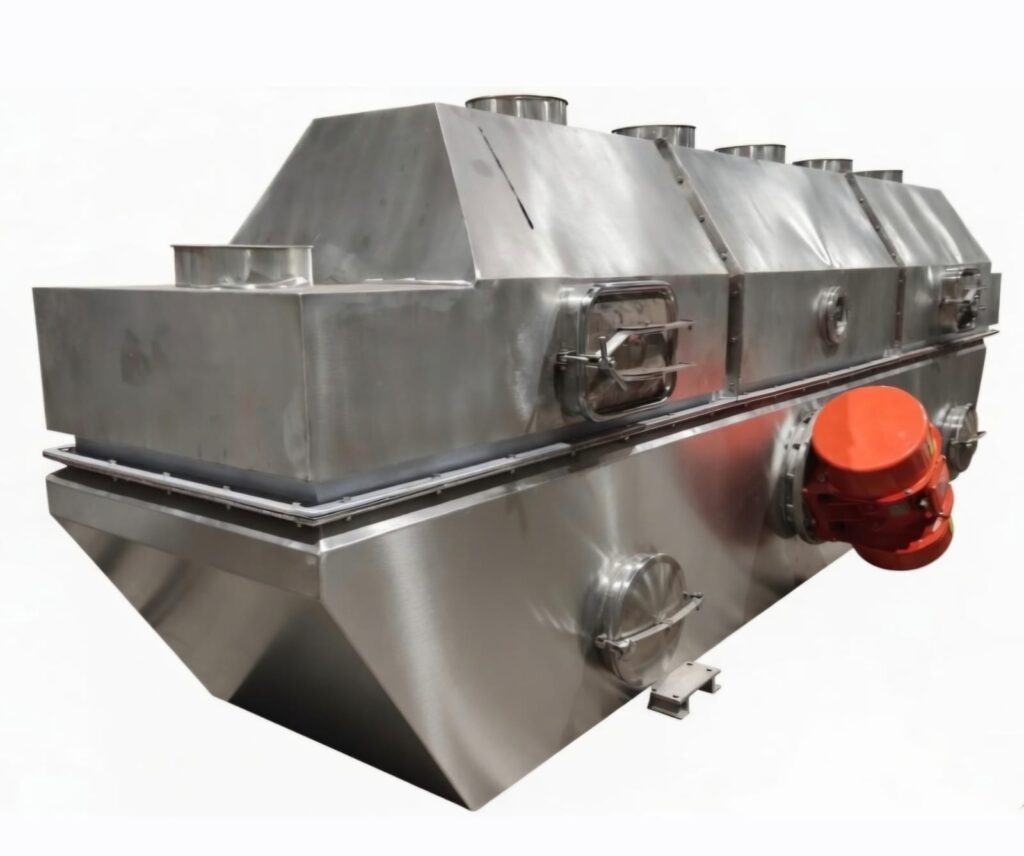
GTI Dryers designs and manufactures industrial VFBD systems for tea and other food-processing applications, with configurations developed according to product characteristics, production capacity and required moisture reduction.
The opportunity is therefore larger than simply selling a tea dryer.
It is about helping tea factories move toward:
Consistent drying → consistent tea quality → efficient production → export-ready processing.
Why CTC Tea Drying Is More Than Moisture Removal
In a tea factory, drying is sometimes described simply as the process of reducing moisture.
Technically, it is much more important than that.
After CTC processing and oxidation, the tea contains substantial moisture and needs controlled drying to stabilize the product.
The drying stage helps:
- Reduce moisture to the required level
- Stop further oxidation
- Stabilize the processed tea
- Preserve desired colour and flavour characteristics
- Improve storage stability
- Prepare the tea for grading, blending and packaging
GTI’s tea drying system information identifies controlled drying as a critical stage for stabilizing processed tea and achieving consistent final moisture.
For an export-oriented tea factory, the objective is therefore:
Not simply to dry the tea, but to dry every portion of the product consistently.
That is where VFBD technology becomes particularly relevant.
India’s CTC Tea Industry: From Assam to Tripura
India has one of the world’s most geographically diverse tea industries.
Major tea-producing regions include:
Assam
Assam is India’s largest tea-producing region and is globally recognized for its strong, full-bodied and malty tea character.
The state produced approximately 687.76 million kg in 2025, representing about half of India’s total production that year.
West Bengal
West Bengal combines several important tea regions:
- Dooars
- Terai
- Darjeeling
The state produced approximately 411.18 million kg in 2025.
Tamil Nadu
Tamil Nadu is one of India’s principal southern tea-producing states and an important production centre for Nilgiri tea.
Kerala
Kerala is another established tea-producing state, particularly in the highland plantation regions.
Tripura
Tripura has also emerged as an important CTC-producing state, making it particularly relevant to manufacturers of industrial CTC tea processing equipment.
Other tea-growing regions include:
Karnataka | Himachal Pradesh | Uttarakhand | Bihar | Arunachal Pradesh | Manipur | Meghalaya | Mizoram | Nagaland | Sikkim
This geographic diversity creates a large potential domestic market for tea-processing machinery.
Why India Is a Strategic Market for CTC Tea Dryer Manufacturers
India combines three major advantages:
Large tea production
Large domestic tea consumption
Strong tea export capability
According to India’s Tea Board, India produced around 1.304 billion kg of tea in 2024, representing approximately 18% of global production. India exported approximately 256 million kg in 2024, or about 13% of global tea exports.
The Indian government also reports that India is the world’s largest producer and consumer of black tea and the second-largest tea producer overall.
This creates demand for modern drying equipment across:
- Large tea estates
- CTC tea factories
- Bought-leaf factories
- Small-grower processing facilities
- Tea cooperatives
- Export-oriented processors
- Tea blending companies
- New tea-processing projects
- Factory modernization projects
What Is CTC Tea?
CTC stands for:
Crush – Tear – Curl
Unlike orthodox tea processing, where leaves are rolled and shaped more traditionally, CTC processing uses specialized rollers to crush, tear and curl tea leaves into smaller granular particles.
The resulting tea is particularly suitable for strong tea liquor and is widely used in tea bags and blends.
The smaller particle structure also means that airflow and moisture movement during drying become important process considerations.
This is one reason a fluidized drying system can be attractive for CTC tea.
Where Does the CTC Tea Dryer Fit?
A simplified CTC tea-processing sequence can be represented as:
Fresh Tea Leaves
↓
Withering
↓
CTC Crushing / Tearing / Curling
↓
Oxidation / Fermentation
↓
CTC Tea Dryer – VFBD
↓
Cooling
↓
Sorting / Grading
↓
Blending
↓
Packaging
↓
Domestic & Export Market
The exact processing configuration varies by factory and tea type.
However, for CTC black tea, the dryer follows the oxidation stage and becomes the point where the processed tea is stabilized through controlled moisture removal.
How Does a VFBD Tea Dryer Work?
A Vibratory Fluid Bed Dryer combines:
Hot air + fluidization + vibration + controlled residence time
to move and dry the tea continuously.
The basic principle is straightforward.
Step 1 – Product Feeding
CTC tea enters the dryer through a controlled feeding system.
Step 2 – Fluidization
Hot air passes through the product bed.
The airflow helps suspend and separate the tea particles, increasing contact between the drying air and the product.
Step 3 – Vibration
The vibrating motion helps transport the tea through the drying chamber while maintaining product movement.
Step 4 – Moisture Removal
Heat transfers into the tea particles and moisture is transferred into the air stream.
Step 5 – Controlled Residence Time
The product remains inside the dryer for the required drying period.
Step 6 – Final Moisture Control
The tea exits with moisture reduced to the required specification.
GTI’s VFBD systems are designed around controlled airflow, vibration, residence time and thermal engineering to provide continuous and uniform drying.
Why VFBD Is Suitable for CTC Tea Drying
CTC tea consists of relatively small, free-flowing particles.
This makes fluidized drying particularly interesting for high-capacity CTC tea factories.
1. Uniform Drying
Fluidization exposes individual tea particles to heated air, supporting uniform heat and mass transfer.
2. Continuous Processing
The VFBD can operate continuously rather than requiring repeated manual loading and unloading.
3. Controlled Residence Time
Tea movement through the dryer can be controlled according to process requirements.
4. Efficient Heat Transfer
Direct contact between the hot air and product promotes effective heat and mass transfer.
5. Gentle Product Movement
Vibration can transport the tea while reducing the need for aggressive mechanical conveying.
6. Automated Operation
Temperature, airflow, vibration and residence-time-related parameters can be integrated into an automated control system.
7. High-Throughput Production
VFBD technology can be engineered for commercial tea factories requiring continuous processing.
GTI specifically lists CTC tea among the applications of its industrial tea drying systems and identifies VFBD as one of its tea-drying technologies.
The Most Important Parameter: Final Moisture
A tea dryer should never be selected only according to capacity.
The drying system must be designed around the complete drying duty.
Important parameters include:
- Initial tea moisture
- Required final moisture
- Tea particle size
- Bulk density
- Feed rate
- Tea temperature sensitivity
- Required residence time
- Airflow
- Heating medium
- Ambient conditions
- Production schedule
GTI’s tea drying system documentation identifies temperature, airflow, moisture content, drying time and residence time as important process-control parameters.
The final operating conditions should therefore be established from actual product and factory data rather than using a universal temperature or residence time.
CTC Tea Drying and Tea Quality
The drying stage can influence several commercially important characteristics.
Colour
Overheating or inconsistent drying can affect the desired appearance of processed tea.
Aroma
Controlled drying helps avoid unnecessary thermal exposure.
Liquor Characteristics
The drying process forms part of the overall manufacturing sequence that determines the final characteristics of the tea.
Moisture
Inconsistent moisture can create differences between batches and affect storage stability.
Shelf Stability
Reducing moisture to the required specification helps stabilize the finished product.
Export Consistency
International buyers generally expect repeatable product specifications.
For this reason, a modern tea factory needs process control rather than simply higher drying temperature.
CTC Tea Dryer Machine for Large Tea Factories
A large tea factory may process substantial quantities of tea during peak production periods.
The dryer therefore needs to match the upstream and downstream equipment.
A properly engineered CTC tea drying system can be integrated with:
- Tea fermentation/oxidation section
- CTC machines
- Feeders
- Cooling systems
- Sorting equipment
- Grading systems
- Blending systems
- Dust collection
- Packaging lines
- Factory automation
This is where GTI’s engineering approach becomes important.
Rather than treating the VFBD as an independent machine, GTI can develop the drying system around the overall tea-processing line.
GTI Approach: Design the Dryer Around the Tea Factory
At GTI Dryers, a CTC tea dryer project starts with understanding the process.
The engineering team can evaluate:
Tea Characteristics
- CTC particle size
- Bulk density
- Initial moisture
- Final moisture
- Temperature sensitivity
Production Requirements
- kg/hr or TPH
- Operating hours
- Seasonal production
- Continuous operation
- Future expansion
Plant Conditions
- Available space
- Heating source
- Steam availability
- Fuel availability
- Electrical supply
- Ambient conditions
Automation Requirements
- Temperature control
- Airflow control
- Vibration control
- Product feeding
- Alarms
- Data monitoring
- PLC/HMI integration
GTI describes its VFBD philosophy as application-specific engineering based on material characteristics, moisture content, particle size, thermal behaviour, capacity and utility availability.
From Assam Tea Factory to Global Tea Processing Plant
The commercial opportunity for a CTC Tea Dryer Manufacturer is not limited to India.
Tea is produced and processed across Asia and Africa, while major tea-importing markets are spread across South Asia, Europe, North America, the Middle East and Africa.
This creates two different business opportunities for GTI:
Tea-Producing Countries
Countries where tea factories require drying equipment:
India | Sri Lanka | Kenya | Bangladesh | Indonesia | Vietnam | Nepal | Turkey | China
Tea-Importing & Blending Countries
Markets where tea is imported, blended, packed or further processed:
Pakistan | UK | USA | UAE | Russia | Egypt | Saudi Arabia | Germany | Iraq | Poland | Morocco
This distinction is important for GTI’s international business-development strategy.
Global Tea Markets GTI Should Target
1. Pakistan – High-Volume Black Tea Market
Pakistan is one of the world’s largest tea-importing markets.
In 2024, Pakistan imported approximately 235.8 million kg of black tea worth about US$618.5 million.
This makes Pakistan an important market for:
- Tea processors
- Blending companies
- Tea importers
- Packaging companies
- Industrial tea-processing projects
GTI opportunity: CTC tea-processing equipment and industrial drying systems.
2. United Kingdom – Tea Blending & Import Market
The UK remains one of the world’s established tea markets.
In 2024, UK tea imports were approximately 114.2 million kg, valued at around US$374 million according to WITS/UN Comtrade data. India supplied approximately 13.3 million kg to the UK that year.
The UK should therefore be targeted not only as a consumer market but also as a tea blending, packaging and distribution market.
3. United States – Large Tea Import Market
The USA imported approximately 85.5 million kg of black tea worth US$183.3 million in 2024.
The market includes:
- Tea brands
- Specialty tea companies
- Blenders
- Beverage manufacturers
- Instant tea producers
- Food ingredient companies
For GTI, this creates opportunities beyond traditional plantation factories.
4. United Arab Emirates – Import, Blending & Re-Export Hub
The UAE is especially important for GTI because it combines strong tea consumption with its role as a regional trading and distribution hub.
The UAE imported approximately 88.1 million kg of bulk black tea in 2024 in the cited trade dataset.
India’s own tea exports also identify the UAE as a leading destination. During April–December 2025–26, the UAE was among India’s largest tea-export markets.
GTI opportunity: Tea processing, blending, drying and export-oriented projects serving the GCC.
5. Russia – Major Tea Importer
Russia is another major tea market.
Global trade data places Russia among the world’s largest tea importers, with approximately 108.7 million kg of tea imports in 2024.
India also counts Russia among its important tea export destinations.
Potential GTI targets include:
Tea factories + processors + blending plants + packaging operations.
6. Egypt – Large Black Tea Import Market
Egypt is another important destination for black tea.
WITS reports Egyptian imports of approximately 77.6 million kg of black tea worth US$255.9 million in 2024.
This makes Egypt relevant for GTI’s North African business expansion.
7. Saudi Arabia – Premium & High-Consumption Market
Saudi Arabia imported approximately 33.4 million kg of black tea worth US$162.1 million in 2024.
For GTI, Saudi Arabia can be targeted alongside:
UAE | Qatar | Kuwait | Oman | Bahrain
as part of a broader GCC tea-processing and food-processing equipment strategy.
8. Germany & European Union
Germany is an important European tea-import market.
Germany imported approximately 42.7 million kg of tea in 2024 across the broader HS 0902 category.
The EU also represents a major tea market.
For GTI, European opportunities can include:
- Tea-processing equipment
- Specialty tea processing
- Herbal tea drying
- Blending systems
- Food-grade drying technology
- Export-oriented tea factories
9. Iraq – Important Market for Indian Tea
Iraq is increasingly important in India’s tea-export geography.
India’s Ministry of Commerce identifies Iraq among India’s leading tea export destinations during April–December 2025–26.
This creates an interesting commercial connection:
Indian tea exporter → Iraqi importer/blender → GTI industrial equipment opportunity
10. Turkey – High Tea-Consumption Market
Turkey is particularly interesting from a consumption perspective.
A 2026 Bangladesh Bank research publication citing International Tea Committee data reported Turkey as having the world’s highest average annual tea consumption per person in 2023, at around 3.1 kg per person.
Turkey therefore represents a market worth monitoring for tea-processing and related food-processing equipment.
Global Target Market Strategy for GTI
| Country / Region | Market Type | GTI Target |
| India | Producer + consumer + exporter | CTC tea factories, modernization |
| Pakistan | Major importer | Tea processing & blending |
| UAE | Import + re-export hub | GCC projects, blending |
| UK | Import + blending | Processing & specialty tea |
| USA | Large importer | Tea processing & specialty applications |
| Russia | Major importer | Tea processing & blending |
| Egypt | Major black-tea importer | Industrial tea processing |
| Saudi Arabia | Import + consumption | GCC processing projects |
| Germany | European importer | Specialty & industrial tea |
| Iraq | Major Indian tea destination | Processing/blending projects |
| Turkey | High tea consumption | Tea-processing equipment |
| Sri Lanka | Major producer/exporter | Tea-factory equipment |
| Kenya | Major producer/exporter | Industrial drying systems |
| Bangladesh | Producer + consumer | CTC tea processing |
| Indonesia | Tea producer | Processing modernization |
| Vietnam | Growing tea producer | Tea-processing equipment |
The market table is based on a combination of current tea import data, India’s export destinations and tea-production indicators; it should not be interpreted as proof of product-specific demand for VFBD machines in every market.
Why Tea Manufacturers Are Moving Toward Continuous Drying
Traditional batch processes can create challenges when factories need:
- Higher production capacity
- Reduced manual handling
- More consistent drying
- Better process monitoring
- Lower moisture variation
- Improved automation
- Continuous operation
A VFBD can address these requirements by combining fluidization and vibration in a continuous system.
GTI’s industrial VFBD systems are designed for continuous operation, uniform drying, controlled final moisture and efficient heat transfer across suitable free-flowing products, including tea.
Key Features of GTI CTC Tea VFBD
A GTI CTC Tea Dryer can be engineered with features such as:
1. Uniform Air Distribution
Designed to provide consistent drying conditions across the product bed.
2. Controlled Temperature
Allows the drying profile to be matched to the product requirement.
3. Adjustable Residence Time
Product movement can be controlled according to drying duty.
4. Vibratory Conveying
Supports continuous movement of the tea through the dryer.
5. Automated Controls
PLC/HMI-based monitoring can be integrated into the system.
6. Food-Grade Construction
Construction materials and design can be selected according to the tea-processing environment.
7. Energy-Conscious Design
Airflow and heat-transfer design can be optimized to reduce unnecessary energy consumption.
8. Industrial Scalability
The system can be engineered around the required production capacity.
GTI’s tea-drying systems emphasize uniform drying, automated temperature and airflow control, food-grade construction and continuous industrial operation.
CTC Tea Dryer vs Conventional Tea Drying
| Parameter | Conventional Batch Drying | VFBD CTC Tea Dryer |
| Operation | Batch | Continuous |
| Product movement | Manual/mechanical | Vibratory |
| Air contact | Less controlled | Fluidized air |
| Moisture uniformity | Process-dependent | Designed for uniformity |
| Automation | Limited to moderate | High potential |
| Production scalability | Limited | High |
| Residence-time control | Less flexible | Adjustable |
| Large factory suitability | Application-dependent | Strong fit for suitable CTC particles |
The actual performance depends on the tea characteristics and dryer design; a technology comparison should therefore be validated through process data or trials.
GTI Dryers: From Machine Manufacturer to Tea-Processing Engineering Partner
For GTI Dryers, the opportunity is not limited to manufacturing one VFBD machine.
The broader objective is to support tea manufacturers with application-specific industrial drying technology.
GTI can support projects through:
Process Understanding
↓
Dryer Selection
↓
Thermal & Capacity Calculation
↓
Equipment Engineering
↓
Manufacturing
↓
Automation Integration
↓
Installation & Commissioning
↓
Performance Testing
↓
After-Sales Support
GTI’s published tea-drying scope includes process design and engineering, equipment manufacturing, installation and commissioning, automation integration, operator training and after-sales support.
What Information Should a Tea Factory Send to GTI?
Before selecting a CTC Tea Dryer Machine, the factory should provide:
Product Data
- CTC tea type
- Initial moisture
- Target final moisture
- Particle size
- Bulk density
- Temperature sensitivity
Production Data
- Capacity in kg/hr
- Peak production
- Operating hours
- Seasonal variation
- Future expansion plans
Utility Data
- Steam availability
- Fuel type
- Electricity
- Hot-air requirements
- Available installation area
Quality Requirements
- Final moisture
- Colour
- Aroma
- Liquor characteristics
- Export specifications
This information allows GTI engineers to determine the appropriate dryer configuration rather than recommending a machine based only on nominal capacity.
Why Choose GTI Dryers for CTC Tea Drying?
The right tea dryer manufacturer should understand more than mechanical fabrication.
The dryer must work with:
Tea particle behaviour
Moisture migration
Airflow
Heat transfer
Residence time
Production capacity
Factory utilities
Automation
Food-grade requirements
GTI Dryers approaches VFBD projects using application-specific process engineering and thermal calculations rather than relying on a single standard configuration.
For tea manufacturers, this means the discussion can begin with the tea and the process, not just the machine.
Expanding From India’s Tea Industry to the Global Market
India provides GTI with a strong domestic base.
The country’s tea industry spans:
Assam → West Bengal → Tamil Nadu → Kerala → Tripura → Other Emerging Tea Regions
But the international opportunity extends much further.
Tea is grown across Asia and Africa, while major importing markets exist in:
South Asia → Middle East → Europe → North America → North Africa
The FAO notes that tea is one of the world’s most consumed beverages after water and that the majority of tea is consumed domestically in producing countries, while tea remains a widely traded commodity.
For GTI, this creates two parallel business-development routes:
Route 1 – Tea-Producing Countries
Sell tea-processing and drying equipment to factories.
Route 2 – Tea-Importing Countries
Target blending, reprocessing, specialty tea and value-added tea facilities.
This makes CTC Tea Dryer SEO useful not only for attracting Indian manufacturers but also for international B2B enquiries.
Frequently Asked Questions
What is a CTC Tea Dryer Machine?
A CTC Tea Dryer Machine is an industrial drying system used after CTC processing and oxidation to reduce moisture in CTC tea under controlled conditions. GTI offers industrial tea drying systems using technologies including VFBD.
Why use a VFBD for CTC tea?
CTC tea consists of small, relatively free-flowing particles. A VFBD combines vibration and fluidized hot air to provide continuous product movement and effective heat and mass transfer.
What is the final moisture of dried tea?
The required final moisture depends on the tea type, process and buyer specification. GTI’s tea-drying information references approximately 2–3% moisture for its tea drying systems, but the actual specification should be established for the specific product and process.
Can GTI manufacture customized CTC Tea Dryers?
Yes. GTI designs industrial drying systems around product characteristics, production capacity, moisture requirements, utilities and plant conditions.
Which tea varieties can be dried using GTI systems?
GTI’s tea drying portfolio covers applications including CTC tea, black tea, green tea and specialty/herbal teas, with the appropriate dryer technology selected according to the product.
Is VFBD suitable for large tea factories?
VFBD technology can be configured for continuous industrial production and is suitable for appropriate free-flowing tea products. Final sizing depends on product characteristics, moisture reduction and required throughput.
Which countries should GTI target for tea dryer exports?
Important markets to investigate include Pakistan, UAE, UK, USA, Russia, Saudi Arabia, Egypt, Germany, Iraq, Turkey, Sri Lanka, Kenya, Bangladesh, Indonesia and Vietnam, based on tea production, consumption and import/export indicators.
Does GTI provide turnkey tea drying solutions?
GTI’s published tea-drying scope includes process engineering, equipment manufacturing, installation and commissioning, automation integration, operator training and after-sales support.
Get a CTC Tea Dryer Machine from GTI Dryers
A modern tea factory does not need drying equipment simply to remove moisture.
It needs a drying system that supports:
Uniformity
Moisture control
Tea quality
Production efficiency
Continuous operation
Automation
Export consistency
GTI Dryers designs and manufactures customized CTC Tea Dryer Machines and VFBD Tea Drying Systems for tea-processing plants in India and international markets.
Whether you are:
- Modernizing an existing CTC tea factory
- Building a new tea-processing plant
- Expanding production capacity
- Replacing an existing dryer
- Developing an export-oriented tea-processing facility
GTI can evaluate the drying requirement based on your actual product and process data.
Looking for a CTC Tea Dryer Machine Manufacturer in India?
Send GTI Dryers your:
Tea Type | Capacity | Initial Moisture | Final Moisture | Heating Source | Plant Location
and discuss the appropriate VFBD configuration for your tea-processing application.
GTI Dryers — Engineered Industrial Drying Solutions from India for Global Tea Processing Industries.