Vibratory Fluidized Bed Dryer India: Engineering Continuous Drying for India’s Growing Process Industries
India’s rapid expansion in pharmaceutical manufacturing, food processing, sugar production, salt refining, spices, tea, fertilizers and agrochemicals is creating increasing demand for reliable industrial drying systems.
Many of these industries process materials in the form of granules, crystals, powders, particles or agglomerates where moisture control directly affects product quality, storage stability, flowability and downstream processing.
This is where a Vibratory Fluidized Bed Dryer (VFBD) can provide an important continuous-drying solution.
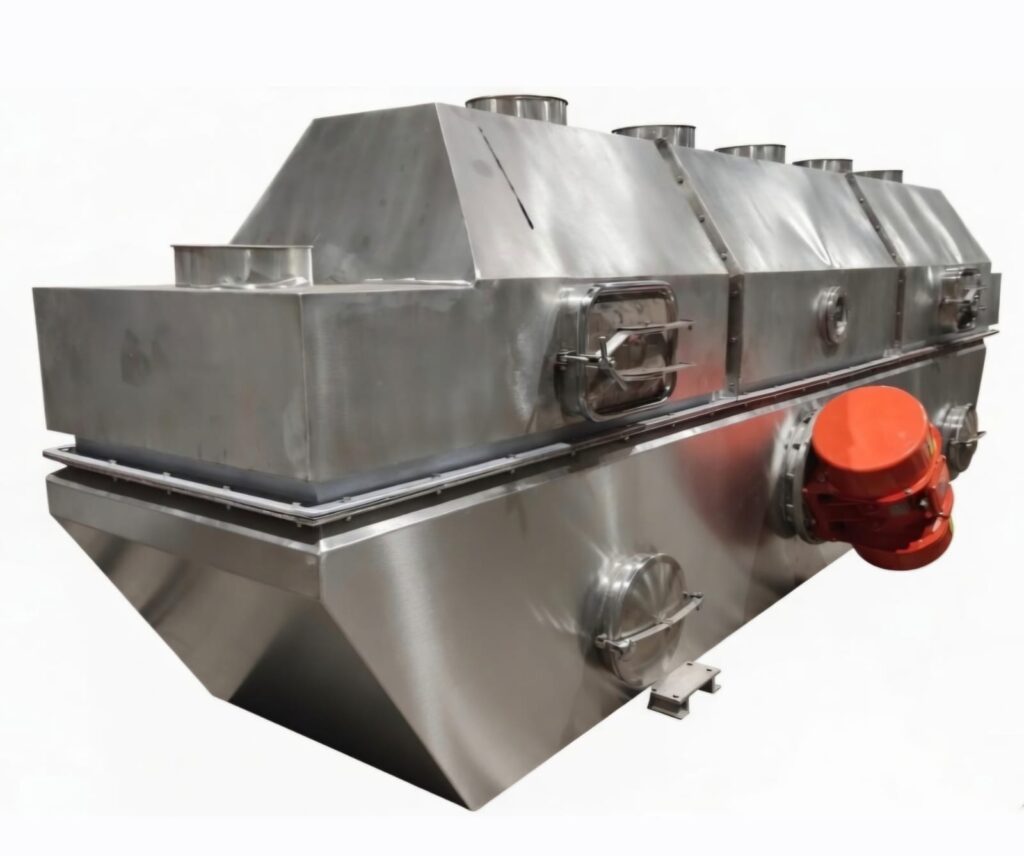
A VFBD combines hot-air fluidization with controlled mechanical vibration. Instead of depending entirely on airflow to move the material, vibration assists product transport through the drying chamber.
This makes the technology particularly interesting for applications requiring:
Continuous Drying + Uniform Moisture Removal + Controlled Residence Time + Gentle Product Handling + Industrial Throughput
For Indian manufacturers, the technology has applications ranging from pharmaceutical granules and food ingredients to sugar, salt, spices, fertilizers and chemical products.
Why VFBD Technology Is Relevant to Indian Industry
India presents a unique combination of:
- Large pharmaceutical manufacturing capacity
- Expanding food-processing infrastructure
- Major agricultural production
- Large sugar-processing industry
- Significant salt production
- Major tea and spice sectors
- Growing fertilizer consumption and manufacturing
- Expanding chemical and specialty-chemical industries
These industries do not all require the same dryer.
A pharmaceutical granule may require a hygienic SS316/SS316L drying system, while a fertilizer or mineral product may require a robust industrial configuration.
Therefore, Indian buyers increasingly need application-specific drying equipment rather than one standard machine for every product.
Where Are Vibratory Fluidized Bed Dryers Used in India?
1. Pharmaceutical & API Manufacturing
India is one of the world’s important pharmaceutical manufacturing and export hubs.
Pharmaceutical production involves numerous intermediate materials that require controlled drying, including suitable:
- API intermediates
- Formulation granules
- Crystalline products
- Pharmaceutical excipients
- Wet granules
- Powdered intermediates
- Chemical intermediates
For these applications, drying performance must be considered alongside:
Product Temperature → Final Moisture → Residence Time → Hygiene → Material of Construction → Containment → Cleaning Requirements
For suitable pharmaceutical applications, VFBD systems can be engineered using SS316/SS316L product-contact components and appropriate instrumentation.
Depending on the product and plant requirement, the system may incorporate:
- Controlled hot-air temperature
- Adjustable vibration
- Variable product residence time
- Closed-loop process control
- PLC/HMI automation
- Dust collection
- Product cooling
- Hygienic construction
For pharmaceutical applications, the equipment specification should be developed around the customer’s GMP, validation, containment and cleaning requirements.
2. Pharmaceutical Formulation Granules
Fluidized bed technology is widely associated with pharmaceutical granulation and drying.
A VFBD can be considered when continuous drying of suitable granules is required.
The major objective is not simply to remove water quickly.
The dryer must achieve the required final moisture while protecting:
- Granule structure
- Particle size distribution
- Flowability
- Product temperature
- Active ingredients
- Downstream processing characteristics
Mechanical vibration can assist controlled product movement through the drying chamber.
This can be particularly useful where maintaining consistent residence time is important.
3. Sugar Industry
India’s large sugar-processing sector creates another significant opportunity for continuous drying technology.
Sugar crystals require controlled moisture to achieve suitable:
- Storage stability
- Flowability
- Crystal quality
- Handling characteristics
- Packaging performance
A Vibratory Fluidized Bed Dryer/Cooler can be designed for suitable sugar-processing applications.
A combined system may provide:
Drying → Cooling → Continuous Conveying
This can reduce the need for separate product-handling stages.
The appropriate configuration depends on crystal size, feed moisture, production capacity, final moisture and required product temperature.
India is also a major salt-producing country, creating applications for industrial drying and cooling systems.
Wet salt crystals may require moisture reduction before:
- Storage
- Packaging
- Further processing
- Refining
- Industrial use
A VFBD can be evaluated for suitable salt crystals where controlled fluidization and vibration-assisted movement are appropriate.
Salt-processing equipment also requires careful consideration of:
Corrosion Resistance + Material Selection + Dust Control + Airflow + Product Temperature
Depending on the process, suitable stainless-steel or specialized construction materials may be required.
India’s tea and spice industries are major agricultural-processing sectors.
Spices such as:
- Turmeric
- Chilli
- Cumin
- Coriander
- Ginger
- Black pepper
may require controlled moisture reduction after processing.
Tea processing similarly requires precise control of moisture and temperature to achieve the desired product characteristics.
For heat-sensitive agricultural products, drying conditions need to be selected carefully because excessive temperature or residence time can affect:
- Aroma
- Color
- Flavor
- Volatile compounds
- Product quality
Depending on particle characteristics and process requirements, VFBD or other continuous drying technologies can be evaluated.
6. Fertilizers & Agrochemicals
India’s agricultural economy creates substantial demand for fertilizers and agrochemical products.
Suitable granular materials may include:
- Fertilizer granules
- Agricultural nutrients
- Mineral salts
- Chemical granules
- Agrochemical intermediates
VFBD technology can provide continuous drying with controlled product movement.
For fertilizer applications, the dryer design should consider:
Granule Size + Moisture + Bulk Density + Abrasion + Corrosion + Dust Generation + Final Moisture
A robust industrial configuration can be engineered according to the product and operating environment.
Why Vibration Makes a Difference
The main difference between a conventional fluidized bed and a Vibratory Fluidized Bed Dryer is the addition of mechanical vibration.
In a conventional fluidized bed, airflow performs much of the work of suspending and moving particles.
In a VFBD:
Hot Air + Controlled Vibration = Fluidization + Product Movement
This can provide several process advantages for suitable products.
Controlled Material Transport
Vibration helps move the product progressively through the dryer.
More Uniform Drying
Product movement combined with air distribution can help expose particles more consistently to the drying medium.
Gentle Handling
For suitable fragile granules and crystals, controlled vibration can reduce dependence on aggressive mechanical conveying.
Continuous Production
VFBD systems can operate continuously, making them suitable for large-scale Indian manufacturing plants.
Drying & Cooling in One Line
A cooling section can be integrated after drying where the product requires controlled cooling before storage or packaging.
VFBD vs Standard Fluidized Bed Dryer
| Feature | Standard Fluidized Bed Dryer | Vibratory Fluidized Bed Dryer |
| Drying medium | Hot air | Hot air |
| Product movement | Primarily airflow | Airflow + vibration |
| Operation | Batch or continuous depending on design | Primarily suited to continuous processing |
| Granules | Suitable | Particularly useful for selected granules |
| Product transport | Air-driven | Vibration-assisted |
| Residence control | Process dependent | Can be controlled through vibration and deck configuration |
| Drying & cooling | Possible | Can be integrated |
| Difficult materials | Application dependent | Vibration can assist movement |
| Industrial throughput | Application dependent | Well suited to continuous high-throughput applications |
The best technology should always be selected after evaluating the actual material.
How to Select a VFBD for an Indian Manufacturing Plant
A dryer should never be selected solely on the basis of the product name.
For example:
“Sugar dryer”
does not provide enough information to engineer the machine.
A manufacturer needs to know:
Feed Information
- Feed rate in kg/h
- Initial moisture
- Final moisture
- Particle size
- Bulk density
- Product temperature limitation
- Stickiness
- Flowability
Process Requirements
- Required evaporation rate
- Residence time
- Drying temperature
- Cooling requirement
- Operating hours
- Continuous or batch operation
Plant Requirements
- Available heat source
- Electrical supply
- Installation space
- Dust collection
- Automation requirements
- Material of construction
This information allows the dryer manufacturer to develop an appropriate process configuration.
How to Calculate VFBD Drying Capacity
One of the most important questions asked by Indian industrial buyers is:
“What size of VFBD do I need?”
The answer begins with the moisture balance.
For example, assume:
Feed = 2,000 kg/h
Initial moisture = 25%
Final moisture = 5%
Dry solids:
2,000 × 0.75 = 1,500 kg/h
Final product:
1,500 ÷ 0.95 ≈ 1,579 kg/h
Approximate water evaporation:
2,000 − 1,579 ≈ 421 kg/h
Therefore, the dryer needs to remove approximately 421 kg of water per hour under these assumed conditions.
Actual equipment sizing additionally requires thermal calculations, airflow calculations, residence-time analysis and product testing where appropriate.
This is why dryer capacity should be specified by evaporation duty as well as feed throughput.
Energy Efficiency of VFBD Systems
For Indian industries, energy efficiency is increasingly important because drying can represent a significant part of total thermal energy consumption.
A well-designed VFBD can be optimized through:
Airflow Management
Delivering the required amount of air without unnecessary fan energy.
Temperature Optimization
Using the appropriate drying temperature instead of simply maximizing temperature.
Multi-Zone Drying
Different drying zones can operate under different process conditions.
Variable Frequency Drives
VFDs can regulate:
- Fans
- Feeders
- Vibratory drives
- Conveyors
- Air-handling systems
Heat Recovery
Where technically and economically suitable, heat from exhaust streams can be recovered.
Thermal Insulation
Proper insulation reduces heat loss from the drying chamber and associated hot-air systems.
Available heat sources may include:
Steam | Thermal Oil | Gas | LPG | Electric | Biomass | Waste Heat
The optimum heat source depends on the customer’s location, fuel availability, energy pricing and process requirements.
Hygienic VFBD Systems for India’s Pharmaceutical & Food Industries
Not every VFBD requires the same construction.
For pharmaceutical, nutraceutical, dairy and food applications, buyers may require higher levels of hygienic design.
Depending on the application, GTI Dryers can evaluate:
- SS304 construction
- SS316 construction
- SS316L product-contact surfaces
- Hygienic welds
- Suitable surface finishing
- Controlled access
- Dust containment
- Product-contact material compatibility
- CIP considerations where applicable
- PLC/HMI automation
The actual specification should be aligned with the customer’s process, regulatory and validation requirements.
Automation: Making Continuous Drying More Consistent
Modern Indian processing plants increasingly require automated equipment rather than manually controlled dryers.
A VFBD can incorporate:
PLC → HMI → VFD → Temperature Sensors → Pressure Monitoring → Airflow Control → Alarm System
Important operating parameters may include:
- Inlet air temperature
- Outlet air temperature
- Product temperature
- Airflow
- Vibration frequency
- Feed rate
- Residence time
- Exhaust conditions
- Final moisture
Automation can improve process repeatability and provide operators with greater visibility into the drying process.
Why GTI Dryers Is a Relevant VFBD Manufacturer in India
For an Indian customer, choosing a domestic industrial dryer manufacturer can provide practical advantages in addition to equipment cost.
GTI Dryers can work with customers from the initial process discussion through dryer engineering and system development.
GTI Dryers’ India-Focused Approach
Process-Based Design
GTI can evaluate the actual:
Feed → Moisture → Capacity → Evaporation → Temperature → Residence Time → Final Moisture
rather than supplying an unsuitable standard machine.
Customized Construction
VFBD systems can be configured according to:
- Capacity
- Product
- Material of construction
- Heating source
- Product-contact requirements
- Automation level
Pharmaceutical-Grade Options
For suitable applications, SS316/SS316L construction and hygienic design features can be incorporated.
Complete Drying Systems
The drying system can be engineered around associated equipment such as:
Feeding → Heating → VFBD → Dust Collection → Cooling → Conveying
This can reduce coordination between multiple equipment suppliers.
Indian Technical Support
A domestic engineering and manufacturing base can simplify:
- Site discussions
- Technical communication
- Spare parts
- Service coordination
- Engineering modifications
- After-sales support
For Indian plants, these factors can be particularly valuable during installation and commissioning.
Why Choose an Indian VFBD Manufacturer Instead of Only Comparing Machine Prices?
The lowest quotation is not necessarily the lowest-cost drying solution.
A dryer with poor airflow distribution, inadequate insulation, unsuitable vibration control or incorrect sizing can create higher operating and maintenance costs.
Indian manufacturers such as GTI Dryers can provide a combination of:
Engineering + Fabrication + Automation + Customization + Local Support
This allows the customer to evaluate the complete project rather than simply comparing the price of the dryer shell.
For international-quality applications, GTI can also structure equipment specifications around the customer’s required materials, instrumentation, documentation and automation standards.
Industries in India That Can Benefit From VFBD Technology
| Industry | Potential Applications |
| Pharmaceuticals | APIs, intermediates, formulation granules |
| Food Processing | Granules, ingredients, food products |
| Sugar | Sugar crystals and derivatives |
| Salt | Salt crystals and refined salt |
| Tea | Processed tea materials |
| Spices | Turmeric, chilli, cumin, coriander and other products |
| Fertilizers | Fertilizer granules and mineral salts |
| Agrochemicals | Suitable chemical intermediates |
| Chemicals | Crystals, granules and particulate materials |
| Nutraceuticals | Suitable heat-sensitive granules and ingredients |
| Minerals | Suitable granular mineral products |
| Animal Feed | Selected granular feed ingredients |
The suitability of VFBD technology should always be confirmed through material and process evaluation.
What Indian Buyers Should Ask a VFBD Manufacturer
Before purchasing a Vibratory Fluidized Bed Dryer, ask the manufacturer:
- What is the feed capacity?
- What is the initial moisture?
- What final moisture is guaranteed?
- What is the evaporation capacity?
- What is the estimated specific energy consumption?
- What is the expected residence time?
- What product temperature will be maintained?
- What material of construction is proposed?
- Is SS316/316L available for product-contact surfaces?
- How is vibration controlled?
- How is airflow distributed?
- Is a cooling section required?
- What dust-collection system is included?
- What automation system is included?
- Can product trials be conducted?
- What documentation will be provided?
- What installation and commissioning support is available?
- What spare-parts support is available after commissioning?
These questions allow buyers to compare engineering quality and total project value, rather than only the initial machine price.
Frequently Asked Questions About Vibratory Fluidized Bed Dryers in India
What is a Vibratory Fluidized Bed Dryer?
A Vibratory Fluidized Bed Dryer is a continuous industrial drying machine that combines hot-air fluidization with mechanical vibration to dry and transport suitable granular, crystalline and particulate materials.
What industries use VFBD dryers in India?
Major potential applications include pharmaceuticals, APIs, food processing, sugar, salt, tea, spices, fertilizers, agrochemicals, chemicals and minerals.
Is VFBD suitable for pharmaceutical applications?
VFBD systems can be designed for suitable pharmaceutical materials, including certain APIs, intermediates and formulation granules. Hygienic construction, containment, cleaning, validation and product-contact requirements must be established for the specific application.
Can a VFBD dryer use SS316?
Yes. For suitable food and pharmaceutical applications, SS316 or SS316L product-contact construction can be considered depending on the required process and hygiene specifications.
Can VFBD dry sugar?
A VFBD can be evaluated for suitable sugar-crystal drying applications. Dryer sizing depends on feed moisture, crystal size, production rate, final moisture and product-temperature requirements.
Can VFBD be used for fertilizer granules?
Yes, suitable fertilizer and mineral granules can be candidates for continuous vibratory fluidized bed drying. Particle properties, corrosion, abrasion, dust and final moisture must be evaluated.
Is a VFBD more energy efficient than a conventional dryer?
Energy performance depends on the material, moisture-removal duty, airflow, temperature, heat source and dryer design. VFBD systems can be engineered to optimize airflow, residence time and product movement, but actual energy consumption should be established from process calculations or testing.
How much does an industrial VFBD cost in India?
There is no single price because the cost depends on capacity, evaporation duty, material of construction, heating system, automation, dust collection, cooling requirements and other engineering specifications.
For a meaningful quotation, manufacturers typically need the feed rate, initial moisture, final moisture, product characteristics and available heat source.
India’s Growing Processing Economy Creates a Strong VFBD Opportunity
India’s pharmaceutical, agricultural and food-processing sectors are increasingly moving toward larger, more automated and quality-controlled production systems.
This transition creates demand for drying technologies that can provide:
Continuous Production
Consistent Moisture
Controlled Product Temperature
Reduced Manual Handling
Energy Optimization
Hygienic Construction
Process Automation
Vibratory Fluidized Bed Dryers fit this requirement for a wide range of suitable granular and particulate products.
GTI Dryers: Vibratory Fluidized Bed Dryer Manufacturer in India
GTI Dryers provides industrial drying solutions for Indian and international process industries.
For VFBD applications, GTI can evaluate systems for:
Pharmaceuticals | APIs | Food Ingredients | Sugar | Salt | Tea | Spices | Fertilizers | Agrochemicals | Chemicals | Minerals
The objective is not simply to supply a dryer.
It is to develop a process-engineered drying system based on the customer’s actual operating requirements.
Your Process. Your Product. Your Drying Requirement.
GTI Dryers can evaluate:
Feed Rate
↓
Initial Moisture
↓
Final Moisture
↓
Water Evaporation
↓
Drying Temperature
↓
Residence Time
↓
Heat Source
↓
VFBD Configuration
↓
Automation & Dust Collection
Request a VFBD Recommendation from an Indian Manufacturer
If you are planning a new pharmaceutical, food, sugar, salt, spice, fertilizer or chemical drying line in India, the first step is to determine whether VFBD is technically suitable for your material.
Send GTI Dryers your product details, feed capacity, initial moisture, desired final moisture, particle characteristics and available heat source.
GTI’s engineering team can use these parameters to develop a preliminary Vibratory Fluidized Bed Dryer concept and application-specific recommendation for your plant.
GTI Dryers — Industrial Drying Technology Engineered & Manufactured in India.