
A continuous conveyor dryer moves product on a belt or mesh conveyor through heated air zones so moisture is removed without tumbling. It is the industrial choice when pieces, flakes, pellets or pre-formed cakes need gentle handling, steady throughput and controlled residual moisture.
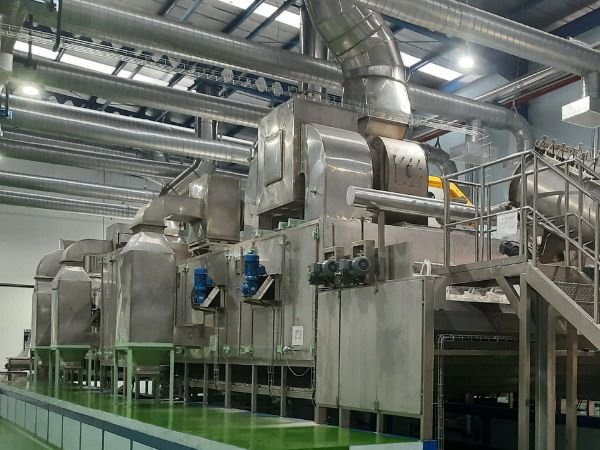
This page helps buyers evaluate a continuous conveyor dryer manufacturer: process fit, design features that matter, sizing logic and a practical supplier checklist.
Quick answer: Continuous conveyor dryers (belt / mesh belt / band dryers) spread product on a perforated conveyor and pass hot air through the bed in one or more temperature zones. Choose them for shaped or fragile solids; specify moisture in/out, capacity and max product temperature before comparing manufacturers.
1. What a Continuous Conveyor Dryer Is
| Element | Function |
|---|---|
| Conveyor belt / mesh | Carries product at controlled speed |
| Perforations / mesh opening | Allows through-circulation of air |
| Insulated chamber | Holds heated drying zones |
| Fans & ducts | Force air through the product layer |
| Zone controls | Independent temperature/airflow along the path |
| Feed & discharge | Continuous, even loading and takeaway |
Industry synonyms: continuous belt dryer, mesh belt dryer, band dryer, conveyor dryer, continuous tray-conveyor dryer (in some legacy wording).
The physics is through-circulation convective drying on a moving bed — not rotary tumbling and not fluidization.
2. Problems This Dryer Solves for Buyers
| Buyer problem | How continuous conveyor drying helps |
|---|---|
| Product breakage in rotary dryers | Product rests on the belt; minimal mechanical stress |
| Uneven moisture in batch ovens | Continuous movement + multi-zone recipes |
| Colour / aroma loss | Cooler finish zones after bulk moisture removal |
| Labour-heavy tray drying | Continuous feed and discharge |
| Need to dry extrudates or formed cakes | Permeable strands/layers dry with through-air flow |
3. Ideal Applications
- Vegetables, fruits, herbs, spices, onion/garlic flakes
- Coconut chips, snack pellets, extruded foods
- Tea and leaf-type products (configuration-dependent)
- Chemical extrudates, pigments, catalyst forms
- Nutraceutical botanicals and gentle food powders after forming
- Formed sludge or biomass pieces (after pre-forming)
Fit test: Can the product form a permeable layer on a mesh without blocking airflow? If yes, conveyor drying is a strong candidate.
4. When to Choose Another Technology
| Situation | Better direction |
|---|---|
| Pumpable liquid/slurry needing powder from droplets | Spray dryer |
| Free-flowing granules that fluidise well | Fluid bed / VFBD |
| Sticky filter cake without forming | Spin-flash / contact dryer |
| Very high-tonnage robust minerals | Rotary dryer often more economical |
| Fine powder that falls through mesh | Different belt, granulation, or another dryer family |
A good manufacturer will say no when conveyor drying is the wrong family.
5. Design Features That Separate Serious Manufacturers
| Feature | Why buyers should care |
|---|---|
| Multi-zone temperature control | Quality and energy; avoid one blunt setpoint |
| Even feeding system | Moisture uniformity starts at loading |
| Belt tracking & tension design | Uptime and mesh life |
| Access doors / cleanability | Food and multi-product plants |
| Airflow balancing | Prevents wet streaks and edge over-drying |
| Optional cooling zone | Packing temperature and caking control |
| Single-pass vs multi-pass options | Floor length vs height trade-off |
| Documented capacity basis | Moisture in/out stated — not vague kg/h |
6. Single-Pass vs Multi-Pass Conveyor Dryers
| Single-pass | Multi-pass (multi-tier) | |
|---|---|---|
| Footprint | Longer | Shorter length, more height |
| Transfers | Few | Intermediate transfers between tiers |
| Fragile products | Often safer | Only if transfers are gentle |
| Cleaning access | Simpler | Must be designed per tier |
| Long residence time | Needs length | Stacks time vertically |
Ask the manufacturer to justify pass count from residence time and building constraints, not from a standard drawing only.
7. How Capacity Should Be Calculated
Evaporation load drives size:W=F×100−MfMi−Mf
- W = kg water removed per hour
- F = wet feed kg/h
- Mi = inlet moisture % (wet basis)
- Mf = target outlet moisture %
Belt area and zone conditions must support peak W, not only average production. Always state whether capacity is wet feed or dry product.
8. Common Operating Problems and Fixes
| Problem | Typical cause | Direction |
|---|---|---|
| Uneven residual moisture | Poor spreading, unbalanced zones | Feeder + airflow commissioning |
| Low throughput | Optimistic moisture basis | Redesign on peak evaporation |
| Product sticking to mesh | Wrong mesh, soft product, local overheating | Mesh selection; zone profile |
| High energy use | Excess air, leakage, over-drying | Recirculation; moisture targets |
| Belt tracking faults | Tension, alignment, heat distortion | Mechanical design + maintenance SOP |
| Hygiene complaints | Poor access, crumb buildup | Cleanable layout, SS contact parts |
9. RFQ Checklist for a Continuous Conveyor Dryer Manufacturer
- Product form (pieces, flakes, extrudates, formed cake)
- Inlet and target moisture + test method
- Maximum product temperature / quality limits
- Capacity continuous and peak
- Preferred heat source (steam, gas, thermic fluid, biomass, electric/heat pump)
- Single-pass or multi-pass preference / footprint limits
- Number of drying zones + cooling need
- Belt material (SS304/SS316) and mesh opening
- Food-grade / hygiene requirements
- Exhaust and dust filtration expectations
- Installation and commissioning scope
10. How to Evaluate Manufacturers
| Check | Positive signal |
|---|---|
| Asks for moisture in/out and product form | Process-led engineering |
| Explains zone strategy for your quality limits | Not a one-temperature box |
| Offers single vs multi-pass logic | Layout-aware design |
| States materials and cleanability | Food/chemical readiness |
| Defines capacity on evaporation basis | Comparable quotations |
| Discusses feeding and exhaust as part of the system | Complete line thinking |
Red flags: Price-only quotes with no moisture basis; “universal conveyor dryer” for liquids and powders alike; no access or hygiene detail for food duties.
11. How GTI Dryers Builds Continuous Conveyor Systems
GTI Dryers is a continuous conveyor / band / mesh-belt dryer manufacturer designing systems for food, spice, agro and industrial solids.
Engineering focus:
- Multi-zone continuous conveyor dryers sized from evaporation load
- Single-pass and multi-pass configurations
- Feed systems for even bed depth
- SS construction and cleanable access for hygienic applications
- Heat-source integration and optional cooling zones
- Process-data proposals with stated assumptions
Geographic Note
Continuous conveyor dryers are widely specified in India for spices, vegetables, coconut and herbs, and for similar duties in export markets. Local manufacturing supports installation supervision, spares and faster design iteration. Capacity must always be confirmed against local product moisture and ambient conditions.
Frequently Asked Questions
What is a continuous conveyor dryer?
An industrial dryer that conveys product on a belt or mesh through heated air zones while air passes through the product bed.
Is a conveyor dryer the same as a band or mesh belt dryer?
Yes. These names describe the same continuous through-circulation belt dryer family.
Who should buy from a continuous conveyor dryer manufacturer?
Processors of pieces, flakes, extrudates and formed solids who need gentle continuous drying with zone control.
Conveyor dryer or fluid bed dryer?
Conveyor for shaped/fragile layers; fluid bed for free-flowing granules that fluidise cleanly.
What data should I send GTI?
Product form, moisture in/out, capacity, max product temperature, heat source and hygiene requirements.
Next Step
If you are selecting a continuous conveyor dryer manufacturer, share your product and moisture data. GTI will confirm process fit and propose a multi-zone conveyor drying system on a clear capacity basis.
Request a continuous conveyor dryer assessment with your process data.
Contact the GTI Technical Team:
Website: gtidryers.com
Email: mktg@gtidryers.com
Phone / WhatsApp: +91 9330077417