
Chilli Dryer Machine Manufacturer in India | Industrial Chilli Drying Systems
Chilli is one of India’s most important spice crops and a major raw material for the global seasoning, food-processing, spice-powder, oleoresin and ingredient industries.
According to the Spices Board of India, chilli contributed 27% of India’s spice export basket by value during 2025–26, making it the largest individual contributor in the country’s spice export basket. India exported approximately 17.34 lakh tonnes of spices and spice products valued at US$4.43 billion during 2025–26.
At the production level, Spices Board statistics estimate India’s chilli production at approximately 2.46 million tonnes in 2025–26, demonstrating the scale of the raw-material ecosystem.
For chilli processors, however, drying is not simply the process of removing water.
A commercial chilli drying system must balance:
Moisture Removal + Colour + Aroma + Capsaicin Quality + Product Uniformity + Hygiene + Energy Efficiency + Throughput
An appropriately engineered industrial chilli dryer can help processors convert fresh chilli into stable dried raw material suitable for storage, grinding, flakes, powder, extraction, seasoning and export-oriented processing.
GTI Dryers designs customized industrial drying systems according to the characteristics of the product, feed form, moisture requirement, throughput and process conditions.
What Is an Industrial Chilli Drying System?
An industrial chilli drying system is a controlled dehydration system used to reduce moisture from fresh or prepared chilli while maintaining the required product characteristics.
Depending on the process, chilli may be handled as:
- Whole fresh chilli
- Whole red chilli
- Chilli pods
- Chilli slices
- Chilli pieces
- Chilli flakes
- Chilli granules
- Processed chilli material
The appropriate dryer depends heavily on the feed form.
A system designed for whole chilli pods should not automatically be considered suitable for finely cut chilli or free-flowing chilli particles.
Therefore, industrial chilli dryer selection should begin with:
Chilli Type → Feed Form → Initial Moisture → Required Final Moisture → Capacity → Drying Profile → Heat Source → Residence Time
Why Is Industrial Chilli Drying Important?
Traditional open-sun drying can be affected by weather, humidity, contamination, inconsistent drying conditions and long processing times.
For commercial processors, controlled drying can provide better process consistency.
Industrial chilli drying can help with:
- Controlled moisture reduction
- Improved storage stability
- Consistent drying
- Reduced dependence on weather
- Better process hygiene
- Improved production planning
- Preparation for grinding and powder production
- Preparation for flakes and granules
- Better batch-to-batch consistency
- Large-scale processing
- Export-oriented production
ICAR has also demonstrated controlled drying technologies for green chilli and other agricultural produce. An ICAR-CIAE technology park reported that its high-capacity smart solar drying system reduced drying time for green chilli compared with open-sun drying while providing controlled aeration and monitoring.
For industrial processors, the same principle applies: controlled airflow, temperature, residence time and product handling are important variables in designing a commercial drying process.
India’s Chilli Processing Industry and Market Opportunity
India has a large and geographically distributed chilli-processing ecosystem.
The country’s chilli industry includes:
Farmers → Aggregators → Drying Units → Spice Processors → Powder Manufacturers → Seasoning Companies → Oleoresin Producers → Food Manufacturers → Exporters
The importance of chilli is also reflected in India’s export structure.
During 2025–26, chilli represented 27% of India’s spice export basket by value, while major destinations for Indian spices included the USA, China, UAE, Bangladesh, Saudi Arabia, the UK, Thailand, Malaysia, Indonesia, Sri Lanka, Germany, the Netherlands, Canada, Nepal and Australia.
This creates opportunities for industrial chilli drying equipment across both domestic processing and export-oriented manufacturing.
Major Chilli-Producing and Processing Regions in India
Chilli production and processing are distributed across several Indian states.
Important chilli-processing regions and commercial search markets include:
Andhra Pradesh
Andhra Pradesh is one of India’s major chilli-producing and processing regions and is an important target market for industrial chilli dryers.
Potential keywords include:
- Chilli dryer machine in Andhra Pradesh
- Industrial chilli dryer in Guntur
- Chilli drying system in Andhra Pradesh
- Red chilli processing machine in Guntur
Telangana
Telangana is another important market for chilli processing and spice-related agricultural industries.
Madhya Pradesh
Madhya Pradesh has a substantial agricultural processing ecosystem involving chilli and other spices.
Karnataka
Karnataka provides opportunities for chilli processing, dehydration and food-ingredient manufacturing.
Maharashtra
Maharashtra has extensive agricultural-processing infrastructure and is relevant for industrial food and spice drying.
Tamil Nadu
Tamil Nadu is another important market for chilli, food processing and spice-processing machinery.
Rajasthan and Gujarat
These states are significant agricultural and spice-processing markets and can also be targeted through broader industrial spice-dryer.
West Bengal and Eastern India
Eastern India provides opportunities for agricultural dehydration, spice processing and food-ingredient production.
For GTI Dryers, these regions can form part of a wider India:
Guntur → Andhra Pradesh → Telangana → Madhya Pradesh → Karnataka → Maharashtra → Tamil Nadu → Rajasthan → Gujarat → West Bengal → India
What Problems Does a Chilli Dryer Solve?
Chilli processors commonly face several drying challenges.
1. Uneven Moisture
Different chilli sizes and thicknesses can dry at different rates.
2. Colour Variation
Excessive or poorly controlled thermal exposure can affect product appearance.
3. Aroma and Quality Loss
Chilli contains volatile flavour compounds, so drying conditions need to be evaluated according to the product specification.
4. Weather Dependence
Open-sun drying depends on ambient weather conditions.
5. Long Drying Cycles
Large quantities of chilli can require significant drying time depending on moisture and environmental conditions.
6. Contamination Risk
Open drying exposes agricultural products to dust, insects, rain and other environmental contamination.
7. Inconsistent Final Moisture
Inconsistent moisture can affect storage, grinding and downstream processing.
8. Limited Production Scalability
Manual and open-air drying becomes difficult to control when processing volumes increase.
A properly designed industrial drying system addresses these problems through controlled air movement, heating, product handling and residence time.
Chilli Dryer Machine: Industrial Drying Technologies
There is no single dryer that is automatically suitable for every chilli-processing application.
GTI Dryers can evaluate different technologies according to the feed form and process requirement.
The major technologies that may be considered include:
- Continuous Band Dryer
- Tray-Type Belt Dryer
- Mesh Belt Dryer
- Tray Dryer
- Cabinet Dryer
- Hot-Air Dryer
- Heat Pump Dryer
- Rotary Dryer for suitable applications
- Fluidized Bed Dryer for suitable particulate materials
- Customized multi-stage drying systems
Chilli Dryer Machine for Whole Chilli
Whole chilli pods require a different drying approach from chilli flakes or powder.
A whole-chilli drying system must provide:
- Controlled hot-air circulation
- Uniform product exposure
- Suitable residence time
- Controlled product temperature
- Appropriate loading depth
- Moisture removal
- Hygienic handling
- Consistent discharge moisture
Depending on the scale and process, continuous belt/band or tray-based systems can be evaluated.
The final selection should be determined through product and process data rather than simply choosing a machine based on name or capacity.
Chilli Dryer Machine for Chilli Slices and Pieces
When chilli is cut into smaller pieces, the available drying surface increases and the drying behaviour changes.
A continuous belt or band drying system can be evaluated for:
- Chilli slices
- Chilli pieces
- Cut chilli
- Prepared chilli material
- Dehydrated chilli products
The belt speed, air temperature, airflow and loading conditions can be configured around the required drying profile.
Chilli Flakes Dryer Machine
Chilli flakes require controlled handling because their smaller size can result in faster moisture removal compared with whole pods.
A chilli flakes dryer may use controlled hot air and continuous conveying to achieve consistent moisture reduction.
Potential applications include:
Fresh Chilli → Washing/Sorting → Cutting → Drying → Flaking → Packaging
or:
Dried Chilli → Crushing/Flaking → Conditioning → Packaging
The actual process depends on the processor’s raw material and final product specification.
Chilli Powder Drying and Processing
Chilli powder is a different application from whole-chilli drying.
A powder-processing line may involve:
Chilli → Cleaning → Drying → Cooling → Grinding → Sieving → Blending → Packaging
In many cases, the primary drying stage occurs before grinding rather than treating the final fine powder as a conventional belt-dryer feed.
For suitable particulate materials, other drying technologies may be evaluated depending on the process.
The dryer should therefore be selected according to the actual stage at which moisture needs to be controlled.
Dedicated Chilli Dryer Machine Page
Industrial Chilli Dryer Machine | Continuous Chilli Drying System
GTI Dryers provides customized industrial drying solutions for chilli and other spice-processing applications.
Depending on the feed form and production requirement, suitable technologies may include band dryers, tray-type belt dryers, mesh belt dryers, tray dryers, hot-air dryers and other customized dehydration systems.
GTI’s existing food-drying portfolio specifically identifies chilli among its spice-drying applications, while its band-dryer technology is described for chilli and spices as well as other food products.
Chilli Dryer Applications
The system can be evaluated for:
- Whole chilli
- Red chilli
- Chilli pods
- Chilli slices
- Chilli pieces
- Chilli flakes
- Selected processed chilli materials
- Other spice and agricultural products
Main Features of an Industrial Chilli Dryer
A customized system can incorporate:
- Controlled hot-air circulation
- Multiple drying zones
- Adjustable residence time
- Adjustable conveyor speed
- Temperature monitoring
- Airflow control
- VFD-based drives
- PLC/HMI automation
- Stainless-steel product-contact construction
- Hygienic design considerations
- Feeding and discharge systems
- Exhaust-air management
- Cooling or conditioning section
- Heat-source integration
- Dust-control provisions where required
How Does a Continuous Chilli Dryer Work?
A typical continuous system works through the following stages:
Chilli Feeding
↓
Controlled Product Distribution
↓
Pre-Drying Zone
↓
Main Drying Zone
↓
Final Drying Zone
↓
Moisture Equalization / Conditioning
↓
Cooling
↓
Dried Chilli
↓
Grinding / Flaking / Packaging
The exact configuration depends on the product, moisture load and production capacity.
Band Dryer for Chilli
A band dryer can be considered for continuous drying of prepared chilli and other agricultural products.
The material is distributed on a moving perforated or mesh conveying surface and passes through controlled drying zones.
Depending on the system design, different zones can be configured with controlled:
- Air temperature
- Air velocity
- Air circulation
- Residence time
- Product loading
- Exhaust conditions
GTI’s band-dryer technology lists chilli and spices among its food-processing applications.
A band dryer can therefore be particularly relevant for processors looking for a continuous chilli dehydration system rather than conventional batch drying.
Tray-Type Belt Dryer for Chilli
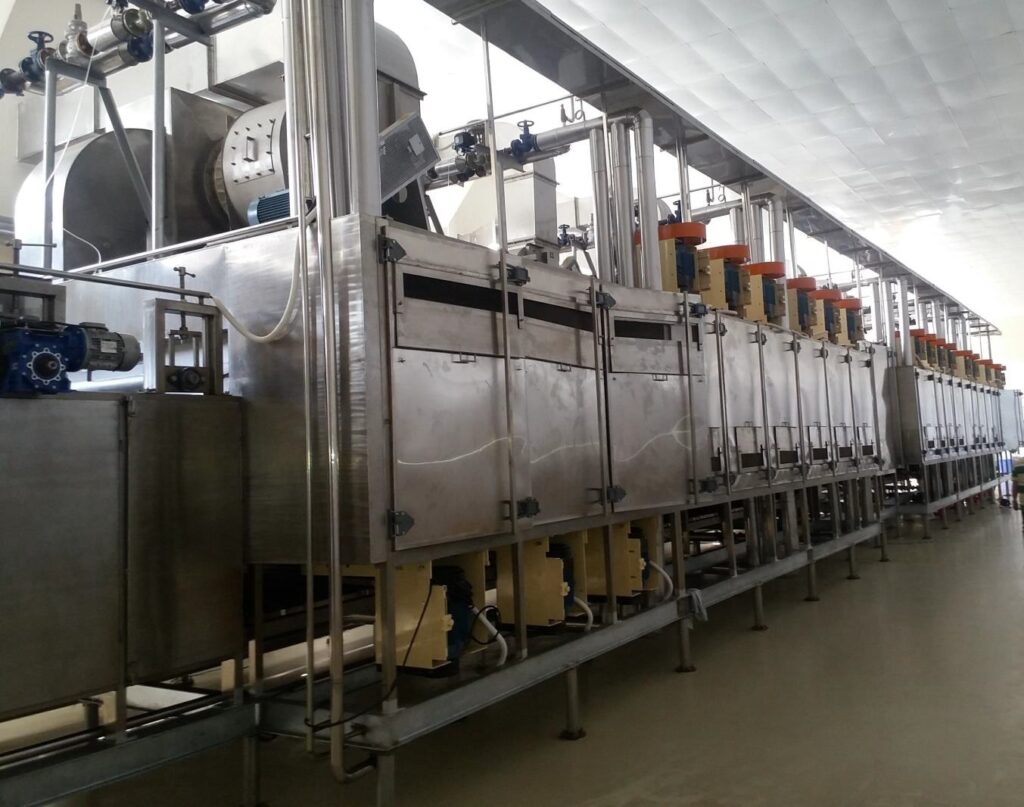
A tray-type belt dryer can be considered where the processor requires continuous movement with controlled drying zones.
It can be evaluated for prepared agricultural products such as:
- Chilli
- Ginger
- Turmeric
- Onion
- Garlic
- Vegetables
- Herbs
- Other spice materials
GTI’s spice-drying technology content describes tray-type belt systems with controlled residence time, multiple drying zones and adjustable airflow for prepared spice and agricultural materials.
Heat Pump Chilli Dryer
For applications where lower-temperature or dehumidified-air drying is advantageous, a heat pump dryer can be evaluated.
Heat pump systems recirculate and dehumidify drying air while recovering heat within the system.
GTI’s heat-pump drying portfolio includes chilli and peppers among its agricultural and food-processing applications.
The suitability of a heat pump dryer depends on:
- Product sensitivity
- Required drying temperature
- Throughput
- Ambient conditions
- Final moisture
- Energy economics
- Operating hours
How to Select the Right Chilli Dryer Machine
Choosing a chilli dryer should begin with the material rather than the machine.
Step 1: Identify the Chilli Form
Is the material:
- Whole?
- Sliced?
- Cut?
- Flaked?
- Granulated?
- Powder?
- Fresh?
- Partially dried?
Step 2: Determine Initial Moisture
The initial moisture significantly affects the evaporation load and dryer sizing.
Step 3: Define Final Moisture
The required final moisture should be based on the intended application and storage requirements.
Step 4: Determine Production Capacity
Capacity can be expressed as:
kg/hour
or:
tonnes/day
Step 5: Evaluate Heat Sensitivity
The drying profile should consider the desired colour, aroma, flavour and overall product quality.
Step 6: Select Energy Source
Possible heating arrangements may include:
- Steam
- Thermal oil
- Gas
- LPG
- Electricity
- Biomass
- Waste heat
- Heat-pump systems
Step 7: Determine Continuous or Batch Operation
For large-scale processing, continuous drying may be evaluated.
For smaller or flexible production, batch systems may be more appropriate.
Chilli Drying Temperature, Moisture and Residence Time
One of the most important points in industrial chilli drying is that there is no universal temperature or residence time applicable to every chilli product.
Drying conditions depend on:
- Chilli variety
- Freshness
- Initial moisture
- Whole or cut form
- Product size
- Loading density
- Air velocity
- Relative humidity
- Desired final moisture
- Colour requirements
- Aroma requirements
- Dryer configuration
Therefore, a manufacturer should calculate the drying requirement from actual product data.
For GTI projects, the process can be approached through:
Product Testing → Moisture Analysis → Drying Calculation → Dryer Selection → Capacity Design → Customized Manufacturing
How to Calculate Chilli Dryer Capacity
A chilli dryer should not be sized only by the amount of fresh chilli entering the plant.
The key calculation is the amount of water that must be removed.
For example:
Wet Feed → Water Evaporation → Dry Product
The evaporation requirement depends on:
- Fresh feed rate
- Initial moisture
- Final moisture
- Operating hours
- Drying efficiency
- Heat losses
- Air conditions
For accurate engineering, GTI can evaluate the actual process data and determine the required dryer capacity and evaporation duty.
Energy-Efficient Chilli Drying System
Energy efficiency is increasingly important for industrial food processors.
A properly designed system can improve energy performance through:
- Controlled airflow
- Heat recovery where applicable
- Insulated drying chambers
- Multi-zone drying
- Variable-speed drives
- Controlled exhaust
- Recirculation
- Appropriate heating-system selection
- Automation
- Product-specific residence time
However, energy consumption should always be calculated for the specific product and process rather than quoted as a universal value.
Hygienic Chilli Drying Equipment
Chilli is ultimately used in food and seasoning applications, making hygienic equipment design important.
Depending on the application, an industrial chilli dryer may incorporate:
- Stainless-steel product-contact surfaces
- Cleanable surfaces
- Accessible inspection areas
- Controlled airflow
- Suitable filtration
- Dust management
- Temperature monitoring
- Controlled feeding
- Hygienic discharge
- Appropriate equipment finishes
For export-oriented processors, equipment and process design should be aligned with the food-safety requirements applicable to the target market.
Automation in Industrial Chilli Drying
Modern chilli drying systems can be integrated with automation to improve process repeatability.
Possible controls include:
- PLC
- HMI
- Temperature sensors
- Airflow monitoring
- VFD control
- Conveyor-speed control
- Fan control
- Heating control
- Alarm systems
- Data monitoring
Automation can help operators maintain consistent process conditions across production batches.
Chilli Drying Process Flow
A typical industrial chilli processing line may follow:
Fresh Chilli
↓
Receiving
↓
Sorting
↓
Cleaning
↓
Washing Where Applicable
↓
Pre-Processing / Cutting Where Required
↓
Industrial Drying
↓
Cooling
↓
Grading
↓
Whole Dried Chilli / Flakes / Grinding
↓
Sieving
↓
Packaging
The actual process varies according to whether the final product is whole dried chilli, flakes, powder, extract or another value-added product.
From Dried Chilli to Value-Added Products
Drying is often the first major step toward value addition.
A processor can move from:
Fresh Chilli
→ Dried Chilli
→ Chilli Flakes
→ Chilli Powder
→ Seasoning Blends
→ Chilli Extract / Oleoresin Applications
→ Value-Added Food Ingredients
This makes industrial drying relevant not only to traditional spice traders but also to:
- Food manufacturers
- Seasoning companies
- Spice exporters
- Ingredient manufacturers
- Ready-to-eat food producers
- Snack manufacturers
- Sauce manufacturers
- Oleoresin processors
- Private-label spice brands
Chilli Dryer Applications Across Industries
Industrial chilli drying systems can support several sectors.
Spice Processing
Whole dried chilli, flakes and powder.
Food Processing
Sauces, seasonings, ready-to-eat foods and processed foods.
Snack Industry
Spice ingredients for snack formulations.
Seasoning Industry
Chilli-based seasoning blends.
Ingredient Manufacturing
Standardized dried chilli ingredients.
Export Processing
Controlled dehydration before grading, packaging and export.
Oleoresin Industry
Drying as part of upstream raw-material preparation.
Global Market for Industrial Chilli Drying Systems
The requirement for chilli drying is not limited to India.
Potential international markets include:
China
Large-scale agricultural and spice-processing industry.
Vietnam
Chilli and food-processing applications alongside other spice industries.
Indonesia
Tropical agricultural processing and spice applications.
Bangladesh
Food processing, chilli consumption and agricultural dehydration.
Sri Lanka
Spice processing and value-added food ingredients.
Nigeria and West Africa
Agricultural processing and growing opportunities for food dehydration.
Middle East
Demand for dried spices, seasonings and imported food ingredients.
Europe
Processed spice ingredients, seasoning products and food manufacturing.
North America
Spice processing, food ingredients and downstream seasoning applications.
For GTI, international enquiries can be developed around country-specific search intent such as:
Chilli Dryer Machine Manufacturer in Bangladesh
Industrial Chilli Dryer in Nigeria
Chilli Drying Machine Supplier in Indonesia
Chilli Dryer Manufacturer in Sri Lanka
Industrial Chilli Dehydration System in Africa
Chilli Dryer for India
GTI can build a topical cluster around:
Core Keyword
Chilli Dryer Machine Manufacturer India
Product Keywords
- Industrial Chilli Dryer
- Chilli Drying Machine
- Red Chilli Dryer
- Chilli Dehydration Machine
- Chilli Dryer Manufacturer
- Chilli Processing Machine
Technology Keywords
- Chilli Band Dryer
- Chilli Belt Dryer
- Chilli Tray Dryer
- Continuous Chilli Dryer
- Hot Air Chilli Dryer
- Industrial Spice Dryer
Product-Form Keywords
- Whole Chilli Dryer
- Chilli Slice Dryer
- Chilli Flakes Dryer
- Dried Chilli Processing System
Geographic Keywords
- Chilli Dryer Machine in Andhra Pradesh
- Chilli Dryer Machine in Guntur
- Chilli Dryer Machine in Telangana
- Chilli Dryer Machine in Madhya Pradesh
- Chilli Dryer Machine in Karnataka
- Chilli Dryer Machine in Maharashtra
- Chilli Dryer Machine in Tamil Nadu
- Chilli Dryer Machine in West Bengal
This creates a stronger topical structure than repeating the same generic “chilli dryer” keyword throughout the page.
Indian Language for Chilli Dryer
India’s multilingual search behaviour can also be incorporated into the content strategy.
Useful Hindi terminology includes:
- मिर्च सुखाने की मशीन — Chilli drying machine
- मिर्च ड्रायर मशीन — Chilli dryer machine
- लाल मिर्च सुखाने की मशीन — Red chilli drying machine
- मिर्च डिहाइड्रेशन मशीन — Chilli dehydration machine
- औद्योगिक मसाला ड्रायर — Industrial spice dryer
Depending on the target state, regional-language landing pages can be developed separately rather than overloading the primary English pillar page.
Common Chilli Drying Problems and Solutions
| Problem | Possible Process Cause | Industrial Approach |
| Uneven moisture | Uneven loading or airflow | Improve product distribution and airflow |
| Excessive drying | Excessive residence time | Adjust belt speed/process profile |
| Poor colour | Unsuitable thermal exposure | Optimize drying profile |
| Long drying time | High moisture load or insufficient drying capacity | Recalculate evaporation duty |
| Uneven final moisture | Non-uniform product exposure | Multi-zone airflow and controlled loading |
| High energy use | Excessive exhaust/heat loss | Evaluate insulation, recirculation and heat recovery |
| Low throughput | Undersized drying area | Recalculate capacity and evaporation load |
| Product sticking | Product characteristics/loading | Evaluate feed preparation and handling |
| Quality variation | Inconsistent raw material | Improve sorting and process control |
These are engineering considerations rather than universal machine settings. The actual solution depends on the material and plant conditions.
How Much Does a Chilli Dryer Machine Cost?
The cost of an industrial chilli dryer cannot be accurately determined from capacity alone.
Important cost factors include:
- Dryer technology
- Capacity
- Evaporation load
- Initial and final moisture
- Product form
- Drying area
- Number of drying zones
- Material of construction
- Heating system
- Automation level
- Feeding system
- Discharge system
- Exhaust system
- Dust-control requirements
- Installation requirements
- Plant layout
For this reason, a project-specific quotation is more meaningful than a generic “price per tonne” estimate.
Why Choose GTI Dryers for Chilli Drying Systems?
GTI Dryers approaches industrial drying as a process-engineering requirement, rather than simply supplying a standard machine.
The design process can be based on:
Product → Feed Form → Initial Moisture → Final Moisture → Throughput → Heat Sensitivity → Residence Time → Energy Source → Plant Layout
GTI’s industrial food-drying portfolio covers chilli and other spice applications, while its band-dryer range includes chilli and spices among its food-processing applications.
Depending on the application, GTI can evaluate:
- Band Dryer
- Tray-Type Belt Dryer
- Mesh Belt Dryer
- Tray Dryer
- Hot-Air Drying System
- Heat Pump Dryer
- Customized Continuous Dryer
- Other application-specific drying technologies
The final configuration should be selected after evaluating the actual product and process requirement.
Chilli Dryer Project Enquiry Checklist
For a preliminary technical evaluation, provide:
Product Information
- Chilli variety
- Whole/sliced/cut/flakes/powder
- Fresh or partially processed
- Product dimensions
Moisture Information
- Initial moisture %
- Required final moisture %
Production Information
- Feed capacity in kg/hour or tonnes/day
- Operating hours/day
- Batch or continuous operation
Process Information
- Desired product quality
- Colour requirements
- Aroma requirements
- Downstream process
Energy Information
- Steam
- Gas
- LPG
- Electricity
- Biomass
- Thermal oil
- Heat pump
- Other available heat source
Plant Information
- Plant location
- Available floor space
- Existing processing equipment
- Installation requirements
The more accurate the process information, the more accurately the dryer can be engineered.
Frequently Asked Questions About Chilli Drying Systems
Which dryer is used for chilli?
The appropriate dryer depends on the chilli form, moisture content, capacity and final product. Continuous belt or band dryers can be evaluated for suitable whole or prepared chilli products, while tray/cabinet systems can be considered for batch applications.
What is an industrial chilli dryer?
An industrial chilli dryer is a controlled dehydration system designed to reduce moisture from chilli while maintaining the required product characteristics and processing consistency.
Can a band dryer dry chilli?
Yes. Band dryers can be evaluated for chilli and spice applications, particularly where continuous processing is required. GTI lists chilli and spices among its band-dryer food-processing applications.
Can a belt dryer be used for chilli flakes?
A suitable belt/band configuration can be evaluated for chilli flakes depending on particle size, bulk density, moisture and required throughput.
Can fresh chilli be dried industrially?
Yes. Industrial drying systems can be designed for fresh chilli after appropriate receiving, sorting, cleaning and other required pre-processing steps.
What is the best temperature for drying chilli?
There is no single temperature that applies to every chilli variety and product form. Drying conditions should be determined from the chilli characteristics, initial moisture, final moisture, quality requirements and dryer configuration.
How is chilli dryer capacity calculated?
Capacity is based on feed rate, initial moisture, target final moisture, operating hours and the amount of water that must be evaporated, together with the drying system’s thermal and air-side design.
Can one dryer process chilli, turmeric and ginger?
A suitably designed multi-product drying system may be evaluated for several spice products. However, each product can require different drying profiles, loading conditions and residence times.
Is continuous drying better than batch drying?
Neither is universally better. Continuous systems can be advantageous for high-throughput production, while batch dryers can provide flexibility for smaller or varied production requirements.
Does GTI manufacture customized chilli dryers?
GTI Dryers develops customized industrial drying systems based on product characteristics, throughput, moisture requirements, energy source and plant conditions.
Build a Customized Industrial Chilli Drying System With GTI Dryers
Chilli processing is moving beyond traditional drying toward controlled dehydration, consistent moisture, hygienic processing, value addition and export-oriented production.
For an industrial processor, the objective is not simply to remove moisture.
The objective is to develop a drying system that can achieve the required:
Capacity + Moisture Reduction + Product Quality + Energy Performance + Hygiene + Process Consistency
GTI Dryers can evaluate the appropriate drying technology according to the actual chilli-processing requirement.
Whether you are establishing a new chilli-processing plant, expanding an existing facility, replacing conventional drying or developing a value-added chilli product, the first step is to understand the product and process.
Send GTI Dryers Your Chilli Drying Requirement
Provide:
Product + Feed Form + Feed Rate + Initial Moisture + Final Moisture + Heat Source + Operating Hours + Plant Location
GTI Dryers can then evaluate the appropriate industrial drying configuration for your application.
GTI Dryers — Engineered Drying Solutions from India for Global Industries.