
Industrial Dryer Manufacturer for Sodium Carbonate, Sodium Bicarbonate, Ammonium Salts, Potassium Chloride, Magnesium Sulfate, Calcium Carbonate, Titanium Dioxide, Silica, Zeolites & Other Bulk Inorganic Chemicals
Bulk inorganic chemicals and salts are among the most established applications for continuous industrial drying.
After crystallization, precipitation, filtration, centrifugation or washing, the product may leave the upstream process as wet crystals, granules, filter cake, agglomerates or pasty solids. The dryer must then remove the required moisture without creating excessive fines, caking, decomposition, unwanted particle-size changes or downstream handling problems.
This is why selecting a dryer for inorganic chemicals is not simply a matter of choosing the machine with the highest evaporation capacity.
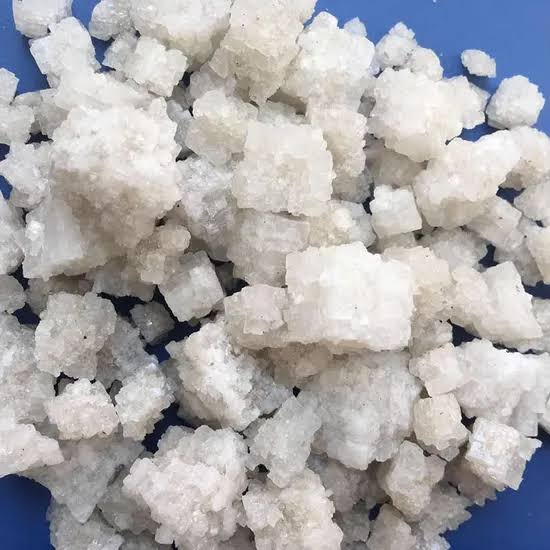
The right system depends on:
- Feed form and particle size
- Initial and target moisture
- Crystal or granule strength
- Product temperature limitation
- Hygroscopicity and caking tendency
- Required throughput
- Bulk density
- Dust generation
- Corrosion characteristics
- Heat source
- Residence time
- Exhaust and dust-handling requirements
- Required final product quality
GTI Dryers designs industrial drying systems around these process conditions rather than applying one dryer technology to every chemical.
Why Drying Is Critical in Bulk Inorganic Chemical Manufacturing
Inorganic chemicals are frequently produced through crystallization, precipitation, reaction, neutralization or other wet-process routes.
The resulting material may contain substantial surface moisture or process liquor.
A typical process route can therefore look like:
Reaction / Precipitation → Crystallization → Solid-Liquid Separation → Washing → Wet Crystals / Filter Cake → Industrial Dryer → Cooling → Screening → Storage / Packing
The dryer is often the bridge between wet chemical processing and a stable commercial product.
Poor drying can create:
- High residual moisture
- Product caking during storage
- Difficult conveying
- Unstable bulk density
- Excessive fines
- Crystal breakage
- Wall deposits
- Uneven moisture distribution
- Product overheating
- Increased energy consumption
- Dust-control problems
- Reduced downstream packing efficiency
For this reason, the drying system should be engineered together with feeding, dust collection, cooling, conveying and product handling.
Which Inorganic Chemicals Require Industrial Drying?
Bulk inorganic chemical drying applications include a wide range of crystals, granules, powders and filter cakes.
Common applications include:
| Material | Typical Feed Condition | Dryer Technologies to Evaluate |
| Sodium carbonate / Soda ash | Crystals / granular solids | Fluid Bed, Rotary, other engineered systems |
| Sodium bicarbonate | Crystals / powder | Fluid Bed, controlled hot-air systems |
| Ammonium sulfate | Crystals / granules | Fluid Bed, Rotary |
| Ammonium nitrate | Granules | Fluid Bed / specialized systems |
| Potassium chloride | Crystals / granules | Fluid Bed, Rotary |
| Magnesium sulfate | Crystals | Fluid Bed, Rotary, other suitable systems |
| Calcium carbonate | Wet cake / powder | Spin Flash, Rotary, other process-specific systems |
| Titanium dioxide | Wet cake / paste | Spin Flash / Roto-Flash, other systems |
| Silica | Wet cake / powder | Spin Flash / Roto-Flash |
| Zeolites | Wet cake / granules | Spin Flash, Fluid Bed, Rotary depending on feed |
| Sodium sulfate | Crystals | Fluid Bed / Rotary |
| Potassium sulfate | Crystals / granules | Fluid Bed / Rotary |
| Mineral-based chemicals | Cake / crystals / granules | Rotary, Fluid Bed, Spin Flash |
| Chemical intermediates | Variable | Technology selected from material characteristics |
The table is a technology-selection starting point, not a universal equipment specification. Final selection should be based on actual product testing and process data.
The First Question: What Is Your Wet Feed Like?
This is one of the most important questions when selecting an inorganic chemical dryer.
Two products with similar chemistry can require completely different dryers if their physical form is different.
1. Free-flowing crystals or granules
Examples include suitable grades of:
- Sodium carbonate
- Sodium bicarbonate
- Potassium chloride
- Ammonium sulfate
- Sodium sulfate
- Potassium sulfate
These materials may be suitable for fluid-bed or rotary drying, depending on particle size, moisture, capacity, heat sensitivity and handling characteristics.
2. Wet filter cakes
A filter cake behaves very differently from a free-flowing crystal.
It may be:
- Cohesive
- Sticky
- Agglomerated
- Difficult to fluidize
- High in moisture
- Prone to wall buildup
In these cases, a spin-flash, paddle or another mechanically assisted drying route may be more appropriate than directly feeding the cake into a conventional fluid bed.
3. Fine powders or precipitated materials
Fine materials can create:
- Dust carryover
- Agglomeration
- Poor feeding
- High pressure drop
- Product loss
- Difficult separation
The drying system may therefore require controlled dispersion, classification and dust collection.
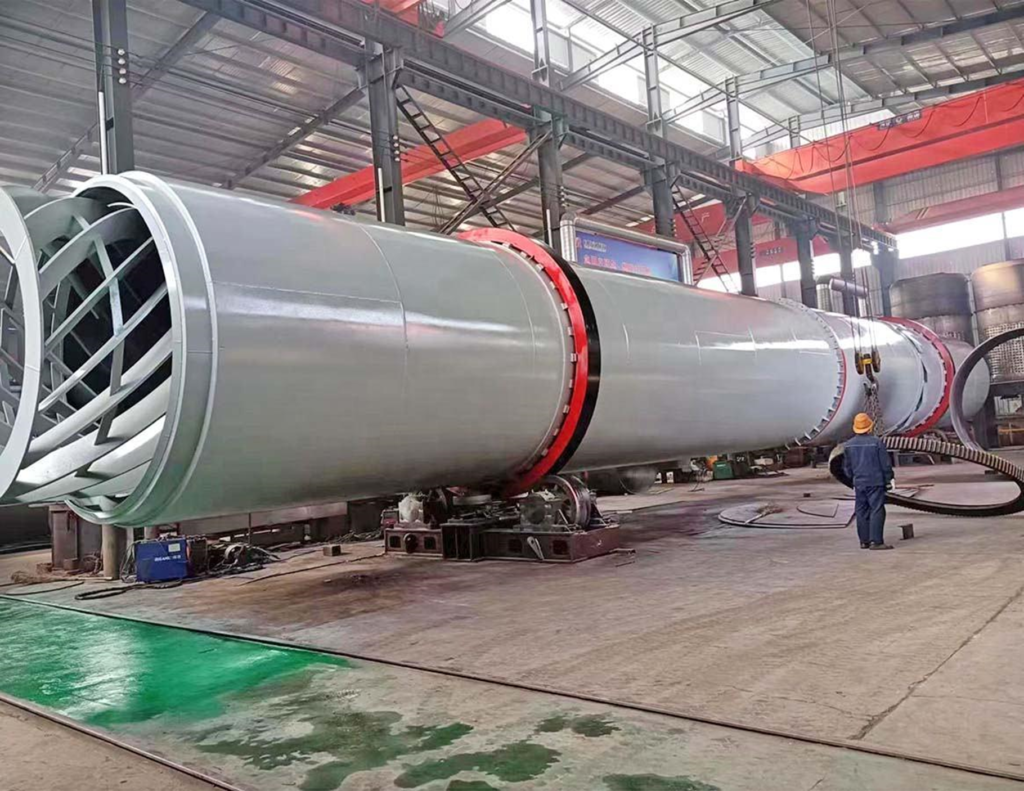
Rotary Dryer for Bulk Inorganic Chemicals & Salts
A rotary dryer is one of the established continuous technologies for high-throughput bulk solids.
It is particularly attractive when the material is:
- Granular
- Crystalline
- Relatively robust
- Suitable for continuous handling
- Produced at high capacity
The material travels through a rotating cylindrical chamber while heated gas transfers energy to the product in a direct or indirect configuration.
Where Can Rotary Dryers Be Considered?
Depending on material characteristics, applications may include:
- Industrial salts
- Mineral products
- Fertilizer-related materials
- Chemical crystals
- Inorganic bulk solids
- Granular materials
The internal flight arrangement, drum dimensions, airflow, residence time and heat-transfer configuration should be designed around the actual product.
Key advantages
- High-throughput operation
- Robust mechanical design
- Continuous processing
- Suitable for many bulk solids
- Relatively simple mechanical concept
- Can be integrated with downstream cooling and dust collection
When a rotary dryer may not be the best choice
A rotary dryer should not automatically be selected for:
- Extremely fragile crystals
- Very fine powders requiring tight particle-size control
- Highly sticky filter cakes
- Materials requiring highly controlled low-temperature drying
- Applications where product attrition must be minimized
In these cases, fluid-bed, spin-flash, paddle or another technology may provide a better process fit.
Fluid Bed Dryer for Inorganic Salts & Crystals
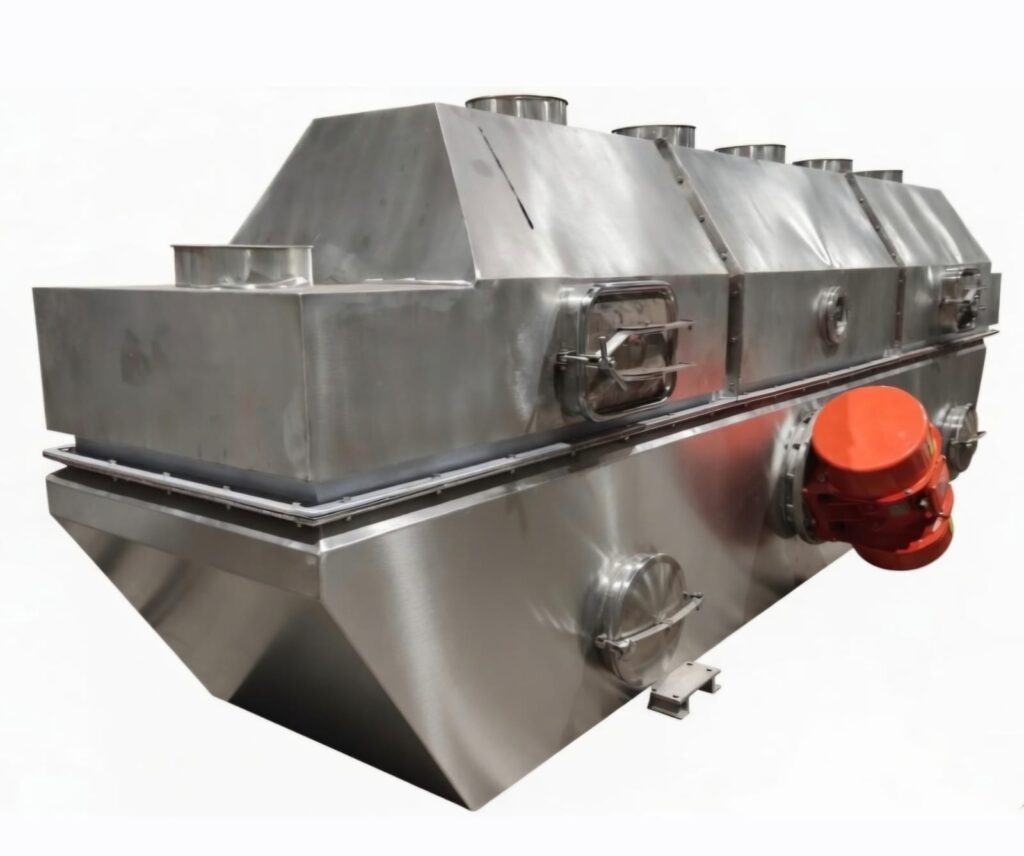
For free-flowing crystals and granules, fluid-bed drying is often an important technology to evaluate.
Hot air passes through a perforated distribution system and fluidizes the particles, creating intensive gas-solid contact.
This can provide efficient moisture transfer and controlled residence time.
Typical Applications
Fluid-bed systems can be considered for suitable:
- Sodium carbonate
- Sodium bicarbonate
- Potassium chloride
- Ammonium sulfate
- Sodium sulfate
- Potassium sulfate
- Other inorganic salt crystals
- Chemical granules
Industry equipment references similarly identify fluid-bed drying as a common route for crystalline inorganic salts and free-flowing granules.
Potential advantages
- Efficient heat and mass transfer
- Good moisture uniformity
- Continuous operation
- Controlled residence time
- Drying and cooling can be integrated
- Suitable for automated process control
Drying + Cooling in One Process Line
For some salt and chemical products, the process should not end immediately after drying.
The product may leave the dryer too hot for:
- Packaging
- Storage
- Conveying
- Screening
- Bulk handling
A fluid-bed dryer-cooler can therefore be evaluated when simultaneous drying and cooling are beneficial.
The complete line may include:
Wet Crystals → Feed System → Fluid Bed Dryer → Cooling Zone → Dust Collection → Conveying → Screening → Storage / Packing
Spin Flash Dryer for Wet Chemical Filter Cakes
A spin flash dryer becomes particularly interesting when the feed is not a free-flowing granular solid.
It is designed for applications involving:
- Wet filter cakes
- Pastes
- Cohesive solids
- Fine chemical materials
- Precipitated products
- Slurries converted to cake
- Materials requiring rapid drying and dispersion
The mechanical rotor helps disperse and break up the wet feed while hot gas rapidly removes moisture.
Spin/roto-flash technology is commercially used for inorganic materials including silica, titanium dioxide, calcium carbonate and zeolite.
Why Spin Flash Can Solve a Different Problem
A conventional fluid bed generally expects material that can be appropriately fluidized.
A wet filter cake may instead form lumps and resist fluidization.
Spin-flash drying can address this by combining:
Mechanical dispersion + rapid hot-air drying + particle classification
This can allow wet cake to be converted into a dry powder in a continuous process.
Typical process concept
Wet Filter Cake → Controlled Feeding → Mechanical Dispersion → Rapid Drying → Classification → Cyclone / Bag Filter → Dry Powder
The actual configuration depends on the material’s moisture, stickiness, particle-size requirement, temperature sensitivity and dust characteristics.
Sodium Carbonate / Soda Ash Drying
Sodium carbonate, commonly known as soda ash, is manufactured in different grades and physical forms.
Depending on the process route and product form, the drying requirement may involve crystalline or granular material.
The major engineering objectives can include:
- Controlled residual moisture
- Uniform drying
- Prevention of unwanted agglomeration
- Product-temperature control
- Dust management
- High throughput
- Reliable continuous operation
For suitable crystalline or granular soda ash, fluid-bed and rotary technologies can be evaluated based on feed and capacity requirements.
Sodium Bicarbonate Dryer
Sodium bicarbonate requires careful thermal management because drying conditions should be selected with consideration for the material’s thermal behavior.
The objective is not simply maximum evaporation.
The system should consider:
- Feed moisture
- Product temperature
- Particle size
- Residence time
- Desired final moisture
- Dust generation
- Product quality requirements
For suitable crystalline material, fluid-bed drying may be evaluated, while other configurations may be considered depending on the feed condition.
Ammonium Sulfate & Ammonium Salt Drying
Ammonium sulfate is commonly handled as crystals or granules.
A continuous dryer may be required after crystallization and solid-liquid separation.
Important design considerations include:
- Crystal size
- Surface moisture
- Throughput
- Caking tendency
- Product temperature
- Dust carryover
- Corrosion
- Final moisture
For suitable free-flowing material, fluid-bed or rotary drying can be evaluated.
Ammonium-based products should always be evaluated for their specific thermal and safety characteristics before finalizing the dryer design.
Potassium Chloride Dryer
Potassium chloride is frequently processed as crystalline material and can require continuous drying after upstream separation.
The drying system must account for:
- Crystal size distribution
- Moisture entering the dryer
- Required final moisture
- Product temperature
- Crystal attrition
- Caking
- Throughput
- Dust recovery
For free-flowing KCl crystals, fluid-bed and rotary systems are common technologies to evaluate.
The final choice depends on whether the priority is high-volume robustness, tighter residence-time control, integrated cooling or another process requirement.
Magnesium Sulfate Dryer
Magnesium sulfate can occur in different hydrated forms, making thermal processing particularly dependent on the required product form and process conditions.
A dryer specification therefore needs to distinguish between:
- Surface moisture
- Hydrated water
- Desired product hydrate
- Final product specification
- Product-temperature limitation
This is important because removing moisture is not necessarily the same as removing chemically bound water.
The dryer should be designed around the required chemical form rather than simply maximizing evaporation.
Calcium Carbonate Dryer
Calcium carbonate can be processed as:
- Wet precipitated calcium carbonate cake
- Fine powder
- Mineral-derived material
- Specialty-grade product
When the feed arrives as a wet filter cake, the main challenge can be dispersion and rapid drying, not simply heat transfer.
Spin-flash technology can be considered for suitable calcium carbonate cakes and fine inorganic materials.
The process should also consider:
- Particle-size distribution
- Bulk density
- Powder recovery
- Wall deposition
- Product temperature
- Dust collection
Titanium Dioxide Dryer
Titanium dioxide is a high-value inorganic pigment, and its drying process requires more than simply removing water.
Important considerations can include:
- Wet-cake characteristics
- Particle morphology
- Product temperature
- Agglomeration
- Particle-size distribution
- Powder recovery
- Downstream finishing requirements
Spin/roto-flash drying is one technology used for suitable titanium dioxide applications. Industrial references specifically identify TiO₂ among materials processed in roto-flash systems.
The final system must be designed around the specific grade and upstream/downstream process.
Silica Dryer
Silica can present a particularly challenging drying application because fine wet silica cakes can be cohesive and difficult to handle.
A suitable spin-flash system can provide:
- Mechanical dispersion
- Rapid moisture removal
- Fine powder production
- Particle-size control through classification
- Continuous operation
Spin-flash technology is specifically used in industrial silica drying applications, where rapid drying and particle-size control can be important.
Zeolite Dryer
Zeolites can be processed through different wet and dry routes.
Depending on the material and required product properties, drying may need to address:
- Wet filter cake
- Particle size
- Bulk density
- Residual moisture
- Product temperature
- Agglomeration
- Final adsorption-related specifications
Spin-flash, fluid-bed or rotary drying may be evaluated depending on whether the feed is a wet cake, granule or free-flowing particulate material.
Dryer Selection Matrix for Inorganic Chemicals
| Process Problem | Dryer Technology to Evaluate | Why |
| High-volume robust crystals | Rotary Dryer | Continuous heavy-duty operation |
| Free-flowing crystals | Fluid Bed Dryer | Efficient gas-solid contact |
| Crystals requiring drying + cooling | Fluid Bed Dryer-Cooler | Integrated thermal conditioning |
| Wet filter cake | Spin Flash Dryer | Mechanical dispersion + rapid drying |
| Fine precipitated chemical cake | Spin Flash Dryer | Breakup, drying and classification |
| Sticky/pasty material | Paddle Dryer / Spin Flash | Mechanical handling of cohesive feed |
| Heat-sensitive specialty chemical | Vacuum / indirect system | Controlled low-temperature processing |
| Fragile particles | Carefully engineered Fluid Bed / Belt | Reduced mechanical stress |
| Very fine powder | Spin Flash / specialized system | Controlled dispersion and collection |
| Very high-volume bulk solids | Rotary / Fluid Bed | Scalable continuous processing |
Important: this is a screening matrix. The correct technology should be confirmed using actual feed samples and process data.
The Real Problem Is Often Upstream of the Dryer
A dryer cannot compensate for an unstable upstream process.
For example:
Problem: Variable filter-cake moisture
Result:
- Dryer load changes
- Outlet moisture fluctuates
- Energy consumption varies
- Product quality becomes inconsistent
Engineering response:
Improve feed preparation and install controlled feeding before optimizing dryer parameters.
Problem: Wet cake enters as large lumps
Result:
- Poor drying
- Wet cores
- Wall buildup
- Longer residence time
Potential solution:
Use suitable mechanical dispersion, size reduction or a dryer technology capable of handling cohesive feed.
Problem: Excessive crystal breakage
Result:
- Increased fines
- Dust loading
- Product-quality changes
- Material losses
Potential solution:
Review mechanical handling, dryer internals, vibration, airflow and residence time.
Problem: Product cakes after drying
Possible causes include:
- Excessive residual moisture
- Product leaving the dryer too hot
- Hygroscopicity
- Inadequate cooling
- Storage humidity
- Poor particle-size distribution
The solution may therefore require drying + cooling + storage-condition control, rather than simply increasing dryer temperature.
Problem: High energy consumption
The first question should be:
Where is the heat actually going?
Potential contributors include:
- High initial moisture
- Excessive exhaust airflow
- Poor insulation
- Low heat recovery
- Incorrect air-to-product ratio
- Over-drying
- Unoptimized residence time
- Inefficient feed distribution
Energy optimization should be performed against the complete process rather than by looking only at the dryer.
Drying Is Not Just About Final Moisture
For inorganic chemicals, the final product specification can involve much more than moisture.
Depending on the product, the buyer may care about:
- Particle size
- Bulk density
- Crystal integrity
- Flowability
- Caking tendency
- Temperature
- Purity
- Fines
- Powder recovery
- Hydration state
- Morphology
- Downstream processability
This is why a dryer capable of achieving a particular moisture level is not automatically the right dryer.
What Should Be Controlled in an Industrial Chemical Dryer?
A properly engineered system can incorporate monitoring and control of parameters such as:
- Feed rate
- Feed moisture
- Inlet air temperature
- Outlet air temperature
- Product temperature
- Airflow
- Pressure
- Residence time
- Bed depth
- Vibration where applicable
- Rotor speed for spin-flash systems
- Exhaust conditions
- Dust loading
- Final product moisture
PLC-based automation can be integrated where required, allowing operators to monitor process conditions and maintain repeatable operation.
Dust Collection Is Part of the Dryer System
Fine inorganic chemicals can generate significant dust.
Therefore, the dryer should not be treated as an isolated machine.
A complete system may include:
Dryer → Cyclone / Primary Separation → Bag Filter → Exhaust System
The exact dust-control configuration depends on:
- Particle size
- Airflow
- Product value
- Dust concentration
- Environmental requirements
- Product recovery requirements
For valuable powders such as pigments or specialty inorganic chemicals, recovering product from the exhaust stream can also be an important part of the process economics.
Corrosion & Materials of Construction
Chemical drying systems may operate in environments where corrosion is a major design consideration.
The equipment specification should therefore consider:
- Chemical composition
- Chlorides
- Acidity / alkalinity
- Temperature
- Moisture
- Condensation
- Cleaning chemicals
- Operating atmosphere
Materials of construction, surface finish and component selection should be finalized from actual chemical and process conditions.
There is no single “stainless steel” specification that is automatically correct for every inorganic chemical application.
Energy-Efficient Industrial Drying
Energy performance depends strongly on the evaporation load and process design.
Potential strategies include:
1. Mechanical dewatering before thermal drying
Removing water mechanically before the dryer can substantially reduce the thermal evaporation duty.
2. Heat recovery
Waste heat can potentially be recovered where process conditions permit.
3. Indirect heating
For selected chemical applications, indirect drying can reduce exhaust volume and isolate the product from combustion gases.
GTI’s paddle-dryer technology, for example, uses indirect heat transfer through heated paddles and a jacket and is designed for suitable wet cakes, inorganic salts, minerals and other difficult materials.
4. Controlled airflow
Excessive airflow can increase heat losses and dust carryover.
5. Drying only to the required specification
Over-drying wastes energy and may negatively affect product quality.
Why Dryer Testing Matters for Inorganic Chemicals
Chemical materials can behave very differently even when they appear similar on paper.
Before final equipment selection, testing can help evaluate:
- Drying rate
- Feed dispersion
- Product temperature
- Moisture reduction
- Particle-size changes
- Agglomeration
- Dust generation
- Wall deposition
- Product recovery
- Energy requirement
For challenging chemical applications, sample testing or pilot trials can reduce the risk of selecting a dryer solely from theoretical calculations.
How GTI Dryers Approaches Bulk Inorganic Chemical Drying
GTI Dryers approaches chemical drying as a process-engineering problem, not simply an equipment purchase.
The engineering route can include:
Step 1 — Understand the Material
GTI evaluates:
- Chemical composition
- Physical form
- Particle size
- Bulk density
- Initial moisture
- Target moisture
- Hygroscopicity
- Thermal sensitivity
- Stickiness
- Caking behavior
Step 2 — Understand the Upstream Process
The dryer may receive material from:
- Crystallizer
- Filter
- Centrifuge
- Precipitation system
- Washing system
- Reactor
- Granulation system
Step 3 — Select the Drying Principle
Depending on the feed, GTI can evaluate technologies such as:
- Rotary Dryer
- Fluid Bed Dryer
- Vibratory Fluid Bed Dryer
- Spin Flash Dryer
- Paddle Dryer
- Belt / Band Dryer
- Vacuum Drying Systems
- Hybrid or multi-stage drying systems
Step 4 — Engineer the Complete Line
The system can be considered together with:
- Feeders
- Drying chamber
- Heating system
- Dust collection
- Cyclone
- Bag filter
- Cooling
- Conveying
- Screening
- Product storage
- Automation
Step 5 — Optimize for the Actual Product
The objective is to achieve the required combination of:
Throughput + Moisture + Product Quality + Energy Performance + Reliability
rather than simply maximizing evaporation.
Why Choose GTI Dryers for Bulk Inorganic Chemical Drying?
GTI Dryers provides industrial drying solutions for chemical and mineral processing applications where dryer selection depends on actual material and process conditions.
The approach is based on:
- Process-specific dryer selection
- Continuous industrial operation
- Customized equipment configuration
- Integration with upstream and downstream systems
- Dust-control consideration
- Energy-conscious design
- Automation options
- Material-of-construction selection
- Testing and process evaluation where required
GTI’s chemical-drying portfolio includes technologies suited to different feed forms, from bulk inorganic salts and crystalline materials to wet filter cakes and difficult chemical solids.
Need a Dryer for Soda Ash, KCl, Ammonium Sulfate, TiO₂, Silica or Another Inorganic Chemical?
Do not start with:
“Which dryer is cheapest?”
Start with:
“What is the physical condition of my feed, what moisture must be removed, and what product quality must be maintained?”
GTI Dryers can evaluate the appropriate industrial drying technology based on your actual process data.
Send GTI these details for a preliminary dryer assessment:
- Chemical / product name
- Feed form — crystals, granules, powder, filter cake or slurry
- Feed capacity — kg/h or TPH
- Initial moisture
- Required final moisture
- Particle-size range
- Bulk density
- Product-temperature limitation
- Upstream equipment
- Required operating hours
- Available heat source
- Plant location
- Desired automation level
- Any dust, solvent or emission-control requirement
With these parameters, the dryer technology can be evaluated around your process rather than around a generic catalogue specification.
Frequently Asked Questions
What type of dryer is used for inorganic salts?
For suitable free-flowing inorganic salt crystals and granules, fluid-bed and rotary dryers are commonly evaluated. The final choice depends on moisture, capacity, particle characteristics, caking, heat sensitivity and required cooling.
Which dryer is suitable for sodium carbonate or soda ash?
Depending on the product form and process, a fluid-bed or rotary dryer may be considered. The correct configuration depends on crystal size, feed moisture, throughput and product requirements.
Which dryer is suitable for potassium chloride?
For free-flowing KCl crystals, fluid-bed or rotary drying can be evaluated. Dryer selection should consider crystal size, moisture, caking, attrition, capacity and cooling requirements.
Which dryer is suitable for titanium dioxide?
For suitable wet TiO₂ cakes, spin-flash / roto-flash drying can be evaluated. Particle-size requirements, feed characteristics, product temperature and downstream finishing requirements must be considered.
Which dryer is suitable for silica?
Wet silica cakes can be challenging to fluidize. A spin-flash drying system may be considered where rapid dispersion, drying and particle-size control are required.
Can a fluid-bed dryer handle wet filter cake?
Not necessarily. A filter cake may be cohesive and unsuitable for direct fluidization. Depending on its physical characteristics, spin-flash, paddle or another mechanically assisted drying technology may be more appropriate.
What information is required to size an industrial chemical dryer?
The most important information includes feed rate, initial moisture, target moisture, feed temperature, particle size, bulk density, product temperature limitation, material characteristics, heat source and operating hours.
Can GTI provide a complete chemical drying system?
Yes. GTI can engineer the dryer together with associated feeding, heating, dust collection, cooling, conveying, screening and automation requirements, depending on project scope.
Final Takeaway
Bulk inorganic chemicals and salts are classic industrial drying applications, but there is no universal chemical dryer.
A free-flowing potassium chloride crystal, a sodium bicarbonate crystal, a wet calcium carbonate cake and a precipitated silica filter cake can all require completely different drying approaches.
The practical selection logic is:
Crystals / Granules → Evaluate Fluid Bed or Rotary
Wet Filter Cake / Cohesive Solids → Evaluate Spin Flash or Paddle
Fine Inorganic Powder → Evaluate Dispersion, Classification & Dust Collection
Heat-Sensitive / Specialized Material → Evaluate Controlled Indirect or Vacuum Options
High-Throughput Plant → Engineer Dryer + Cooling + Dust Collection + Conveying as One System
The best drying system is therefore the one engineered around the material, moisture load, throughput, product quality and complete process line.
GTI Dryers — Engineered Drying Solutions from India for Global Chemical & Process Industries.
Request a Bulk Chemical Dryer Evaluation
Send your material name, feed condition, capacity, initial moisture and target moisture to GTI Dryers for a preliminary technology assessment.