
Desiccated coconut, coconut chips and coconut flakes are high-value products for domestic and export markets. Drying determines colour, residual moisture, shelf life and oil stability. Continuous band (mesh-belt) dryers are widely used because they handle layered chips and flakes gently and allow multi-zone temperature control.
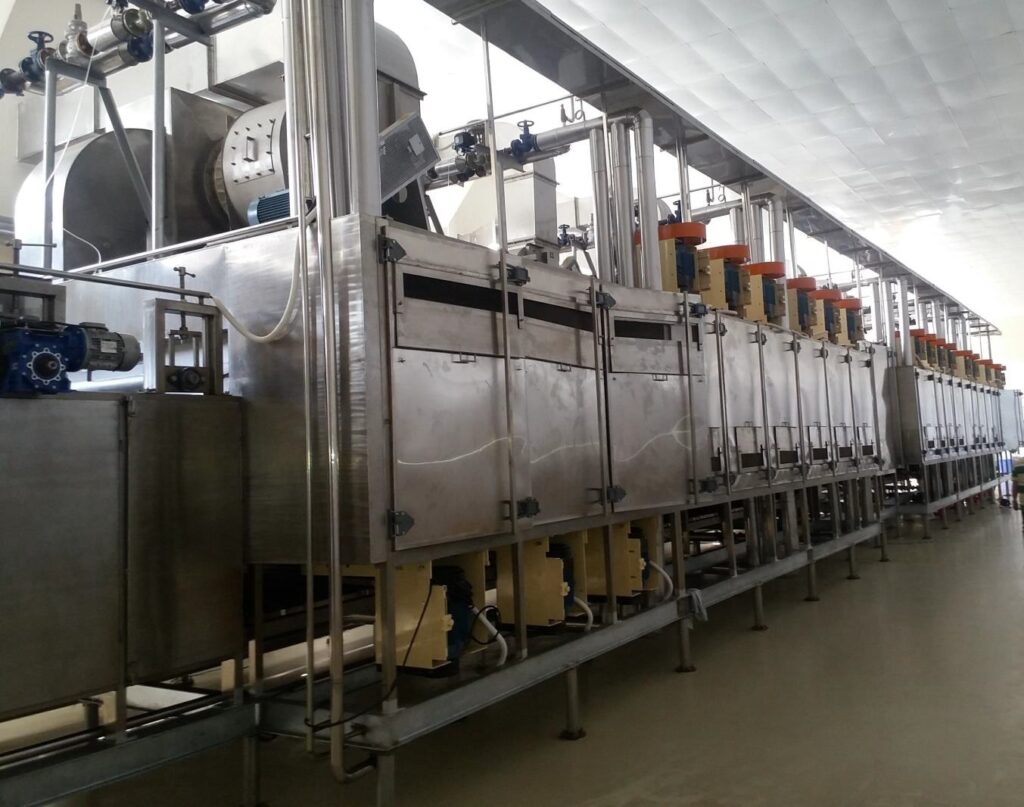
This 2026 buyer’s guide explains what coconut processors should require from a band dryer, how to protect colour and quality, and how to specify a system for Indian and export-oriented plants.
Note on “best”
There is no single best dryer for every coconut product and capacity. The right band dryer is the one matched to your cut size, inlet moisture, residual-moisture target, colour standard and throughput. This guide shows how to define that match.
1. Coconut Products and What the Dryer Must Achieve
| Product | Typical form entering dryer | Main drying priorities |
|---|---|---|
| Coconut chips | Sliced or chipped kernel | Shape retention, colour (avoid browning), uniform residual moisture |
| Coconut flakes / threads | Thin flakes or shredded strands | Gentle handling, colour, consistent moisture for packaging |
| Desiccated coconut | Grated or finely cut kernel (often after further size reduction) | Low residual moisture for shelf life, colour, free-flowing character |
All three benefit from controlled temperature and residence time. Overheating darkens the product and can affect flavour and oil quality; under-drying shortens shelf life and risks mould in storage or transit.
2. Why Band / Mesh-Belt Dryers Suit Coconut Chips & Flakes
- Layered loading — Chips and flakes form a permeable bed on a mesh belt; air can pass through the layer.
- Gentle movement — Product is carried, not tumbled, so breakage and fines are lower than in rotary systems.
- Multi-zone control — Temperature can be higher while surface moisture is high and reduced in finishing zones to limit browning.
- Continuous operation — Matches industrial and export-oriented capacity needs better than batch tray drying.
- Integration — Fits after cutting/blanching (where used) and before cooling, grading and packing.
Fluid-bed systems can suit some granular coconut intermediates but are less ideal for large fragile chips. Rotary dryers generally cause more attrition and are harder to profile for colour-sensitive coconut.
3. Critical Quality Parameters for Coconut Drying
Colour
Browning is a primary reject cause for export and premium domestic grades. It is driven by product temperature and time at temperature, especially as moisture falls. Multi-zone band dryers that finish at lower temperature reduce this risk compared with a single high-temperature zone.
Residual moisture
Target residual moisture depends on product type and customer specification (often in a low single-digit range for desiccated and many chip/flake products). Specify the exact target; do not dry “as hard as possible.” Over-drying wastes energy and increases heat damage; under-drying causes storage and shipping problems.
Uniformity
Moisture and colour variation across the belt width or between chips leads to mixed quality in the bag. Even loading, balanced airflow and adequate zone control are essential.
Oil and flavour
Excessive heat can affect volatile notes and oil stability. Temperature profiling and prompt cooling after the dryer help protect product character.
4. Process Outline (Typical Continuous Line)
- Kernel preparation — Dehusking, shelling, paring as required
- Cutting / slicing / grating — To chip, flake or desiccated size
- Optional blanching or pre-treatment — Where the process requires it
- Feeding and spreading — Even layer on the belt
- Multi-zone band drying — Progressive moisture removal with controlled temperatures
- Cooling — Stop residual drying and stabilise product
- Grading / packing — To customer size and packaging standards
The dryer must be sized on the actual cut product rate and moisture, not only on whole-nut input.
5. What to Specify in a Band Dryer for Coconut
| Specification area | Buyer focus |
|---|---|
| Zones | Multiple independent temperature and airflow zones; ability to run a lower-temperature finish |
| Belt / mesh | Food-grade mesh or perforated belt suitable for chips/flakes; cleanable design |
| Construction | SS304 or SS316 product-contact surfaces as required for food and export hygiene |
| Capacity | Continuous throughput at your inlet moisture and target residual moisture; allow for peak production |
| Loading | Design loading (kg/m²) and spreading method so the bed stays even |
| Heating | Steam, thermic fluid, gas or other site-available source; discuss efficiency and control |
| Cooling | Integrated or separate cooling stage after drying |
| Access & cleaning | Practical access for hygiene and changeover |
| Controls | Reliable temperature, belt speed and airflow control; recipe capability if multiple products |
6. Single-Layer vs Multi-Layer for Coconut
- Single-layer — Suitable when capacity and required residence time fit one pass and building length is adequate.
- Multi-layer — Useful when higher capacity or longer gentle drying is needed without extending the factory footprint. Transfer points must remain cleanable for food duty.
Ask the manufacturer to justify the configuration against your capacity and residual-moisture target, not only to offer the maximum number of layers.
7. India and Export Market Considerations
India
Major coconut-producing and processing regions require continuous systems that handle local cut styles, seasonal volume and domestic plus export quality standards. Local manufacturers can simplify commissioning, spares and process support.
Export markets
Buyers often specify residual moisture, colour limits and food-safety documentation. The dryer must deliver uniform moisture and controlled colour so that grading and packing can meet contract specifications. Food-grade construction and traceable materials support audit requirements.
Energy cost and fuel type (steam, biomass, gas, thermic fluid) vary by location; residual-moisture discipline and multi-zone control improve both quality and operating cost regardless of fuel.
8. Common Problems and How Band Dryer Design Addresses Them
| Problem | Typical cause | Design / operating response |
|---|---|---|
| Browning / dark colour | High product temperature in final stages; over-drying | Multi-zone profile; lower finish temperature; enforce residual-moisture target |
| Moisture variation | Uneven loading or airflow | Even spreading; balanced zones; correct belt loading |
| Broken chips / excess fines | Rough handling or wrong dryer type | Band dryer (gentle carry); avoid rotary-style cascading |
| Short shelf life / mould risk | Residual moisture above specification | Accurate finishing zone and cooling; moisture measurement discipline |
| High energy use | Over-drying; single high-temperature zone; no recovery | Moisture target control; staged temperatures; evaluate heat recovery where viable |
9. Buyer Checklist Before Requesting Quotations
- Product type: chips, flakes, desiccated (and cut size)
- Inlet moisture range after cutting/preparation
- Target residual moisture and any colour standard
- Required continuous capacity (and peak)
- Heat source available on site
- Food-grade material requirements (SS304/SS316)
- Single- or multi-layer preference / footprint limits
- Cooling and packing integration needs
- Export or domestic quality documentation expectations
10. How GTI Dryers Approaches Coconut Band Drying
GTI Dryers designs and manufactures continuous band / mesh-belt dryers for coconut chips, flakes and related products. The engineering approach includes:
- Multi-zone temperature and airflow control for colour and moisture management
- Food-grade construction options for domestic and export-oriented plants
- Capacity sizing from product form, inlet moisture and residual-moisture target
- Single- or multi-layer configurations according to residence time and layout
- Integration considerations for feeding, cooling and hygiene
GTI does not claim a universal “best” machine. It evaluates each project on the product and quality data above and proposes a suitable continuous band system for technical discussion.
Frequently Asked Questions
Is a band dryer suitable for desiccated coconut as well as chips?
Yes, when the grated or finely cut form is spread as a permeable layer and zones are set for the required residual moisture and colour. Very fine grades may need careful loading and airflow to avoid uneven drying or dust issues.
What residual moisture should we target?
Follow your customer or export specification. State the number clearly when requesting a quote; do not rely on a generic “fully dry” setting.
Can one dryer run chips and flakes?
Often yes, with adjustable belt speed, loading and zone temperatures, plus defined cleaning/changeover procedures. Confirm with your size range and quality standards.
Why not use a rotary dryer for coconut chips?
Rotary tumbling increases breakage and makes tight colour-oriented temperature profiling harder. Band dryers are generally preferred when appearance matters.
What data should we send for an assessment?
Product form and cut size, inlet and target moisture, capacity, heat source and any colour or export requirements.
Next Step
If you are specifying or upgrading a continuous dryer for desiccated coconut, coconut chips or flakes in India or for export markets, share your product form, capacity and quality targets. GTI can review the data and propose a multi-zone band / mesh-belt configuration suited to colour retention and residual-moisture control.
Request a coconut chips / flakes / desiccated coconut band dryer assessment with your process data.
Contact the GTI Technical Team:
Website: gtidryers.com
Email: mktg@gtidryers.com
Phone / WhatsApp: +91 9330077417