
Buyers searching for a band dryer manufacturer in India usually need more than a product photo. They need to know whether a continuous belt dryer suits their feed, how capacity is defined, what construction and zone control to demand, and how to judge an Indian supplier before placing an order.
GTI Dryers (Genex Tech Industries) designs and manufactures continuous band, belt and mesh-belt dryers for food, spices, herbs, chemicals, biomass and formed sludge. This page is written as a practical guide so you can evaluate the technology and the manufacturer on process facts.
Quick answer: A band dryer (belt dryer / mesh belt dryer) carries product on a moving perforated belt through controlled hot-air zones. It is chosen for pieces, flakes, pellets and extrudates that need gentle handling and uniform residual moisture. GTI engineers each system from your moisture data, capacity and quality limits.
1. What Is a Band Dryer?
A band dryer is a continuous convective dryer. Wet product is spread on a stainless-steel wire-mesh or perforated belt and moves through an insulated chamber divided into zones. Heated air passes up or down through the product layer, removes moisture and leaves through the exhaust; part of the air is often recirculated to save energy.
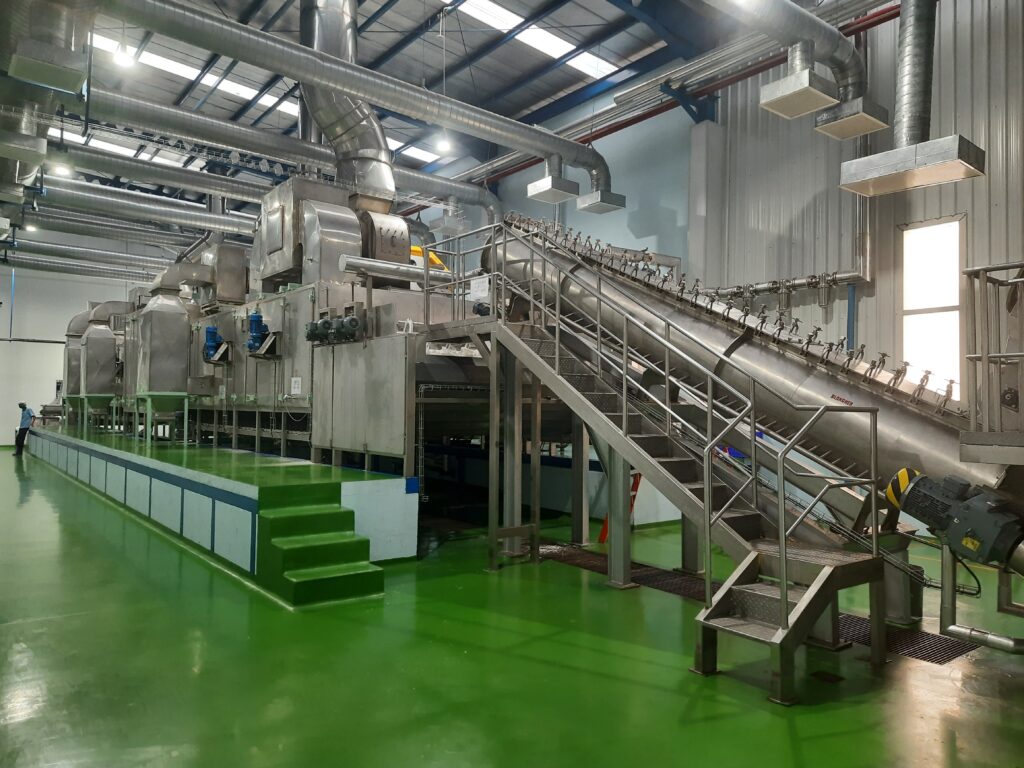
Because the product rests on the belt instead of tumbling, breakage and dust stay low. That is why band dryers are preferred when shape and appearance matter.
Same machine, different names: belt dryer, conveyor dryer, mesh belt dryer, continuous belt dryer, multi-pass belt dryer.
2. How a Band Dryer Works
- Feeding — Even spreading at controlled bed depth
- Zone drying — Independent temperature and airflow per zone (stronger early, gentler finish)
- Through-circulation air — Air flows through the bed; direction may reverse between zones
- Exhaust & recirculation — Humid air exits; recoverable heat can be reused where process allows
- Cooling (optional) — Product cooled before discharge
- Continuous discharge — Steady residual moisture for packing or further processing
3. When You Should Choose a Band Dryer Manufacturer
| Choose band / mesh-belt when | Consider another technology when |
|---|---|
| Feed is slices, flakes, pieces, pellets or extrudates | Feed is a fine powder that falls through mesh |
| Shape and appearance must be preserved | Feed is a pumpable liquid or slurry → spray dryer |
| You need multi-zone temperature control for colour/flavour | Feed is a sticky non-formed cake → spin-flash or contact dryer after review |
| Continuous industrial output is required | Feed is free-flowing granules that fluidise well → fluid bed / VFBD |
| Formed sludge or biomass pieces must dry evenly | Very high-tonnage robust minerals → rotary often more economical |
Matching feed form to technology avoids the most expensive mistakes.
4. What to Check Before Buying from a Band Dryer Manufacturer in India
Use this checklist with every shortlisted supplier — including GTI.
| Check | Why it matters |
|---|---|
| Asks for product form, inlet/outlet moisture and capacity | Prevents generic undersizing or oversizing |
| States capacity as evaporation load or feed at stated moistures | “kg/h” alone is not a specification |
| Offers multi-zone temperature and airflow control | Critical for food, spices and heat-sensitive products |
| Specifies contact materials (SS304 / SS316) | Hygiene and corrosion |
| Explains single-pass vs multi-pass for your residence time and footprint | Floor space vs drying time |
| Discusses heat source options against your utilities | Operating cost |
| Defines scope (fans, filters, ducting, controls, installation) | Comparable quotations |
| Provides commissioning, spares and training terms | Uptime after handover |
| Willing to document assumptions | Honest engineering |
Red flags: quote without moisture data; vague “food grade” with no steel grade; no zone-control discussion; pressure to order before process alignment.
5. How to Size Capacity (Buyer Method)
Evaporation load (wet basis):
W=F×100−MfMi−Mf
- W = water to remove (kg/h)
- F = wet feed rate (kg/h)
- Mi = inlet moisture (%)
- Mf = target residual moisture (%)
Belt area then depends on the evaporation rate per m² your product achieves in trial (bed depth, temperature, airflow). Always design for peak credible load, not only average.
Send GTI: product form, Mi, Mf, capacity basis, max product temperature, heat source, hygiene needs.
6. Features Buyers Typically Specify
- Single-pass or multi-pass belts
- Independent drying zones
- SS304 or SS316 contact parts
- Steam, thermic fluid, gas, biomass, hot water or heat-pump heating
- Air recirculation and insulated panels
- Feeders for pieces, pastes or formed sludge
- Optional cooling zone
- PLC/HMI recipes; optional SCADA
- Cyclone, bag filter or scrubber on exhaust
7. Industries and Products
- Food & spices: onion, garlic, ginger, herbs, vegetable pieces, coconut chips/flakes
- Agro & snacks: pellets, extrudates, seeds, nuts
- Chemical: extruded pastes, pellets, selected filter-cake forms
- Biomass: chips, prepared agro residues
- Environment: dewatered sludge after forming into a permeable bed
8. Band Dryer vs Fluid Bed vs Rotary (Short Decision View)
| Need | Prefer |
|---|---|
| Gentle handling of slices/flakes + zone profiling | Band / mesh-belt |
| Free-flowing granules, high heat transfer | Fluid bed / VFBD |
| High tonnage of robust bulk solids | Rotary |
GTI manufactures band, fluid-bed and rotary systems and recommends from feed behaviour — not from a single default machine.
9. Energy and Operating Cost Levers
- Enforce residual-moisture targets (avoid over-drying)
- Use multi-zone profiles instead of one high temperature throughout
- Balance airflow; maintain recirculation and insulation
- Evaluate exhaust heat recovery when temperature and fouling allow
- Keep loading even across belt width
Specific energy (kJ per kg water evaporated) should be discussed with stated test conditions — not as a bare marketing percentage.
10. How GTI Dryers Works as Your Manufacturer Partner
GTI Dryers is an India-based manufacturer of continuous band and mesh-belt dryers. Engagement typically follows:
- Process data review (form, moisture, capacity, quality limits)
- Confirmation that band drying fits — or recommendation of another family
- Configuration (passes, zones, materials, heat source)
- Proposal with stated assumptions
- Manufacturing, installation support and commissioning as agreed
Manufacturing: Howrah, West Bengal
Head office: Kolkata
Service: India and export projects
ISO 9001:2015 certified manufacturing. List only certificates you actually hold on the live page.
11. Documents Serious Buyers Request
- Technical datasheet (revision-controlled)
- General arrangement drawing
- Airflow / zone schematic
- Utility load summary
- Material certificates when required
- Trial report when a pilot is run
Ask for revision numbers and dates on every file.
Geographic Note
India has a strong base of industrial dryer manufacturers serving domestic food, spice and agro processors and export markets. Local engineering, site visits and spare-parts logistics can reduce project risk for plants in India and nearby regions. Export buyers should confirm documentation, packaging and commissioning arrangements for the destination country. Selection criteria — feed fit, zone control, metallurgy and after-sales — remain the same everywhere.
Frequently Asked Questions
Who is a reliable band dryer manufacturer in India?
Evaluate any supplier — including GTI — on process-data engagement, multi-zone design, stated capacity basis, SS contact materials and after-sales terms rather than on slogans.
What is the difference between a band dryer and a belt dryer?
In industry the names are used interchangeably for continuous perforated-belt dryers.
Can one dryer handle onion, garlic and spices?
Often yes, with adjustable zone temperatures, belt speed and defined cleaning/changeover — confirm with your size range and quality standards.
How long does a project take?
Lead time depends on size, materials and scope; it is confirmed on order after technical alignment.
Do you offer trials?
Where product behaviour is uncertain, trials or representative-feed evaluation are recommended before final sizing.
How do I get a quotation?
Send product form, inlet and target moisture, capacity, heat source and hygiene requirements to mktg@gtidryers.com or +91-9330077417.
Next Step
If you are selecting a band dryer manufacturer in India for food, spice, chemical or sludge drying, share your process data. GTI will review technology fit and provide a clear, assumption-based proposal for a continuous band or mesh-belt system — or advise a better dryer family when band drying is not the right match.
Request a band dryer consultation with your product and capacity data.
GTI Dryers — Engineered Drying Solutions from India for Global Industries.
Call +91-9330077417 · Email
WhatsApp – 919330077417