Germany’s Growing Demand for Energy-Efficient Continuous Drying
Germany represents a technically advanced market for industrial drying equipment, particularly where energy efficiency, waste utilization, emissions control and process reliability are important.
For industries processing biomass, wood products, sewage sludge, food ingredients and specialty chemicals, conventional high-temperature drying can result in significant thermal losses. This has increased interest in low-temperature belt dryers and continuous band drying systems, particularly when waste heat or other low-grade thermal energy is available.
The German market is especially relevant for two applications:
Biomass Drying → Pelletizing / Briquetting / Energy Recovery
and
Sewage Sludge Drying → Thermal Treatment / Resource Recovery / Phosphorus Recovery
Germany’s sewage-sludge regulations are also pushing the industry toward thermal treatment and phosphorus recovery. The German Environment Ministry states that phosphorus-recovery requirements apply from 2029 at the latest for relevant sludge streams.
This creates a strong technical case for efficient industrial belt dryers in Germany.
Why Belt Dryers Fit the German Industrial Environment
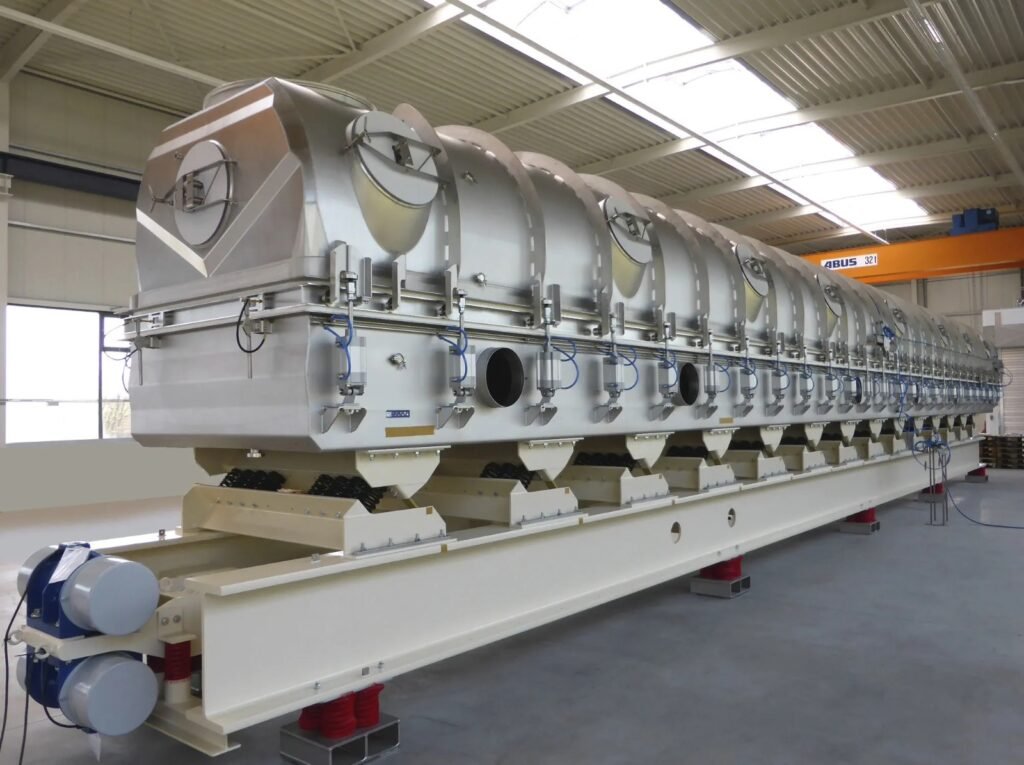
A Band Dryer, also called a belt dryer, mesh belt dryer or conveyor dryer, continuously transports material through a controlled drying chamber.
Unlike a simple batch dryer, the system can be divided into multiple drying zones.
Typical process
Wet Material
↓
Controlled Feeding
↓
Pre-Drying
↓
Main Drying
↓
Final Moisture Adjustment
↓
Cooling / Discharge
The drying profile can be adjusted through:
- Air temperature
- Air velocity
- Belt speed
- Residence time
- Recirculation
- Exhaust-air control
- Product layer thickness
This makes belt drying particularly attractive for materials that benefit from gentle, controlled and continuous moisture removal.
Germany’s Two Major Band Dryer Opportunities
1. Biomass, Wood Chips & Pellet Production
Germany’s biomass industry provides an important application for industrial belt drying.
Materials such as:
- Wood chips
- Sawdust
- Bark
- Wood residues
- Energy wood
- Biomass blends
often require moisture reduction before downstream processing.
Drying can prepare biomass for:
Drying → Pelletizing → Briquetting → Combustion → Gasification → Other Thermal Processes
Industrial belt dryers can be particularly useful when the process can utilize low-temperature heat or recovered energy.
A current German example illustrates the direction of the market: a pellet plant in Kerkingen commissioned a new low-temperature belt dryer in April 2026, with the manufacturer reporting an 18 t/h drying output and specific heat consumption of 450 kWh per tonne of pellets.
This demonstrates why energy efficiency is becoming a key purchasing factor rather than simply dryer capacity.
2. Municipal Sewage Sludge Drying
Germany is also an important market for sewage sludge belt dryers.
The country’s wastewater sector produces substantial quantities of sludge, and the regulatory framework is increasingly focused on thermal treatment and phosphorus recovery.
According to Germany’s Federal Environment Agency, approximately 1.8 million tonnes of municipal sewage sludge have historically been generated annually, with the majority already undergoing thermal treatment rather than agricultural use.
The transition is becoming even more significant as phosphorus recovery requirements approach.
Typical process
STP / Wastewater Treatment
↓
Mechanical Dewatering
↓
Wet Sewage Sludge
↓
Belt Dryer
↓
Dried Sludge
↓
Mono-Incineration / Thermal Utilization / Resource Recovery
Germany’s official environmental data also shows that sewage sludge is generally dried before subsequent disposal or thermal utilization when required.
Why Low-Temperature Belt Drying Is Attractive for German Plants
One of the strongest advantages of a belt dryer is its ability to work with relatively low-temperature heat sources, depending on the application.
Potential heat sources include:
- Waste heat
- Hot water
- Steam
- Thermal oil
- Hot gas
- Heat recovery systems
This is particularly relevant to German plants where an existing process may already generate recoverable thermal energy.
For example, industrial belt-dryer systems are commercially used for biomass, sludge and alternative fuels with options for partial or full air recirculation and waste-heat utilization.
Energy optimization can involve:
Waste Heat Recovery
→ Reuse available thermal energy instead of generating all heat from a new fuel source.
Air Recirculation
→ Recycle suitable portions of heated process air.
Multi-Zone Drying
→ Adjust temperature and airflow according to the product’s drying stage.
Thermal Insulation
→ Reduce unnecessary heat losses.
Variable-Speed Drives
→ Adjust fans, conveyors and feed systems according to actual production conditions.
The actual energy performance should always be established from material-specific drying calculations, rather than assuming a fixed percentage of savings.
Band Dryer Applications Across Germany
The opportunity extends beyond biomass and sludge.
Potential applications include:
- Vegetables
- Herbs
- Fruits
- Potato products
- Food ingredients
- Plant-based materials
Specialty Chemicals
Belt dryers can be evaluated for suitable:
- Granules
- Crystals
- Chemical intermediates
- Industrial salts
- Specialty materials
Applications include:
- Wood chips
- Sawdust
- Biomass pellets
- Agro-residues
- Alternative fuels
Wastewater & Environmental Technology
Potential applications include:
- Municipal sewage sludge
- Industrial sludge
- Dewatered sludge
- Organic residues
- Waste-derived materials
German Sewage Sludge Regulations Make Drying More Strategic
Germany’s sewage-sludge policy is an important differentiator from many other markets.
The German Sewage Sludge Ordinance restricts soil application of sludge from larger treatment plants after transitional periods, while phosphorus recovery becomes mandatory for relevant sludge streams from 2029.
This means drying is increasingly connected to a larger process objective:
Sludge Dewatering
→ Thermal Drying
→ Incineration
→ Ash Processing
→ Phosphorus Recovery
The German Environment Agency’s recent work specifically evaluates available thermal treatment and phosphorus-recovery capacity ahead of the 2029 transition.
Therefore, a sludge belt dryer in Germany should not be evaluated as an isolated machine. It should be considered as part of the plant’s complete sludge-management and resource-recovery strategy.
Belt Dryer vs Rotary Dryer in Germany
The right dryer depends on the material.
| Requirement | Band / Belt Dryer | Rotary Dryer |
| Low-temperature drying | Excellent | Moderate–High depending on design |
| Waste-heat utilization | Excellent potential | Possible |
| Biomass | Excellent for suitable feedstocks | Excellent |
| Sewage sludge | Strong application | Also possible |
| Minerals & sand | Limited depending on feed | Excellent |
| Gentle drying | Excellent | Moderate |
| Multi-zone control | Excellent | Possible |
| Fine moisture control | Excellent | Good |
| Very coarse bulk solids | Good depending on design | Excellent |
| Continuous operation | Yes | Yes |
There is no universally “best” dryer.
For German projects, the choice should be based on feed moisture, particle size, thermal sensitivity, available heat source, final moisture and downstream process.
How to Calculate a Band Dryer for a German Plant
A proper dryer design starts with a material and energy balance.
Key parameters
Feed Capacity
kg/h
↓
Initial Moisture
%
↓
Final Moisture
%
↓
Water Evaporation
kg/h
↓
Heat Duty
kW / MW
↓
Airflow & Temperature
↓
Residence Time
↓
Required Belt Area
This calculation helps determine the actual dryer size rather than selecting equipment solely on nominal throughput.
For German projects, energy calculations can also incorporate:
- Available waste heat
- Steam availability
- Hot-water temperature
- Electricity cost
- Fuel cost
- Ambient conditions
- Exhaust-air losses
- Heat-recovery potential
Why GTI Dryers Can Target the German Market
For GTI Dryers, Germany represents an attractive market for custom-engineered continuous drying systems, particularly where customers require a combination of energy efficiency and application-specific design.
GTI Dryers can evaluate systems such as:
Band Dryers | Mesh Belt Dryers | Rotary Dryers | Fluid Bed Dryers | Paddle Dryers | Flash Dryers | Vacuum Dryers
The correct system is selected according to the material rather than simply the industry.
GTI Dryers’ Engineering Approach
Material Characterization
↓
Laboratory / Pilot Testing
↓
Drying Calculation
↓
Energy & Heat-Source Evaluation
↓
Dryer Selection
↓
Equipment Engineering
↓
Manufacturing
↓
Installation & Commissioning Support
This approach is particularly valuable for German buyers looking for custom industrial drying equipment rather than generic machinery.
What German Buyers Should Ask Before Purchasing a Belt Dryer
Before requesting a quotation, prepare the following information:
Material
- What material needs to be dried?
- Is it biomass, sludge, food, chemical or another product?
Moisture
- Initial moisture?
- Required final moisture?
Capacity
- kg/h or tonnes/h?
- Continuous or seasonal operation?
Heat Source
- Waste heat?
- Steam?
- Hot water?
- Thermal oil?
- Natural gas?
- Biomass?
Product Requirements
- Maximum product temperature?
- Particle size?
- Bulk density?
- Stickiness?
- Dust generation?
Downstream Process
Is the dried product going to:
- Pelletizing?
- Incineration?
- Combustion?
- Phosphorus recovery?
- Packaging?
- Further chemical processing?
These answers determine whether a band dryer, rotary dryer, fluid bed dryer, paddle dryer or another technology is appropriate.
Germany-Focused Search Intent
Potential search queries for this market include:
- Band dryer Germany
- Industrial belt dryer Germany
- Belt dryer manufacturer Germany
- Low temperature belt dryer Germany
- Biomass belt dryer Germany
- Wood chip dryer Germany
- Pellet belt dryer Germany
- Sewage sludge belt dryer Germany
- Sludge drying system Germany
- Industrial sludge dryer Germany
- Waste heat belt dryer Germany
- Continuous belt dryer Germany
- Industrial drying equipment Germany
- Energy efficient belt dryer Germany
- Belt drying system for biomass
- Belt dryer for sewage sludge
For German-language search visibility, relevant terminology can also include:
Bandtrockner Deutschland
Bandtrockner für Klärschlamm
Bandtrockner für Biomasse
industrielle Trocknungsanlagen Deutschland
Niedertemperatur-Bandtrockner
These should be used naturally rather than keyword-stuffed.
Why the German Market Is Different
Germany’s opportunity is not simply about selling another industrial dryer.
The strongest proposition is around:
Energy Efficiency
Use available low-grade or recovered heat wherever technically practical.
Resource Recovery
Support drying before thermal treatment and phosphorus-recovery processes.
Process Reliability
Design systems for continuous industrial operation.
Environmental Performance
Consider dust, exhaust air, emissions and heat losses as part of the complete system.
Lifecycle Economics
Evaluate energy consumption, maintenance, downtime and operating costs—not just initial equipment price.
Frequently Asked Questions
What is a band dryer used for in Germany?
Band dryers can be used for suitable biomass, wood products, sewage sludge, food products, chemicals and other continuous drying applications. The exact suitability depends on feed characteristics and required final moisture.
What is a low-temperature belt dryer?
A low-temperature belt dryer uses controlled warm air and extended residence time to remove moisture while limiting product temperature. It can be particularly attractive when waste heat or low-grade thermal energy is available.
Are belt dryers suitable for sewage sludge?
Yes. Belt drying is an established approach for suitable dewatered sewage sludge. Germany’s environmental documentation includes numerous sludge-drying installations using belt-dryer technology.
Can a belt dryer use waste heat?
Yes. Depending on the plant configuration, belt dryers can be engineered to utilize available waste heat, hot water, steam or other thermal sources.
Is a belt dryer better than a rotary dryer?
Not universally. Belt dryers are particularly attractive for controlled, low-temperature and gentle continuous drying, while rotary dryers are often advantageous for coarse, high-throughput bulk solids. Material testing and drying calculations should determine the final selection.
Looking for a Band Dryer Manufacturer for Germany?
Germany’s combination of biomass processing, pellet production, wastewater treatment, sludge thermal utilization, food processing and specialty chemical manufacturing creates a strong market for advanced continuous drying technology.
For GTI Dryers, the opportunity is to provide application-specific industrial drying systems engineered around German process requirements, rather than simply supplying standard equipment.
If you are evaluating a:
Biomass Belt Dryer | Wood Chip Dryer | Pellet Dryer | Sewage Sludge Belt Dryer | Industrial Band Dryer | Mesh Belt Dryer | Low-Temperature Belt Dryer
share your material, feed moisture, final moisture, capacity and available heat source with GTI Dryers.
The engineering team can evaluate the appropriate drying technology and develop a preliminary drying calculation, energy assessment and equipment recommendation for your application.
GTI Dryers — Industrial Drying Solutions for Biomass, Sludge, Food, Chemicals and Process Industries.