Band Dryer China: High-Performance Continuous Drying for Food, Chemicals, Textiles & Biomass
China’s enormous manufacturing and processing ecosystem is creating strong demand for continuous industrial drying systems capable of handling high production volumes while maintaining consistent product quality.
From dehydrated vegetables and fruits to tea, food ingredients, chemicals, catalysts, textiles and biomass, manufacturers increasingly require dryers that can operate continuously, provide uniform moisture removal and optimize thermal energy consumption.
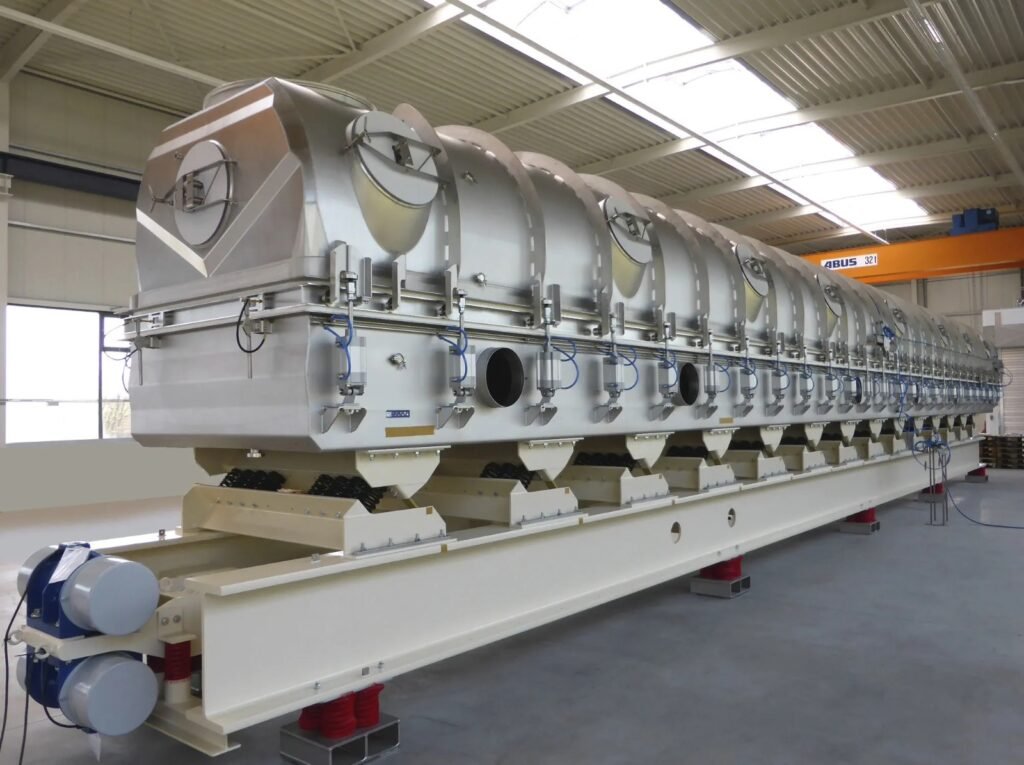
A Band Dryer, also known as a belt dryer or conveyor dryer, is one of the most versatile continuous drying technologies for these applications.
For Chinese manufacturers, the key question is not simply “Which dryer can remove moisture?”
It is:
Which continuous dryer can deliver the required capacity, moisture uniformity, product quality and energy efficiency at the lowest practical operating cost?
This is where properly engineered industrial band drying systems become valuable.
Why Is Demand for Band Dryers Growing in China?
China has large-scale production clusters across food processing, chemicals, agriculture, textiles, biomass and advanced manufacturing.
Many of these industries operate continuously and require controlled drying rather than conventional batch processing.
A modern band dryer can provide:
- Continuous material feeding
- Controlled residence time
- Multi-zone temperature control
- Adjustable airflow
- Uniform moisture reduction
- High-volume production
- Automated operation
- Heat recovery opportunities
- Flexible heating-source integration
For large processing plants, these features can help improve production consistency while reducing unnecessary thermal losses.
Where Are Industrial Band Dryers Used in China?
The applications for continuous belt drying are broad, but several sectors represent particularly strong opportunities.
1. Dehydrated Vegetables & Food Processing
China is a major producer and processor of agricultural commodities, creating significant demand for industrial food dehydration.
Band dryers can be engineered for products such as:
- Garlic
- Onion
- Ginger
- Carrot
- Mushroom
- Chili
- Fruits
- Herbs
- Tea
- Vegetable flakes
- Agricultural ingredients
The multi-stage configuration allows drying conditions to be adjusted according to the product’s moisture-removal characteristics.
For example:
Fresh Product → Pre-Drying → Main Drying → Final Drying → Cooling → Packaging
This controlled process can help achieve more consistent final moisture while protecting product appearance and quality.
2. Food Ingredients & Tea Drying
Food manufacturers increasingly require continuous systems for products where temperature, residence time and moisture content must be carefully controlled.
Band dryers can be evaluated for:
- Tea leaves
- Herbs
- Spices
- Fruit pieces
- Vegetable products
- Food powders and granules
- Plant-based ingredients
For heat-sensitive products, lower-temperature zones and controlled airflow can be incorporated into the dryer design.
3. Chemical & Catalyst Processing
China’s extensive chemical manufacturing sector also creates demand for continuous drying systems.
Band dryers can be considered for suitable:
- Chemical intermediates
- Catalysts
- Pigments
- Inorganic compounds
- Granulated chemicals
- Specialty chemical products
- Industrial salts
- Process residues
Chemical applications often require greater control over:
Temperature + Airflow + Residence Time + Moisture + Product Handling
The dryer configuration can therefore be customized according to the physical and thermal characteristics of the material.
4. Textile & Continuous Industrial Processing
China’s textile manufacturing industry operates at enormous scale, where continuous thermal processing is essential.
Depending on the process, continuous belt or conveyor drying systems can be integrated into production lines requiring controlled moisture removal from suitable textile-related materials and industrial products.
Important considerations include:
- Uniform airflow
- Controlled temperature
- Conveyor speed
- Residence time
- Exhaust management
- Production capacity
- Heat recovery
The objective is to maintain stable drying conditions without unnecessary thermal consumption.
5. Biomass & Agricultural Residues
China’s expanding biomass and agricultural processing sectors also create opportunities for continuous drying technology.
Potential materials include:
- Agricultural residues
- Biomass particles
- Plant-based materials
- Wood-related residues
- Organic by-products
- Processed biomass feedstocks
For biomass applications, the dryer must be designed around material moisture, particle size, bulk density, thermal behavior and required throughput.
Multi-Stage Band Dryer: Why It Matters
A multi-stage or multi-zone band dryer is particularly useful when the drying curve changes significantly throughout the process.
Instead of maintaining one temperature and airflow condition throughout the dryer, different zones can be configured.
Example:
Zone 1 – Initial Drying
Higher moisture removal with controlled airflow.
↓
Zone 2 – Main Drying
Optimized thermal conditions for efficient evaporation.
↓
Zone 3 – Final Drying
Lower moisture target with carefully controlled temperature.
↓
Zone 4 – Cooling / Conditioning
Product stabilization before discharge.
This approach can improve moisture uniformity and provide greater control over energy consumption.
How Does an Industrial Band Dryer Work?
The basic operating principle is straightforward.
Wet Feed
↓
Controlled Feeding
↓
Perforated/Mesh Conveyor Belt
↓
Hot-Air Circulation
↓
Moisture Evaporation
↓
Multi-Zone Drying
↓
Exhaust & Heat Recovery
↓
Final Product
The product moves continuously through the dryer while heated air passes through or across the material.
Drying parameters can be adjusted according to:
- Feed moisture
- Final moisture
- Feed rate
- Product thickness
- Particle size
- Air temperature
- Air velocity
- Residence time
How to Select a Band Dryer for a Chinese Processing Plant
Choosing a band dryer based only on production capacity can lead to poor results.
A proper engineering assessment should consider the complete drying requirement.
Feed Material
Determine:
- Material name
- Initial moisture
- Particle size
- Bulk density
- Stickiness
- Flowability
- Thermal sensitivity
Production Requirement
Determine:
- Feed rate
- Operating hours
- Required final moisture
- Continuous or batch operation
- Seasonal production variation
Heating Source
Possible heating configurations may include:
- Steam
- Thermal oil
- Hot water
- Natural gas
- LPG
- Biomass
- Electricity
- Waste heat
The best option depends on local energy availability and the economics of the individual plant.
Band Dryer Energy Efficiency: What Should Buyers Look For?
For high-capacity Chinese processing plants, energy consumption can have a major impact on operating costs.
An energy-efficient band dryer can incorporate:
Heat Recovery
Recovering usable heat from exhaust air can reduce overall thermal losses where technically feasible.
Optimized Airflow
Air velocity should be matched to the material rather than simply maximizing airflow.
Multi-Zone Temperature Control
Different drying zones allow thermal energy to be applied where it is most effective.
Variable Frequency Drives
VFDs can regulate:
- Fans
- Feeders
- Conveyors
- Exhaust systems
Thermal Insulation
Proper insulation minimizes heat loss from the dryer chamber and hot-air circulation system.
Band Dryer vs Rotary Dryer: Which Is Better?
Neither technology is universally better.
The correct selection depends on the material.
| Requirement | Band Dryer | Rotary Dryer |
| Heat-sensitive food | Excellent for suitable products | Good for suitable bulk products |
| Long residence time | Excellent | Good |
| Multi-zone control | Excellent | Moderate |
| Thin-layer drying | Excellent | Limited |
| Very high bulk throughput | Good–Excellent | Excellent |
| Free-flowing minerals | Possible | Excellent |
| Agricultural products | Excellent | Good |
| Sticky materials | Application dependent | Application dependent |
| Gentle product handling | Strong advantage | More mechanical movement |
For vegetables, herbs, tea, fruits and other products requiring controlled residence time, a band dryer may provide advantages.
For high-volume minerals, sand and rugged bulk solids, a rotary dryer may be more appropriate.
The final selection should be based on actual material testing and drying calculations.
What Capacity Can a China Band Dryer Handle?
Band dryer capacity cannot be accurately determined from dryer dimensions alone.
The actual capacity depends on:
Feed Rate + Initial Moisture + Final Moisture + Product Thickness + Drying Temperature + Airflow + Residence Time
For example, two products entering the same dryer at the same feed rate may require completely different dryer configurations because their moisture-binding characteristics and thermal behavior differ.
This is why material-specific drying calculations and pilot testing are important before selecting commercial equipment.
Pilot Testing Before Purchasing a Band Dryer
For manufacturers investing in large-scale drying equipment, pilot testing can reduce technical uncertainty.
GTI Dryers can evaluate material-specific parameters such as:
- Drying rate
- Moisture reduction
- Product quality
- Energy requirement
- Residence time
- Temperature profile
- Airflow requirement
- Approximate commercial capacity
Pilot data can then be used to develop a more reliable commercial dryer configuration.
Drying Calculation: The First Step Toward Accurate Dryer Sizing
A preliminary drying calculation generally begins with the material balance.
Feed Material
→ Initial Moisture
→ Target Final Moisture
→ Water to Be Evaporated
→ Heat Requirement
→ Airflow Requirement
→ Residence Time
→ Dryer Size
→ Estimated Energy Consumption
This engineering approach is more reliable than selecting equipment purely from a generic capacity table.
Why Consider GTI Dryers for China?
GTI Dryers develops customized industrial drying systems for food, agricultural, chemical, biomass and other processing applications.
Depending on material characteristics and process requirements, the technology portfolio can include:
Band Dryers | Mesh Belt Dryers | Multi-Stage Belt Dryers | Rotary Dryers | Flash Dryers | Fluid Bed Dryers | Spray Dryers | Paddle Dryers | Vacuum Dryers
The objective is not to sell one standard dryer for every application.
It is to identify the most appropriate drying technology for the customer’s material and process.
GTI Dryers can support customers through:
- Material evaluation
- Drying calculations
- Pilot testing
- Dryer selection
- Process engineering
- Customized equipment design
- Automation integration
- Energy optimization
- Installation and commissioning support
China-Focused Industrial Drying Applications
Businesses searching for drying equipment in major Chinese industrial regions may require solutions for different applications.
Food Processing Hubs
Shandong | Henan | Guangdong | Jiangsu | Zhejiang
Potential applications include vegetable, fruit, tea and food ingredient dehydration.
Chemical Manufacturing
Jiangsu | Zhejiang | Shandong | Guangdong
Potential applications include chemical intermediates, pigments, catalysts and industrial chemicals.
Biomass & Agricultural Processing
Agricultural and biomass processing facilities across China can evaluate continuous belt drying for suitable high-moisture materials and residues.
For every region, the dryer should ultimately be selected according to the material, production capacity and required moisture reduction, rather than geography alone.
Frequently Asked Questions About Band Dryers in China
What is a band dryer?
A band dryer is a continuous industrial dryer in which material travels through a drying chamber on a moving belt while controlled heated air removes moisture.
What is the difference between a band dryer and belt dryer?
In industrial drying terminology, band dryer, belt dryer and conveyor dryer are often used to describe similar continuous drying equipment. The exact design varies according to the application and manufacturer.
What products can be dried in a band dryer?
Suitable applications can include vegetables, fruits, herbs, tea, biomass, agricultural products, food ingredients and certain chemicals.
Is a band dryer suitable for heat-sensitive products?
Yes, for suitable materials. Multi-zone temperature and airflow control can allow a gentler drying profile.
How is band dryer capacity calculated?
Capacity depends on feed rate, initial moisture, final moisture, evaporation load, product characteristics, drying temperature, airflow and residence time.
How can band dryer energy consumption be reduced?
Heat recovery, optimized airflow, multi-zone control, proper insulation and variable-speed drives can help improve thermal efficiency.
Should I conduct a pilot test before buying?
For unfamiliar or difficult-to-dry materials, pilot testing is strongly recommended because it provides application-specific performance information before commercial-scale equipment is selected.
Looking for an Industrial Band Dryer in China?
China’s enormous food-processing, chemical, agricultural and manufacturing sectors create strong opportunities for continuous industrial drying technology.
Whether your requirement involves dehydrated vegetables, fruits, tea, food ingredients, chemicals, catalysts, biomass or another high-moisture material, the correct dryer must be engineered around the material and production process.
GTI Dryers can help evaluate:
Material → Moisture → Capacity → Drying Technology → Energy Requirement → Dryer Configuration
If you are looking for a band dryer manufacturer, industrial belt dryer, continuous conveyor dryer or customized multi-stage drying system, contact GTI Dryers with your material details.
Provide your:
Material + Feed Moisture + Final Moisture + Capacity + Available Heat Source
and GTI Dryers can develop a preliminary drying calculation, technology recommendation and pilot-testing approach for your application.