Brazil’s Agro-Industrial Scale Creates a Strong Market for Continuous Drying
Brazil is one of the world’s most important agricultural and agro-industrial economies, making it a natural market for continuous industrial drying technology.
The country’s processing industries operate across enormous volumes of:
Soybeans | Corn | Cassava | Sugarcane | Coffee | Fruits | Animal Feed | Biomass | Agro-Industrial Residues
The scale is significant. Brazil’s July 2026 agricultural outlook projected approximately 353 million tonnes of grains, including about 174.9 million tonnes of soybeans. Sugarcane production was estimated at more than 716 million tonnes, while cassava production was approximately 19.6 million tonnes.
For processors handling materials at this scale, drying is not simply a moisture-removal operation.
It directly affects:
Product Stability → Storage → Transportation → Processing Efficiency → Final Quality → Energy Cost
This is where industrial band dryers, belt dryers and conveyor drying systems can become valuable process equipment.
What Is a Band Dryer and Why Does It Matter in Brazil?
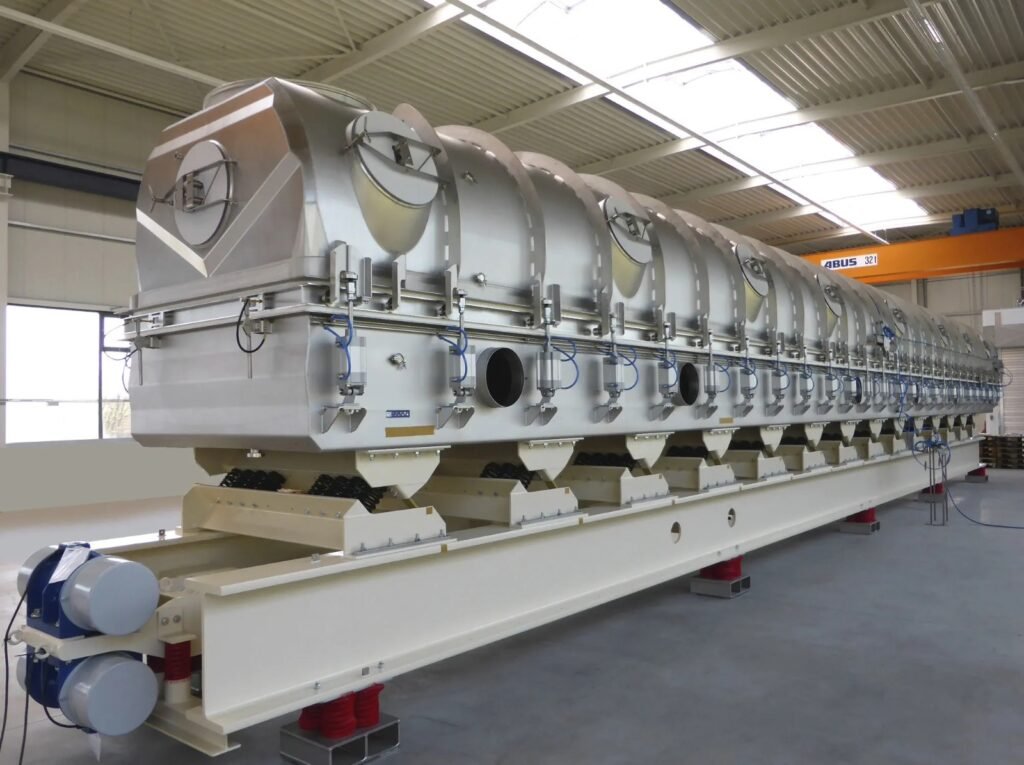
A Band Dryer, also known as a belt dryer, mesh belt dryer or conveyor dryer, is a continuous drying system in which material moves through a controlled hot-air chamber on a perforated or mesh conveyor.
Instead of relying on one drying condition, the system can be divided into multiple zones.
A typical process looks like:
Wet Material
↓
Controlled Feeding
↓
Pre-Drying
↓
Main Drying
↓
Final Moisture Control
↓
Cooling
↓
Dry Product
The drying environment can be adjusted through:
- Temperature
- Air velocity
- Belt speed
- Residence time
- Air recirculation
- Exhaust-air control
- Product-layer thickness
This makes continuous belt drying particularly interesting for agricultural products, food ingredients, biomass and other materials requiring controlled moisture reduction.
Brazil’s Most Important Band Dryer Opportunities
1. Soybean & Agricultural Processing
Soy is one of Brazil’s most important agricultural commodities.
CONAB’s 2025/26 outlook projects Brazilian soybean production at approximately 177.7 million tonnes, reinforcing the country’s position as a major global soybean producer.
Large soybean-processing ecosystems create opportunities for drying technologies around:
- Soy-based ingredients
- Soy protein products
- Agricultural residues
- Processed food ingredients
- Animal-feed materials
- Biomass by-products
Not every soybean application requires a band dryer; the technology should be selected according to the product form, moisture content and downstream process.
For suitable products, continuous belt drying can provide:
Controlled Temperature + Continuous Operation + Uniform Moisture Reduction
2. Cassava & Starch Processing
Cassava is another important Brazilian agricultural crop, with 2026 production estimated at approximately 19.6 million tonnes in the July agricultural outlook.
Brazilian cassava-processing operations can involve:
- Cassava flour
- Starch
- Modified starch
- Cassava-based ingredients
- Process residues
- Animal-feed materials
For suitable starch-based or granular products, continuous drying can help processors achieve stable final moisture before packaging, storage or further processing.
Potential application regions include:
Paraná | Pará | Bahia | São Paulo | Mato Grosso do Sul
The dryer selection depends heavily on particle characteristics, feed concentration and whether the product is granular, fibrous, pasty or powder-like.
3. Sugarcane, Bagasse & Biomass
Brazil’s sugarcane industry represents another major opportunity for industrial drying.
The July 2026 agricultural estimate placed sugarcane production at approximately 716.5 million tonnes.
Sugar and ethanol production generates significant quantities of fibrous and organic residues.
Potential drying applications can include:
- Bagasse
- Biomass residues
- Agro-industrial by-products
- Organic fibres
- Alternative fuels
- Biomass feedstocks
However, dryer selection is critical.
For very coarse and high-throughput biomass, a rotary dryer may be more appropriate.
For materials requiring controlled residence time, staged drying or gentler handling, a belt/band dryer may offer advantages.
This distinction creates an important opportunity for GTI Dryers: matching the drying technology to the material instead of selling the same dryer for every application.
4. Animal Feed & Feed Ingredients
Brazil’s large agricultural and livestock economy creates significant demand for processed feed ingredients.
Potential band-dryer applications include suitable:
- Feed ingredients
- Plant-based feed materials
- Agricultural by-products
- Fibrous materials
- Functional feed ingredients
- Processed food residues
A continuous dryer can help maintain consistent moisture before:
Drying → Milling → Blending → Pelletizing → Packaging
For feed applications, parameters such as particle size, bulk density, feed temperature and required final moisture must be considered during dryer design.
5. Food & Dehydrated Agricultural Products
Brazil’s diverse agricultural production also creates opportunities for industrial food dehydration.
Potential products include:
- Fruits
- Vegetables
- Herbs
- Coffee-related materials
- Plant-based ingredients
- Food residues
- Specialty agricultural products
Brazil’s Ministry of Agriculture identifies post-harvest processing and preservation as important areas for maintaining food quality, safety and extending product usability.
For heat-sensitive products, multi-zone belt drying can provide better process control than applying one high-temperature condition throughout the dryer.
6. Biomass Energy & Agro-Industrial Residues
Brazil’s agro-industry produces large quantities of organic residues.
Instead of treating all residues simply as waste, processors can evaluate whether drying can improve:
Moisture Reduction → Handling → Storage → Fuel Preparation → Energy Recovery
Possible materials include:
- Bagasse
- Wood residues
- Agricultural fibres
- Sawdust
- Crop residues
- Organic by-products
A belt dryer can become particularly attractive when an industrial plant has access to waste heat or another low-cost thermal source.
Where Is the Opportunity in Brazil?
Industrial marketing, the Brazilian market should not be treated as one generic location.
Important industrial and agricultural regions include:
São Paulo
Strong opportunity across:
Sugar & Ethanol | Food Processing | Chemicals | Animal Feed | Agro-Industry
Paraná
Important for:
Soy | Corn | Cassava | Animal Feed | Food Processing
Mato Grosso
Major agricultural production region with strong relevance to:
Soy | Corn | Grain Processing | Animal Feed | Biomass
Minas Gerais
Relevant to:
Coffee | Dairy | Food Processing | Agriculture | Mining
Goiás
Important for:
Soy | Corn | Animal Feed | Agro-Processing | Biomass
Bahia
Potential applications across:
Agriculture | Fruit Processing | Cassava | Food Processing | Biomass
Rio Grande do Sul
Relevant to:
Grains | Animal Feed | Food Processing | Agro-Industrial Products
This regional structure allows GTI Dryers to target searches such as:
Band Dryer São Paulo
Industrial Belt Dryer Paraná
Agro-Industrial Dryer Mato Grosso
Biomass Dryer Brazil
Food Dryer Brazil
rather than relying only on the broad keyword “Band Dryer Brazil.”
Band Dryer or Rotary Dryer for Brazilian Biomass?
This is one of the most important technical questions for Brazilian buyers.
| Requirement | Band Dryer | Rotary Dryer |
| Gentle continuous drying | Excellent | Good |
| Multi-zone drying | Excellent | Possible |
| Heat-sensitive food products | Excellent | Application dependent |
| Agricultural products | Excellent for suitable materials | Good |
| Biomass | Good for suitable feedstocks | Excellent for many coarse materials |
| Bagasse | Application dependent | Often strong candidate |
| Fine control of residence time | Excellent | Moderate |
| Very high bulk throughput | Good | Excellent |
| Waste-heat utilization | Strong potential | Strong potential |
| Minerals & sand | Usually not first choice | Excellent |
There is no single dryer that is best for every Brazilian application.
The correct selection should consider:
Material → Moisture → Particle Size → Feed Rate → Final Moisture → Heat Source → Residence Time
How Much Energy Does a Band Dryer Use?
Energy consumption depends on the quantity of water that must be evaporated and the efficiency of the complete drying system.
A preliminary engineering assessment should consider:
Initial Moisture
Final Moisture
Feed Rate
Evaporation Requirement
Heat Source
Dryer Efficiency
A modern system can potentially reduce unnecessary thermal losses through:
- Hot-air recirculation
- Heat recovery
- Optimized airflow
- Multi-zone drying
- Proper insulation
- Variable-frequency drives
- Exhaust-air optimization
For Brazil, the availability of biomass, process heat and agro-industrial waste streams can also influence the most economical heat-source configuration.
The actual energy consumption should be established through a material-specific drying calculation, not a generic kWh/tonne assumption.
How to Calculate Band Dryer Capacity for a Brazilian Plant
Before selecting a machine, establish the water-evaporation requirement.
For example:
Feed Capacity
↓
Initial Moisture
↓
Dry-Solids Load
↓
Target Final Moisture
↓
Water Evaporation per Hour
↓
Required Heat Duty
↓
Drying Area
↓
Belt Dryer Capacity
Important design information includes:
- Feed rate in kg/h or tonnes/h
- Initial moisture percentage
- Final moisture percentage
- Product temperature limit
- Particle size
- Bulk density
- Available heat source
- Ambient conditions
- Required operating hours
This is why GTI Dryers recommends drying calculations and material testing before final equipment selection for demanding applications.
Why GTI Dryers Can Serve the Brazilian Market
Brazilian customers may require equipment adapted to very different materials—from food ingredients and agricultural products to biomass and industrial materials.
GTI Dryers can evaluate several technologies depending on the process:
Band Dryer | Mesh Belt Dryer | Rotary Dryer | Fluid Bed Dryer | Flash Dryer | Paddle Dryer | Vacuum Dryer | Spray Dryer
The objective is not simply to supply a machine.
It is to develop a drying system around:
Material Characteristics + Production Capacity + Moisture Reduction + Energy Source + Product Quality
GTI’s Engineering Process
Material Information
↓
Laboratory / Pilot Testing
↓
Drying Calculation
↓
Heat & Energy Assessment
↓
Technology Selection
↓
Customized Dryer Design
↓
Manufacturing
↓
Installation & Commissioning Support
This approach is particularly relevant for Brazilian processors looking for customized drying equipment rather than standard machinery.
What Brazilian Buyers Should Provide Before Requesting a Dryer Quotation
To obtain a meaningful preliminary recommendation, provide:
Material Details
- Material name
- Physical form
- Particle size
- Bulk density
- Stickiness
Moisture
- Initial moisture
- Required final moisture
Production
- kg/h or tonnes/h
- Operating hours/day
- Seasonal or continuous operation
Product Quality
- Maximum allowable temperature
- Colour requirements
- Nutritional or active-component requirements
Heat Source
- Steam
- Natural gas
- LPG
- Biomass
- Hot water
- Thermal oil
- Waste heat
- Electricity
This information enables GTI Dryers to evaluate whether a band dryer, rotary dryer, fluid bed dryer, flash dryer or another technology is most appropriate.
Opportunity for Brazil
For Brazilian search visibility, the page should naturally incorporate Portuguese terminology alongside English keywords.
Useful Brazilian search terms include:
secador de correia
secador de esteira industrial
secador de banda industrial
secador contínuo
secador de biomassa
secador industrial para alimentos
secador para ração animal
secador de resíduos agrícolas
equipamento de secagem industrial
fabricante de secadores industriais
sistema de secagem contínua
These terms can be incorporated into headings, image ALT text, FAQs and supporting content without keyword stuffing.
Frequently Asked Questions About Band Dryers in Brazil
What is a band dryer used for?
A band dryer is used for continuous drying of suitable food, agricultural, biomass, chemical and other industrial materials where controlled moisture reduction is required.
Is a band dryer suitable for Brazilian agricultural products?
Yes, for suitable materials. Agricultural products such as food ingredients, herbs, vegetables, cassava-derived products and other materials can be evaluated for continuous belt drying.
Is a band dryer suitable for bagasse?
It can be considered for suitable bagasse and biomass applications, but the final technology should be selected after evaluating moisture, particle size, bulk density, throughput and downstream use. For some high-throughput coarse biomass applications, a rotary dryer may be more appropriate.
What is the difference between a band dryer and a rotary dryer?
A band dryer transports material through controlled drying zones on a belt and offers strong control over residence time and drying conditions. Rotary dryers tumble material inside a rotating drum and are often advantageous for coarse, high-volume bulk solids.
Can a band dryer use biomass energy?
Yes. Depending on the system configuration, biomass can be used as a heat source, and industrial plants may also evaluate process waste heat or recovered thermal energy.
How do I select a band dryer capacity?
Capacity should be calculated from feed rate, initial moisture, final moisture, water evaporation requirement, drying temperature, residence time and available heat source—not simply from the tonnes of wet material entering the machine.
Brazil’s Opportunity for Continuous Industrial Drying
Brazil’s enormous agricultural and agro-industrial ecosystem creates a broad market for continuous belt and band drying technology.
The strongest opportunities are found where large quantities of material need reliable moisture control:
Soy & Grains
Cassava & Starch
Sugarcane & Bagasse
Animal Feed
Food Processing
Biomass
Agro-Industrial Residues
The country’s 2026 agricultural indicators reinforce the scale of these industries, with soy, corn, sugarcane and other major crops contributing substantially to national agricultural output.
For GTI Dryers, the Brazilian market presents an opportunity to combine Indian industrial drying engineering with application-specific solutions for Brazil’s agro-processing and biomass industries.
Looking for a Band Dryer Manufacturer for Brazil?
If your Brazilian plant requires a:
Industrial Band Dryer | Belt Dryer | Mesh Belt Dryer | Conveyor Dryer | Biomass Dryer | Food Dryer | Agricultural Dryer
GTI Dryers can evaluate your application based on material characteristics, moisture reduction, capacity, energy source and final-product requirements.
Send the following information:
Material + Feed Moisture + Final Moisture + Capacity + Product Temperature + Available Heat Source
and GTI Dryers can develop a preliminary drying calculation and technology recommendation for your application.
GTI Dryers
Continuous Industrial Drying Solutions for Food, Agriculture, Biomass, Chemicals, Pharmaceuticals & Process Industries.
For the Brazilian market, the goal is not simply to install a dryer. It is to develop a reliable, energy-conscious drying process that fits the material, production scale and downstream operation.