
In agrochemical manufacturing, a drying problem can become a formulation-quality problem. A powder that retains too much moisture may cake during storage, while poorly controlled granule drying can affect flowability, strength and dispersion behaviour. Excessive thermal exposure can also compromise a temperature-sensitive formulation.
For manufacturers of pesticides, crop-protection chemicals and specialty agricultural powders, the objective is not simply to remove moisture. It is to achieve a stable, consistent product that meets its intended formulation and handling specifications.
GTI Dryers, from Genex Tech Industries LLP, provides industrial drying equipment and engineered drying solutions for process industries. For agrochemical applications, the appropriate technology must be evaluated according to the feed condition, formulation requirements, active-ingredient stability and production target.
This guide takes a different approach to conventional dryer articles: it starts with the problems agrochemical manufacturers face, explains which drying technologies deserve consideration, and provides a practical checklist for selecting equipment and requesting a technical quotation.
1. When Drying Becomes a Formulation Problem
A dryer may remove moisture successfully while the finished product still fails its quality requirements. This is because agrochemical formulations depend on more than moisture content alone.
Consider these common production challenges:
- Powder caking: The product forms hard lumps during storage or loses its free-flowing characteristics.
- Poor wetting: A wettable powder does not wet readily when added to water.
- Slow granule disintegration: Water-dispersible granules do not break down as expected.
- Uneven moisture: Different portions of the product leave the dryer with different moisture levels.
- Granule breakage: Excessive mechanical stress creates fines or damages granule structure.
- Dust generation: Fine material escapes during conveying, collection or packaging.
- Thermal degradation: The active ingredient or formulation components may be sensitive to heat.
- Unstable production: Variations in feed moisture, solids content or feed distribution lead to inconsistent output.
These problems should be diagnosed individually. For example, poor dispersion may originate in the formulation, particle size, granulation method or surface properties—not just the dryer.
FAO/WHO pesticide specifications include relevant physical properties such as wetting, dispersibility, suspensibility, dustiness and particle-size characteristics for applicable formulation types.
The practical implication is important: select the dryer against the required finished-product performance, not moisture removal alone.
2. Which Agrochemical Formulation Are You Manufacturing?
The feed’s physical state determines which drying technologies should be considered. Agrochemical manufacturing includes several solid formulations, and each has different process requirements.
| Product or intermediate | Typical process requirement | Drying consideration |
| Wettable powder (WP) | Produce a fine, dry powder for subsequent dispersion in water | Drying, milling, classification and moisture protection must be considered together |
| Water-dispersible granules (WG/WDG) | Produce granules that disintegrate and disperse in water | Fluid-bed or other suitable drying may be evaluated after granulation |
| Wet granules | Reduce moisture while retaining suitable granule structure | Fluid-bed, vibratory fluid-bed or another compatible granule dryer |
| Spray-dried intermediate | Convert a suitable liquid feed into a powder | Spray dryer, subject to formulation and thermal requirements |
| Specialty chemical powder | Achieve a defined moisture and handling specification | Technology depends on material behaviour and process conditions |
| Wet filter cake or paste | Remove moisture from a cohesive or difficult-to-handle feed | Paddle, contact, flash or another suitable dryer may be considered |
Wettable powders and water-dispersible granules are different formulation categories. WG products are intended to disintegrate and disperse in water, while WP products are fine powders intended to form a suspension after mixing.
Not every formulation needs a separate drying stage. The requirement depends on the manufacturing route, feed condition and final specification.
3. Fluid-Bed Dryers for Agrochemical Granules and Suitable Powders
A fluid-bed dryer passes heated air or another suitable gas through a bed of particles. Under appropriate operating conditions, the particles become fluidized, promoting contact between the gas and the material.
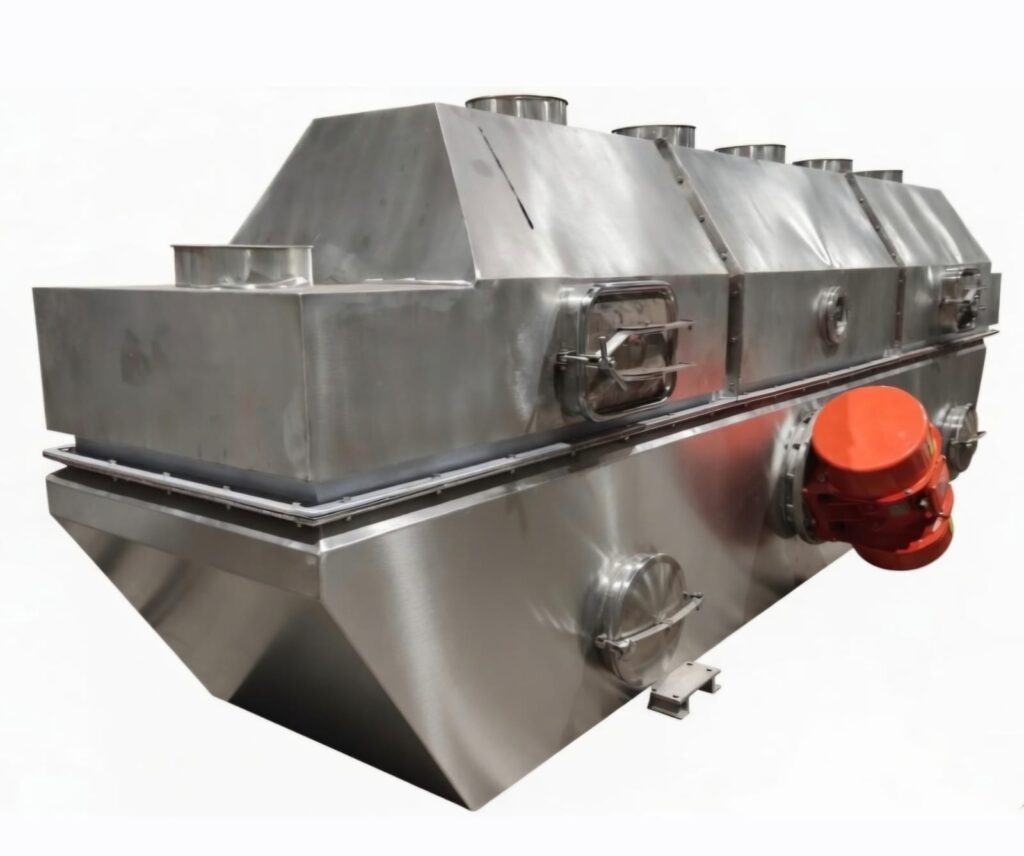
For agrochemical applications, fluid-bed technology may be considered for suitable wet granules, crystals, pellets and other particulate intermediates.
When should you consider a fluid-bed dryer?
- The feed consists of particles that can be fluidized effectively.
- The product requires consistent moisture reduction.
- Granule integrity and fines generation must be managed.
- The process benefits from controlled drying and, where required, cooling.
- Continuous processing or integration with upstream granulation is desirable.
Problems to investigate
Uneven final moisture
Possible causes include variations in feed moisture, poor distribution across the bed, changes in airflow or unsuitable operating conditions. The solution may require improvements to the feed system, air distribution or process controls.
Excessive fines
Granule attrition can be influenced by particle strength, fluidization conditions, feed characteristics and handling equipment. A complete process review is more effective than changing drying conditions in isolation.
Poor flowability after drying
Residual moisture, formulation properties, particle-size distribution and storage conditions can all contribute. The final product should be evaluated after drying and cooling, not just at the dryer outlet.
Granules that do not disperse correctly
Drying is only one part of water-dispersible granule performance. Binder selection, granulation, particle structure and formulation design also matter. A dryer cannot independently guarantee the required dispersion behaviour.
Fluid-bed drying and cooling
Some processes benefit from an integrated drying-and-cooling arrangement. Cooling can help prepare the material for downstream screening, conveying and packaging, but its necessity and configuration should be determined from the product’s behaviour and the overall process.
Engineering note: Conventional fluid-bed drying is not automatically suitable for every fine powder or sticky material. Cohesive feeds may require conditioning, a different dryer design or an alternative process route.
4. Spray Dryers for Suitable Agrochemical Intermediates
Spray drying converts a suitable liquid feed—such as a solution, slurry or suspension—into a powder by atomizing the feed into droplets and evaporating the liquid in a drying chamber.
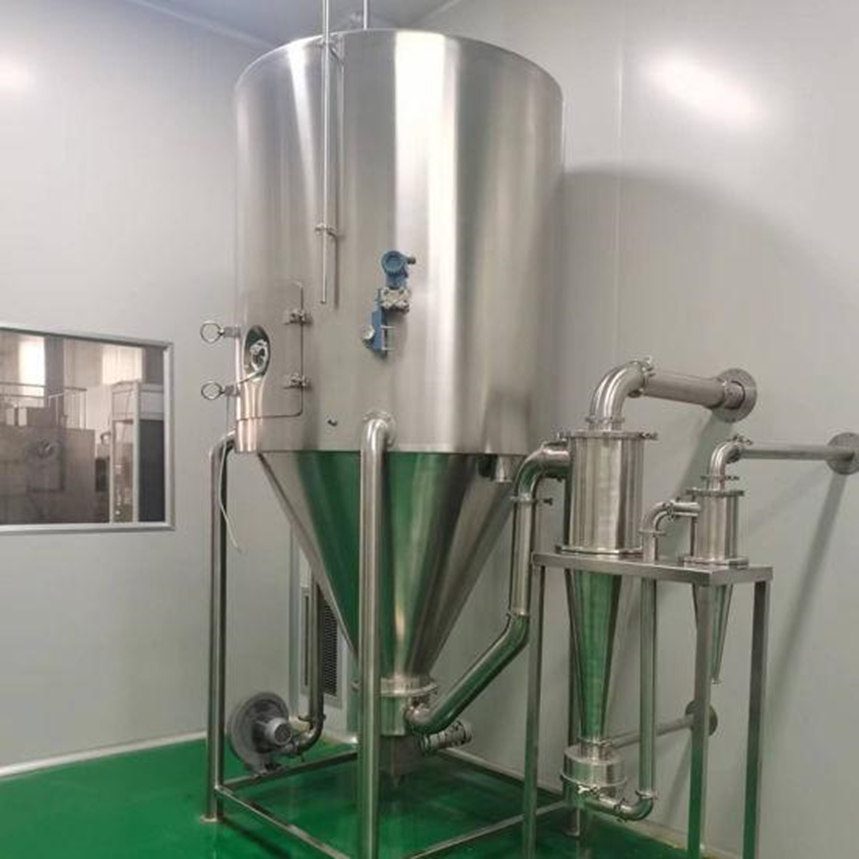
This makes spray drying relevant to selected agrochemical intermediates and specialty chemical powders where the upstream feed can be prepared for reliable atomization.
When should you consider spray drying?
- The incoming feed is pumpable and suitable for atomization.
- The process requires conversion from a liquid or slurry into a powder.
- The required particle properties can be achieved through formulation and process development.
- The active ingredient and other formulation components can tolerate the proposed thermal exposure.
- Powder collection and downstream handling can be integrated into the plant design.
Production problems to solve
| Problem | What to evaluate |
| Atomizer or nozzle blockage | Feed viscosity, suspended solids, filtration and feed stability |
| Powder sticking to chamber walls | Feed properties, droplet behaviour, drying conditions and chamber design |
| High powder losses | Exhaust flow, separator design, filtration and product recovery |
| Inconsistent powder properties | Feed composition, atomization stability and operating conditions |
| Product quality changes | Thermal sensitivity, residence time and formulation stability |
| Difficult powder handling | Particle morphology, moisture, bulk density and downstream conditioning |
Spray drying should not be treated as a universal solution for finished wettable powders or water-dispersible granules. In many cases, granulation and fluid-bed drying may be more appropriate. The decision depends on the physical state of the feed and the required product form.
5. Spray Drying vs Fluid-Bed Drying: Which Is Right for Your Process?
These technologies serve different purposes. The most useful comparison begins with the material entering the equipment.
| Selection factor | Spray dryer | Fluid-bed dryer |
| Typical feed | Pumpable solution, slurry or suspension | Suitable wet or dry particles |
| Main purpose | Convert liquid feed into powder | Remove moisture from particulate material; may also cool it |
| Particle formation | Droplets dry into particles | Existing particles are dried; some specialized fluid-bed systems also support granulation |
| Main challenge | Atomization, wall deposition and powder recovery | Fluidization, bed distribution, attrition and moisture uniformity |
| Suitable application | Selected agrochemical intermediates and specialty powders | Suitable wet granules, pellets, crystals and particulate formulations |
| Key selection criteria | Feed viscosity, solids content, thermal sensitivity and powder requirements | Particle properties, stickiness, moisture load and granule strength |
A combined process may be appropriate when a formulation requires more than one operation. For example, a liquid feed might undergo spray drying, while a separate granulation process may use fluid-bed technology for granule formation and drying. These are different process routes, not interchangeable configurations.
The correct choice should be confirmed using feed data, product specifications and process trials where necessary.
6. Wettable Powder Manufacturing: Why Moisture Is Only One Variable
Wettable powders are designed to form a suspension when mixed with water. Their performance depends on the active ingredient, carriers, wetting and dispersing agents, particle-size distribution and other formulation components.
Drying can help establish the required moisture level, but it does not replace the other manufacturing and quality-control steps.
Common WP problems
Powder cakes during storage
Investigate residual moisture, hygroscopicity, formulation compatibility, packaging and exposure to ambient humidity.
Powder does not wet readily
Review the formulation’s surface properties, wetting-agent system, particle size and the applicable wetting test. The problem may not be caused by the dryer.
Suspension performance is inconsistent
Assess particle-size distribution, dispersion properties, formulation homogeneity and the applicable suspensibility requirements.
Powder generates excessive dust
Evaluate the milling and classification steps, particle distribution, material handling and dust-collection arrangement.
For WP products, the manufacturing line should therefore be assessed as a complete system involving feed preparation, drying where required, milling or classification, blending, collection and packaging.
7. Water-Dispersible Granules: Drying Without Compromising Granule Quality
Water-dispersible granules are designed to break apart and disperse in water during application. The product must balance dry storage stability, suitable handling characteristics and the required performance when mixed with water.
FAO/WHO guidance describes WG formulations as dry, free-flowing and essentially non-dusty, with the granule size range and dispersion properties assessed against the applicable specification. <Cite refs={[“turn181433search22″,”turn181433search1”]}/>
What can go wrong during drying?
Granules become too fragile
Drying and mechanical handling may contribute to breakage. Investigate granule structure, binder system, drying conditions, transfer points and screening.
Granules cake during storage
Possible causes include residual moisture, hygroscopic ingredients, inadequate cooling, unsuitable packaging or exposure to humid conditions.
Granules disperse slowly
The cause may involve granule structure, binder properties, formulation composition or drying-related changes. Testing is needed to identify the actual limitation.
Fines increase after drying
Review particle strength, airflow, mechanical impact and handling. Fines can influence dustiness, segregation and the consistency of the finished product.
A fluid-bed dryer may be appropriate for suitable WG granules, but the drying profile must be matched to the formulation. The required product properties should be verified through appropriate quality testing.
8. Protecting Active-Ingredient Stability During Drying
Agrochemical formulations may contain active ingredients and co-formulants with different thermal and moisture sensitivities. The acceptable process conditions therefore cannot be established from the product category alone.
Before choosing a dryer, establish:
- The active ingredient’s thermal stability.
- The effect of moisture and temperature on formulation stability.
- The required residual moisture or water activity, where relevant.
- Whether the feed contains volatile or heat-sensitive components.
- The acceptable product-temperature range and exposure time.
- Whether cooling or controlled storage is required after drying.
Where a material is heat-sensitive, engineers may need to evaluate alternative drying methods, reduced thermal exposure, indirect heating, vacuum operation or a different process sequence.
No single dryer technology is inherently suitable for every pesticide or specialty agrochemical. Process conditions should be established from product data, qualified formulation expertise and suitable testing.
9. Dust Collection, Containment and Safe Powder Handling
Agrochemical manufacturing requires attention to occupational exposure, product containment and environmental controls. Fine powders may create dust, while some active ingredients and formulation components present specific toxicological or other hazards.
The equipment and plant layout should be evaluated for:
- Enclosed feed and discharge arrangements where appropriate.
- Suitable dust extraction and filtration.
- Product recovery from exhaust streams.
- Compatibility of construction materials with the formulation.
- Safe access for inspection, cleaning and maintenance.
- Prevention of cross-contamination between products.
- Appropriate personal protection and exposure-control measures.
- Assessment of combustible-dust hazards where applicable.
- Compliance with relevant site, environmental and regulatory requirements.
Cleaning and changeover requirements are particularly important for plants producing multiple formulations. The design should support the required level of product segregation and cleaning verification.
A dust collector or enclosed dryer does not by itself establish that a process is safe. Appropriate controls depend on the actual material hazard assessment and operating conditions.
10. How to Reduce Drying Costs Without Sacrificing Product Quality
The lowest-cost dryer is not necessarily the system with the lowest purchase price. Operating costs can be affected by energy consumption, product recovery, downtime, rework, cleaning and maintenance.
Consider the following areas.
Reduce unnecessary evaporation
Measure the feed’s initial moisture and the product’s target moisture. Where suitable, upstream mechanical dewatering may reduce the water load entering the dryer.
Stabilize feed conditions
Variations in solids content, feed rate and moisture can cause inconsistent drying and unstable production. Better feed preparation and monitoring may improve overall operation.
Improve heat and airflow management
Insulation, appropriate airflow, exhaust management and heat recovery may help reduce energy consumption. The benefit depends on the specific process and operating conditions.
Improve product recovery
Review dust collection, separator performance, discharge and transfer equipment. Valuable powder lost through the exhaust or during handling can increase the effective cost per tonne of saleable product.
Avoid over-drying
Excessive drying may waste energy or affect product properties. The target should be the verified product specification—not the lowest achievable moisture regardless of cost or quality.
Integrate cooling and packaging
Evaluate whether cooling, screening, conveying and packaging are contributing to caking, breakage, dust or unnecessary downtime.
Any expected savings should be supported by process calculations, operating data or validated trials rather than generic percentage claims.
11. How to Select an Agrochemical Dryer Manufacturer in India
A supplier comparison should go beyond nameplate capacity and equipment price. The manufacturer should understand the required feed condition, product properties, operating constraints and downstream process.
Use this checklist when evaluating a project.
| Evaluation area | Questions to ask |
| Product and formulation | What active ingredient and formulation type are involved? |
| Feed condition | Is the feed a liquid, slurry, wet granule, powder or filter cake? |
| Capacity | What are the required hourly or daily throughput and operating hours? |
| Moisture specification | What are the measured inlet moisture and target final moisture? |
| Product quality | Which particle, flowability, dispersibility or stability properties must be preserved? |
| Thermal sensitivity | What process limits are supported by product data? |
| Technology selection | Why is spray, fluid-bed or another drying method appropriate? |
| Dust and containment | What extraction, filtration, containment and safety measures are needed? |
| Cleaning | How will the equipment be cleaned and verified between products? |
| Automation | Which process variables and interlocks must be monitored? |
| Energy and utilities | What heating, cooling, electrical and exhaust systems are required? |
| Performance verification | How will the final product and operating performance be tested? |
A strong technical proposal should identify its design basis, assumptions, scope, exclusions and performance-acceptance criteria.
12. GTI Dryers: Engineering-Focused Drying Solutions
GTI Dryers, from Genex Tech Industries LLP, supplies industrial drying equipment and process-engineering solutions for a range of industries. Its published equipment portfolio includes technologies such as spray, fluidized-bed, rotary, flash and paddle dryers. Visit the GTI Dryers official website to review the company’s industrial drying portfolio.
For an agrochemical project, the first step is to confirm the appropriate equipment based on the feed and the finished-product specification.
A technical assessment should consider:
- Whether the process begins with a liquid feed or a particulate material.
- Whether the requirement is powder production, granule drying or moisture reduction in an intermediate.
- The thermal and chemical compatibility of the material.
- Product-recovery and containment requirements.
- Cleaning, automation and downstream handling.
- Utility requirements and operating-cost considerations.
This application-led approach helps buyers avoid selecting a machine solely because it is marketed as an agrochemical dryer.
Final equipment suitability, configuration and performance must be established for the specific product and process.
13. Request a Technical Evaluation for Your Agrochemical Drying Project
If your plant is facing moisture variation, granule breakage, caking, poor powder recovery or inconsistent production, a structured technical enquiry can help identify the appropriate next step.
Share the following information when requesting a preliminary assessment:
- Product: Agrochemical, pesticide formulation or specialty powder name.
- Formulation type: WP, WG/WDG, granules, powder, intermediate or another form.
- Feed condition: Liquid, slurry, wet granules, paste or filter cake.
- Feed capacity: Kilograms per hour or tonnes per day.
- Initial moisture: Measured value and reporting basis.
- Target specification: Final moisture and relevant product-quality requirements.
- Material properties: Thermal sensitivity, particle size, stickiness and other relevant characteristics.
- Existing process: Upstream preparation and downstream milling, granulation, screening or packaging.
- Current challenge: Caking, uneven moisture, fines, dust, poor dispersion, high energy use or another issue.
- Utilities: Available heating, cooling, electrical and exhaust systems.
- Safety requirements: Relevant hazards, containment and cleaning needs.
- Project scope: New installation, replacement, capacity expansion or process improvement.
- Plant location: Country and installation site.
This information provides a practical starting point for evaluating technology options and defining the engineering scope.
Need help selecting a dryer for agrochemical powders or granules?
Contact GTI Dryers to discuss the feed material, production target and drying challenge.
- Website: https://gtidryers.com/
- Email: mktg@gtidryers.com
- Phone: +91-9330077417
GTI Dryers — Engineered Drying Solutions from India for Global Industries.
14. Frequently Asked Questions
Which dryer is suitable for agrochemical manufacturing?
The choice depends on the feed form and required product. Spray dryers may suit appropriate liquid feeds converted into powders, while fluid-bed dryers may suit compatible granules and particulate materials. Wet cakes, pastes or other difficult feeds may require a different technology.
Can a fluid-bed dryer be used for water-dispersible granules?
A fluid-bed dryer may be suitable for compatible wet granules. The design must account for particle strength, feed distribution, moisture load and the required final granule properties.
Is spray drying suitable for wettable powders?
Spray drying may be appropriate for selected liquid intermediates that need to be converted into powders. It is not automatically the right process for a finished wettable powder, which may require a different manufacturing route.
Why do agrochemical powders cake after drying?
Caking may be associated with residual moisture, hygroscopic ingredients, formulation characteristics, inadequate cooling, packaging or storage conditions. The actual cause should be established before changing dryer settings.
Does lower final moisture always mean better product quality?
No. The target should be the specified moisture level and associated quality requirements. Over-drying may waste energy or affect product properties, and moisture alone does not determine dispersion, flowability or stability.
How can a manufacturer reduce dust during drying and handling?
Potential measures include suitable feed preparation, appropriate granule-strength control, enclosed transfer, effective dust extraction and product-recovery systems. The design must account for the material’s hazard characteristics.
What information is needed to size an agrochemical dryer?
Key inputs include feed form, throughput, initial and target moisture, particle properties, thermal sensitivity, required product specifications, operating hours, utilities and safety requirements.
Can one dryer handle different agrochemical formulations?
Possibly, but only if the equipment design, material compatibility, process conditions and cleaning requirements support the intended products. Multi-product operation requires careful assessment of cross-contamination and changeover.
How should the performance of an agrochemical drying system be verified?
Verification should use agreed feed conditions, product sampling and suitable tests for moisture and the relevant quality attributes. Depending on the formulation, these may include particle-size distribution, wetting, dispersibility, suspensibility, dustiness or granule integrity.
Does GTI Dryers offer customized drying equipment?
GTI’s website presents a range of industrial drying technologies and process solutions. For an agrochemical application, buyers should discuss the material, process requirements and equipment scope directly with GTI to confirm suitability.
Conclusion: Choose a Dryer That Protects Formulation Performance
Agrochemical drying is not simply a moisture-removal task. The process must support the physical properties and stability required by the finished formulation, whether the product is a wettable powder, water-dispersible granule or specialty chemical intermediate.
Spray drying and fluid-bed drying serve different roles. The appropriate choice depends on the incoming material, the desired product form, thermal sensitivity, granule or powder characteristics and the wider production process.
For manufacturers planning a new installation or troubleshooting an existing line, the most productive starting point is to define the formulation problem, establish the required product specification and assess the complete process before selecting equipment.
GTI Dryers can be approached to discuss industrial drying requirements and confirm the appropriate technology and project scope for your application.