GTI at China International Allfood Expo 2026: Exploring the Future of Industrial Food Drying & Processing
The global food processing industry is rapidly moving toward automation, energy-efficient processing, hygienic equipment design and precise moisture control.
For modern food manufacturers, drying is no longer simply a moisture-removal operation. Industrial dehydration directly influences shelf life, product stability, texture, color, aroma, production capacity, storage requirements and overall processing efficiency.
To understand these evolving industry requirements and connect with food-processing professionals, Genex Tech Industries LLP (GTI) visited the 27th China International Allfood Expo in Hangzhou, China, from August 13–15, 2026, as a visiting delegation.
GTI did not operate a physical exhibition booth at the event. Instead, the technical team participated as visitors, using the exhibition as an opportunity for industry networking, technical discussions, market observation and understanding emerging food-processing requirements.
The event provided valuable exposure to the latest developments across food products, ingredients, snacks, food processing machinery and industrial production technologies.
What We Observed at Allfood Expo 2026
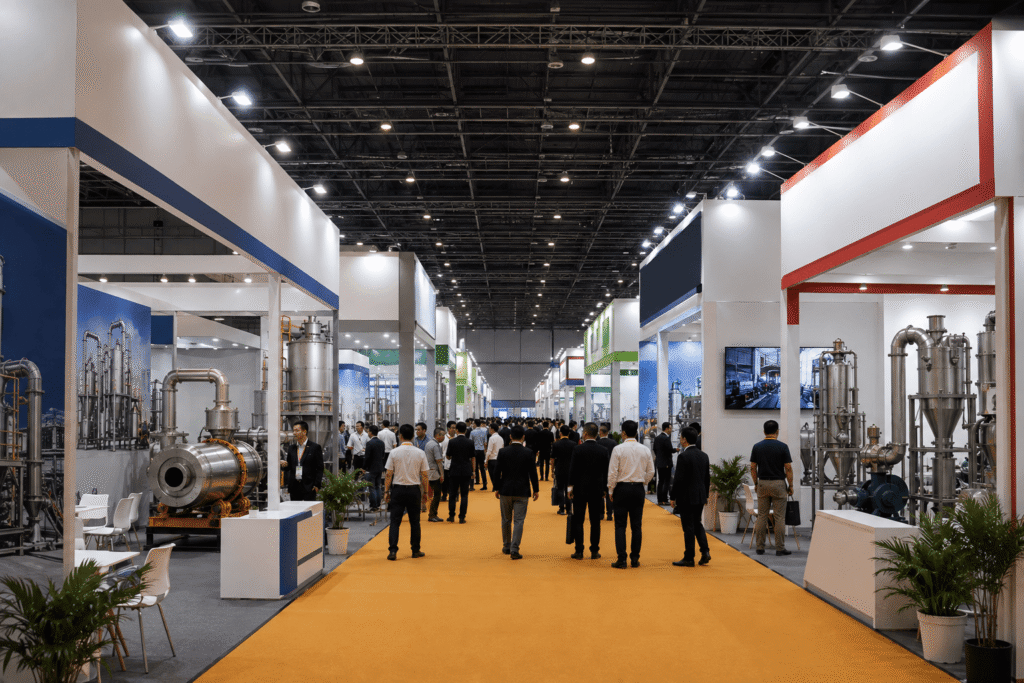
The 27th China International Allfood Expo brought together food manufacturers, processing companies, technology suppliers, engineering professionals, distributors and other industry stakeholders.
According to the source material, the event was held at the Hangzhou Grand Convention and Exhibition Center from August 13–15, 2026, with its focus extending across snack foods, frozen and prepared foods, functional ingredients and food-processing machinery.
From GTI’s perspective, one of the most important takeaways was the increasing requirement for controlled, scalable and efficient thermal processing systems.
Today’s food manufacturers are looking for equipment that can deliver:
- Consistent final moisture
- Uniform drying
- Better energy utilization
- Continuous production
- Hygienic processing
- Automated operation
- Reduced product losses
- Flexible production capacity
- Better control of product quality
These requirements make advanced industrial dryers increasingly important in modern food-processing plants.
Why Industrial Food Dehydration Is Becoming More Important
Moisture control is a fundamental part of food processing.
Reducing moisture can help improve product stability, reduce transportation weight and enable the development of shelf-stable food products.
Industrial dehydration can provide several important benefits:
1. Moisture & Water Activity Control
Controlled moisture reduction can help improve product stability and reduce conditions favorable to microbial growth. The exact water-activity target depends on the individual food product and its formulation.
2. Reduced Product Weight
Removing water reduces product mass and volume, which can help improve storage and transportation efficiency.
3. Product Quality Preservation
Controlled temperature and airflow can help maintain desired characteristics such as:
- Natural color
- Texture
- Aroma
- Flavor
- Selected heat-sensitive compounds
4. Value-Added Food Products
Industrial dehydration enables manufacturers to produce products such as:
- Dried fruits
- Vegetable flakes
- Garlic and onion powders
- Desiccated coconut
- Food ingredients
- Snack products
- Instant powders
- Functional ingredients
The source specifically identifies dehydrated fruits and vegetables, desiccated coconut, extruded snacks, meat/pet food, spices and botanicals, and starches/agro-flours among GTI’s relevant processing applications.
Key Industrial Dryer Technologies GTI Focuses On
One of the major technical areas relevant to modern food processing is selecting the right dryer for the right product.
Different products have different moisture characteristics, particle sizes, heat sensitivities and flow properties.
GTI’s industrial dryer portfolio includes multiple technologies designed for different processing conditions.
The Industrial Band Dryer, also known as a continuous belt or conveyor dryer, is designed for continuous drying of food, agricultural and industrial products.
Wet material is distributed across a moving perforated belt and transported through multiple controlled drying zones.
The drying profile can be adjusted across different zones according to the product’s drying characteristics.
Typical Applications
- Fruits
- Vegetables
- Coconut products
- Spices
- Herbs
- Agricultural products
- Food ingredients
- Snack materials
Key Benefits
- Continuous operation
- Multi-zone temperature control
- Controlled residence time
- Large processing capacity
- Flexible heating options
- Automated operation
The source describes GTI’s band dryer configurations for throughputs ranging from approximately 100 kg/hr to 10 TPH, depending on the project design.
2. Heavy-Duty Apron Band Dryer
One of the technologies particularly relevant to demanding applications is the Apron Band Dryer.
An apron band dryer uses heavy-duty interlocking metallic apron plates instead of a conventional lightweight mesh belt.
This configuration provides additional mechanical support for heavy, dense, coarse or abrasive materials.
Potential Applications
- Root vegetable products
- Coconut products
- Dense food materials
- Pressed fruit pomace
- Biomass
- Agricultural materials
- Heavy industrial solids
Why Use an Apron Band Dryer?
The heavy-duty apron conveyor can provide:
- High structural load capacity
- Reduced belt sagging
- Stable product-bed support
- Continuous material conveying
- Controlled drying
- Multi-zone drying capability
The source specifically describes the apron system as being designed for heavy material beds, sticky lumps and dense substrates such as root vegetable chunks, pressed fruit pomace and high-fat desiccated coconut.
Apron Band Dryer vs Mesh Belt Dryer
| Feature | Apron Band Dryer | Mesh Belt Dryer |
| Conveyor | Heavy-duty metallic apron | Perforated mesh |
| Best suited for | Heavy/dense materials | Lighter food products |
| Load capacity | High | Application-dependent |
| Air permeability | Depends on apron design | High |
| Product handling | Robust | Gentle |
| Typical use | Dense food, biomass, industrial solids | Fruits, vegetables, herbs, spices |
| Operation | Continuous | Continuous |
3. Multi-Tier Continuous Mesh Belt Dryer
For food manufacturers working with limited floor space, a Multi-Tier Mesh Belt Dryer can provide an alternative configuration.
Instead of using one long horizontal drying chamber, several mesh belts are arranged vertically.
This can increase the available drying path while reducing the overall floor-space requirement.
Key Advantages
- Reduced footprint
- Long residence time
- Multi-zone drying
- Controlled belt speed
- Gentle product movement
- Continuous operation
The source notes that product can gently tumble between tiers, increasing exposure to the drying air.
4. Closed-Loop Heat Pump Dehumidification Dryer
Heat-sensitive food products require a different approach.
A Closed-Loop Heat Pump Dryer can provide controlled low-temperature dehydration by continuously circulating and dehumidifying process air.
This technology can be considered for:
- Herbs
- Botanical products
- High-value food ingredients
- Heat-sensitive foods
- High-fat materials
The source describes an operating range of approximately 30°C to 65°C, depending on the process, with a closed-loop system designed to recover thermal energy.
Potential Benefits
- Low-temperature processing
- Controlled humidity
- Reduced oxidation risk
- Better preservation of color and aroma
- Thermal-energy recovery
- Closed-loop operation
Actual energy savings depend on the product, ambient conditions, operating parameters and system design.
5. Indirect Hollow Paddle Dryer
The Indirect Hollow Paddle Dryer is suitable for challenging wet materials such as pastes, slurries, spent grains and high-moisture organic residues.
Unlike direct hot-air dryers, heat is transferred indirectly through heated surfaces.
Potential Applications
- Food pastes
- Starch slurries
- Brewery spent grains
- Distillery grains
- Organic processing residues
- Sticky materials
The source describes intermeshing hollow paddles and jacketed surfaces designed to promote heat transfer and reduce material buildup.
6. Industrial Rotary Drum Dryer
For high-volume bulk materials, the Industrial Rotary Drum Dryer remains an important drying technology.
A rotating cylindrical drum moves the product through the drying chamber while internal flights lift and cascade the material.
Potential Applications
- Agricultural residues
- Grain-processing by-products
- Biomass
- Cassava residues
- Citrus pulp
- Beet pulp
- Other bulk materials
The source describes rotary dryer configurations for high-throughput applications, including capacities exceeding 30 MTPH depending on the specific design.
The Vibratory Fluid Bed Dryer (VFBD) is particularly suitable for granular and free-flowing products.
Controlled vibration combined with upward-flowing hot air creates a fluidized product bed.
Applications
- Instant beverage granules
- Salt
- Sugar crystals
- Seasoned snack pellets
- Food ingredients
- Granular products
Benefits
- Uniform drying
- Controlled residence time
- Good heat and mass transfer
- Reduced agglomeration
- Continuous operation
The source specifically highlights VFBD applications for granular foods, instant beverage granules, salt, crystal sugars and seasoned snack pellets.
A Pneumatic Flash Dryer is designed for rapid moisture removal from fine wet materials.
Wet particles are dispersed into a high-velocity heated air stream, enabling rapid moisture evaporation.
Applications
- Cassava starch
- Native starch
- Cassava flour
- Fine food powders
- Protein meals
Flash drying can be particularly useful when rapid drying of surface moisture is required.
A Spray Dryer converts liquid feed materials into dry powders.
The liquid feed is atomized into fine droplets inside a drying chamber. Hot air removes moisture from the droplets, producing a powder.
Potential Applications
- Fruit juices
- Food extracts
- Dairy feeds
- Liquid food ingredients
- Food solutions
- Slurries
Spray drying is particularly useful for manufacturers producing powdered food ingredients from liquid feedstocks.
10. Vacuum Tray Dryer & Industrial Tray Dryer
Vacuum drying can be useful for heat-sensitive or oxygen-sensitive products.
Under vacuum conditions, the boiling point of moisture is reduced, allowing evaporation at lower temperatures.
Potential Applications
- Pharmaceutical materials
- Botanical extracts
- Heat-sensitive products
- Specialty food ingredients
- Solvent-containing materials
Industrial tray dryers can also be used for batch drying of products such as fruits, vegetables, spices and nuts.
11. Drum Flakes Dryer
The Drum Flakes Dryer, also known as a rotary scraper dryer, is designed to convert certain liquid or paste-like materials into dry flakes.
The wet material forms a thin layer on a heated rotating drum. As the layer dries, a scraper removes the dried material from the drum surface.
Potential Applications
- Food pastes
- Starch slurries
- Gelatin
- Cooked cereal products
- Other suitable liquid or paste feeds
What Food Manufacturers Are Looking for in Modern Drying Systems
Our visit to Allfood Expo 2026 reinforced the importance of several key requirements in modern food processing.
1. Energy Efficiency
With rising energy costs, manufacturers are increasingly interested in:
- Heat recovery
- Efficient air circulation
- Insulated drying chambers
- Heat pump systems
- Optimized drying profiles
2. Consistent Product Quality
Industrial dryers need to deliver repeatable:
- Moisture
- Color
- Texture
- Aroma
- Particle characteristics
3. Hygienic Construction
Food-processing equipment requires appropriate material selection and hygienic engineering.
GTI’s source describes SS304/SS316L product-contact surfaces, sanitary welding, washdown access and hygienic design features for its food-processing machinery.
Actual compliance requirements should always be confirmed according to the specific equipment configuration, application and destination-market regulations.
4. Automation
Modern production lines increasingly require:
- PLC control
- Temperature monitoring
- Humidity monitoring
- Variable-speed drives
- Automated feeding
- Automated discharge
- Process alarms
5. Flexible Production
Manufacturers increasingly need drying systems that can handle changes in:
- Product type
- Production capacity
- Moisture content
- Drying temperature
- Residence time
Key Food Products Suitable for Industrial Dehydration
Industrial drying technology can be applied to a broad range of food and agricultural materials.
Fruits & Vegetables
- Mango
- Pineapple
- Onion
- Garlic
- Other fruit and vegetable products
Coconut
- Desiccated coconut
- Coconut gratings
- Coconut flakes
- Coconut-based ingredients
Spices & Botanicals
- Ginger
- Turmeric
- Chili
- Herbal roots
- Botanical ingredients
Snacks
- Snack pellets
- Extruded snacks
- Puffed products
- Other processed snack materials
Starches & Flours
- Cassava starch
- Native starches
- Fine flours
- Agro-based powders
The source identifies these categories as key substrates relevant to GTI’s thermal equipment.
How to Select the Right Industrial Food Dryer
One of the most important lessons from modern food-processing technology is that there is no single best industrial dryer for every product.
The correct dryer should be selected based on the actual process requirements.
Before selecting equipment, manufacturers should evaluate:
Product Information
- Product name
- Physical form
- Particle size
- Bulk density
- Stickiness
- Flowability
Moisture Information
- Initial moisture
- Target final moisture
- Moisture-binding characteristics
Production Information
- Feed rate
- Operating hours
- Required throughput
- Batch or continuous operation
Thermal Information
- Maximum allowable product temperature
- Heating source
- Required residence time
- Drying-air temperature
Quality Requirements
- Color
- Aroma
- Texture
- Nutritional properties
- Powder characteristics
Industrial Dryer Selection Guide
| Product / Requirement | Dryer Technology to Consider |
| Fruits & vegetables | Band / Mesh Belt Dryer |
| Desiccated coconut | Band / Apron Band Dryer |
| Heavy coconut products | Apron Band Dryer |
| Herbs & botanicals | Heat Pump Dryer |
| Snack pellets | VFBD |
| Cassava starch | Flash Dryer |
| Food liquids | Spray Dryer |
| Food pastes | Paddle / Drum Flakes Dryer |
| Bulk agricultural materials | Rotary Dryer |
| Heat-sensitive products | Vacuum Dryer / Heat Pump Dryer |
| Granular food ingredients | VFBD |
| Fine food powders | Flash Dryer |
The final equipment selection should be established from product trials and process engineering rather than from the product category alone.
GTI’s Experience at Allfood Expo 2026
Visiting the 27th China International Allfood Expo in Hangzhou provided GTI with an opportunity to observe the direction of the food-processing industry and interact with professionals involved in food manufacturing and processing technology.
As a visiting delegation, GTI’s focus was on:
- Understanding current processing requirements
- Connecting with food manufacturers
- Meeting technology professionals
- Discussing industrial drying challenges
- Exploring potential technology partnerships
- Understanding equipment requirements for modern food plants
The exhibition also created an opportunity to discuss how continuous drying, advanced dehydration and thermal-processing technologies can support food manufacturers looking to improve production efficiency.
Why Customized Industrial Drying Systems Matter
Every food product behaves differently during drying.
Two products with the same initial moisture can require completely different drying systems because of differences in:
- Particle size
- Structure
- Fat content
- Sugar content
- Stickiness
- Heat sensitivity
- Moisture-binding characteristics
Therefore, industrial dryer selection should be based on process engineering rather than machine naming alone.
A typical project evaluation can follow:
Product → Initial Moisture → Target Moisture → Capacity → Drying Temperature → Residence Time → Heating Source → Dryer Selection → Process Design
This helps manufacturers determine whether they require a Band Dryer, Apron Band Dryer, Mesh Belt Dryer, Heat Pump Dryer, Paddle Dryer, Rotary Dryer, VFBD, Flash Dryer, Spray Dryer, Vacuum Dryer or Drum Flakes Dryer.
GTI Industrial Drying Solutions for Global Food Manufacturers
GTI develops and manufactures industrial drying systems for food, agricultural, chemical and pharmaceutical applications.
Its drying technology portfolio includes:
- Industrial Band Dryers
- Apron Band Dryers
- Multi-Tier Mesh Belt Dryers
- Heat Pump Dehumidification Dryers
- Hollow Paddle Dryers
- Rotary Drum Dryers
- Vibratory Fluid Bed Dryers
- Pneumatic Flash Dryers
- Spray Dryers
- Vacuum Tray Dryers
- Industrial Tray Dryers
- Drum Flakes Dryers
These technologies can be configured according to product characteristics, capacity, moisture requirements, heating source and plant conditions.
Frequently Asked Questions
Did GTI attend the China International Allfood Expo 2026?
Yes. GTI attended the 27th China International Allfood Expo in Hangzhou from August 13–15, 2026, as a visiting delegation. GTI did not operate a physical exhibition booth or stall.
Where was the Allfood Expo 2026 held?
The event was held at the Hangzhou Grand Convention and Exhibition Center in Hangzhou, China, from August 13–15, 2026.
What industrial dryers are suitable for food processing?
Depending on the product and process, food manufacturers may consider Band Dryers, Apron Band Dryers, Mesh Belt Dryers, Heat Pump Dryers, Fluid Bed Dryers, Spray Dryers, Flash Dryers, Rotary Dryers, Paddle Dryers and Vacuum Dryers.
Which dryer is best for heat-sensitive food?
Heat Pump Dehumidification Dryers and appropriately designed low-temperature drying systems can be considered for heat-sensitive products. Vacuum drying may also be suitable for specific applications.
What is an Apron Band Dryer?
An Apron Band Dryer is a heavy-duty continuous drying system using interlocking metallic apron plates to transport and dry dense, heavy or mechanically demanding materials.
Which dryer is suitable for cassava starch?
A Pneumatic Flash Dryer can be considered for rapid drying of fine starch materials such as cassava starch and cassava flour.
Which dryer is suitable for desiccated coconut?
Depending on the product characteristics and required capacity, Band Dryers, Mesh Belt Dryers or Heavy-Duty Apron Band Dryers can be evaluated for desiccated coconut and coconut-related products.
Can GTI provide customized industrial food dryers?
GTI’s source material describes its drying equipment as customized for commercial food, chemical and pharmaceutical processing requirements.
Looking Ahead After Allfood Expo 2026
The food-processing industry is moving toward greater automation, improved energy efficiency, hygienic manufacturing and precise moisture control.
Our visit to the 27th China International Allfood Expo reinforced the importance of developing drying systems that are not only capable of removing moisture but are also designed around the specific characteristics and production objectives of each product.
From fruits, vegetables, coconut and spices to starches, snacks, food powders and specialty ingredients, advanced industrial dehydration technologies can play an important role in modern food manufacturing.
GTI continues to develop customized drying solutions designed around the requirements of food manufacturers, processing companies, EPC contractors and technology partners.
Looking for an Industrial Food Dryer?
If you are planning a food-processing or dehydration project, share:
Product + Initial Moisture + Final Moisture + Production Capacity + Heating Source
with the GTI technical team to discuss the appropriate drying technology for your application.
Explore GTI’s industrial drying solutions and food-processing technologies to find the right system for your next project.