
Short answer: Spray dryer wall deposits form when particles reach the chamber wall still wet or soft, above their sticky point. The usual fixes are lowering product temperature or moisture at the wall, adjusting atomisation and air flow so droplets do not reach the wall, and cooling or cleaning surfaces. Confirm the cause with a sticky-point test and a trial.
Last updated: 23 November 2026
This guide is for process engineers and plant managers who spray dry chemicals, resins, pigments, detergents and other industrial powders and are losing yield or stopping to clean deposits from the chamber, cone, ducts or cyclone. It explains why deposits form, how to read the location of a deposit, what to measure, and which changes usually help. Worked numbers use illustrative inputs only and are not GTI performance data. The published studies cited are laboratory and pilot work, and several used food powders as test materials, so use them for the mechanisms, not for your numbers.
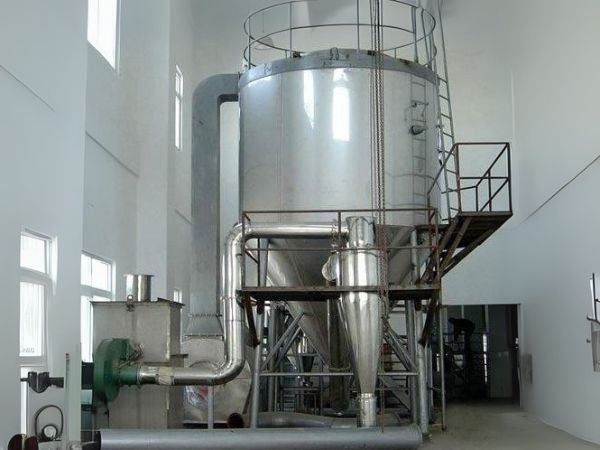
What are spray dryer wall deposits, and why do they matter?
Spray dryer wall deposits are layers of product that stick to the inside of the drying chamber, cone, ducts or cyclone instead of leaving as free-flowing powder. They reduce yield, change powder moisture and particle size when pieces fall off, add cleaning downtime and, for combustible products, can become a fire risk if material overheats on the wall. A 2026 review in Drying Technology on powder wall sticking in spray drying reports that powder sticking occurs in the food, pharmaceutical, chemical and agricultural sectors, and identifies surface modification, moisture and agglomeration among the major contributing themes. So the problem is common across industries, and it is a particle-state problem more than a food problem.
Why do particles stick to the wall?
Particles stick when their surface is wet or softened at the moment they touch a surface. Amorphous materials (those without an ordered crystal structure, such as many polymers, resins, dyes and some salts and organics) soften when their temperature rises above the glass transition temperature, Tg. Moisture lowers Tg, so a particle that is dry enough to flow at one temperature can become sticky if it still holds more water.
Published work links this to the “sticky point”. A review of spray drying of sugar-rich products in Drying Technology notes that the sticky behaviour appears when product temperature is about 10 to 20 °C above Tg, and that product temperature kept at or below that level avoids wall deposition. It lists remedies in three families:
- Material-based: raising Tg, for example by adding a carrier with a high Tg.
- Process-based: cooling the chamber walls, lowering the outlet air temperature, using dehumidified air, and scraping or sweeping the wall.
- Combined: using both.
A second line of evidence comes from a pilot-scale study of wall deposition of skim milk powder. It varied inlet air swirl, inlet temperature and feed rate. Deposition was highest when the outlet particle temperature was furthest above the sticky-point temperature, which happened at the lowest inlet air temperature and the highest product moisture. The air swirl angle also had a significant effect. Changing the wall surface to a non-stick food-grade plastic, adhesive tape or stainless steel made no significant difference, and grounding the dryer made no significant difference either. The authors suggest the same trends may apply to other materials. This pilot used a food powder, but it shows the key point: in that study, wall material and electrostatic grounding mattered less than moisture, temperature and air flow.
How does the location of the deposit point to the cause?
The place where material builds up is a useful clue. These patterns are typical engineering experience, not rules, so confirm with temperature and moisture measurements.
| Where deposits form | Often points to | First checks |
|---|---|---|
| Ceiling and top of chamber | Air disperser flow pattern, recirculation near the roof, droplets reaching the roof | Inlet air distribution, atomiser spray angle, swirl settings |
| Chamber wall at atomiser height | Spray cone too wide, droplets still wet when they reach the wall | Atomiser speed or nozzle size, feed rate, chamber diameter match |
| Lower wall and cone | Sticky, still-warm product, high product moisture | Outlet temperature, residual moisture, wall cooling |
| Duct to cyclone and cyclone | Fines with moisture, condensation, cold surfaces | Exhaust temperature versus dew point, insulation, leaks |
| Around the nozzle or atomiser wheel | Wetting of the atomiser face, partly blocked nozzle, wet feed film | Nozzle condition, feed viscosity and solids, wheel condition |
Our guide on atomiser types and choice explains how atomiser selection changes droplet size and spray shape, and our spray dryer working principle article covers the basics.
What should you measure when you have deposits?
- Outlet air temperature and, where possible, product temperature at the cone, along with inlet temperature and feed rate.
- Residual moisture of the powder at the outlet and of any deposit samples. Wetter deposit than product points to sticking from still-wet particles.
- Feed solids content, feed temperature and viscosity, because each changes droplet size and water load.
- Sticky-point or Tg data for the powder at several moisture levels, from a laboratory test.
- Wall temperatures, especially where deposits form, and exhaust temperature compared with dew point.
- Atomiser condition and speed or nozzle pressure.
GTI’s spray dryer page lists inlet and outlet temperature, feed rate, and airflow and air velocity among the critical spray dryer parameters, and notes that optimised airflow helps prevent wall deposition. It also lists pressure nozzle, rotary and twin-fluid atomisers, so atomisation changes can be considered during a retrofit or new design.
How does feed concentration change evaporation load?
Raising feed solids reduces the water to evaporate per kilogram of powder, which cuts the thermal load. But it also changes viscosity and droplet size, so test it before relying on it.
Worked example (illustrative inputs): produce powder at 3% moisture (wet basis) from a slurry fed at 500 kg/h and 40% solids by weight, compared with 45% solids at the same dry solids rate.
| Quantity | 40% solids feed | 45% solids feed |
|---|---|---|
| Dry solids rate | 500 × 0.40 = 200 kg/h | 200 kg/h |
| Feed rate for same solids | 500 kg/h | 200 ÷ 0.45 = 444 kg/h |
| Powder at 3% moisture | 200 ÷ 0.97 = 206 kg/h | 206 kg/h |
| Water evaporated | 500 − 206 = 294 kg/h | 444 − 206 = 238 kg/h |
At 2.26 MJ/kg (the latent heat of water near 100 °C from steam-table data such as the NIST Chemistry WebBook; the true value is higher at lower evaporation temperatures), the lower evaporation load is worth about 35 kW of thermal energy: roughly 184 kW against 150 kW at minimum, before sensible heat and losses. That is thermal energy only, separate from fan and atomiser electrical load. Higher solids can lower the energy per kilogram of product, but in some systems it increases viscosity or leaves larger or wetter droplets. So treat concentration as a trial variable, not a given. See our guide to calculating dryer capacity and evaporation load.
What fixes usually work?
Work from the cheapest, least invasive change to structural changes:
- Reduce product wetness at the wall. Lower feed rate, or raise outlet temperature carefully if the product is not temperature-limited, so particles are drier on arrival. This is the opposite of simply lowering temperature, so check which side of the sticky point your product sits on.
- Lower product temperature relative to its sticky point. If the product is soft at the outlet temperature, a lower outlet temperature, cooler walls or dehumidified air may help, as noted in the review above. Watch the residual moisture limit when doing this.
- Adjust air flow and swirl. The pilot study shows swirl angle affected deposition, so inlet air distribution is worth a trial.
- Change atomisation. Smaller or larger droplets, or a different spray angle, change where droplets dry. Rotary, pressure nozzle and twin-fluid atomisers behave differently.
- Change the formulation where permitted. Add a carrier or drying aid that raises Tg, if the end use allows it.
- Use mechanical or air-sweep cleaning on the wall. Air brooms, hammers or scrapers can keep light deposits from building up. They treat the symptom, not the cause.
- Consider a different dryer concept. For very sticky products, a spray dryer combined with a fluid bed for agglomeration and finishing may suit better than pushing the chamber conditions. See our article on hybrid multi-stage drying systems.
Safety note: deposits on hot surfaces can overheat, smoulder or burn, especially for combustible or solvent-containing products. Review our dryer fire and dust explosion checklist before changing temperatures or cleaning methods, and consult a qualified safety engineer for your specific product.
When is a trial needed?
Whenever a product keeps sticking despite sensible changes, or when you are adding a new product, a drying trial gives sticky-point, deposit and yield data on your own feed. Pilot spray drying is a standard way to test atomiser, temperature and feed solids combinations before a full-scale decision; see our pilot plant testing guide.
Frequently asked questions
Why does my spray dryer powder stick to the wall?
Because particles reach the wall wet or above their sticky point, so they stay soft and adhere. Moisture, temperature and air flow patterns decide this.
Does a non-stick wall coating stop deposits?
Not reliably. In the pilot study cited above, changing wall material to a non-stick plastic, tape or stainless steel made no significant difference to deposition for that product.
Should I raise or lower outlet temperature to stop sticking?
It depends on which side of the sticky point the product sits. If particles are still wet, a higher outlet temperature may dry them; if they are hot and soft, a lower one may help. Measure moisture and test.
Can I fix deposits with a different atomiser?
Atomisation changes droplet size and spray shape, which can help if droplets are reaching the wall wet. It is one option among several and should be tested.
Does GTI make spray dryers for chemical products?
GTI lists fine and specialty chemicals, dyestuffs and pigments, mineral concentrates, detergent powders and polymer and resin solutions among its spray dryer applications. Send your product details to discuss suitability.
Discuss spray drying with GTI
For assistance with dryer selection, spray dryer troubleshooting, processing requirements or a project-specific quotation, contact Genex Tech Industries LLP (GTI Group).
Email: mktg@gtidryers.com
Call or WhatsApp: +91-93300 77417
Website: https://gtidryers.com/
Please share your material, required wet-feed capacity, initial and target moisture, available heating source and installation location.