
API drying is a controlled unit operation, not a simple moisture-removal step. Residual solvent, residual moisture, crystal form, potency and impurity profiles must stay within specification while the equipment, documentation and cleaning regime support GMP expectations.
Three technologies dominate many solid-API trains:
- Vacuum tray dryers (VTD)
- Fluid bed dryers (FBD) — including pharmaceutical designs
- ANFD (Agitated Nutsche Filter Dryers) — filter–dry in one contained vessel
This guide explains when each ensures quality, how GMP discipline enters equipment selection, and what buyers should specify.
Quick answer: Choose the dryer from feed form, solvent, temperature limit and containment need. ANFD suits filter cake that should stay contained from filtration through drying. Vacuum tray suits smaller batches and heat/solvent-sensitive solids needing static vacuum drying. Fluid bed suits free-flowing granules needing fast, uniform convective drying when product can tolerate fluidization.
1. What “Quality” Means in API Drying
| Quality attribute | Why drying matters |
|---|---|
| Residual solvent | Patient safety and regulatory limits |
| Residual moisture | Stability, downstream processing |
| Polymorph / crystallinity | Bioavailability and filing commitments |
| Potency / impurity profile | Thermal or oxidative degradation risk |
| Particle size integrity | Avoid attrition that shifts dissolution |
| Uniformity within batch | Tray position, bed channeling, or agitation dead zones |
| Cross-contamination control | Cleaning and changeover between products |
GMP compliance is the system that makes these outcomes repeatable and documented — equipment design, procedures, qualifications and records.
2. Vacuum Tray Dryers for APIs
How they work
API is loaded on trays inside a heated, sealed chamber operated under vacuum. Lower pressure reduces boiling temperature of water/solvents; heat is supplied through jacketed shelves or chamber walls.
Quality strengths
- Low product temperature capability for heat-sensitive APIs
- Closed system supports solvent recovery via condensers
- Gentle — minimal mechanical attrition
- Familiar batch documentation model for many plants
Limits
| Limit | Practical impact |
|---|---|
| Batch and manual tray handling | Labour, exposure risk if not contained |
| Moisture uniformity | Depends on tray loading discipline and shelf temperature uniformity |
| Throughput | Lower than continuous or large agitated systems |
| Cleaning | Many surfaces and tray sets to clean/validate |
Best when
- Small to medium batches
- High value, heat-sensitive or solvent-wet cakes/crystals
- Static drying is preferred over fluidization or strong agitation
- Vacuum solvent recovery is required
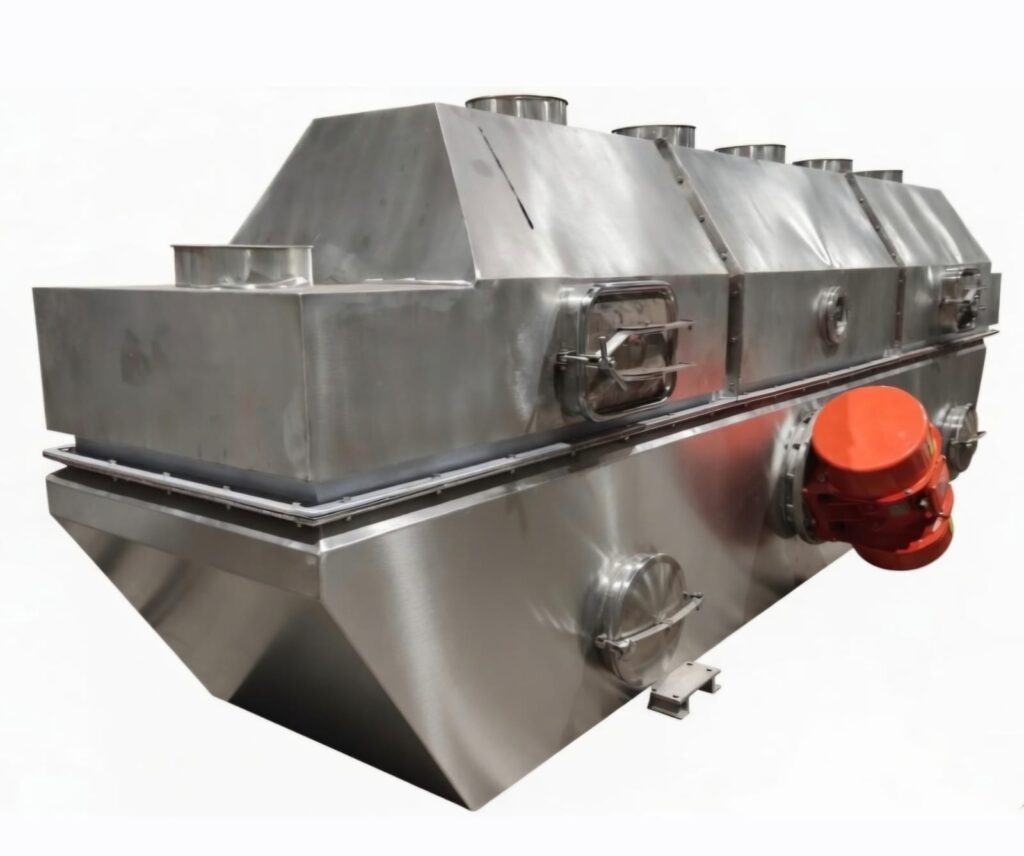
3. Fluid Bed Dryers for Pharmaceutical APIs / Granules
How they work
Heated gas fluidises a bed of particles so each granule contacts drying air. Pharma FBDs use qualified air handling, filters and often WIP/CIP features.
Quality strengths
- Fast, uniform drying when particles fluidise cleanly
- Good for wet granules after granulation
- Temperature and airflow recipes support validated cycles
- Scale-up pathway familiar in oral solid dose trains
Limits
| Limit | Practical impact |
|---|---|
| Feed must fluidise | Sticky cakes and some fine APIs channel or agglomerate |
| Attrition | Friable crystals may generate fines |
| Solvent handling | Possible, but vacuum tray/ANFD often preferred for heavy solvent duties |
| Emission / filtration design | HEPA and safe change filters as required by containment strategy |
Best when
- Free-flowing wet granules
- Aqueous granulation moisture removal
- Validated oral solid dose manufacturing
- Product tolerates convective fluidization
Note: Direct drying of potent neat API powders in FBD requires careful containment and toxicology assessment — many sites restrict FBD to granule duties.
4. ANFD — Agitated Nutsche Filter Dryer
How it works
An ANFD combines filtration and drying in one agitated, jacketed vessel under vacuum or controlled atmosphere. After filtration and washing, the cake is dried in place by contact heat, vacuum and agitation.
Quality & compliance strengths
- Contained transfer from slurry to dry product — fewer open handling steps
- Excellent for solvent-wet cakes needing vacuum drying
- Agitation improves heat transfer vs static trays
- Supports nitrogen blanketing and solvent recovery design
- Strong fit for multi-product API plants seeking exposure control
Limits
| Limit | Practical impact |
|---|---|
| Mechanical shear | Agitation can damage some crystals if poorly set |
| Batch cycle time | Filter + wash + dry sequence must be scheduled honestly |
| Complexity | Higher capital and maintenance than simple tray dryers |
| Heel / discharge | Design and validation of discharge completeness matter |
Best when
- API is isolated as a filter cake
- Solvents and operator exposure are major concerns
- End-to-end containment from crystalliser discharge to dry cake is valued
- Batch sizes justify agitated filter-dryer economics
5. Side-by-Side Selection Matrix
| Criterion | Vacuum tray | Fluid bed | ANFD |
|---|---|---|---|
| Typical feed | Cake/crystals on trays | Free-flowing wet granules | Slurry → filter cake in vessel |
| Heat mode | Vacuum + conduction | Convective gas | Vacuum + conduction + agitation |
| Solvent recovery | Strong | Moderate (design-dependent) | Strong |
| Containment | Moderate (tray handling risk) | Filter/housing dependent | Strong (closed vessel) |
| Attrition risk | Very low | Medium | Low–medium (agitation settings) |
| Batch documentation | Straightforward | Recipe-based cycles | Recipe-based filter-dry cycles |
| Throughput style | Small–medium batch | Fast batch granule drying | Medium–large batch cake duties |
6. GMP Compliance — What Buyers Should Require
GMP is not a sticker on the machine. For API drying systems, buyers should plan for:
| GMP element | Equipment/process implication |
|---|---|
| Design qualification mindset | Materials of construction, surface finish, drainability |
| Cleaning & cleaning validation | Access, WIP/CIP where used, swab-friendly geometry |
| Batch identity | Clear loading/discharge controls and records |
| Critical process parameters | Temperature, vacuum, time, airflow — monitored and recorded |
| Solvent control | Condenser capacity, vacuum integrity, emission limits |
| Containment | Aligned with occupational exposure band for the API |
| Change control | Recipe and spare parts discipline after validation |
| Data integrity | Appropriate instrumentation and record practices for the site standard |
Qualification depth (IQ/OQ/PQ) follows the site’s quality system and market (e.g. regulated export). Equipment vendors support with design documentation; the marketing authorisation holder / manufacturer owns GMP release decisions.
7. Problem–Solution Map for API Drying
| Problem | Likely cause | Direction |
|---|---|---|
| Residual solvent high | Insufficient vacuum/time or poor mass transfer | Vacuum recipe; ANFD agitation; condenser capacity |
| Polymorph shift | Temperature/solvent path outside design space | Tighten product temperature; review solvent wetness |
| Potency drop | Thermal/oxidative stress | Lower T; inerting; shorter cycle |
| Moisture variation in VTD | Uneven tray load or shelf T | Loading SOP; shelf mapping |
| FBD channeling | Cohesive wet mass | Improve granulation; consider vacuum contact route |
| Cross-contamination | Inadequate cleaning design | Geometry + validated cleaning method |
| Operator exposure | Open tray handling of potent API | Prefer ANFD or closed charging systems |
8. Decision Guide
| Situation | Lean toward |
|---|---|
| Solvent-wet filter cake, containment priority | ANFD |
| Small-batch heat-sensitive API, static drying acceptable | Vacuum tray |
| Wet granules for OSD, aqueous moisture | Fluid bed |
| Heavy residual solvent, recovery needed | Vacuum tray or ANFD |
| Friable crystals, minimal attrition | Vacuum tray (or gentle ANFD settings) |
| High operator exposure concern | Closed ANFD path over open trays |
9. RFQ Checklist for API Drying Systems
- API form — crystals, cake, granules
- Solvents present and residual solvent targets
- Residual moisture target
- Maximum product temperature / polymorph constraints
- Batch size range
- Containment / OEL expectations
- Preferred technology (VTD / FBD / ANFD) or ask for recommendation
- Materials of construction and surface finish requirements
- CIP/WIP vs manual cleaning
- Solvent recovery expectations
- Documentation package needed for site qualification
- Utilities — steam, vacuum, nitrogen, cooling
10. How GTI Dryers Supports API-Related Drying Discussions
GTI Dryers designs continuous and engineered drying systems including fluid bed and contact / vacuum-capable process concepts for chemicals and heat-sensitive solids.
For API-oriented enquiries we:
- Start from feed form, solvent and temperature limits
- Help map whether fluid-bed granule drying or vacuum/contact cake drying is the rational path
- Discuss containment and cleanability expectations at system level
- Recommend pilot trials when residual solvent or polymorph risk is high
- Remain clear about battery limits: full GMP manufacturing authorisation and site validation remain the pharmaceutical manufacturer’s responsibility
Specialised pharma ANFD and qualified vacuum tray packages are selected to match validated site standards; GTI supports process definition and drying-stage engineering integration within its technology scope.
Geographic Note
API drying under GMP is required for plants supplying regulated markets in India, US, EU and other regions. Documentation expectations differ by market, but the engineering choice — tray vs FBD vs ANFD — still follows feed form, solvent and containment physics. Local engineering partners can support utilities and installation interfaces; quality systems stay with the licensed manufacturer.
Frequently Asked Questions
What is the best dryer for APIs?
There is no single best dryer. ANFD for contained filter-cake drying, vacuum tray for gentle batch vacuum drying, and fluid bed for suitable wet granules are the primary industrial options.
What is an ANFD?
An Agitated Nutsche Filter Dryer combines filtration, washing and vacuum drying in one agitated jacketed vessel — reducing open handling of API cakes.
When should we use a vacuum tray dryer?
For heat- or solvent-sensitive batches where static vacuum drying and simple batch control are preferred, especially at modest scale.
Does equipment alone guarantee GMP compliance?
No. GMP compliance requires qualified equipment plus validated processes, trained people, quality systems and documentation owned by the manufacturer.
What should I send GTI?
API feed form, solvents, residual moisture/solvent targets, batch size, max product temperature and containment needs.
Next Step
If you are selecting API drying systems involving vacuum tray, fluid bed or ANFD technology, share your cake/granule data and quality constraints. GTI can help frame the drying-stage options and engineering interfaces aligned with quality and compliance expectations.
Request an API drying stage assessment with your process data.
Contact the GTI Technical Team:
Website: gtidryers.com
Email: mktg@gtidryers.com
Phone / WhatsApp: +91 9330077417