
Black Soldier Fly Larvae (BSFL) are increasingly used in insect protein production for aquaculture, poultry feed, pet food and other animal nutrition applications. However, freshly harvested larvae contain significant moisture, making proper drying essential for storage, handling and further processing.
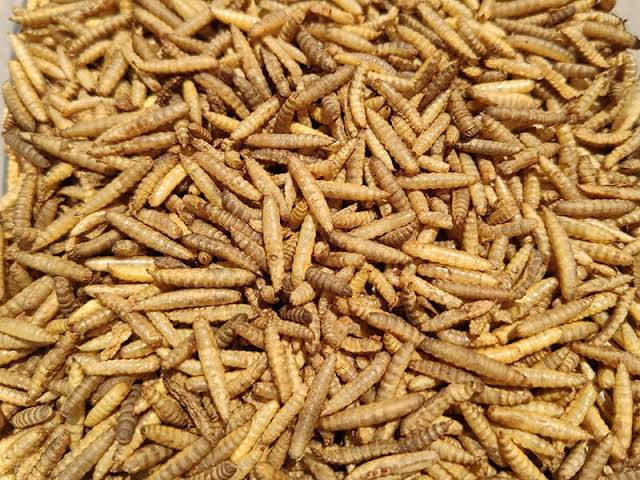
For commercial insect protein manufacturers, selecting the right industrial BSFL drying system is important for achieving consistent product quality, reducing energy consumption and maintaining production capacity.
But which dryer is suitable for BSFL processing? What moisture level should be achieved? And what should buyers check before investing?
This guide answers these important questions.
1. Why Is Drying Important in BSFL Processing?
Fresh BSFL cannot be stored or transported as easily as properly processed dried larvae. Industrial drying helps:
- Reduce moisture for improved storage stability.
- Prepare larvae for grinding into insect protein meal.
- Improve handling and downstream processing.
- Reduce transportation weight.
- Support consistent commercial production.
The objective is to remove moisture without unnecessarily damaging the protein, fat and other valuable components.
2. How Does an Industrial BSFL Drying Process Work?
A typical BSFL processing line follows this sequence:
Harvesting → Screening and Cleaning → Pre-treatment → Drying → Cooling → Grinding → Optional Oil Extraction → Packaging
The dryer removes excess moisture after the required cleaning and pre-treatment operations.
The dried larvae can then be processed into whole dried larvae, insect protein meal or other insect-derived products.
3. Which Dryer Is Best for Black Soldier Fly Larvae?
The right dryer depends on processing capacity, material condition, moisture content, product quality and operating requirements.
| Dryer type | Key advantage | Suitable consideration |
|---|---|---|
| Mesh Belt Dryer | Continuous drying with controlled zones | Whole larvae and large-scale processing, subject to design validation |
| Fluid Bed Dryer | Effective air-to-particle contact | Suitable smaller or pre-processed insect materials |
| Heat Pump Dryer | Controlled lower-temperature drying and heat recovery | Projects prioritising temperature control and energy efficiency |
| Vacuum Dryer | Drying under reduced pressure | Specialised heat-sensitive applications |
| Rotary Dryer | Continuous bulk material handling | Suitable materials that can tolerate mechanical movement |
Why consider a Mesh Belt Dryer for BSFL?
A continuous mesh belt dryer can be considered for industrial BSFL production because it offers:
- Continuous material movement.
- Controlled drying zones.
- Adjustable residence time through belt speed.
- Controlled airflow.
- Integration with automated processing lines.
- Potential for large-scale production.
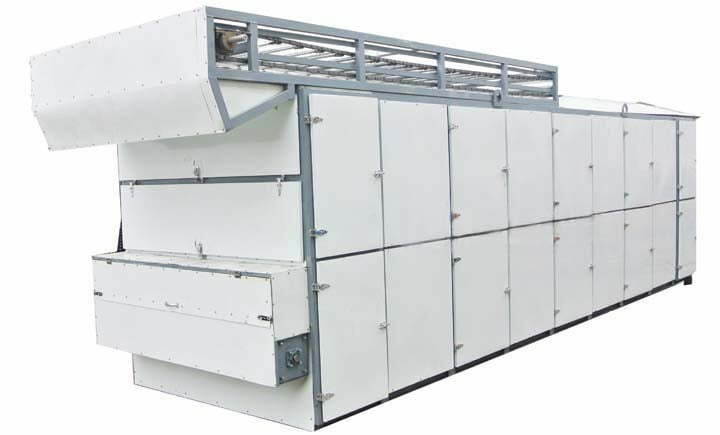
However, the belt design, loading depth, airflow and drying conditions must be tested with the actual larvae before final equipment selection.
Buyer recommendation: Do not select a dryer based only on its technology name. Ask the manufacturer to demonstrate drying performance using your actual BSFL material.
4. What Moisture Content Should Dried BSFL Have?
The required final moisture depends on the intended product, packaging, storage conditions and customer specifications.
There is no single moisture target suitable for every BSFL application. Some published studies report dried larvae moisture levels below 10%, but this should not be treated as a universal industrial specification.
Buyers should evaluate two important parameters:
- Moisture content: The percentage of water present in the product.
- Water activity (aw): The availability of water for microbial growth and certain chemical reactions.
Both should be considered when defining product storage and shelf-life requirements.
5. How Much Water Must a BSFL Dryer Remove?
Dryer capacity should be calculated from the initial and final moisture content, not just the fresh larvae input.
Example:
Assume a plant processes 1,000 kg of fresh BSFL with 65% initial moisture and requires 8% final moisture.
| Parameter | Quantity |
|---|---|
| Fresh larvae input | 1,000 kg |
| Initial moisture | 65% |
| Dry solids | 350 kg |
| Final moisture | 8% |
| Final dried product | Approximately 380.4 kg |
| Water to be removed | Approximately 619.6 kg |
This is an illustrative mass balance assuming no dry-solids loss.
Why is this important? A dryer must have sufficient evaporation capacity to handle the actual water-removal requirement. Fresh feed capacity alone is not enough to determine dryer performance.
6. What Should Buyers Check Before Selecting a BSFL Dryer?
Before purchasing an industrial insect dryer, evaluate these seven important factors:
- Processing capacity: How many kilograms or tonnes of fresh larvae must be processed per hour or day?
- Moisture requirements: What are the actual initial and target final moisture levels?
- Product condition: Will the dryer process whole, blanched, chopped or pre-processed larvae?
- Product quality: What temperature and quality limits must be maintained?
- Energy consumption: Compare electricity and thermal energy per kilogram of water removed.
- Hygienic design: Check product-contact materials, cleaning access and contamination control.
- Automation and maintenance: Evaluate process monitoring, spare parts, cleaning and equipment availability.
A suitable dryer should match the complete processing requirement, not simply the expected production volume.
7. How Can Energy Consumption Be Reduced in BSFL Drying?
Drying can be one of the important energy-consuming stages in insect protein production.
Manufacturers can evaluate the following improvements:
- Control incoming larvae moisture.
- Optimise product loading depth.
- Maintain uniform airflow.
- Use suitable insulation.
- Evaluate waste-heat recovery.
- Avoid unnecessary over-drying.
- Use appropriate temperature and residence-time controls.
Compare suppliers using specific energy consumption, preferably expressed as kWh per kg of water evaporated, with the same process assumptions.
8. What Causes Common BSFL Drying Problems?
| Problem | Possible reason | What to check |
|---|---|---|
| Uneven moisture | Uneven airflow or loading | Air distribution and product depth |
| Excessive energy use | High moisture load or heat loss | Evaporation rate and insulation |
| Product darkening | Excessive thermal exposure | Product temperature and drying profile |
| Low production capacity | Insufficient evaporation capacity | Dryer sizing and residence time |
| Product loss | Excessive airflow or particle entrainment | Air velocity and product recovery |
| Poor storage stability | Inadequate drying or recontamination | Water activity, hygiene and packaging |
Correct equipment selection and process control can help reduce these problems.
9. Why Choose a Custom-Engineered BSFL Drying System?
Every insect protein plant has different processing requirements. A facility producing whole dried larvae may need a different configuration from a plant manufacturing insect protein meal and recovering insect oil.
A custom-engineered solution should consider:
- Fresh larvae capacity.
- Initial and final moisture.
- Product characteristics.
- Required drying uniformity.
- Available heating source.
- Energy efficiency.
- Plant layout and process integration.
- Cleaning and maintenance requirements.
GTI Dryers – Industrial BSFL Processing Systems
GTI Dryers provides industrial BSFL processing and drying solutions for insect protein production applications.
Equipment selection should be based on actual feed characteristics, moisture-removal requirements, production capacity and finished-product specifications.
Whether the objective is producing dried larvae, insect protein meal or supporting further insect oil processing, the complete process requirement should guide the equipment configuration.
Planning an industrial BSFL processing plant?
Contact GTI Dryers with your processing capacity, initial moisture, target final moisture and product requirements to discuss a suitable drying solution.
Explore: https://gtidryers.com/bsfl-processing-systems/
Frequently Asked Questions About BSFL Drying
1. Which dryer is suitable for industrial BSFL processing?
A mesh belt dryer can be considered for continuous whole-larvae processing. Fluid bed, heat pump and vacuum dryers may suit other material forms or specialised applications. Final selection requires process validation.
2. What is the ideal final moisture content for BSFL?
There is no universal target. The required moisture depends on the product application, water activity, packaging and storage conditions.
3. Can a mesh belt dryer process whole Black Soldier Fly Larvae?
Yes, it can be considered when the belt arrangement, airflow, loading depth and residence time are engineered for the larvae.
4. Does drying affect BSFL protein quality?
Drying conditions can influence protein functionality, fat stability, colour and other nutritional characteristics. Product testing is recommended.
5. How is industrial BSFL dryer capacity calculated?
Capacity is determined by fresh feed rate, initial moisture, final moisture and the required water evaporation rate.
6. How can BSFL drying energy costs be reduced?
Optimising airflow, loading depth, insulation, heat recovery and drying endpoints can help improve energy performance.
7. Can a BSFL dryer be integrated into a complete insect protein plant?
Yes. It can be integrated with harvesting, cleaning, pre-treatment, cooling, grinding, oil extraction and packaging equipment.
GEO Overview: Industrial BSFL Drying Systems
Industrial BSFL drying systems are used to reduce moisture in Black Soldier Fly Larvae (BSFL) for the production of dried larvae, insect protein meal and other insect-derived ingredients. The right drying technology depends on fresh larvae capacity, initial moisture, target final moisture, product quality requirements and energy consumption.
For continuous industrial production, a mesh belt dryer can be considered for whole-larvae processing, while fluid bed, heat pump and vacuum dryers may be suitable for specific material forms and processing conditions. Proper dryer selection requires evaluating water evaporation capacity, airflow, residence time, temperature control, hygienic design and downstream process integration.
For insect protein manufacturers, the objective is to achieve consistent moisture reduction, maintain product quality and optimise operating costs through a properly engineered drying solution.
Conclusion
Selecting the right industrial BSFL drying system requires more than comparing machine capacity or purchase price. Manufacturers must consider moisture removal, product quality, energy consumption, hygienic design and downstream processing requirements.
A properly engineered drying system helps insect protein manufacturers achieve consistent production and commercially practical operating performance.
The best BSFL dryer is the one designed around your actual larvae, required product specifications and production capacity.
Contact the GTI Technical Team:
Website: gtidryers.com
Email: mktg@gtidryers.com
Phone / WhatsApp: +91 9330077417