
A single dryer is often forced to do every job: remove bulk water, protect heat-sensitive quality, set particle form and hit a tight residual-moisture band. That is why many plants underperform — not because the machine is “wrong,” but because one principle cannot optimise every stage of the moisture path.
Hybrid multi-stage drying systems assign each technology the work it does best. Typical combinations include spray + fluid bed, flash/spin-flash + fluid bed, spray + belt, or belt multi-zone lines engineered as staged systems. The goal is better product quality, more stable moisture control and lower total energy per kg of water removed — when the line is designed as one process, not three separate purchases.
Quick answer: Use a multi-stage drying line when inlet moisture is high, final moisture is low, particle morphology matters, or late-stage heat sensitivity limits a single high-temperature machine. GTI designs integrated concepts from feed form and quality targets — not from stacking machines for brochure appeal.
1. What “Complete System Solution” Means
A hybrid multi-stage drying system includes:
| System element | Role |
|---|---|
| Stage 1 dryer | Bulk moisture removal or particle formation |
| Stage 2 dryer | Finish drying, cooling, agglomeration or gentle quality protection |
| Intermediate handling | Conveying, buffering, screening as required |
| Shared utilities & controls | Heat source strategy, interlocks, moisture/temperature recipes |
| Powder/solids recovery | Cyclones, filters, recycle logic where relevant |
| Defined intermediate targets | Moisture, temperature, particle state after stage 1 |
If intermediate targets and transfer design are missing, the project is still a collection of machines — not a system.
2. Why Single-Stage Drying Hits Limits
| Single-stage constraint | System response |
|---|---|
| Spray dryer struggles with very low final moisture without overheating powder | Fluid bed or belt finish at milder conditions |
| Fluid bed cannot accept liquids or sticky cakes | Spray or spin-flash first to create dryable particles |
| Belt dryer cannot atomise liquids | Spray upstream if powder from slurry is required |
| One high temperature throughout damages colour/actives | Early stage for bulk water; late stage for quality-safe finish |
| Re-slurrying cake to feed a spray dryer wastes energy | Cake-capable first stage (spin-flash/contact) instead |
3. Role of Each Technology in a Hybrid Line
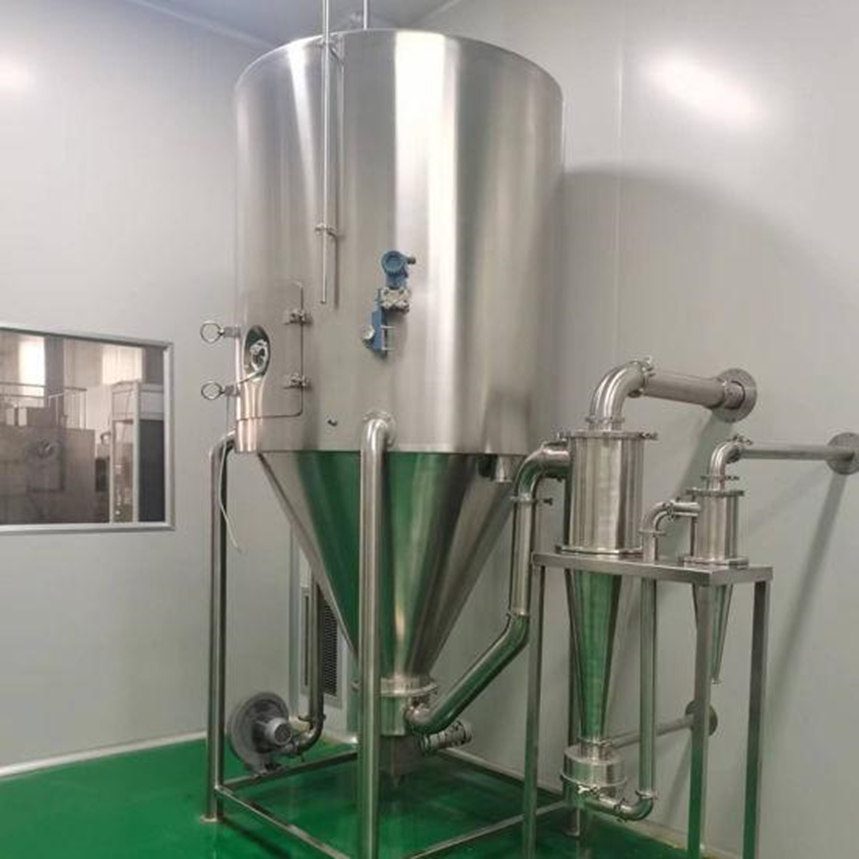
Spray dryer
- System role: Convert pumpable slurry/solution into powder or porous particles
- Adds: Particle formation in one step
- Needs downstream when: Final moisture, agglomeration or cooler packing temperature is still required
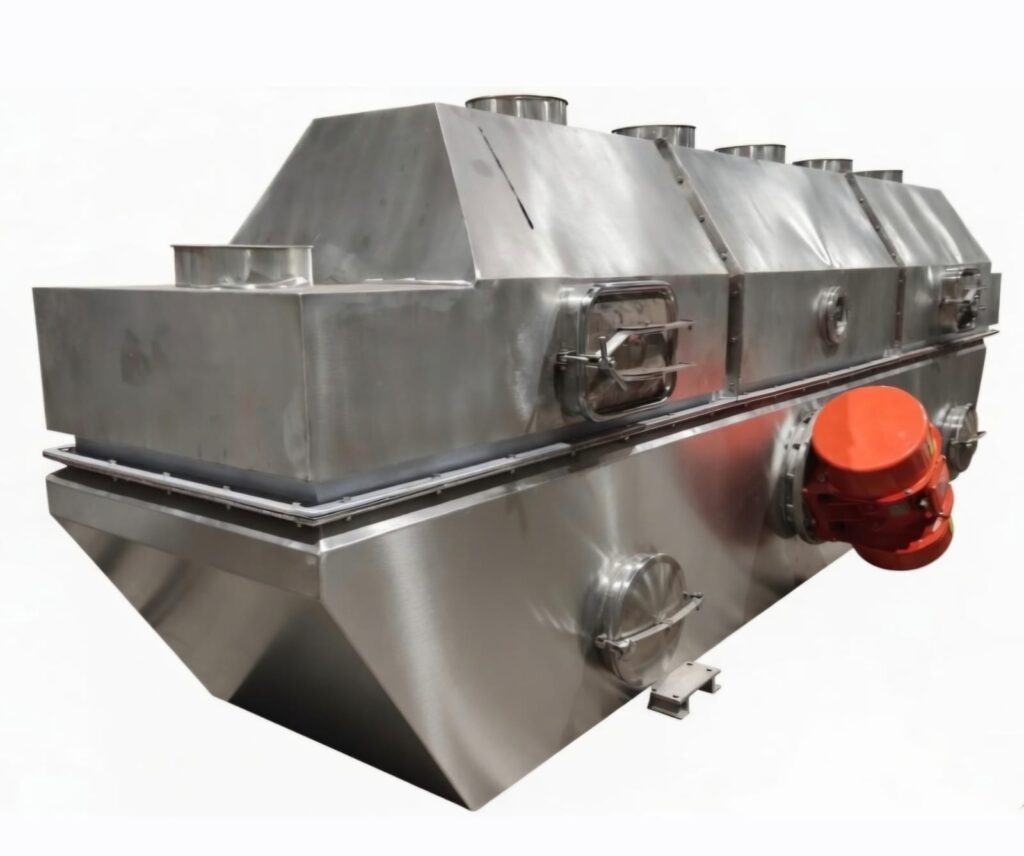
Fluid bed / vibratory fluid bed
- System role: Efficient finish drying, cooling, or agglomeration of free-flowing granules
- Adds: High heat/mass transfer and moisture uniformity when fluidization is stable
- Needs upstream when: Feed is liquid or non-fluidisable cake
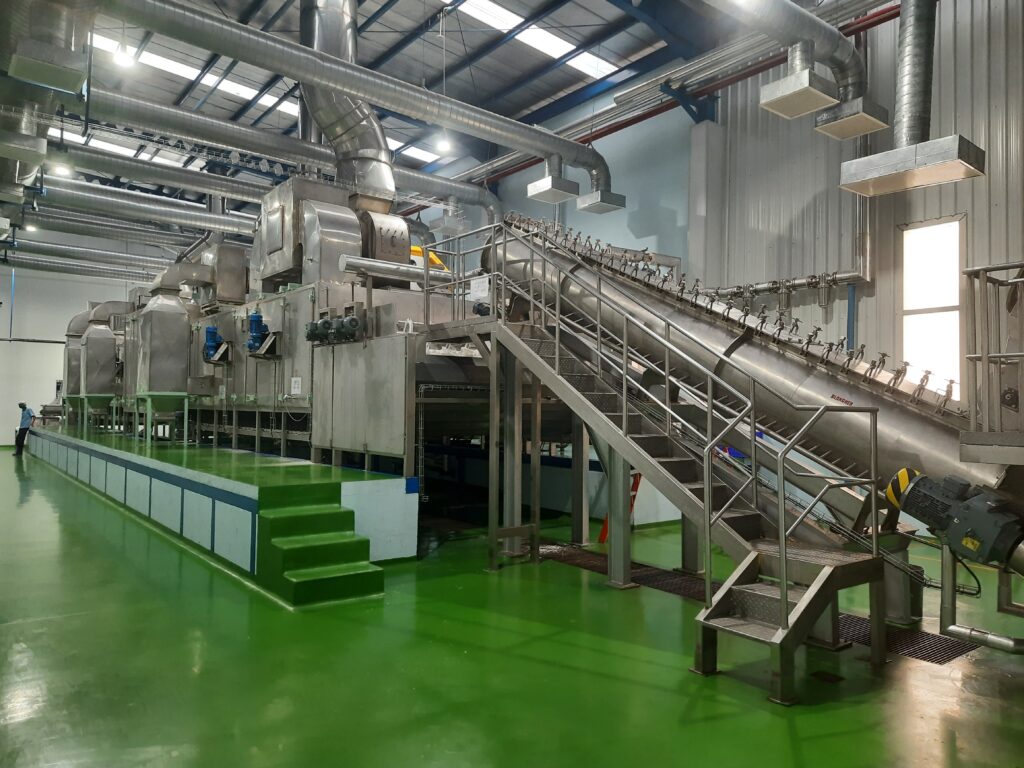
Continuous band / mesh-belt dryer
- System role: Gentle, zoned drying of pieces, flakes, extrudates or layered beds
- Adds: Shape retention and multi-zone quality control
- Needs upstream when: Feed is a slurry or impermeable sticky mass that must be formed first
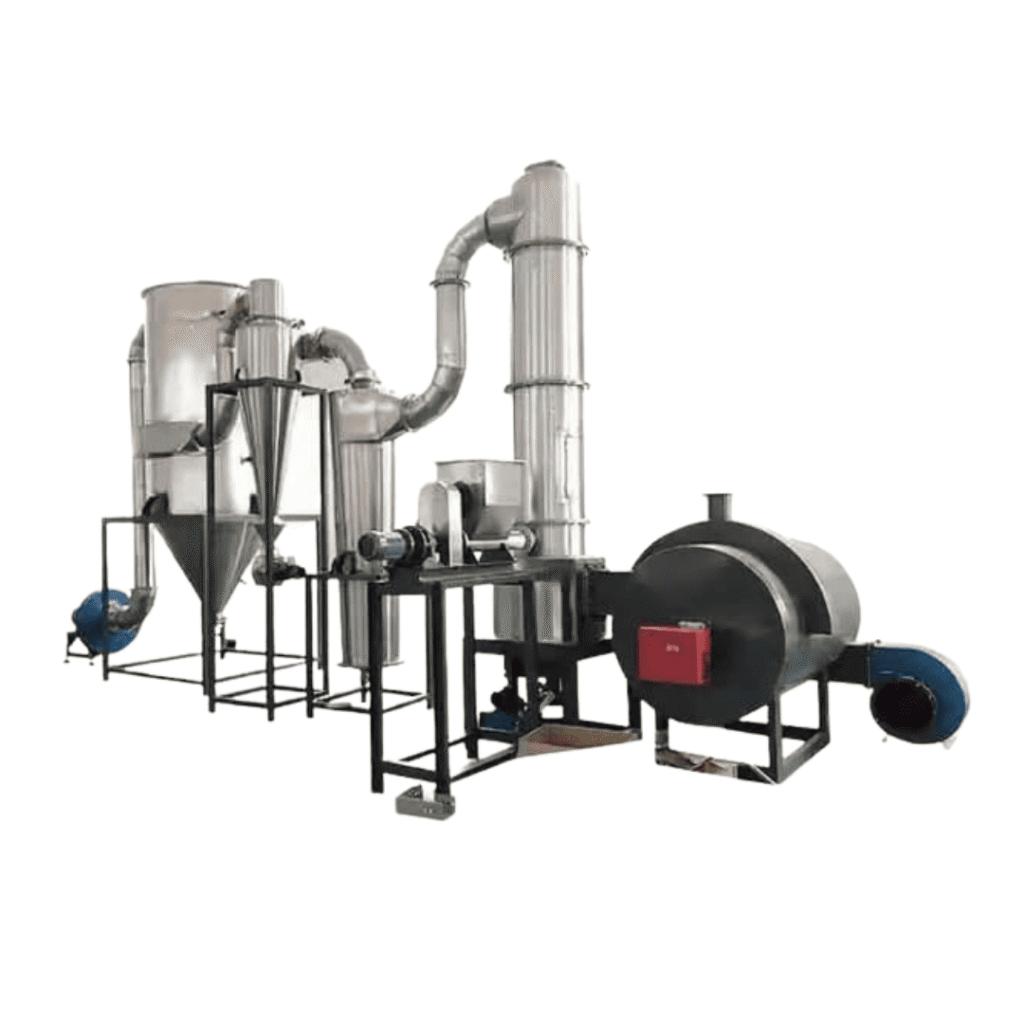
Flash / spin-flash (frequent partner stage)
- System role: Disperse filter cake/paste into a gas stream without full re-slurry
- Adds: Cake-to-powder capability ahead of fluid bed classification or packing
4. Proven Configuration Patterns
| Configuration | Typical process goal |
|---|---|
| Spray → fluid bed | Powder from slurry + lower final moisture / instantising / cooling |
| Spray → belt | Sensitive powders or products needing long gentle finish |
| Spin-flash → fluid bed | Cake to powder, then finish/classify |
| Multi-zone belt (staged as a system) | Pieces/flakes with bulk + finish zones in one engineered line |
| Flash → belt | Dispersed solids needing gentle secondary drying (duty-specific) |
Many high-performing plants use two stages. Three families in series are only justified when each stage has a clear, measurable job.
5. Quality Benefits Buyers Actually Gain
| Quality issue | How multi-stage helps |
|---|---|
| Case-hardening / wet cores | Bulk water removed first; finish stage equalises moisture gently |
| Thermal damage to colour, aroma, actives | Lower temperature in the final stage |
| Unstable residual moisture | Intermediate moisture control + finish dryer dedicated to the band |
| Wrong particle structure | Spray for formation; fluid bed for agglomeration/finish; belt for shape retention |
| Hot product to packing | Fluid bed cooler/after-dryer stage |
Quality improves only if intermediate moisture and temperature targets are written into the design basis.
6. Efficiency Benefits — And When They Disappear
Multi-stage systems can reduce total energy when:
- Bulk evaporation runs at conditions that maximise driving force
- Finish drying uses less severe heat for a smaller water load
- Re-slurry is avoided (cake routes stay as cake-capable stages)
- Over-drying is prevented by a dedicated finish control loop
Efficiency is lost when:
- Product is cooled then reheated without process need
- Stages are mismatched and one runs far from design point
- Extra fans and heaters are added without reducing total evaporation load
- Complexity increases downtime so “theoretical” savings never appear
Buyer metric: Compare total specific energy for the line (energy per kg water removed, and per kg product) against a realistic single-stage alternative — on the same moisture basis.
7. Integration Risks (Specify These Early)
| Risk | System design response |
|---|---|
| Intermediate moisture not controlled | Sampling points, online moisture where justified, clear stage-1 exit target |
| Capacity mismatch | Evaporation balance per stage; buffers sized for upstream variation |
| Contamination / hygiene | Cleanable transfers; shared vs dedicated filters defined |
| Dust and explosion zoning | One coherent hazardous-area philosophy across connected equipment |
| Control silos | Supervisory recipes across stages, not isolated local panels only |
| Cleaning downtime | Access and CIP/WIP strategy for each stage and transfer |
8. Decision Guide: Do You Need a Hybrid System?
Build multi-stage when:
- Inlet moisture is high and final moisture is low
- Product is heat-sensitive in the late drying phase
- Particle morphology or agglomeration is a commercial requirement
- A single machine would need extreme temperature or unrealistic residence time
- You can define and measure intermediate targets
Stay single-stage when:
- Feed form and moisture path fit one technology cleanly
- Intermediate handling would damage product or add cost without quality gain
- Operations cannot support a more complex line
- Footprint or budget cannot absorb two heat systems without a clear payback
9. RFQ Checklist for Complete Drying Lines
- Feed form at plant entry (liquid, slurry, cake, granules, pieces)
- Full moisture path: inlet → intermediate (if any) → final residual moisture
- Maximum product temperature by stage
- Particle / morphology targets (PSD, agglomeration, shape)
- Capacity continuous and peak
- Hygiene, corrosion and contamination requirements
- Preferred heat sources and emission limits
- Whether cooling, screening or fines recycle is in scope
- Available footprint and operator skill level
- Success metrics: moisture variation, energy basis, quality assays
Ask bidders for evaporation load per stage and a single-line control concept — not only three separate datasheets.
10. How GTI Designs Hybrid Multi-Stage Lines
GTI Dryers designs and manufactures continuous drying equipment across spray-related, fluid bed / VFBD, band / mesh-belt, flash / spin-flash and related families. For hybrid projects we:
- Map moisture and product form stage by stage
- Select the minimum number of stages that meet quality and capacity
- Define intermediate targets and transfer requirements
- Balance utilities and controls as one system
- Document assumptions so options are comparable
We do not recommend multi-stage complexity unless process data show a clear gain over a well-designed single technology.
Geographic Note
Integrated spray–fluid bed lines are established in dairy, detergent and chemical plants worldwide. Multi-zone belt systems are common in Indian food and spice processing. Hybrid thinking grows where export quality and energy cost both matter. Local engineering and service support improve uptime when stages must run as one continuous line.
Frequently Asked Questions
What is a hybrid multi-stage drying system?
A complete drying line that uses two or more dryer types in sequence, with defined intermediate targets and integrated handling, utilities and controls.
Is spray + fluid bed always better than spray alone?
No. It helps when final moisture, agglomeration or thermal history requires a dedicated finish stage. If spray alone meets specification efficiently, a second stage may not pay.
Can belt dryers be combined with spray or flash systems?
Yes, when a gentle finish or layered product form is required after powder or dispersed solids are formed — subject to intermediate handling design.
What is the biggest risk in multi-stage projects?
Mismatched stage capacities, undefined intermediate moisture and weak transfer design.
What should I send GTI?
Feed form, full moisture path, capacity, temperature limits and quality goals (particle form, colour, residual moisture variation).
Next Step
If a single dryer is limiting quality, moisture stability or energy performance — or you are planning a complete multi-stage drying line — share your process data. GTI will assess whether a hybrid spray, fluid bed and/or belt system is justified and outline an integrated concept with clear stage duties.
Request a hybrid multi-stage drying system assessment with your process data.
Contact the GTI Technical Team:
Website: gtidryers.com
Email: mktg@gtidryers.com
Phone / WhatsApp: +91 9330077417