
A paddle dryer is an indirect (contact) dryer that heats wet solids through a jacketed trough and heated rotating paddles while continuously agitating the material. It is widely used for filter cakes, pastes, sludge and other cohesive feeds that need controlled temperature, limited gas volume and mechanical movement through the sticky moisture range.
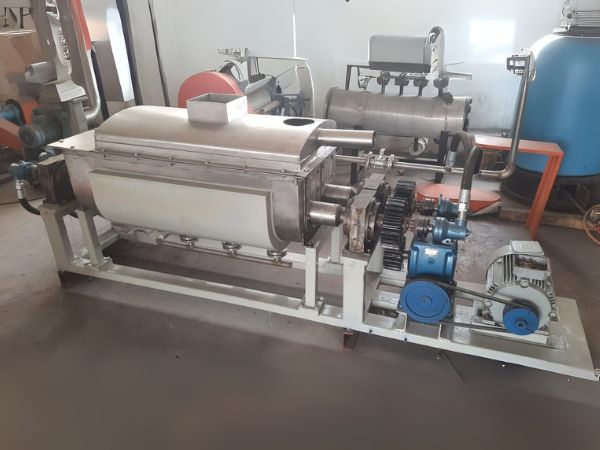
This guide explains the working principle, main advantages, ideal applications and the limits buyers should weigh before selecting a paddle dryer.
1. Working Principle
Wet feed enters a horizontal U- or W-shaped trough. One or more shafts carry wedge- or plough-shaped paddles that rotate at relatively low speed. The trough jacket and the hollow paddles are heated by steam, thermic fluid or hot water. Heat transfers by conduction from the hot metal surfaces into the solids. Agitation continually renews the contact layer, mixes the bed and moves product from feed end to discharge.
Moisture evaporates into a small flow of sweep gas (air or inert gas) or is removed under vacuum in vacuum paddle designs. Vapour leaves through a dome or vapour nozzle to a condenser or scrubber system.
In short:
Indirect heat + slow mechanical agitation → drying without a large volume of hot process air.
text
[Wet feed] → [Jacketed trough + heated paddles]
                    ↓
            [Agitated bed, conduction heating]
                    ↓
        [Vapour out] ← sweep gas / vacuum
                    ↓
            [Dry or semi-dry product discharge]
2. Core Engineering Points
| Element | Role |
|---|---|
| Jacket | Primary heat-transfer area on the trough wall |
| Hollow paddles / shafts | Additional heated surface and mixing |
| Fill level | Typically a substantial fraction of the trough; design-specific — affects torque and contact |
| Residence time | Set by throughput, fill and geometry (often longer than flash dryers) |
| Atmosphere | Atmospheric with sweep gas, or vacuum for lower boiling point / solvent recovery |
| Torque & drive | Must handle sticky and high-solids phases without stalling |
Because heat comes through metal walls, product temperature is tied to jacket/paddle temperature and contact efficiency — not to a high-temperature gas stream as in direct rotary or flash dryers.
3. Advantages of Paddle Dryers
| Advantage | Practical meaning for the plant |
|---|---|
| Indirect heating | Product does not contact combustion gases; useful for purity and odour control |
| Low carrier-gas volume | Smaller exhaust handling than direct dryers; easier condensation of solvents |
| Handles cohesive feeds | Agitation keeps cakes and pastes moving through sticky phases better than many static beds |
| Temperature control | Jacket fluid temperature gives a clear upper bound for product heating |
| Solvent / vacuum capability | Well suited to closed systems and solvent recovery when designed for it |
| Continuous or batch | Configurations exist for both operating modes |
| Compact vapour system | Less air to heat and move per kg of water evaporated (energy structure differs from convective dryers) |
Advantages only hold when the machine is sized for the real torque, stickiness and heat-transfer area of your feed — not from a generic catalogue claim.
4. Ideal Applications
Paddle dryers are typically shortlisted when the feed is semi-solid or cohesive and indirect heat is preferred:
- Chemical and pharmaceutical filter cakes and pastes
- Sludges (industrial or selected municipal) where contact drying is specified
- Pigments, dyes and inorganic cakes that tolerate the temperature and shear
- Products needing solvent removal with condensation and recovery
- Heat-sensitive materials that benefit from moderated jacket temperatures and, where needed, vacuum
- Duties where minimal exhaust gas simplifies emission control
Less ideal as first choice when:
- Feed is a free-flowing granule that fluidises cleanly → fluid bed / VFBD often more efficient
- Feed is a pumpable liquid → spray dryer
- Feed is fragile slices/flakes (onion, garlic, coconut chips) → band / mesh-belt dryer
- Very high tonnage robust minerals with no purity constraint → direct rotary may be more economical
- Extreme abrasion without suitable wear design → high maintenance risk
5. Paddle Dryer vs Related Technologies
| Criterion | Paddle (contact) | Spin flash | Direct rotary | Fluid bed |
|---|---|---|---|---|
| Heat mode | Indirect conduction | Direct convection + dispersion | Direct (or indirect shell) | Direct convection |
| Typical feed | Cake, paste, sludge | Wet cake / paste | Bulk solids | Free-flowing particles |
| Gas volume | Low | High | High | High |
| Attrition | Moderate (shear from paddles) | High dispersion | Cascading attrition | Depends on velocity |
| Solvent recovery | Strong fit with vacuum/closed design | Possible but larger gas stream | Possible with condensation | Possible with condensation |
| Temperature ceiling | Set by jacket fluid | Set by gas inlet / particle history | Set by gas / shell | Set by gas |
6. Key Design and Operating Variables
| Variable | Effect |
|---|---|
| Jacket / paddle temperature | Drives heat flux; limited by product degradation |
| Shaft speed | Mixing and wall renewal vs shear damage and power |
| Fill level | Contact area and residence time; overload raises torque |
| Feed moisture and rate | Evaporation load and sticky-phase behaviour |
| Sweep gas or vacuum level | Removal of vapour; vacuum lowers boiling temperature |
| Residence time | Final moisture; too short → wet discharge; too long → overheating or capacity loss |
7. Common Buyer Concerns and Practical Answers
Will it handle my sticky cake?
Often yes, if torque, paddle design and possible back-mixing or staged temperature are engineered for that cake. Pilot testing is recommended for unknown formulations.
Is product temperature equal to jacket temperature?
Not instantly. Product temperature depends on contact, moisture (evaporative cooling) and residence time. Design should respect a maximum product temperature, not only jacket set point.
How does capacity scale?
With heat-transfer area (jacket + paddles), temperature difference, agitation efficiency and the evaporation load from your moisture balance — not with drum volume alone.
What about wear?
Abrasive solids require hard-facing, suitable clearances and a maintenance plan. Specify abrasiveness up front.
Batch or continuous?
Both exist. Continuous suits steady industrial rates; batch suits multiproduct or longer residence pharmaceutical duties.
8. What to Check Before Specifying a Paddle Dryer
- Feed form (cake, paste, sludge) and how it is produced
- Inlet and target residual moisture
- Maximum allowable product temperature
- Solvent present? Need for vacuum or inerting?
- Abrasive or corrosive nature
- Continuous vs batch preference
- Required capacity (and peak)
- Utilities (steam pressure, thermic fluid temperature)
- Vapour handling and emission requirements
Ask suppliers for the heat-transfer area basis, assumed temperature difference and torque design philosophy — not only a “kg/h” label.
9. How GTI Dryers Approaches Contact and Related Drying Duties
GTI Dryers evaluates drying technology from feed form first. For cohesive cakes and pastes, options may include:
- Spin-flash / mechanical dispersion systems when rapid pneumatic drying of dispersed cake is appropriate
- Contact / paddle-type principles when indirect heat, low gas volume or solvent recovery dominate the requirement
- Band, fluid-bed or rotary when the solid’s physical form points clearly to those families
The goal is a matched process route — not forcing every wet solid into one machine type. Pilot or representative-feed evaluation is advised when stickiness or temperature sensitivity is uncertain.
Geographic Note
Paddle and hollow-flight contact dryers are used globally in chemical, environmental and pharmaceutical plants. Indian fabrication is common for domestic projects; export duties add documentation and code requirements. Energy cost and solvent regulations often favour indirect systems with condensation where solvents are present.
Frequently Asked Questions
What is the working principle of a paddle dryer?
Indirect heat from a jacketed trough and heated paddles, combined with slow agitation, dries cakes and pastes while vapour is removed by sweep gas or vacuum.
What are the main advantages?
Indirect heating, low carrier-gas volume, ability to process cohesive feeds, good temperature control and suitability for solvent recovery designs.
Is a paddle dryer the same as a rotary dryer?
No. Rotary dryers typically tumble solids in a rotating shell with large gas contact (direct) or shell heating. Paddle dryers use internal agitated contact surfaces in a stationary trough.
When should I choose spin flash instead?
When the cake can be mechanically dispersed into a hot gas stream and a fine powder with short residence time is acceptable — especially if you want to avoid a long contact residence time.
What data should I send for an assessment?
Feed form, moisture in/out, temperature limits, capacity, solvent/vacuum needs and any abrasion or corrosion concerns.
Next Step
If you are evaluating a paddle dryer for filter cake, paste or sludge — or comparing it with spin-flash, rotary or fluid-bed options — share your process data. GTI can help determine whether contact drying or another technology is the practical fit.
Request a paddle / contact dryer suitability assessment with your process data.
Contact the GTI Technical Team:
Website: gtidryers.com
Email: mktg@gtidryers.com
Phone / WhatsApp: +91 9330077417