
A spray dryer turns a pumpable liquid or slurry into a dry powder in one continuous operation. It does this by atomising the feed into fine droplets and contacting those droplets with hot gas so that moisture evaporates while the droplets are airborne. The solid that remains is collected as powder.
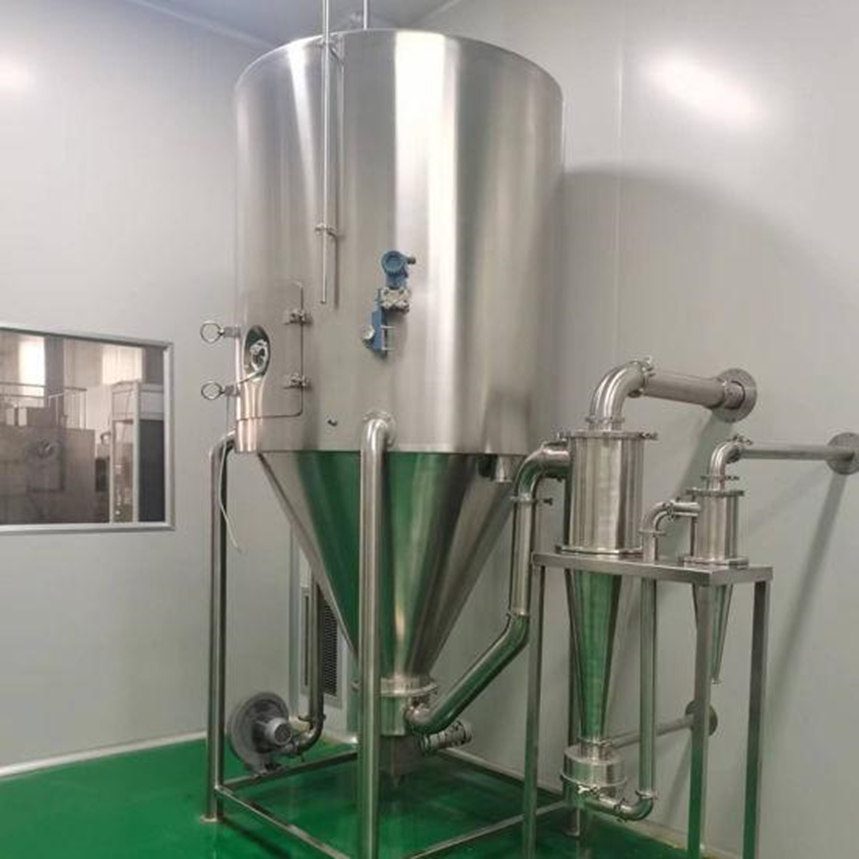
This page explains the working principle, the process stage by stage, the main components, and the practical limits buyers should understand before specifying a spray dryer.
1. Working Principle in One Paragraph
Liquid feed is atomised into a spray of droplets inside a drying chamber. Hot air (or other gas) is introduced in a controlled pattern. Heat transfers to the droplets, moisture evaporates rapidly, and particle temperature is limited while evaporation continues. Dry or semi-dry particles leave with the exhaust gas and are separated in cyclones and/or a bag filter. Fine control of inlet temperature, outlet temperature, feed rate and atomisation determines residual moisture, particle size and product quality.
2. Process Flow Diagram (Text Schematic)
Use this sequence as the basis for any plant diagram or training schematic:
text
[Feed tank / preparation]
        ↓
[Feed pump + filter]
        ↓
[Atomiser: rotary wheel OR pressure nozzle OR two-fluid nozzle]
        ↓
[Drying chamber] ← [Hot gas generator / heater + inlet air]
        ↓
[Primary separation: cyclone(s)]
        ↓
[Secondary separation: bag filter] → [Exhaust fan → stack]
        ↓
[Powder discharge] → [Cooling / sieving / packing as required]
Optional blocks often added: feed concentrate evaporator, fines recycle, closed-cycle inert gas system, wet scrubber after the bag filter.
(On the published page, place a labelled process diagram here showing feed → atomiser → chamber → cyclone → bag filter → product out, with hot air in and exhaust out.)
3. Stage-by-Stage Process Explanation
Stage 1 — Feed preparation
The feed must be pumpable and relatively free of tramp solids that would block the atomiser.
Typical steps: dissolving or dispersing, solids adjustment, screening/filtration, sometimes pre-concentration to raise solids and cut dryer load.
Buyer note: Higher feed solids generally mean less water to evaporate per kg of powder and a smaller dryer for the same product rate — within viscosity and atomisation limits.
Stage 2 — Atomisation
The feed is broken into droplets. Droplet size controls surface area, drying time and final particle size.
| Atomiser type | How it works | Typical traits |
|---|---|---|
| Rotary (wheel / disk) | High-speed spinning wheel flings liquid into droplets | Flexible on feed; wide capacity range; common in industrial food and chemical dryers |
| Pressure nozzle | High-pressure liquid through a small orifice | Narrower droplet spectrum; multiple nozzles for large chambers |
| Two-fluid (pneumatic) nozzle | Liquid + compressed air/steam | Useful for smaller duties or difficult feeds; higher energy for atomisation gas |
Poor atomisation produces coarse wet particles, wall deposits or excessive fines.
Stage 3 — Hot gas supply and contact
Ambient air (or inert gas in closed cycle) is filtered, heated and distributed into the chamber through an air disperser.
- Co-current: Gas and spray move in the same direction — common; product temperature stays closer to the wet-bulb/outlet regime while moisture remains.
- Counter-current or mixed: Used in specific designs; product can see higher temperatures — only when the solid tolerates it.
Inlet gas temperature is set high enough for capacity; outlet gas temperature is the main practical handle on residual moisture and thermal exposure of the powder.
Stage 4 — Drying in the chamber
Each droplet undergoes:
- Heat-up and surface evaporation
- Continued evaporation with particle formation
- Approach to residual moisture set by outlet conditions and residence time
As long as surface moisture evaporates freely, particle temperature stays relatively moderate. When the surface dries, temperature can rise toward the gas temperature — the critical period for heat-sensitive products.
Chamber volume and air pattern must give enough residence time for the largest droplets without excessive wall contact.
Stage 5 — Powder separation
Gas + powder leave the chamber and enter separation equipment:
- Cyclone(s): Primary recovery of coarser powder
- Bag filter: Captures fines; often the final product stream or a separate fines cut
- Sometimes a wet scrubber for residual dust or soluble recovery
Product is discharged through rotary valves or other sealed devices to packing or intermediate storage. Fines may be blended back or recycled into the feed depending on the process.
Stage 6 — Exhaust
The exhaust fan maintains system draft. Exhaust is hot and humid; heat recovery is sometimes evaluated but must respect fouling and hygiene constraints.
4. Main Components (What the Buyer Is Paying For)
| Component | Function |
|---|---|
| Feed system | Tank, agitation, pump, filter, pipework to atomiser |
| Atomiser | Creates the droplet size distribution |
| Air heater | Steam coil, gas burner, thermic fluid coil, or electric |
| Air disperser | Distributes inlet gas; critical for wall deposits and drying uniformity |
| Drying chamber | Residence time and containment of the spray |
| Cyclone / bag filter | Powder recovery and emission control |
| Exhaust fan & stack | System airflow and discharge |
| Controls | Feed rate, temperatures, interlocks, often PLC |
| Optional | CIP, inert loop, explosion protection, cooling conveying |
5. Key Operating Variables
| Variable | Effect |
|---|---|
| Inlet temperature | Higher → more drying capacity; limited by product sensitivity and materials |
| Outlet temperature | Primary control of residual moisture and thermal history of powder |
| Feed rate | Must match evaporation capacity; over-feed → wet powder / deposits |
| Feed solids / viscosity | Affects droplet size, capacity and atomiser behaviour |
| Atomiser speed or pressure | Droplet size and particle size distribution |
| Airflow | Residence time and humidity in the chamber |
Stable control of outlet temperature and feed rate is central to consistent powder quality.
6. When a Spray Dryer Is the Right Choice
Strong fit when:
- Feed is a true liquid or stable slurry that can be pumped and atomised
- A powder product is required in one step from solution or slurry
- Relatively fast drying and spherical or characteristic spray-dried morphology are desired
Poor fit when:
- Feed is a non-pumpable sticky filter cake (consider spin-flash or contact drying instead of re-slurrying)
- Product cannot tolerate the temperature history of spray drying even at optimised outlet conditions
- Very coarse granules are required without agglomeration steps
Re-slurrying a cake only to spray-dry it adds evaporation load and energy cost; evaluate cake-capable dryers first.
7. Common Process Problems (Buyer-Relevant)
| Symptom | Typical process links |
|---|---|
| Wall deposits / sticky powder | Outlet temp too low, feed solids/composition, air pattern, atomisation |
| High residual moisture | Evaporation capacity exceeded, outlet temp too low, coarse droplets |
| Scorched or discoloured powder | Outlet or local particle temperature too high; long hold-up |
| Excessive fines | Atomisation too fine, brittle product, aggressive conveying |
| Low capacity | Inlet temp limited by product, wet feed solids low, airflow or fouling limits |
Structured troubleshooting starts with feed solids, atomisation quality, inlet/outlet temperatures and air disperser condition — not with random set-point changes.
8. How GTI Dryers Approaches Spray Drying Applications
GTI Dryers evaluates spray drying when the feed is pumpable and the product specification suits atomisation and pneumatic drying. Assessment focuses on:
- Feed solids, viscosity and atomisation route
- Inlet/outlet temperature window vs product sensitivity
- Chamber and separation concept for the required capacity
- Integration with upstream concentration and downstream handling
Where the feed is a wet cake rather than a slurry, GTI also evaluates spin-flash and other cake-capable systems so that unnecessary re-slurrying is avoided.
Geographic Note
Spray dryers are used worldwide in food, dairy, chemical, ceramic and pharmaceutical plants. Ambient humidity, fuel type and emission rules affect heater and exhaust design; the core process — atomise, contact with hot gas, separate powder — remains the same. Local fabrication and support in India are often preferred for domestic projects; export projects add documentation and destination compliance requirements.
Frequently Asked Questions
How does a spray dryer differ from a flash dryer?
Spray dryers atomise liquids/slurries into droplets. Flash dryers disperse wet solids or cakes into a hot gas stream. Feed form decides which principle applies.
What controls final moisture in a spray dryer?
Primarily outlet gas temperature and the balance of feed rate vs evaporation capacity, together with droplet size.
Why is outlet temperature more important than inlet for product quality?
While moisture remains, evaporative cooling limits particle temperature. As particles dry, they approach the surrounding gas temperature; outlet temperature indicates that thermal environment.
Can every liquid be spray-dried?
No. Feed must atomise reliably; product must tolerate the temperature history; and economics must justify evaporating the water present. Some materials need low-temperature, vacuum or non-spray routes.
What data should I send to assess spray drying?
Feed composition and solids content, rheology if known, inlet moisture or concentration, target residual moisture, temperature limits, required capacity and any hazard or hygiene constraints.
Next Step
If you are evaluating spray drying for a new powder product or replacing an existing system, share your feed type, solids level and capacity targets. GTI can confirm whether spray drying is appropriate or whether another technology fits the feed form better.
Request a spray dryer process / suitability assessment with your feed data.
Contact the GTI Technical Team:
Website: gtidryers.com
Email: mktg@gtidryers.com
Phone / WhatsApp: +91 9330077417