
Buying an industrial dryer is a process decision. The supplier’s location in India can offer advantages in cost, communication and service access — but only if technology fit, capacity basis, construction, scope and support are verified before the order.
This checklist is written for plant engineers, project managers and procurement teams who want to avoid the most common post-order problems: undersized capacity, wrong dryer type, unclear battery limits and weak after-sales response.
1. Confirm Technology Fit Before You Talk Price
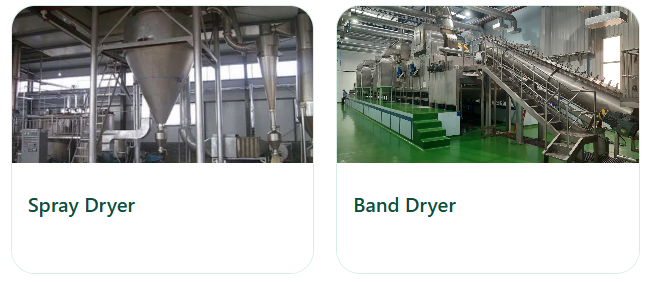
Indian manufacturers supply spray, rotary, fluid-bed, flash/spin-flash, band/mesh-belt and other dryers. The wrong family cannot be fixed by negotiation.
| Your feed form | Typically evaluate first |
|---|---|
| Pumpable liquid / slurry | Spray dryer |
| Sticky filter cake / paste | Spin-flash or contact systems |
| Free-flowing granules | Fluid bed / VFBD |
| Slices, flakes, layered product | Band / mesh-belt dryer |
| Robust bulk solids | Rotary dryer |
Check: Does the manufacturer ask about feed form, moisture and quality limits — or only about “kg/h”?
If they do not engage with process data, stop and reconsider.
2. Lock the Capacity Basis (Evaporation Load, Not a Vague kg/h)
“500 kg/h dryer” is not a specification until you know:
- Feed rate or product rate
- Inlet moisture and target residual moisture (and the basis: wet or dry)
- Whether the number is feed, product or water evaporated
Check:
- Have you calculated evaporation load from your own data?
- Does the quotation state the moisture in/out and the capacity basis used?
- Is peak seasonal or process load included?
Without this, you cannot compare two Indian manufacturers fairly or know if the machine will meet production.
3. Material of Construction and Hygiene Design
| Duty | Typical expectation |
|---|---|
| General chemical / mineral | MS or SS as corrosion requires |
| Food / spice / coconut | SS304 or SS316 product contact; cleanable design |
| Pharma / high-purity | Higher finish, documentation, sometimes validated design |
Check:
- Exact grades for product-contact parts (not only “SS food grade”)
- Surface finish and cleanability if required
- Material certificates available on request
- Gaskets, seals and non-contact parts suitable for the product and temperature
4. Scope of Supply — What Is Included and Excluded
Many disputes start here. Align scope in writing:
- Dryer body and internals
- Feed system (atomiser, screw, rotor, spreader, etc.)
- Heat source interface (coil, burner, duct connections)
- Fans, ducting, dampers
- Dust collection (cyclone, bag filter)
- Controls (local panel, PLC, sensors)
- Structures, platforms, insulation
- Installation, commissioning, training
- Documentation (GA drawings, manuals, material certificates)
Check: Request a clear included/excluded list from every shortlisted manufacturer. Add your own civil, utilities and emission-control items to the project budget.
5. Performance Definition and Acceptance Logic
Agree before order:
- Residual moisture target and how it will be measured
- Capacity basis (feed/product/evaporation at stated moistures)
- Any product temperature or quality limits
- Utilities assumed (steam pressure, gas, power, ambient design conditions)
- What happens if performance is not met (re-test, adjustment, responsibility)
Check: Is performance described with assumptions, or only as marketing claims? Avoid orders based on unspecified “guaranteed efficiency.”
6. Energy and Operating Cost Awareness
Capital cost is visible; energy is continuous.
Check:
- Does the design target your real residual moisture (not systematic over-drying)?
- Multi-zone or staged control where the product needs it?
- Realistic discussion of heat source and possible recovery — with limits, not magic percentages?
- Access for cleaning heat exchangers and filters?
A cheap dryer that forces high fuel use or constant cleaning rarely delivers good total cost of ownership.
7. Controls, Safety and Compliance
| Topic | What to verify |
|---|---|
| Controls | Start/stop, temperature, interlocks; PLC/SCADA if required |
| Dust / explosion | Relief, suppression or other measures if dust or solvent requires them |
| Emissions | Bag filter or other control adequate for local norms |
| Electrical | Motor protection, cabling philosophy, any area classification |
| Documentation | Drawings, manuals, material certs, as-built updates after commissioning |
8. Manufacturing Quality and Inspection
Indian fabrication quality varies by workshop discipline, not by geography alone.
Check:
- Willingness to allow inspection at defined stages
- Welding and finishing standards appropriate to the duty
- Critical bought-outs (fans, burners, instruments) — brands or specifications stated
- Hydrotest, leak test or other relevant checks for the design
9. After-Sales: Commissioning, Spares and Response
Continuous dryers need support after the invoice is paid.
Check:
- Who commissions the system and trains operators?
- Recommended spare-parts list and expected lead times
- Where spares are held
- How process or mechanical issues are handled in the first year and after
- Contact path for technical questions (not only sales)
Local manufacturers can offer faster site access — but only if the organisation is set up for service, not only for despatch.
10. Commercial and Contract Clarity
- Payment terms linked to engineering and inspection milestones where appropriate
- Delivery time with realistic engineering + fabrication allowance
- Liquidated damages or delay terms only if they match real project risk
- Warranty scope (what is covered, what is excluded, what voids cover)
- Responsibility for performance test conditions (feed quality, utilities, operator compliance)
Check: Read warranty and performance clauses with the same care as the price.
11. Red Flags
- Quote without process data or moisture basis
- “One size” capacity claim for unrelated products
- Vague metallurgy (“food grade SS”) with no grade or contact-part list
- Scope that silently excludes fans, filters, ducting or controls
- No discussion of residual moisture, product temperature or feed form
- Unwillingness to document assumptions
- Pressure to place a full order before a clear technical alignment
12. Practical Pre-Purchase Sequence
- Define product, feed form, moisture in/out, capacity and quality limits.
- Confirm technology family (or ask for a reasoned recommendation).
- Issue the same data pack to shortlisted Indian manufacturers.
- Compare technology response, capacity basis, metallurgy, scope and support — then price.
- Clarify performance assumptions and acceptance approach.
- Finalise commercial terms only after technical alignment.
- Plan utilities, civil works, installation and training in the project budget.
13. How GTI Dryers Expects to Be Evaluated
GTI Dryers is an India-based manufacturer of industrial drying systems (band/mesh-belt, fluid-bed/VFBD, rotary, flash/spin-flash, spray and related configurations). Buyers should apply the same checklist:
- Process-data-led technology and capacity discussion
- Clear moisture and capacity basis
- Specified materials of construction
- Transparent scope
- Commissioning and application support orientation
GTI does not ask to be chosen on location alone. It asks to be compared on engineering clarity and fit to your duty.
Geographic Note
Indian manufacturers serve domestic plants and many export projects. Advantages often include fabrication economics, easier site visits and regional spare-parts logistics. Export buyers should additionally confirm packaging, documentation language, destination standards and overseas commissioning arrangements. The technical checklist above remains valid for both domestic and export orders.
Frequently Asked Questions
Is an Indian manufacturer always cheaper overall?
Capital cost is often competitive; total cost depends on energy use, reliability, spares and process fit. Evaluate TCO, not only ex-works price.
What is the single most important technical check?
Technology fit to feed form plus a defined capacity basis (evaporation load at stated moistures).
Do I need a pilot trial?
When the product is sticky, heat-sensitive or new to the manufacturer’s experience, trials reduce risk. When the duty is standard and well characterised, detailed data may be enough — still document assumptions.
How many manufacturers should I shortlist?
Enough to compare engineering approaches (typically a small number), not so many that data packs and reviews become superficial.
What should I send GTI before buying discussions?
Feed form, inlet and target moisture, capacity, heat source, material/hygiene needs and any hazard or emission constraints.
Next Step
Before you place an order for an industrial dryer from an Indian manufacturer, run through the checklist above. If you want a structured technical review of your duty and a clear proposal basis, share your process data with GTI.
Request a pre-purchase industrial dryer technical review with your process data.
Contact the GTI Technical Team:
Website: gtidryers.com
Email: mktg@gtidryers.com
Phone / WhatsApp: +91 9330077417