
Selecting a band or mesh-belt dryer manufacturer in India is a process decision, not a catalogue purchase. For food, spice, onion, garlic, ginger, vegetable and similar lines, the wrong choice shows up as colour loss, uneven residual moisture, difficult cleaning or weak after-sales support.
This page gives buyers a practical checklist to evaluate manufacturers of food-grade continuous band / mesh-belt drying systems in 2026.
1. What You Are Actually Buying
A food-grade continuous band (mesh-belt) dryer carries product as a layer on a moving perforated or mesh belt through controlled temperature and airflow zones. For Indian food and spice plants the usual requirements include:
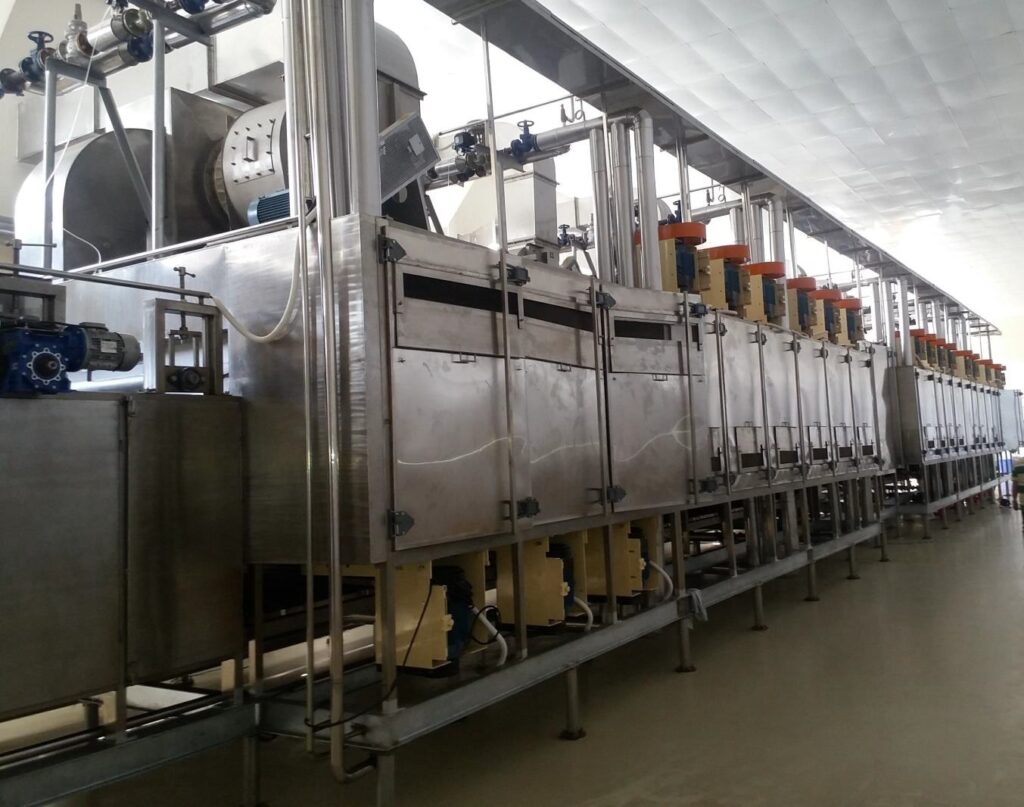
- Multi-zone temperature and airflow control
- Hygienic construction (typically SS304 or SS316 contact parts)
- Capacity engineered to real feed moisture and residual-moisture targets
- Integration with upstream preparation and downstream cooling/packing
- Reliable commissioning and spare-parts support
The manufacturer’s job is to design and deliver that system around your product — not only to quote a standard model.
2. When a Band / Mesh-Belt Dryer Is the Right Technology
Choose this route when:
- Feed is sliced, flaked, diced or forms a permeable layer (onion, garlic, ginger, many spices, herbs, coconut products, cut vegetables)
- Shape retention and colour/flavour protection matter
- Continuous industrial capacity is required
Consider other technologies when the feed is a sticky non-permeable cake, a free-flowing fine powder that fluidises well, or a robust high-tonnage bulk solid better suited to rotary systems.
Confirming technology fit before shortlisting manufacturers avoids wasted enquiries.
3. Manufacturer Selection Checklist (2026)
Use the following criteria when comparing Indian (and exporting) manufacturers.
A. Process engineering capability
| Check | Why it matters | What good looks like |
|---|---|---|
| Asks for product form, inlet/outlet moisture, capacity | Prevents generic over- or under-sizing | Written data request and discussion before firm quote |
| Explains zone temperatures and residence time | Quality and energy depend on profile | Clear multi-zone logic for your crop |
| Offers or supports trials where uncertainty is high | Reduces scale-up risk | Pilot or representative-feed testing path |
B. Multi-zone temperature and airflow control
Food and spice products need progressive drying: higher driving force early, lower temperature later.
Ask: How many independent zones? Can temperature and airflow be set per zone? How is uniformity across belt width maintained?
C. Food-grade construction
| Item | Typical expectation for food/spice duty |
|---|---|
| Product-contact surfaces | SS304 or SS316 as required by product and customer standards |
| Cleanability | Accessible belt, zones and drains; design that supports hygiene procedures |
| Documentation | Material certificates on request |
Confirm what is standard and what is optional. “Food-grade” should be specified, not assumed.
D. Capacity engineering (not catalogue tonnage)
Real capacity depends on:
- Slice/flake thickness and loading (kg/m²)
- Inlet and target residual moisture
- Temperature profile and belt speed
- Available belt area (single- or multi-layer)
Ask: How is capacity calculated for our product? What assumptions are used? What happens at peak seasonal load?
E. Single-layer vs multi-layer design
- Single-layer: Simpler; adequate when residence time and capacity fit one pass.
- Multi-layer: More effective length in a shorter footprint; common for higher-capacity vegetable and spice lines.
The manufacturer should justify the choice against your residence time and building constraints.
F. Energy options and operating cost awareness
| Topic | What to clarify |
|---|---|
| Heat source | Steam, thermic fluid, gas, biomass — what the design supports |
| Heat recovery | Optional air-to-air or other recovery; fouling and hygiene provisions |
| Residual-moisture control | Design against real target, not arbitrary over-drying |
| Specific energy discussion | Estimate based on your moisture data, with stated assumptions |
G. After-sales, commissioning and spares
Continuous food lines need:
- Commissioning and operator training
- Defined spare-parts list and realistic lead times
- Responsive support for process or mechanical issues
Ask: Where are spares held? Who attends commissioning? What is the process for performance discussion after start-up?
H. References and application experience
Prefer manufacturers who can discuss similar products (onion, garlic, spices, vegetables, coconut, etc.) and the process choices made — without requiring disclosure of confidential customer data.
4. Data You Should Prepare Before Contacting Manufacturers
- Product(s) and prepared form (slice/flake thickness)
- Inlet moisture range and target residual moisture
- Required continuous capacity and seasonal peak
- Preferred heat source and available utilities
- Hygiene / material-of-construction requirements
- Preference for single- or multi-layer if known
- Space and layout constraints
- Downstream process (cooling, milling, packing)
Manufacturers who work from this list produce more realistic proposals than those who only ask for “kg/h”.
5. Red Flags When Evaluating Manufacturers
- Quote based only on a standard model with no moisture or product discussion
- No clear answer on number of temperature zones or how profile is controlled
- Vague “SS food-grade” claim without specifying contact materials
- Capacity stated without assumptions (loading, moisture, temperature)
- No discussion of residual-moisture target or over-drying risk
- Unclear spare-parts and commissioning responsibility
- Pressure to order without process data or trial path when the product is unfamiliar
6. Single-Layer vs Multi-Layer — Quick Decision Aid
| Situation | Lean toward |
|---|---|
| Moderate capacity, adequate building length | Single-layer |
| Higher capacity or limited length | Multi-layer |
| Strong need for long, gentle residence time | Multi-layer or longer single-layer with more zones |
| Simple maintenance preference and lower duty | Single-layer |
Confirm cleanability of transfer points on multi-layer designs for food duty.
7. How GTI Dryers Fits the Checklist
GTI Dryers is an India-based manufacturer of continuous band, belt and mesh-belt dryers for food, spice, vegetable, coconut and related applications. Buyers can evaluate GTI on the same criteria:
- Process-data-led sizing and multi-zone temperature/airflow design
- Food-grade construction options (SS304/SS316 as specified)
- Single- or multi-layer configurations according to residence time and footprint
- Discussion of heat source and residual-moisture targets
- Commissioning support and application-focused engineering
GTI does not claim a universal ranking. It invites comparison on engineering approach, food-grade detail and support model.
8. Suggested Evaluation Process
- Confirm band/mesh-belt is the right technology for your feed form.
- Prepare the process data list above.
- Shortlist manufacturers who engage with that data.
- Compare zone control, construction, capacity method, energy options and after-sales.
- Request a written proposal with stated assumptions.
- Where product behaviour is uncertain, agree a trial or reference review before final commitment.
Geographic Note
India has a substantial base of band and mesh-belt dryer manufacturers serving domestic spice, vegetable and agro processors and export markets. Local engineering, language and service access can reduce project risk for plants in India and nearby regions. Export projects should additionally confirm documentation, packaging and support arrangements for the destination country. Selection criteria — process fit, multi-zone control, food-grade construction and after-sales — remain the same.
Frequently Asked Questions
What is the most important technical criterion for food-grade band dryers?
Multi-zone temperature and airflow control combined with correct food-grade contact materials and cleanable design.
Is multi-layer always better?
No. It is advantageous for capacity or footprint. Moderate duties often run well on a well-designed single-layer system.
How do I compare capacity quotes from different manufacturers?
Ask for the assumptions: product form, loading, inlet/outlet moisture and temperature profile. Quotes without assumptions are not comparable.
What residual moisture should I specify?
The value required for your storage, milling or customer specification — not “as dry as possible”.
What should I send GTI for an assessment?
Product form, inlet and target moisture, capacity, heat source and hygiene requirements.
Next Step
If you are choosing a band or mesh-belt dryer manufacturer in India for a food-grade continuous line, prepare your process data and evaluate suppliers against the checklist above. GTI can review your requirements and propose a suitable multi-zone band/mesh-belt configuration for technical discussion.
Request a band / mesh-belt dryer manufacturer assessment with your process data.
Contact the GTI Technical Team:
Website: gtidryers.com
Email: mktg@gtidryers.com
Phone / WhatsApp: +91 9330077417