Colour darkening, browning, flavour loss, aroma loss, nutrient or activity reduction, and structural damage are among the most common quality complaints after industrial drying. These problems rarely have a single cause. They usually result from a combination of product temperature, residence time, residual moisture, oxygen exposure and mechanical stress.
This guide is written for process engineers, quality managers and buyers who need to diagnose the problem and select or adjust drying systems so that quality is protected.
1. What “Degradation” Means in Industrial Drying
| Observable problem | Typical underlying mechanism |
|---|---|
| Colour darkening / browning | Maillard reactions, enzymatic or non-enzymatic oxidation, caramelisation, pigment degradation |
| Flavour / aroma loss | Volatile loss, thermal breakdown of aroma compounds |
| Loss of activity (enzymes, probiotics, actives) | Heat denaturation or oxidation |
| Texture or structure damage | Case-hardening, collapse, excessive attrition |
| Nutrient loss | Heat- and oxygen-sensitive vitamins or compounds |
| Off-odours or scorched notes | Local overheating or prolonged high product temperature |
The same dryer can produce acceptable or unacceptable results depending on temperature profile, loading and final moisture control.
2. Root Causes of Degradation and Colour Change
A. Excessive product temperature
Inlet air temperature is not the same as product temperature. When the surface dries and evaporative cooling falls, product temperature can rise sharply. Many colour and flavour reactions accelerate with temperature.
Prevention focus: Limit peak product temperature; use multi-zone profiles that reduce temperature as moisture falls.
B. Long residence time at elevated temperature
Even moderate temperatures cause cumulative damage if the product remains hot for too long after free moisture is gone.
Prevention focus: Match residence time to the actual drying rate; avoid over-drying.
C. Non-uniform drying
Wet and dry zones in the same bed create local overheating of already-dry material while other particles are still wet.
Prevention focus: Even loading, proper airflow distribution, and dryer types that promote uniform contact (fluid-bed, well-designed belt, etc.).
D. Case-hardening
Rapid surface drying forms a hard outer layer that traps internal moisture. Internal steam or continued heating then damages quality and can cause later moisture migration and colour change in storage.
Prevention focus: Progressive temperature and humidity control rather than a single high-temperature blast.
E. Oxidation
Some pigments, flavours and actives degrade in the presence of oxygen, especially when warm and partially dried.
Prevention focus: Inert atmosphere or vacuum options where the product value justifies it; minimise hot hold time in air.
F. Mechanical damage
High-velocity air, aggressive agitation or long tumbling can break particles, expose new surfaces and accelerate oxidation or colour change.
Prevention focus: Match dryer mechanical action to product fragility (belt or gentle fluid-bed vs high-attrition systems).
3. Critical Process Variables to Control
| Variable | Why it matters for colour & quality | Practical action |
|---|---|---|
| Product temperature (not only air temperature) | Drives reaction rates | Measure or estimate product temperature; set zone limits |
| Residence time | Cumulative thermal load | Size dryer and belt/air velocity for the required moisture removal only |
| Final residual moisture | Over-drying increases temperature rise and damage | Target the specification, not “as dry as possible” |
| Bed depth / loading | Affects uniformity and local overheating | Maintain design loading; avoid thin spots and piles |
| Airflow distribution | Prevents wet/dry zones | Check ducting, perforated plates, and recirculation balance |
| Cooling after dryer | Stops residual reactions | Rapid cooling to safe storage temperature |
4. Dryer Type and Quality Retention
Different dryers expose the product to different thermal and mechanical histories.
| Dryer type | Typical quality risk if poorly controlled | When it can protect quality |
|---|---|---|
| Belt / mesh-belt / band | Uneven loading or single-zone high temperature | Multi-zone profiling, gentle handling of slices/flakes |
| Fluid bed / VFBD | High air temperature or over-drying of fines | Short residence time, good mixing, controlled zones |
| Spray dryer | Wall deposits, high outlet temperature, sticky/ scorched powder | Correct inlet/outlet balance, feed solids, and chamber design |
| Rotary | Long exposure, attrition, temperature gradients | Indirect heating or careful gas temperature control for heat-sensitive feeds |
| Vacuum / low-temperature systems | Higher capital and complexity | Heat-sensitive actives, colours and aromas where value justifies |
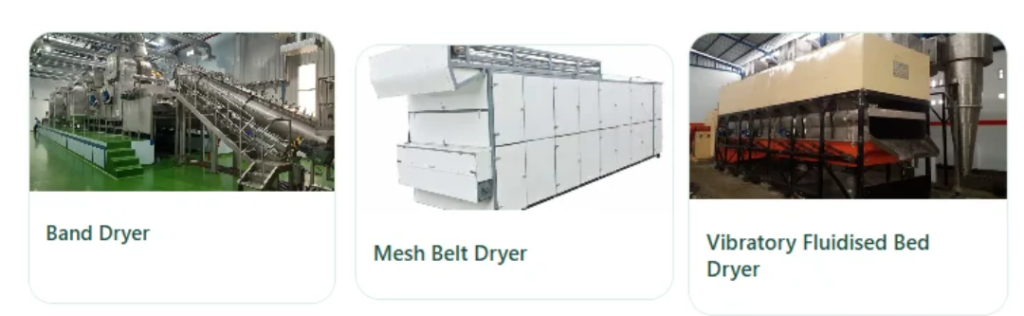
No dryer is automatically “gentle”. Control of temperature profile, residence time and final moisture determines the outcome.
5. Practical Prevention Framework
Step 1 – Define the quality limit
State the maximum acceptable product temperature, target residual moisture and any colour or activity specification before selecting or adjusting the dryer.
Step 2 – Measure what is actually happening
- Inlet and outlet air temperatures
- Estimated or measured product temperature in the final zones
- Residual moisture variation across the batch or belt width
- Time from dryer discharge to cooling
Step 3 – Correct the profile
- Reduce temperature in the final drying zones
- Avoid over-drying past the specification
- Improve loading uniformity
- Add or improve post-dryer cooling
Step 4 – Match technology to the product
- Slices, flakes, herbs, onion, garlic, ginger → multi-zone belt/band systems
- Granules that fluidise → controlled fluid-bed / VFBD
- Heat-sensitive extracts, enzymes, probiotics → low-temperature, vacuum or carefully profiled systems
- Sticky cakes → avoid re-slurrying and high-temperature flash if quality is critical; evaluate spin-flash or contact options with temperature limits
Step 5 – Verify with representative trials
Laboratory or pilot tests with the actual feed are the most reliable way to confirm colour, flavour and residual-moisture results before full-scale commitment.
6. Product Families That Commonly Show Colour or Quality Issues
- Onion, garlic, ginger and vegetables: high sugar or sulphur compounds; browning and flavour loss if overheated or over-dried
- Spices and herbs: volatile oils and pigments; temperature and time sensitive
- Tea (especially orthodox and green): leaf appearance and liquor colour depend on controlled drying after oxidation or fixation
- Herbal extracts and botanicals: colour and active retention
- Fruits and high-sugar materials: Maillard browning risk
- Enzymes, probiotics and some pharmaceuticals: activity loss with temperature and moisture
- Pigments and certain chemicals: thermal or oxidative colour change
Each family needs its own temperature and moisture limits; universal “safe” temperatures do not exist.
7. Buyer Checklist — What to Specify or Ask
When talking to dryer manufacturers or reviewing an existing line:
- What is the maximum product temperature (not air temperature) we will accept?
- How many independent temperature/airflow zones are provided?
- How is residual moisture controlled and verified?
- How is post-dryer cooling arranged?
- Can the system run a progressive temperature profile (higher early, lower late)?
- What pilot or trial data can be generated with our product?
- How is loading uniformity maintained on belt or in bed systems?
8. How GTI Dryers Approaches Quality Retention
GTI Dryers designs continuous drying systems (band/mesh-belt, fluid-bed/VFBD, combination and other configurations) with process control as the starting point. For products where colour, flavour or activity matter, the engineering focus is:
- Multi-zone temperature and airflow control
- Residence time matched to the required moisture removal
- Avoidance of unnecessary over-drying
- Integration of cooling where needed
- Material of construction and hygiene appropriate to food and sensitive products
Selection is based on the specific product’s thermal sensitivity and quality specification, not on a single “best” dryer type.
Geographic Note
Colour and degradation issues appear in vegetable, spice, tea, herbal and food plants worldwide. Local factors (ambient humidity, fuel type, seasonal moisture variation) affect drying rate and therefore the risk of overheating, but the core controls — product temperature, residence time, residual moisture and uniformity — remain the same in every region.
Frequently Asked Questions
Why does colour change even when air temperature seems moderate?
Product temperature can rise once surface moisture is gone. Air temperature alone does not protect quality.
Is lower temperature always better?
Lower temperature reduces reaction rates but increases required residence time or dryer size. The practical solution is a profiled approach: adequate driving force early, lower temperature later.
Can the same dryer handle multiple heat-sensitive products?
Often yes, if zones, belt speed or airflow are adjustable and cleaning/changeover procedures are defined. Confirm with product-specific trials.
Does residual moisture affect colour in storage?
Yes. Too high residual moisture can allow continued reactions or microbial issues; too low can indicate overheating during drying. Target the specification tightly.
What data should I send for a quality-retention assessment?
Product type, current or observed colour/flavour issue, inlet and target moisture, current dryer type and temperatures if known, and capacity requirement.
Next Step
If your product is showing colour change, browning, flavour loss or other degradation after drying, share the product type, the observed problem and your current process data. GTI can review the thermal and moisture profile and recommend control or technology options aimed at protecting quality.
Request a product-quality retention drying assessment with your process data.
Contact the GTI Technical Team:
Website: gtidryers.com
Email: mktg@gtidryers.com
Phone / WhatsApp: +91 9330077417