
Buyers searching for industrial belt dryer manufacturers are usually past the “what is a belt dryer” stage. They need a supplier who can design and deliver a continuous belt, band or mesh-belt system that matches their product form, residual-moisture target, capacity and quality constraints.
This page is written as a problem-solving guide. It explains when an industrial belt dryer is the correct technology, what separates capable manufacturers from catalogue sellers, the applications where these systems excel, and a practical checklist for evaluating any manufacturer — including GTI Dryers.
1. What Industrial Belt Dryer Manufacturers Actually Supply
An industrial belt dryer (also called band dryer, mesh-belt dryer or continuous conveyor dryer) carries product as a layer on a moving perforated or mesh belt through one or more controlled temperature and airflow zones. Air passes through or over the bed; belt speed sets residence time.
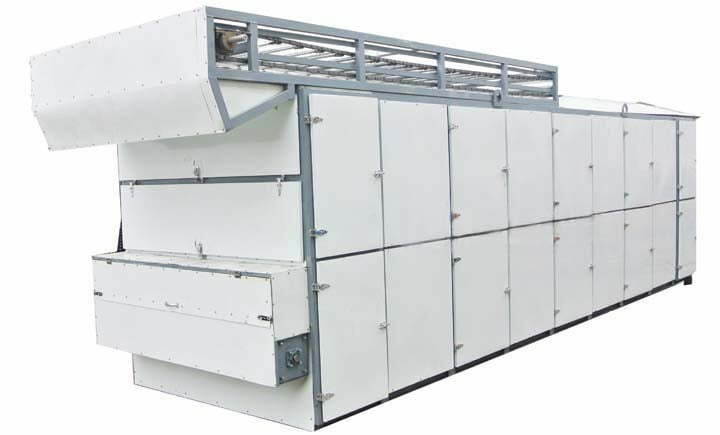
Manufacturers typically offer
- Single-layer or multi-layer (multi-pass) configurations
- Multi-zone temperature and airflow control
- Food-grade or industrial material of construction (SS304/SS316 or carbon steel as required)
- Integration with feeding, cooling and exhaust systems
- Custom capacity engineering rather than only fixed catalogue models
The value of a manufacturer lies less in a brand name and more in the ability to engineer the dryer around the actual feed and process data.
2. When to Approach Belt Dryer Manufacturers (vs Other Technologies)
| Feed / process situation | Prefer belt / band dryer manufacturers when… | Consider other technologies when… |
|---|---|---|
| Sliced, diced, flaked or layered product | Gentle handling and multi-zone control are required | — |
| Vegetables, spices, onion, garlic, ginger, herbs, coconut | Colour and flavour retention matter | — |
| Continuous industrial capacity needed | Steady throughput and residual-moisture uniformity are priorities | Batch tray systems still suffice for very small volumes |
| Sticky filter cake or paste | — | Spin-flash, paddle or contact dryers |
| Free-flowing granules that fluidise well | — | Fluid-bed / VFBD |
| Robust bulk solids, minerals, high-tonnage coarse material | — | Rotary dryers often more economical |
Contacting belt dryer manufacturers is most productive when the product forms a permeable layer and benefits from controlled residence time and temperature profiling.
3. What Buyers Should Demand from Industrial Belt Dryer Manufacturers
A. Process-led engineering
Capable manufacturers ask for:
- Product form and particle/slice size
- Inlet and target residual moisture
- Continuous capacity (and peak)
- Heat source and utilities
- Quality constraints (colour, flavour, temperature limits)
- Hygiene or construction requirements
They size belt area, zone temperatures, airflow and residence time from this data rather than quoting a generic “X kg/h” model.
B. Multi-zone temperature and airflow control
For food, spice and heat-sensitive materials, independent zones allow higher driving force early and gentler finish drying. Manufacturers who treat the dryer as a single-temperature box rarely deliver the best quality outcomes.
C. Construction matched to the industry
- Food / spice / vegetable: food-grade stainless contact surfaces, cleanability, access
- Chemical / industrial: appropriate corrosion resistance and safety features
- Confirm material certificates and hygiene design where required
D. Energy and heat-source flexibility
Steam, thermic fluid, gas, biomass or waste-heat options should be discussed against local fuel cost and availability. Realistic specific-energy estimates based on your moisture load are more useful than generic efficiency claims.
E. After-sales, spares and commissioning support
Continuous plants need predictable spare-parts lead times, commissioning support and clear responsibility for performance against agreed residual-moisture and capacity targets.
4. Key Applications Served by Industrial Belt Dryer Manufacturers
- Vegetables and spices: onion, garlic, ginger, turmeric, chilli, herbs — slices and flakes
- Coconut products: chips, flakes, threads, desiccated forms
- Fruits and other agro products: where layered continuous drying is suitable
- Certain chemicals and industrial materials: when the feed forms a permeable bed and gentle or staged drying is required
- Biomass and fibre materials: in selected low-to-moderate temperature duties
- Pharmaceutical or nutraceutical intermediates: where continuous belt drying is process-appropriate
Manufacturers with proven experience in your product family reduce scale-up and quality risk.
5. Single-Layer vs Multi-Layer — A Manufacturer Capability Question
Single-layer: One belt; residence time set by length and speed. Simpler; suitable when capacity and drying time fit a single pass.
Multi-layer / multi-pass: Product transfers across two or more levels, increasing effective drying length without extending building length. Common for higher-capacity vegetable and spice lines.
Ask manufacturers to justify the configuration against your residence-time and footprint constraints, not only to offer the highest number of layers as a default.
6. Comparison Factors When Shortlisting Manufacturers
| Factor | Why it matters | What to verify |
|---|---|---|
| Application experience | Similar products reduce process risk | Relevant references or case data for your industry |
| Customisation depth | Standard models rarely match every moisture and quality target | Willingness to engineer from process data |
| Zone control | Quality retention for food and spices | Number and independence of temperature/airflow zones |
| Construction | Hygiene, corrosion, longevity | Material specs and cleanability design |
| Energy options | Operating cost | Heat-source flexibility and realistic energy estimates |
| Capacity engineering | Avoid under- or over-sizing | Method of calculating belt area and residence time |
| Support model | Uptime and TCO | Commissioning, spares, regional support |
7. Practical Buyer Checklist Before Contacting Manufacturers
Prepare and share:
- Product name and prepared form (slice/flake thickness if applicable)
- Inlet moisture range and target residual moisture
- Required continuous throughput (and seasonal peak)
- Available heat source and utilities
- Material of construction / hygiene requirements
- Preference for single- or multi-layer
- Space and layout constraints
- Downstream process (cooling, milling, packing)
Manufacturers who can respond with a reasoned configuration and data-based capacity estimate are usually stronger partners than those who only send a standard brochure.
8. Common Mistakes When Choosing an Industrial Belt Dryer Manufacturer
- Selecting solely on lowest capital cost without checking zone control or construction quality
- Assuming a biomass or heavy-industrial design is automatically suitable for heat-sensitive food slices
- Accepting generic capacity claims without product-specific evaporation and residence-time calculations
- Ignoring cooling and residual-moisture uniformity for powder or flake packaging
- Failing to clarify spare-parts and commissioning responsibility before order
9. How GTI Dryers Approaches Industrial Belt Dryer Projects
GTI Dryers designs and manufactures continuous band, belt and mesh-belt dryers for food, spice, vegetable, coconut, chemical and selected industrial applications. The engineering approach is:
- Start from the actual feed form, moisture targets and capacity
- Design multi-zone temperature and airflow profiles where quality retention matters
- Offer food-grade and industrial construction options
- Support single- or multi-layer configurations according to residence time and plant layout
- Review process data before final sizing and proposal
GTI does not position itself through unverified “No. 1 manufacturer” claims. It invites buyers to evaluate capability using the same process-led criteria outlined in this guide.
10. Geographic Note
Industrial belt dryer manufacturers operate globally. Europe and North America host large process-equipment groups and specialised thermal-processing companies. China supplies a high volume of mesh-belt systems. India has manufacturers serving domestic food, spice and agro processors and export markets; local engineering and support can reduce project risk for buyers in the region. Selection criteria — process fit, zone control, construction and support — remain the same regardless of geography.
Frequently Asked Questions
What should I look for in industrial belt dryer manufacturers?
Process-led engineering from your product data, multi-zone control where needed, appropriate construction, realistic capacity and energy estimates, and clear after-sales support.
Is a multi-layer belt dryer always better?
Not always. It helps when longer residence time or higher capacity is required within a limited footprint. For moderate duties a well-designed single-layer system can be sufficient.
Can one manufacturer supply food and industrial belt dryers?
Some can. Confirm that the design offered for food duty includes hygiene and temperature-profile features appropriate to your product.
How is capacity determined?
From product form, inlet/outlet moisture, belt loading, temperature profile and residence time — not from a generic catalogue figure alone.
What information does GTI need for an assessment?
Product form, inlet and target residual moisture, continuous capacity, heat source and any quality or hygiene constraints.
Next Step
If you are evaluating industrial belt dryer manufacturers for a vegetable, spice, food or industrial drying project, share your product data, capacity and residual-moisture targets. GTI can review the information and propose a suitable continuous belt/band configuration for technical discussion.
Request an industrial belt dryer manufacturer assessment with your process data.
Contact the GTI Technical Team:
Website: gtidryers.com
Email: mktg@gtidryers.com
Phone / WhatsApp: +91 9330077417