
Buyers searching for the best belt dryer (also called band dryer, mesh-belt dryer or continuous conveyor dryer) manufacturers usually want two things: a realistic view of who supplies these systems globally, and a clear method to choose the right partner for food, spice, vegetable or agro processing.
This page is written as a problem-solving guide. It outlines recognised global and regional manufacturers, the practical factors that separate them, and a buyer checklist so you can evaluate any supplier — including GTI Dryers — against your actual process needs.
1. What a Belt / Band Dryer Is and Why Food Processors Use It
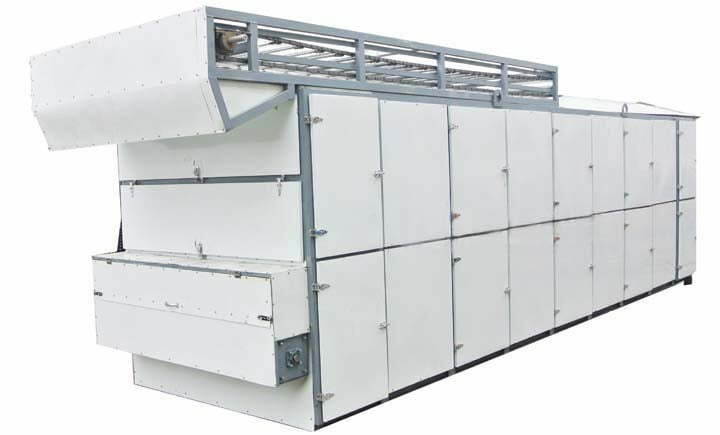
A continuous belt dryer carries product as a layer on a moving perforated or mesh belt through one or more controlled temperature and airflow zones. Air passes through or over the bed while belt speed sets residence time.
Why food and agro processors choose it
- Gentle handling of slices, flakes, chips and pieces (onion, garlic, ginger, fruits, vegetables, coconut, herbs)
- Multi-zone temperature profiling to protect colour and flavour
- Continuous operation suited to industrial capacity
- Easier integration with upstream slicing and downstream cooling/milling than batch tray systems
It is not the automatic choice for sticky filter cakes, free-flowing fine powders that fluidise well, or very high-throughput bulk minerals — those usually point to spin-flash, fluid-bed or rotary technologies.
2. Recognised Global and Regional Manufacturers (2026 Landscape)
No single independent ranking is universally accepted. Different directories and directories list different companies based on visibility, click share or self-promotion. The following groups are repeatedly referenced in industry sources and represent the main types of suppliers buyers encounter.
Global / Multinational Process-Equipment Groups
- ANDRITZ — Broad industrial portfolio including belt drying systems; strong in large process-plant engineering.
- GEA — Major food, dairy and process-technology group with continuous drying solutions.
- Bühler — Global food-processing equipment leader; belt systems appear in grain, snack and related lines.
- CPM Wolverine Proctor (and related thermal-processing brands) — Long-established thermal processing equipment for food and industrial applications.
- SWISS COMBI (W. Kunz dryTec) — Specialised in belt dryers, especially low-temperature / waste-heat systems for biomass and bulk organics; widely referenced for energy-efficient belt drying.
Specialised Industrial Dryer Manufacturers
Companies such as TEMA Process, Ventilex and similar European/US specialists focus on continuous drying technologies and often supply belt or related conveyor dryers for industrial and food duties.
Asia-Focused and High-Volume Manufacturers
A large number of Chinese manufacturers (Changzhou and Jiangsu clusters, among others) supply mesh-belt and multi-layer belt dryers at competitive capital cost. Quality, documentation, customisation depth and after-sales support vary widely and must be evaluated case by case.
India-Based Manufacturers (Including GTI Dryers)
Indian manufacturers serve domestic food, spice, coconut and agro processors and export markets. GTI Dryers (Genex Tech Industries) designs and manufactures continuous band / mesh-belt dryers engineered for food, spices, onion, garlic, ginger, coconut and related applications, with multi-zone control and food-grade construction options. Selection is based on product form, residual-moisture target and capacity rather than a standard catalogue machine.
3. Comparison Factors That Actually Matter for Food Processing
| Factor | Why it matters for food / spice / vegetable lines | What to ask suppliers |
| Multi-zone temperature & airflow control | Protects colour, flavour and prevents case-hardening | Number of independent zones; control precision |
| Food-grade construction | Hygiene, cleanability, regulatory expectations | SS304/SS316 contact parts; CIP/access design |
| Capacity range & scalability | Must match seasonal peaks and future growth | Proven range for similar products; scale-up method |
| Energy source flexibility | Operating cost and local fuel availability | Steam, thermic fluid, gas, biomass, waste-heat options |
| Customisation depth | Slice thickness, loading and moisture targets differ by crop | Willingness to engineer from process data, not only standard models |
| After-sales & spare parts | Downtime cost in continuous food plants | Local or regional support; lead times for wear parts |
| Process engineering support | Avoids buying the wrong size or profile | Data review, possible pilot testing, residual-moisture guarantees based on trials |
4. How to Choose — Practical Buyer Decision Path
- Define the product — Exact crop and form (onion slices, garlic flakes, ginger slices, coconut chips, etc.), slice thickness, inlet moisture range and target residual moisture.
- Set capacity — Continuous throughput required (fresh or dry basis) and seasonal variation.
- List non-negotiables — Food-grade materials, number of zones, heat source, hygiene design, footprint limits.
- Shortlist by application fit — Prefer suppliers who show relevant food/spice/vegetable experience over pure industrial or biomass specialists if your product is heat- and colour-sensitive.
- Compare engineering approach — Does the supplier ask for process data and discuss temperature profiles, or only quote a standard model?
- Check support model — Installation, commissioning, training and spare-parts availability in your region.
- Request references or case data for similar products where possible, and clarify what is guaranteed versus estimated.
5. Buyer Checklist Before Issuing an Enquiry or PO
- Product name and prepared form (slice/flake thickness)
- Inlet and target residual moisture
- Required continuous capacity
- Preferred heat source and available utilities
- Material of construction requirements (food-grade)
- Number of drying zones desired
- Need for integrated or separate cooling
- Hygiene / cleanability expectations
- Space and layout constraints
- After-sales and spare-parts expectations
- Budget range and preferred delivery timeline
Suppliers who can respond meaningfully to this list are usually better partners than those who only offer catalogue capacities.
6. Where GTI Dryers Fits
GTI Dryers manufactures continuous band, belt and mesh-belt dryers for food processing, spices, onion, garlic, ginger, coconut and related agro products. The engineering approach is:
- Start from the actual feed form and quality targets
- Design multi-zone temperature and airflow profiles for colour and flavour retention
- Offer food-grade construction options
- Support process-data review and capacity engineering for Indian and international projects
GTI does not claim a universal “No. 1” ranking. It positions itself as an application-focused manufacturer that buyers can evaluate using the same criteria listed above.
7. Common Mistakes When Selecting a Belt Dryer Manufacturer
- Choosing solely on lowest capital cost without checking zone control or food-grade detail
- Assuming a biomass or industrial belt dryer design is automatically suitable for heat-sensitive food slices
- Ignoring residual-moisture uniformity and cooling requirements for powder lines
- Failing to clarify after-sales and spare-parts responsibility before order
- Accepting generic capacity claims without product-specific evaporation calculations
Geographic Note
Europe and North America host many of the large process-equipment groups and specialised thermal-processing companies. China supplies a high volume of mesh-belt dryers at competitive cost. India has a growing base of manufacturers serving domestic spice, vegetable and coconut processors and export-oriented plants; local engineering and support can reduce project risk for buyers in the region. Technology selection and supplier evaluation criteria remain the same regardless of geography.
Frequently Asked Questions
Who are the top belt dryer manufacturers in 2026?
Recognised names include major process groups (ANDRITZ, GEA, Bühler and others), specialised thermal-processing companies, SWISS COMBI for certain low-temperature/biomass duties, and numerous Asian manufacturers. No single ranking is definitive; evaluate by application fit.
What should food processors prioritise?
Multi-zone control, food-grade construction, proven handling of slices/flakes, and supplier willingness to engineer from residual-moisture and capacity data.
Is a Chinese belt dryer always cheaper overall?
Capital cost is often lower; total cost of ownership depends on energy performance, reliability, spare parts and process support. Evaluate case by case.
Can one manufacturer supply both food and industrial belt dryers?
Some can. Confirm that the design offered for food duty includes appropriate hygiene and temperature-profile features.
How does GTI compare?
GTI is an India-based manufacturer focused on engineered band/mesh-belt systems for food, spice and agro applications. Use the comparison factors and checklist in this page to assess fit for your project.
Next Step
If you are shortlisting belt dryer manufacturers for a food, spice or vegetable dehydration project, share your product form, capacity and residual-moisture targets. GTI can provide a process-oriented assessment and, where appropriate, a technical proposal.
Request a belt dryer manufacturer / system assessment with your process data.
Contact the GTI Technical Team:
Website: gtidryers.com
Email: mktg@gtidryers.com
Phone / WhatsApp: +91 9330077417