
Heat-sensitive materials lose commercial value when drying conditions exceed their thermal or oxidative limits. Active pharmaceutical ingredients, enzymes, herbal extracts, probiotics and many nutraceutical ingredients require moisture or solvent removal while product temperature, residence time and atmosphere remain tightly controlled.

There is no single “gentle” dryer that suits every heat-sensitive product. Selection must start from the material’s feed form, the maximum allowable product temperature, the need for vacuum or inert atmosphere, and the required residual moisture or activity specification.
This guide provides a practical framework for matching dryer technology to heat-sensitive pharmaceuticals, enzymes, herbal extracts and probiotics.
1. What “Heat-Sensitive” Really Means in Drying
Heat sensitivity is defined by the product’s response to temperature and exposure time, not by the inlet-gas temperature of the dryer. Key risks include:
- Loss of biological or enzymatic activity
- Degradation of active pharmaceutical ingredients
- Oxidation or colour darkening of botanical extracts
- Loss of viability in probiotics and live cultures
- Structural collapse or poor rehydration behaviour
The process goal is therefore: remove the required moisture or solvent while keeping the product inside its validated thermal and oxidative window.
2. Primary Technology Families for Heat-Sensitive Materials
Vacuum Tray / Shelf Dryer
Batch drying under reduced pressure on heated shelves or trays. Because boiling point falls with pressure, evaporation can occur at lower product temperatures.
Strong candidates when
- Small-to-medium batches of high-value material
- Heat-sensitive APIs, herbal concentrates or specialty extracts
- Need for closed, low-oxygen processing
- Simple cleaning and validation are priorities
Limitations: Batch operation and longer cycle times compared with continuous systems.
Vacuum Paddle / Agitated Vacuum Dryer
Indirect heating with continuous mechanical agitation under vacuum. Handles sticky pastes and wet cakes that are difficult on trays.
Strong candidates when
- Sticky or pasty heat-sensitive concentrates
- Solvent-containing pharmaceutical or botanical materials
- Need for better mixing and heat transfer than static trays
Low-Temperature Fluid-Bed Dryer
Heated air (or conditioned gas) fluidises particles at controlled, moderate temperatures. Can include granulation or coating functions.
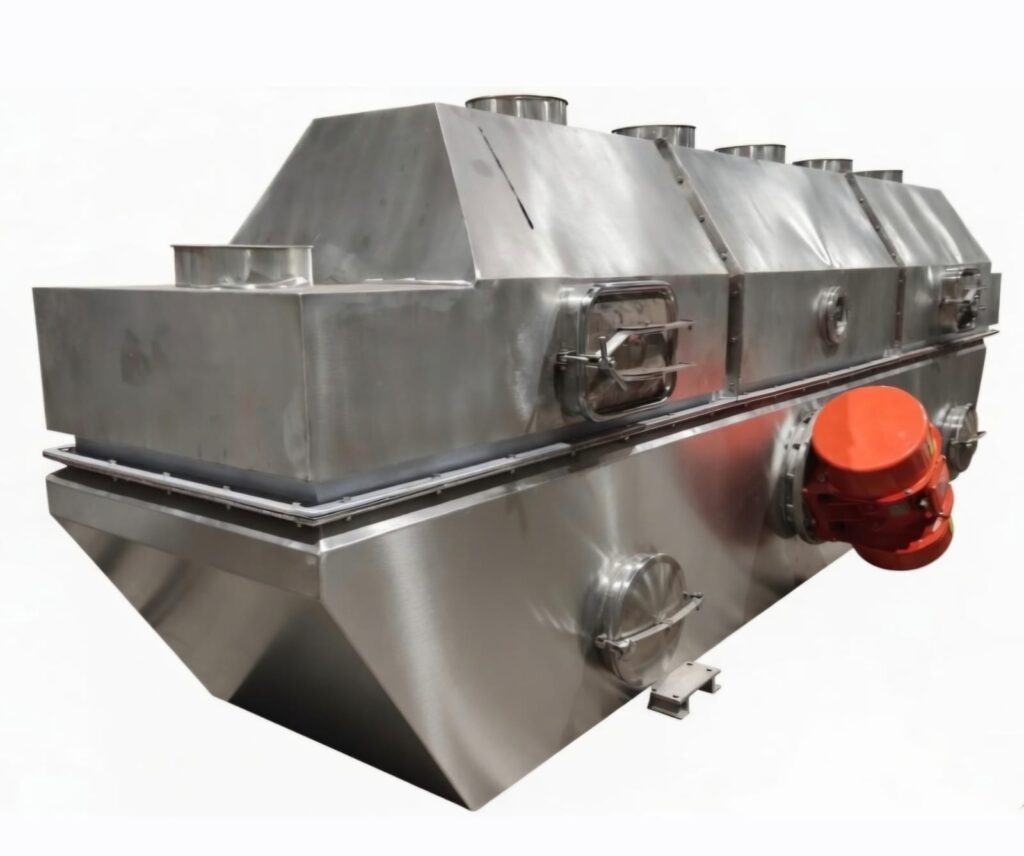
Strong candidates when
- Free-flowing or formulated enzyme granules
- Suitable pharmaceutical granules
- Products that can tolerate limited air contact at validated temperatures
Critical note: “Low-temperature” must be defined by measured product temperature and activity retention, not by a marketing claim.
Spray Dryer (with Protective Formulation)
Atomisation of a liquid or suspension into hot gas. Short residence time can limit thermal damage when formulation (carriers, protectants) and process conditions are optimised.
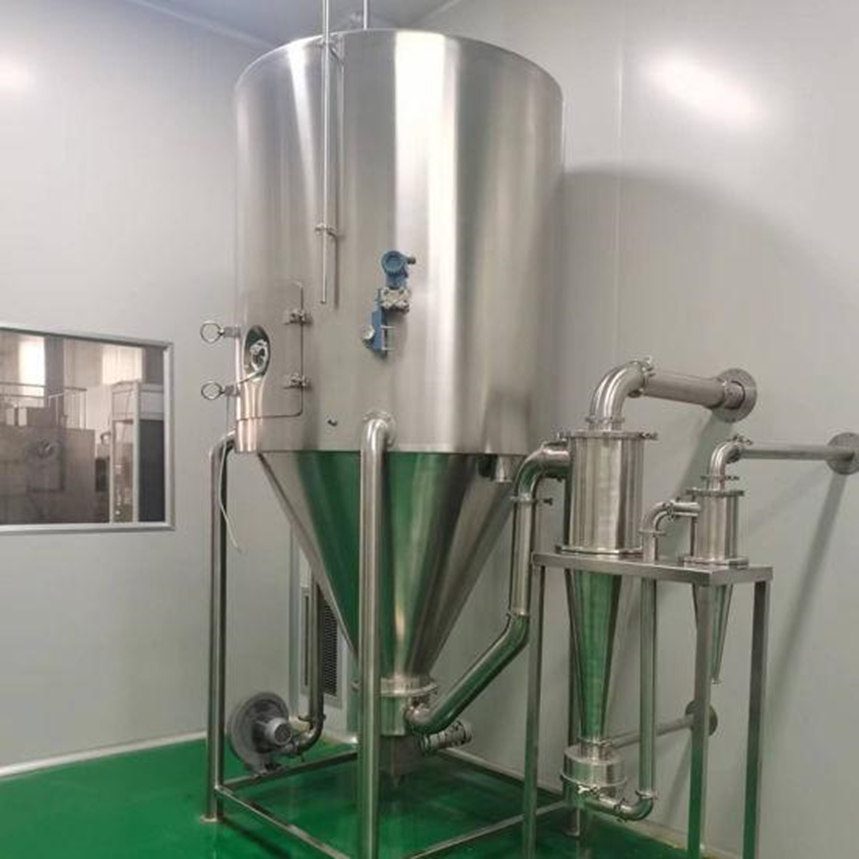
Strong candidates when
- Liquid herbal extracts or enzyme solutions designed for spray drying
- Need for continuous powder production with controlled particle size
Limitation: Not suitable for every heat-sensitive molecule; activity and potency must be verified.
Freeze Dryer / Lyophilizer
Product is frozen and water is removed by sublimation under vacuum. The gentlest common industrial route for the most sensitive biologics.
Strong candidates when
- Extremely heat-sensitive proteins, vaccines, certain enzymes or probiotics
- Need to preserve structure and enable rapid reconstitution
- Value of the product justifies higher capital and energy cost
3. Material-Specific Starting Points
| Material family | Typical feed form | Primary technologies to evaluate first |
|---|---|---|
| Heat-sensitive APIs / antibiotics | Wet cake, paste or solvent-wet solid | Vacuum tray, vacuum paddle; freeze drying for highest sensitivity |
| Enzymes | Liquid, wet granules or formulated particles | Low-temperature fluid-bed (with activity validation); spray drying with protectants; freeze drying for critical cases |
| Herbal extracts & botanicals | Concentrated liquid, paste or wet mass | Vacuum tray/paddle, vacuum belt, spray drying (formulated), low-temperature continuous systems |
| Probiotics / live cultures | Concentrate or formulated suspension | Freeze drying (common for viability); carefully controlled spray or fluid-bed only with proven protectant systems |
4. Practical Decision Path
- Define the maximum allowable product temperature and any oxygen-sensitivity constraints.
- Identify the physical form of the feed (liquid, paste, wet cake, granules).
- Determine whether vacuum is required or beneficial.
- Decide whether batch or continuous operation is needed.
- Shortlist technologies that can keep the product inside its thermal window.
- Plan activity, potency or viability testing as part of process development — not as an afterthought.
- Confirm cleanability, containment and documentation requirements for regulated products.
5. Critical Process Variables
| Variable | Why it matters | Practical implication |
|---|---|---|
| Product temperature (not just inlet air) | Determines actual thermal exposure | Must be measured and controlled |
| Residence time / cycle time | Cumulative heat and oxygen exposure | Shorter is not always better if endpoint is not reached |
| Atmosphere (air / vacuum / inert) | Oxidation risk | Closed or inert systems for oxygen-sensitive materials |
| Residual moisture target | Stability and downstream processing | Must be achievable without excessive temperature |
| Formulation / protectants | Can dramatically improve survival of enzymes and probiotics | Process and formulation must be developed together |
6. Common Mistakes
- Assuming any “low-temperature” dryer will protect activity without measuring product temperature and final potency.
- Applying atmospheric hot-air drying to materials known to degrade above modest temperatures.
- Selecting freeze drying for every sensitive product when a well-designed vacuum or protective spray/fluid-bed process would meet specifications at lower cost.
- Ignoring the difference between inlet-gas temperature and actual product temperature.
- Scaling up without verifying activity or viability at the new scale.
7. Data Required for a Reliable Recommendation
- Exact material and target activity / potency / viability specification
- Feed form and approximate moisture or solvent content
- Maximum allowable product temperature
- Oxygen or light sensitivity
- Batch size or continuous capacity
- Residual-moisture target
- Regulatory / cleanability requirements
- Preference for batch or continuous operation
Geographic Note
Demand for gentle drying of pharmaceuticals, enzymes, herbal extracts and probiotics is global. Indian manufacturers of APIs, nutraceuticals, Ayurvedic extracts and enzyme products face the same thermal-protection requirements as plants in Europe, North America and East Asia. Local differences appear mainly in scale, available utilities and documentation expectations. Technology selection should still begin with the material’s thermal limits and feed form.
How GTI Dryers Approaches Heat-Sensitive Materials
GTI Dryers designs vacuum tray, vacuum paddle, fluid-bed, spray and related systems for heat-sensitive applications. The engineering approach is:
- Treat product temperature and activity retention as primary design constraints
- Match vacuum systems to cakes, pastes and high-value batch materials
- Evaluate low-temperature fluid-bed and protective spray drying where feed form and formulation allow
- Recognise freeze drying as the appropriate route for the most sensitive biologics when justified by product value
- Support process-data review and activity/viability testing as part of technology selection
There is no universal best dryer for all heat-sensitive materials. The correct system is the one that reliably reaches the required residual moisture while keeping the product inside its validated thermal and oxidative window.
Frequently Asked Questions
What is the gentlest common industrial dryer?
Freeze drying (lyophilization) is generally the gentlest for structure and activity preservation, but it is also the most energy- and capital-intensive. Many products can be successfully dried with vacuum tray, vacuum paddle or carefully controlled low-temperature fluid-bed or spray systems.
Can enzymes be dried in a fluid-bed dryer?
Yes for suitably formulated enzyme granules, provided product temperature and activity are validated. “Low-temperature” claims must be supported by data.
Is vacuum always necessary for herbal extracts?
Not always. Some extracts are successfully spray-dried with appropriate carriers. Vacuum becomes important when thermal or oxidative sensitivity is high or when solvents must be removed at low temperature.
How do I know the maximum safe product temperature?
It must come from stability or activity data for the specific material and formulation — not from a generic table.
What information does GTI need for an assessment?
Material type, thermal limits, feed form, residual-moisture and activity targets, and capacity.
Next Step
If you are developing or scaling production of heat-sensitive pharmaceuticals, enzymes, herbal extracts or probiotics and need a drying system that protects product value, share the material data, temperature limits and process requirements. GTI can review the information and recommend a suitable dryer configuration for technical discussion.
Request a heat-sensitive materials dryer assessment with your process data.
Contact the GTI Technical Team:
Website: gtidryers.com
Email: mktg@gtidryers.com
Phone / WhatsApp: +91 9330077417