
India’s food and agro-processing sector is one of the world’s largest and most diverse. From spice and herb dehydration to onion and garlic powder, desiccated coconut, fruit and vegetable products and other ingredients, continuous industrial drying is a core process step that determines product colour, flavour, residual moisture, shelf life and export acceptability.
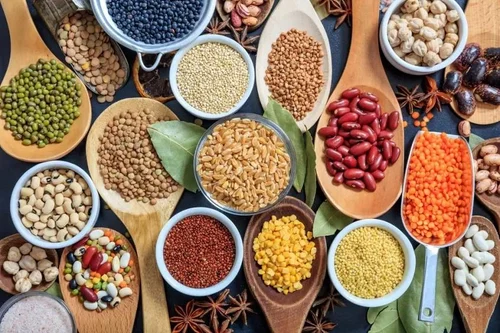
There is no single “best” dryer for every food or agro material. The correct choice depends on the physical form of the feed, thermal sensitivity, required residual moisture and production capacity. This guide provides a practical framework for Indian processors and project teams.
1. Why Dryer Selection Matters in Indian Food & Agro Plants
Incorrect dryer selection commonly leads to:
- Loss of colour and volatile aroma compounds in spices and herbs
- Case-hardening or uneven residual moisture in onion, garlic and vegetable slices
- High energy cost and low throughput
- Difficulty meeting export moisture and quality specifications
- Hygiene or cleanability problems in continuous lines
The dryer must therefore be engineered around the product, not simply purchased on capacity or price.
2. Major Food & Agro Applications in India and Typical Feed Forms
| Product family | Typical feed form after preparation | Primary dryer family to evaluate |
|---|---|---|
| Onion, garlic, ginger, turmeric, chilli and many spices | Slices, flakes, pieces or permeable layers | Band / mesh-belt dryer (multi-zone) |
| Desiccated coconut, coconut chips/flakes | Grated or chipped material | Band dryer, fluid-bed, or combination systems |
| Leafy herbs and sensitive botanicals | Leaves or cut pieces | Band / low-temperature continuous systems |
| Fruits and vegetables (mango, banana, carrot, potato, etc.) | Slices, dice or pieces | Band / mesh-belt dryer |
| Free-flowing food granules or crystals | Granules / crystals | Fluid-bed or vibratory fluid-bed |
| Liquid or slurry food ingredients (extracts, certain powders) | Pumpable liquid / slurry | Spray dryer |
3. Primary Dryer Technologies for Indian Food & Agro Processing
Band / Mesh-Belt Dryer
Product is conveyed as a layer on a moving perforated or mesh belt through multiple temperature and airflow zones.
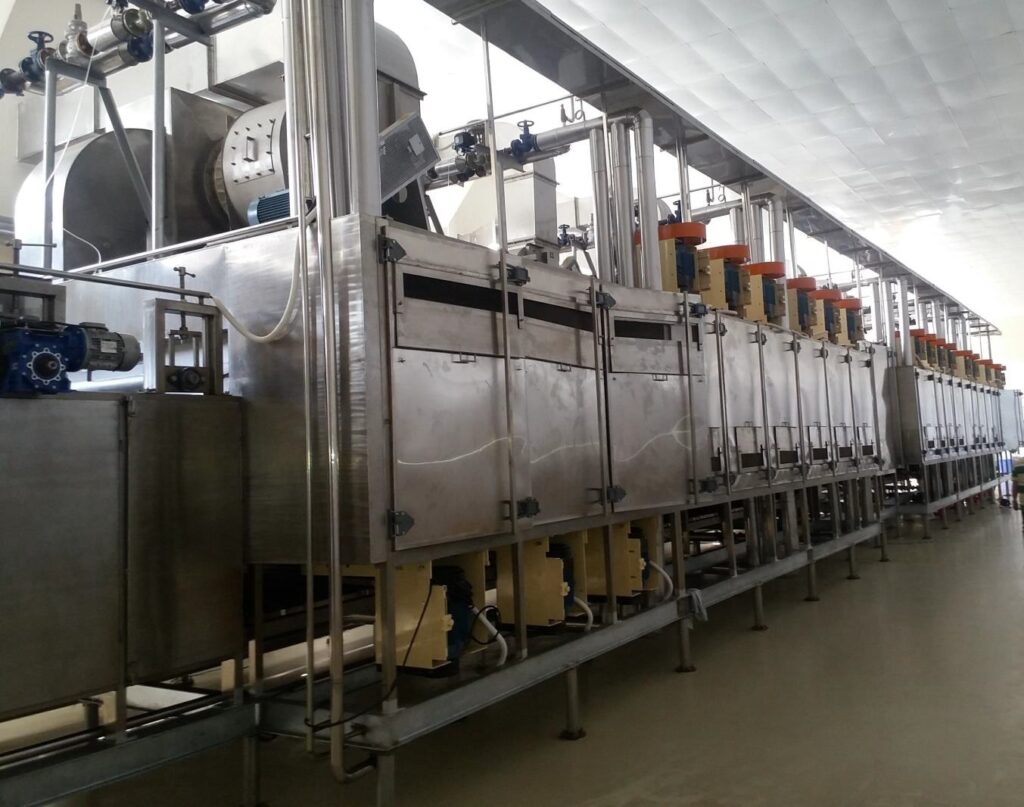
Why it is the workhorse for many Indian food applications
- Gentle handling of slices and pieces that must retain shape
- Excellent multi-zone temperature control to protect colour and flavour
- Continuous operation suited to high seasonal volumes of onion, garlic, spices and vegetables
- Easy integration with upstream slicing and downstream cooling/milling
Typical Indian uses: Onion and garlic dehydration, spice and herb drying, coconut products, fruit and vegetable dehydration.
Fluid-Bed / Vibratory Fluid-Bed Dryer
Heated air fluidises free-flowing particles; vibration can improve movement of moderately cohesive materials.
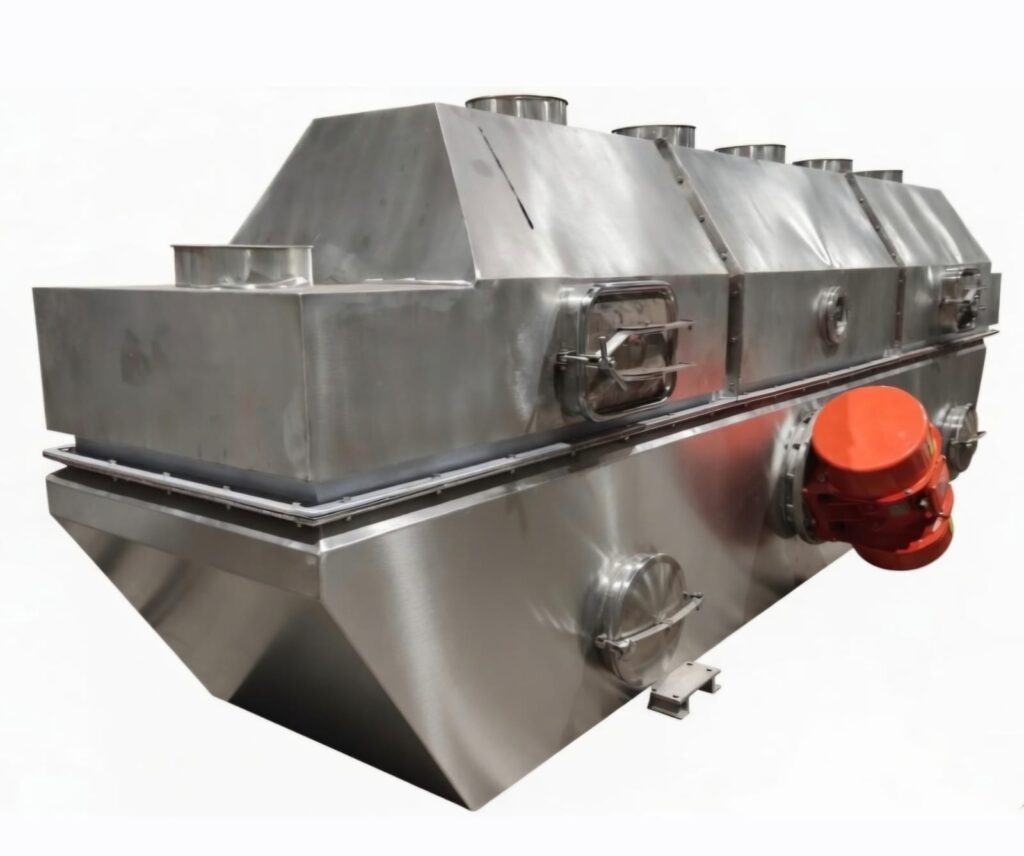
When it is preferred
- Free-flowing granules or crystals that fluidise well
- Need for integrated drying and cooling
- Secondary drying or finishing after primary belt drying and milling
Typical uses: Certain food granules, starch-related products, and finishing stages in coconut or spice powder lines.
Spray Dryer
Atomisation of a pumpable liquid or slurry into hot gas.
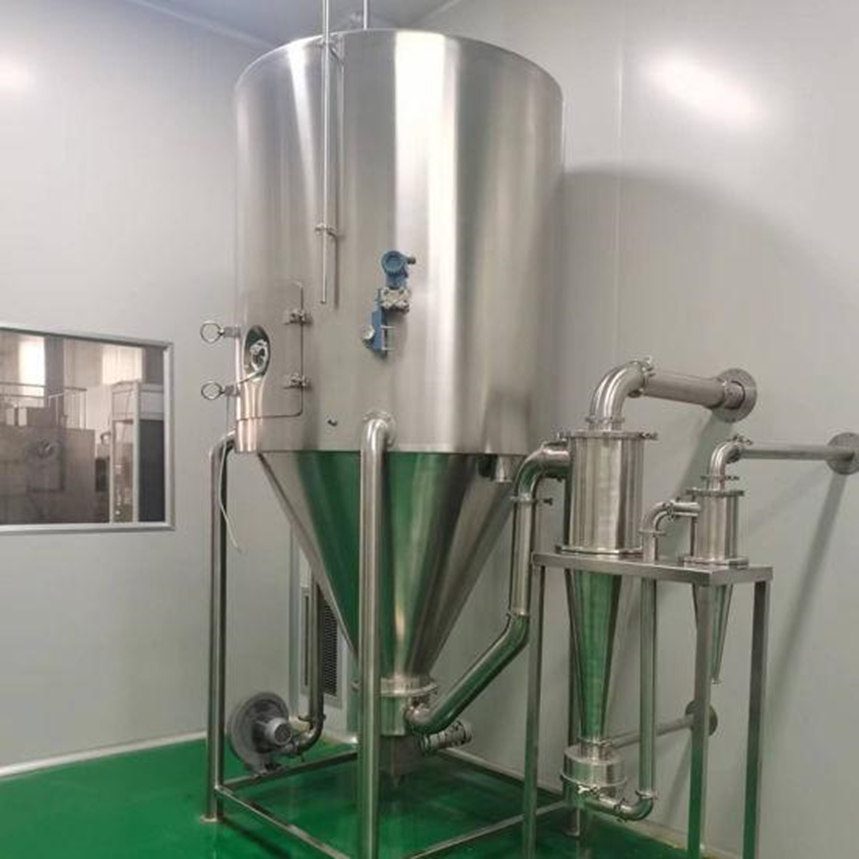
When it is relevant
- Liquid extracts, certain dairy or plant-based ingredients, and processes designed around a slurry feed
- Direct conversion of liquid to powder with controlled particle properties
Limitation: Not the primary technology for sliced spices, onion or garlic.
Other Options
Tray dryers remain in use for small batches or highly sensitive products. Heat-pump and low-temperature systems are evaluated when energy recovery or very gentle drying is prioritised. Rotary dryers are generally secondary for delicate food pieces because of higher attrition risk.
4. Practical Decision Path for Indian Processors
- Identify the exact product and its physical form after preparation (slices, flakes, grated material, granules or liquid).
- Define the target residual moisture and any colour, flavour or rehydration requirements (especially for export).
- Estimate continuous capacity and seasonal peak loads.
- Evaluate band/mesh-belt drying first for slices, pieces and layered products.
- Evaluate fluid-bed systems for free-flowing granules or as a secondary stage.
- Evaluate spray drying only when the process starts from a pumpable liquid or slurry.
- Confirm hygiene design, cleanability and available utilities (steam, thermic fluid, gas, biomass).
- Plan for cooling, milling and packaging integration where powder is the final product.
5. Key Engineering Considerations Specific to Food & Agro
| Factor | Why it matters in Indian food processing | Design implication |
|---|---|---|
| Colour and aroma retention | Export and domestic quality expectations | Multi-zone temperature profiling; avoid excessive product temperature |
| Residual moisture uniformity | Prevents mould, caking and specification failures | Adequate residence time and even bed loading |
| Seasonal feedstock variation | Moisture and quality change with harvest | Dryer must handle a realistic moisture range |
| Hygiene and cleanability | Food-safety and audit requirements | Food-grade contact surfaces, accessible design, CIP where needed |
| Energy cost | Major operating expense | Heat recovery, insulation and correct heat-source selection |
| Integration with milling | Powder lines require controlled feed to grinders | Cooling after drying is often essential |
6. Common Mistakes in Indian Food & Agro Dryer Projects
- Applying a rotary or high-temperature design intended for minerals to heat-sensitive spices or vegetables.
- Undersizing the dryer for peak seasonal volume and then running at excessive temperature to compensate.
- Ignoring multi-zone control and treating the dryer as a single-temperature box.
- Neglecting cooling before milling, leading to quality loss in the powder.
- Selecting solely on lowest capital cost without evaluating residual-moisture uniformity and product quality.
7. Data Required for a Reliable Recommendation
- Exact product (onion, garlic, specific spice, coconut grade, fruit/vegetable, etc.)
- Feed form after preparation (slice thickness, flake size, grated form, etc.)
- Inlet moisture range and target residual moisture
- Required throughput (fresh or dry basis)
- Colour, flavour or rehydration specifications
- Available heat source and utilities
- Hygiene / food-grade requirements
- Preference for continuous multi-stage or batch operation
Geographic Note – India Focus
India is a global leader in spice production and export and a major producer of onion, garlic, coconut and many fruits and vegetables. Continuous band/mesh-belt dryers are widely evaluated for these materials because they combine gentle handling with the multi-zone control needed for colour and flavour retention. Fluid-bed systems appear for free-flowing granules and finishing stages; spray dryers for liquid-based ingredients. Local factors such as seasonal harvest peaks, export moisture specifications, FSSAI-related hygiene expectations and available utilities (including biomass and thermic fluid) influence final configuration, but the fundamental selection still begins with feed form and product quality requirements.
How GTI Dryers Supports Indian Food & Agro Processors
GTI Dryers designs and manufactures band/mesh-belt, fluid-bed, spray and related industrial drying systems for food and agro applications. The approach is:
- Begin with the actual product and its physical form after preparation
- Prioritise multi-zone band drying for slices, flakes and heat-sensitive agro materials
- Evaluate fluid-bed and spray options where feed form and process design justify them
- Engineer systems for continuous operation, residual-moisture control and food-grade construction
- Support process-data review based on real Indian feedstock characteristics
There is no universal best dryer for all food and agro processing in India. The correct system is the one that reliably delivers the required residual moisture and product quality for the specific material at acceptable operating cost and risk.
Frequently Asked Questions
What is the most common industrial dryer for onion and garlic in India?
Continuous multi-zone band / mesh-belt dryers are widely used because they handle slices gently and allow controlled temperature profiling.
Can the same dryer be used for spices and coconut?
Band dryers can be engineered for both, but zone temperatures, airflow and belt loading must be set according to the specific product. Dedicated or carefully scheduled lines are often preferred for quality control.
When is a fluid-bed dryer used in food processing?
Primarily for free-flowing granules or as a secondary drying/cooling stage after belt drying and milling.
Is spray drying suitable for spices?
Only when the process is designed around a liquid extract or slurry. Whole or sliced spices are not spray-dried.
What information does GTI need for an assessment?
Product type, feed form, moisture targets, capacity and any export or quality specifications.
Next Step
If you are planning or upgrading a food or agro-processing line in India and need a dryer matched to your product and capacity, share the material details, residual-moisture target and throughput requirements. GTI can review the data and recommend a suitable dryer configuration for technical discussion.
Request a food & agro dryer assessment for your Indian processing project.
Contact the GTI Technical Team:
Website: gtidryers.com
Email: mktg@gtidryers.com
Phone / WhatsApp: +91 9330077417