
In biomass fuel and wood-pellet production, drying is one of the highest-impact process steps. Fresh wood chips, sawdust, shavings and many agricultural residues typically contain 30–60 % moisture. Pellet mills and most combustion systems require a much narrower residual-moisture window — commonly in the 8–15 % range depending on the process and product standard.
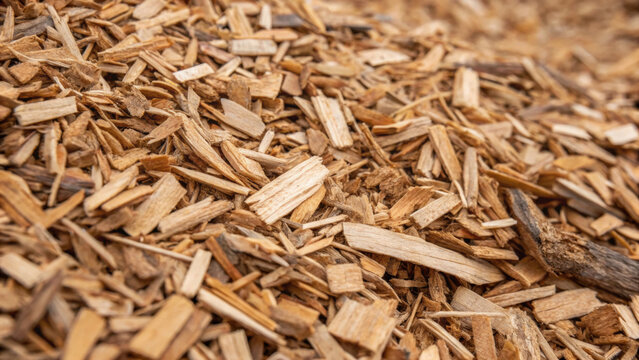
Selecting the right dryer determines energy consumption, product consistency, plant availability and fire-safety risk. This guide provides a practical framework for matching dryer technology to biomass feedstock and pellet-plant requirements.
1. Why Moisture Control Matters in Pellet and Biomass Plants
Excess moisture in the feedstock causes:
- Poor pellet quality (low durability, high fines)
- Higher energy consumption in the pellet mill
- Reduced calorific value if the material is burned directly
- Handling and storage problems (freezing, bridging, microbial activity)
Drying is therefore not optional in most modern pellet and biomass-fuel plants; it is a core process unit that must deliver consistent residual moisture at high continuous throughput.
2. Common Biomass Feedstocks and Their Drying Behaviour
| Feedstock | Typical inlet moisture | Notes for dryer selection |
|---|---|---|
| Wood chips | 30–55 % | Robust, relatively free-flowing; high-volume rotary systems common |
| Sawdust / shavings | 30–60 % | Finer particles; dust and fire-risk management critical |
| Bark | Variable, often higher | Can be more heterogeneous; may need robust cascading design |
| Agricultural residues (bagasse, rice husk, straw, etc.) | Highly variable | Particle size, ash content and seasonal variation affect design |
| Mixed forestry residues | Variable | Consistency of feed preparation becomes important |
The physical form (chip size, fines content, bulk density) influences flight design, air velocity and dust-collection requirements more than the botanical species alone.
3. Primary Dryer Technologies for Biomass and Pellet Plants
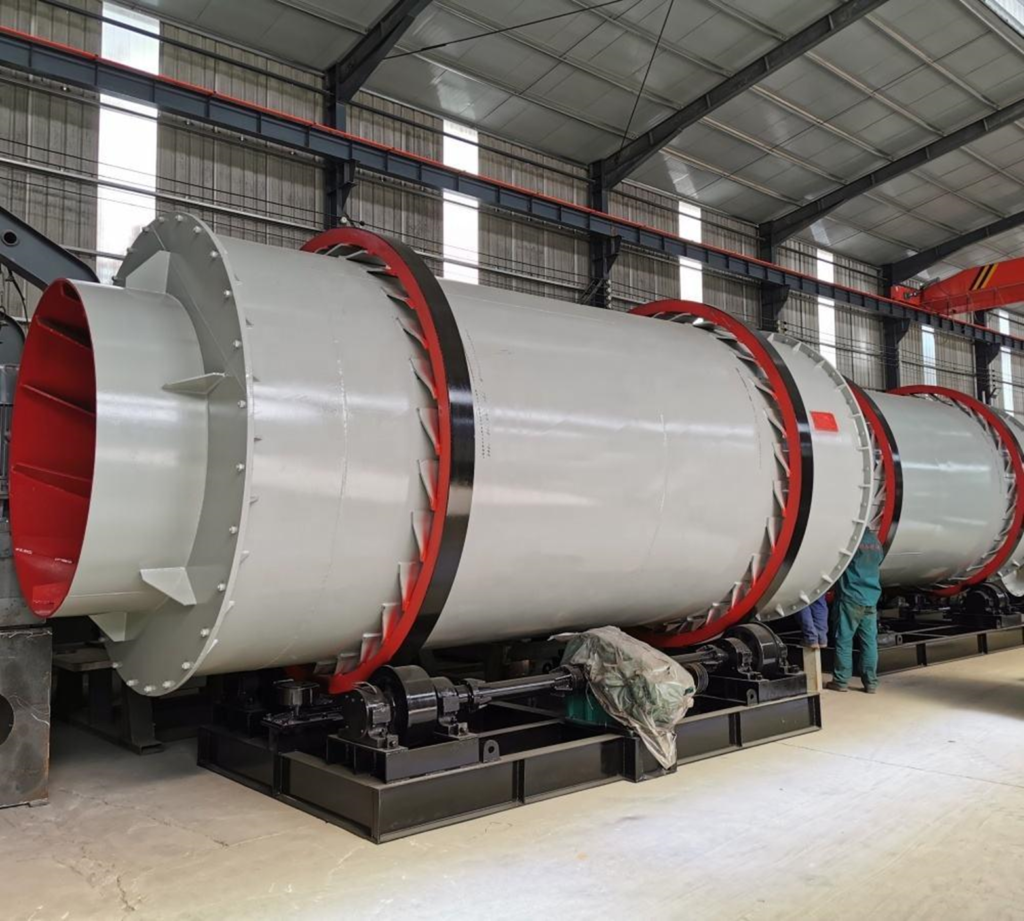
Direct Rotary Dryer
A rotating cylindrical drum with internal flights cascades the biomass through a stream of hot gas. Direct-fired systems (using natural gas, biomass, or other fuels) are widely used in pellet plants because of their high evaporation capacity and continuous operation.
Why it is frequently the first choice
- High continuous throughput matched to industrial pellet lines
- Good gas–solid contact for rapid moisture removal
- Proven on wood chips, sawdust and many agricultural residues
- Flexible heat sources, including biomass itself in some configurations
Key design variables
- Single-pass vs multi-pass (triple-pass) drum
- Co-current gas flow (common for heat-sensitive or very wet feeds)
- Flight design matched to particle size and stickiness
- Integrated dust collection and fire-protection measures
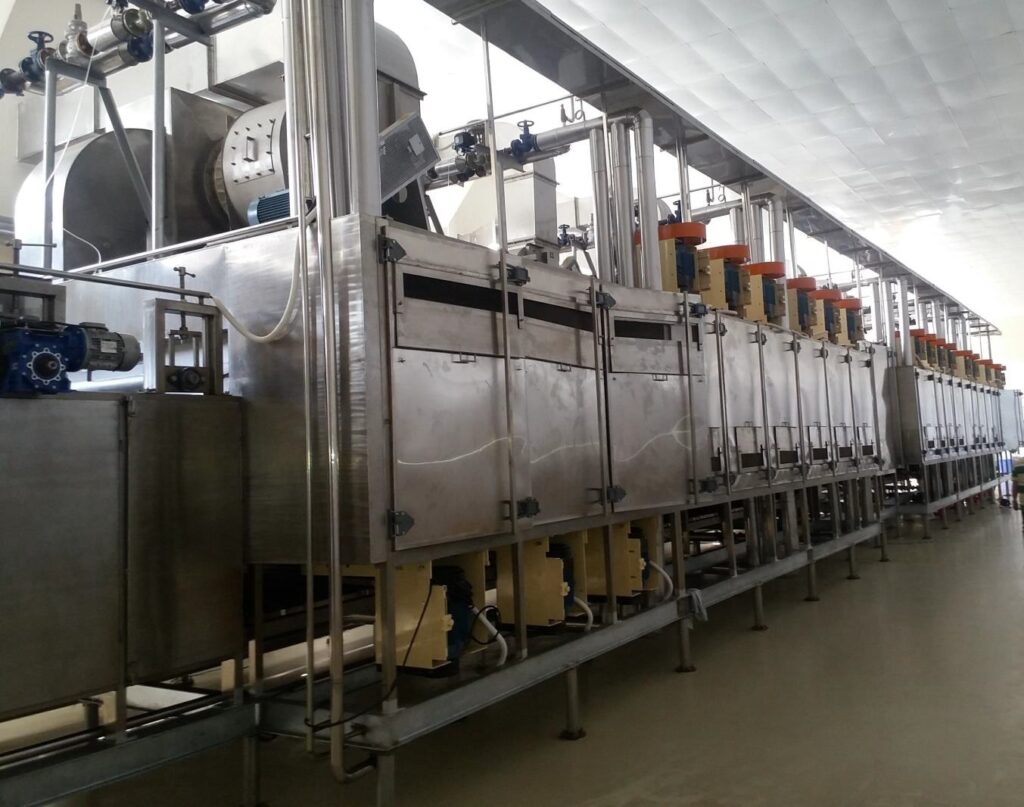
Belt / Band / Mesh-Belt Dryer
Biomass is conveyed as a layer on a moving perforated or mesh belt through controlled temperature zones. Often evaluated when lower-temperature drying or waste-heat utilisation is prioritised.
When it is attractive
- Lower product-temperature requirements
- Availability of low-grade or recovered heat
- Need for gentler handling or multi-zone profiling
- Certain European and specialised biomass projects
Trade-offs
- Larger footprint for equivalent capacity compared with a well-designed rotary system
- Air-distribution and bed-loading uniformity become critical
Other Options
Indirect rotary dryers appear where product contact with combustion gases must be avoided. Fluid-bed systems are less common for primary wood-chip drying but may be considered for finer, more uniform fractions after size reduction.
4. Technology Selection Starting Matrix
| Requirement | Direct Rotary Dryer | Belt / Band Dryer |
|---|---|---|
| High continuous throughput (pellet-plant scale) | Strong | Good |
| Wood chips & sawdust | Strong | Good |
| Robust bulk drying | Strong | Good |
| Lower product temperature / multi-zone control | Moderate | Strong |
| Waste-heat or low-temperature heat source | Possible | Strong |
| Compact footprint | Advantage | Larger |
| Dust & fire-risk management | Requires careful engineering | Requires careful engineering |
| Capital cost for high evaporation duty | Often favourable | Application-dependent |
5. Practical Decision Path for Pellet and Biomass Plants
- Define the feedstock — chip size, fines content, seasonal moisture range.
- Set the target residual moisture required by the pellet mill or end-use specification.
- Quantify the evaporation load from inlet moisture, target moisture and dry-basis capacity.
- Evaluate heat-source strategy — direct biomass firing, natural gas, waste heat, or combination.
- Assess fire and explosion risk — biomass dust requires proper ignition control, spark detection, and explosion protection where applicable.
- Compare rotary vs belt on capacity, footprint, temperature profile and energy integration.
- Engineer the complete system — feeding, drying, dust collection, heat recovery and product cooling/handling.
6. Critical Engineering Considerations
| Factor | Why it matters | Design implication |
|---|---|---|
| Inlet moisture variability | Seasonal and source variation is common | Dryer must handle a realistic moisture range, not a single design point |
| Residual moisture uniformity | Pellet quality depends on consistent feed moisture | Residence time and gas–solid contact must be adequate |
| Fines and dust | Increases fire risk and collection load | Flight design, air velocity and dust systems must be matched |
| Fire safety | Biomass drying involves combustible material and dust | Spark detection, suppression, temperature monitoring and proper isolation |
| Heat recovery | Energy is a major operating cost | Exhaust-heat recovery and process integration improve economics |
| Downstream pellet mill requirements | The dryer serves the pelletising process | Residual moisture and particle-size distribution must suit the mill |
7. Common Mistakes
- Sizing the dryer only on average moisture and ignoring seasonal peaks.
- Under-investing in dust collection and fire-protection systems.
- Choosing the lowest-capital dryer without evaluating total energy cost and plant availability.
- Treating all biomass as identical — bark, sawdust and large chips behave differently.
- Ignoring the interface between dryer discharge moisture and pellet-mill performance.
8. Data Required for a Reliable Recommendation
- Exact feedstock (wood chips, sawdust, mixed residues, agricultural biomass)
- Typical and maximum inlet moisture
- Target residual moisture
- Required dry-basis throughput
- Particle-size range and fines content
- Available heat sources and fuel strategy
- Space and layout constraints
- Any specific pellet-mill or end-product moisture specification
Geographic Note
Rotary dryers dominate high-volume wood-pellet and biomass drying in North America, Europe and many Asian markets because of their capacity and robustness. Belt dryers gain attention where low-temperature or waste-heat drying is prioritised, particularly in parts of Europe. In India and other growing biomass markets, the same engineering logic applies: match the dryer to feedstock form, evaporation load and heat-source economics. Local fuel costs and emission rules influence the final configuration but do not change the fundamental selection criteria.
How GTI Dryers Approaches Biomass and Pellet-Plant Drying
GTI Dryers designs industrial rotary and belt drying systems for biomass, wood chips and related materials. The engineering approach is:
- Begin with feedstock form, moisture range and target residual moisture
- Evaluate direct rotary configurations (including single- and multi-pass) as the primary high-throughput option
- Consider belt/band systems when lower-temperature or multi-zone drying adds value
- Integrate dust collection, fire-safety measures and heat recovery into the overall system design
- Support process-data review based on real feedstock characteristics
There is no universal “best” biomass dryer. The correct system is the one that reliably delivers the required residual moisture at the needed capacity while managing energy use, dust and fire risk at acceptable operating cost.
Frequently Asked Questions
What is the most common dryer for wood-pellet plants?
Direct rotary dryers are widely used for high-throughput drying of wood chips, sawdust and similar feedstocks before pelletizing.
Can a belt dryer replace a rotary dryer in a pellet plant?
It can be suitable when capacity, temperature profile and heat-source strategy favour it. For large continuous pellet lines, rotary systems remain the more frequent choice.
What residual moisture should I target?
It depends on the pellet mill and product specification. Many plants aim for a range that supports good pellet durability — often cited around 8–15 %, but the exact target must be confirmed with the downstream process.
How important is fire protection?
Critical. Biomass drying involves combustible dust and material. Proper temperature monitoring, spark detection, suppression and system isolation should be part of the design.
What single piece of information is most important for sizing?
Inlet moisture range, target residual moisture and dry-basis capacity — these determine the true evaporation load.
Next Step
If you are developing or expanding a biomass, wood-chip or pellet plant and need a drying system matched to your feedstock and capacity, share the material type, moisture data and throughput requirements. GTI can review the information and recommend a suitable dryer configuration for technical discussion.
Request a biomass / wood-chip / pellet-plant dryer assessment with your process data.
Contact the GTI Technical Team:
Website: gtidryers.com
Email: mktg@gtidryers.com
Phone / WhatsApp: +91 9330077417