
Rotary dryers are among the most widely used continuous systems for bulk solids, minerals, biomass, chemicals and many agricultural materials. Once a plant decides that a rotary dryer is the right technology family, a second critical choice appears: direct heating or indirect heating.
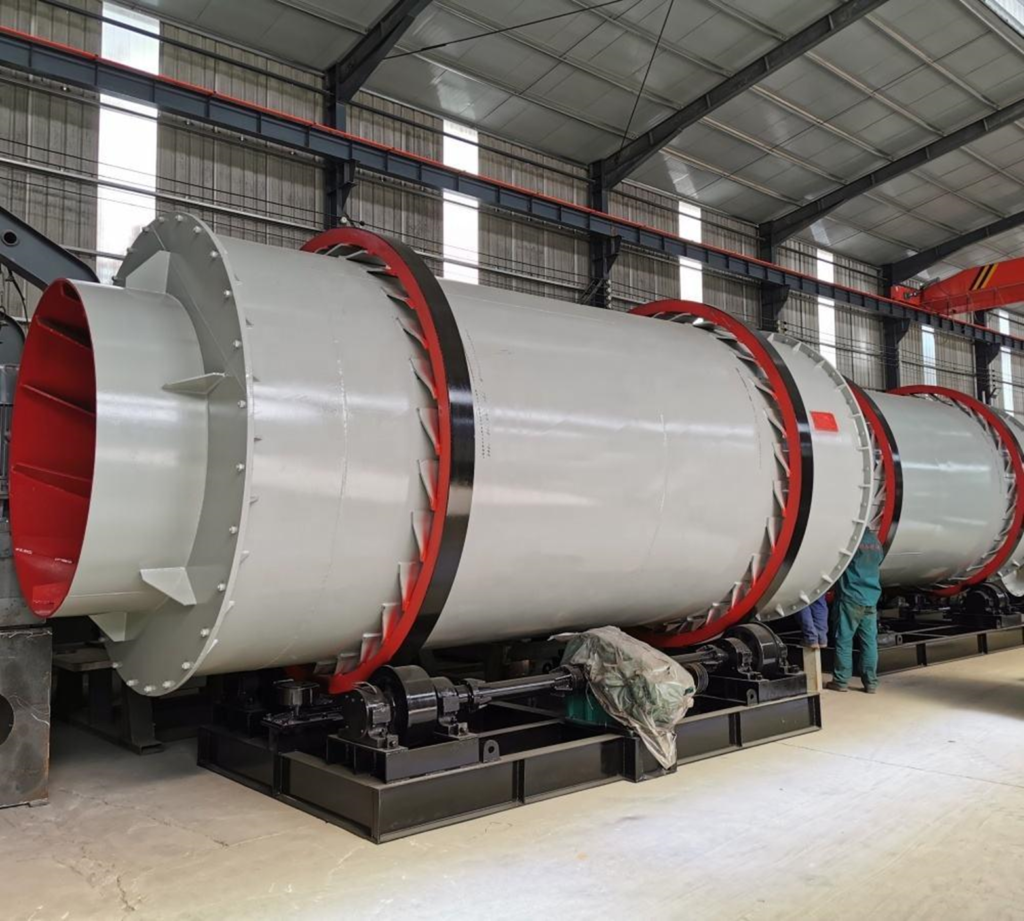
The two configurations look similar from the outside — a rotating drum with flights — but they transfer heat and interact with the product in fundamentally different ways. Selecting the wrong one affects product purity, thermal exposure, energy use, emission handling and long-term operating risk.
This guide explains the practical differences and gives clear decision criteria.
1. How the Two Configurations Work
Direct Rotary Dryer
Hot gas (from a burner, hot-air generator or waste-heat source) flows through the rotating drum and comes into direct contact with the cascading product. Heat transfer is primarily convective.
Typical gas flow arrangements
- Co-current (gas and product travel in the same direction) — often preferred for heat-sensitive or very wet feeds
- Counter-current (gas and product travel in opposite directions) — can achieve lower residual moisture
Indirect Rotary Dryer
Heat is supplied through the drum shell or through internal tubes/coils. The product does not contact combustion gases. Heat transfer is primarily conductive (and some radiation). Common variants include steam-tube rotary dryers and systems heated by thermal oil or other media circulating in a jacket or tubes.
2. Side-by-Side Comparison
| Factor | Direct Rotary Dryer | Indirect Rotary Dryer |
| Heat transfer | Direct contact with hot gas (convective) | Through metal surfaces (conductive) |
| Product contact with combustion gases | Yes | No |
| Typical evaporation capacity | High | Generally lower for the same drum size |
| Contamination / purity risk | Higher (combustion products, NOx, etc.) | Very low |
| Atmosphere control | Limited | Stronger possibility of controlled or inert atmosphere |
| Solvent or odour recovery | More difficult (large gas volume) | Easier (much lower gas volume) |
| Dust in exhaust | Higher gas volume, more entrainment potential | Lower gas volume, generally less dust load |
| Energy efficiency | Can be high with good design and heat recovery | Often higher thermal efficiency for suitable duties; depends on heat-source cost |
| Capital cost | Usually lower for equivalent evaporation | Usually higher |
| Best for | Robust bulk solids, minerals, sand, many biomass streams | Heat- or contamination-sensitive products, food-grade, solvent-containing, or when clean heating is required |
3. Pros and Cons
Direct Rotary Dryer
Advantages
- High evaporation capacity and good gas–solid contact
- Generally lower capital cost for a given duty
- Proven on high-throughput minerals, sand, aggregates, many biomass and fertilizer applications
- Flexible heat sources (natural gas, biomass, waste heat, etc.)
Limitations
- Product contacts combustion gases — potential contamination or oxidation
- Larger exhaust-gas volume increases dust-collection and emission-treatment duty
- Less suitable when product purity, colour or food-grade status is critical
- Product temperature control relies heavily on gas temperature and residence time
Indirect Rotary Dryer
Advantages
- Product isolated from combustion gases — cleaner drying
- Better suited to heat-sensitive, oxidation-sensitive or contamination-sensitive materials
- Lower process-gas volume simplifies odour, solvent or emission handling
- Possibility of controlled or inert atmosphere
- Can integrate well with steam or thermal-oil utilities already available in the plant
Limitations
- Generally lower evaporation capacity per unit drum volume than a well-designed direct system
- Higher capital cost in many cases
- Heat-transfer surface must remain clean; fouling reduces performance
- Heat-source cost (steam, thermal oil) can dominate operating cost
4. When to Choose Each
Choose a direct rotary dryer when:
- The material is robust (minerals, sand, aggregates, many biomass fuels, certain fertilizers and bulk chemicals)
- High continuous throughput and evaporation capacity are priorities
- Contact with combustion gases is acceptable
- Capital cost and simplicity of the hot-gas system are important
Choose an indirect rotary dryer when:
- Product purity or contamination risk is critical (certain food ingredients, specialty chemicals)
- The material is heat-sensitive or prone to oxidation/scorching
- Solvent recovery or low-odour exhaust is required
- The plant already has steam or thermal-oil capacity that can be used efficiently
- A controlled or inert atmosphere is needed
Borderline cases (evaluate both)
- Rendering / fish-meal applications — protein quality and odour management often favour careful temperature control; indirect or well-controlled direct systems are both used depending on the specific process.
- Some chemical intermediates — depends on whether trace combustion products are acceptable.
5. Other Design Variables That Still Matter
Even after choosing direct or indirect, the following must still be engineered correctly:
- Flight design and cascading pattern
- Co-current vs counter-current flow (mainly relevant to direct systems)
- Residence time (drum length, slope, speed)
- Product-temperature monitoring (not just inlet gas temperature)
- Dust collection and exhaust treatment
- Feed and discharge sealing
- Materials of construction for abrasion or corrosion
6. Common Selection Mistakes
- Defaulting to direct heating solely because it is cheaper, then discovering contamination or colour problems later.
- Specifying indirect heating for a high-volume mineral duty where the lower specific capacity makes the system unnecessarily large and expensive.
- Ignoring the available heat source — an indirect dryer is only practical if steam or thermal oil is available at reasonable cost.
- Focusing only on “rotary dryer” without stating whether combustion-gas contact is acceptable.
7. Data Required for a Correct Recommendation
- Exact material and particle characteristics
- Inlet and target residual moisture
- Maximum allowable product temperature
- Whether contact with combustion gases is acceptable
- Required throughput
- Available heat sources (gas, biomass, steam, thermal oil, waste heat)
- Dust, odour, solvent or emission constraints
- Downstream process and product-purity requirements
Geographic Note
The same engineering logic applies in Indian and international plants. Direct rotary dryers dominate high-volume mineral, sand and many biomass applications. Indirect systems appear more frequently where food-grade, specialty-chemical or solvent-recovery requirements exist, or where steam/thermal-oil utilities are already in place. Local fuel costs and emission norms influence the final economic comparison but do not change the fundamental contamination and heat-transfer differences.
How GTI Dryers Approaches the Choice
GTI Dryers designs both direct-heated and indirect-heated rotary dryers. The selection approach is:
- Confirm that a rotary dryer is appropriate for the feed form
- Determine whether product contact with combustion gases is acceptable
- Match the heating method to product-temperature limits, purity requirements and available utilities
- Engineer flights, residence time and gas handling around the actual material
The goal is the configuration that meets process and product requirements at acceptable operating risk and cost.
Frequently Asked Questions
Is a direct rotary dryer always more efficient?
It often delivers higher evaporation capacity for robust materials. Thermal efficiency depends on heat recovery, insulation and the cost of the heat source. Indirect systems can be more efficient in specific steam- or oil-heated duties.
Can an indirect rotary dryer handle the same capacity as a direct one?
Usually a larger or more complex indirect unit is needed for the same evaporation duty. Capacity must be evaluated case by case.
What is a steam-tube rotary dryer?
A common form of indirect rotary dryer in which steam flows through tubes inside the rotating drum, transferring heat to the product without direct gas contact.
Does indirect heating eliminate all contamination risk?
It eliminates contact with combustion gases. Other contamination sources (upstream process, construction materials, sealing) must still be managed.
What is the single most important question when choosing?
Is contact between the product and combustion gases acceptable for the final product specification?
Next Step
If you are evaluating a rotary dryer and need to decide between direct and indirect heating, share your material, moisture targets, product-purity requirements and available heat sources. GTI can review the data and recommend the appropriate configuration for technical discussion.
Request a direct vs indirect rotary dryer assessment with your process data.
Contact the GTI Technical Team:
Website: gtidryers.com
Email: mktg@gtidryers.com
Phone / WhatsApp: +91 9330077417