
Band dryers, mesh-belt dryers and vibratory fluid-bed dryers (VFBD) are three continuous technologies frequently evaluated when plants need relatively gentle drying with good control of residence time and product temperature. They are not interchangeable.
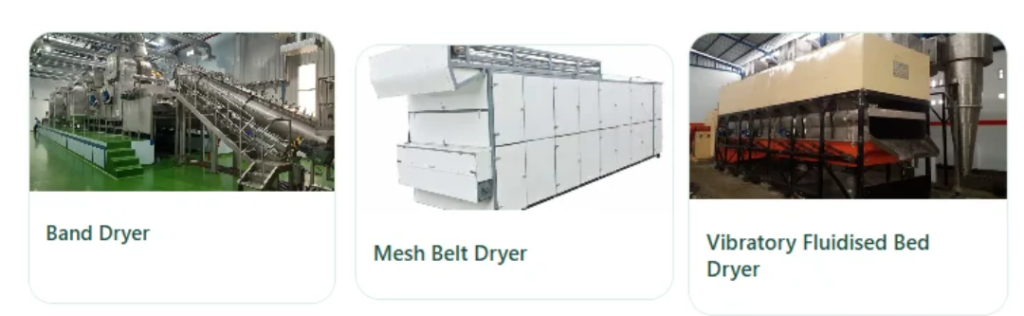
This page provides a practical engineering comparison so process teams can match the correct system to their feed and product requirements.
1. First Clarification: Band Dryer and Mesh Belt Dryer Belong to the Same Family
In industrial practice the terms band dryer, belt dryer, mesh-belt dryer and apron dryer are often used for the same basic machine concept:
- Material is carried as a layer on a moving perforated or mesh conveyor.
- Heated air passes through (or over) the bed in one or more controlled zones.
- Residence time is set primarily by belt speed and dryer length.
“Mesh belt” usually refers to the common stainless-steel mesh construction that allows air to flow through the product layer. Functionally, band dryers and mesh-belt dryers are variants of the same continuous conveyor-dryer family. Differences are mainly in belt construction, number of passes, zone arrangement and materials of construction — not in the fundamental drying principle.
The more important engineering contrast is therefore between the conveyor-dryer family (band / mesh-belt) and the vibratory fluid-bed dryer.
2. How Each Technology Moves and Dries the Product
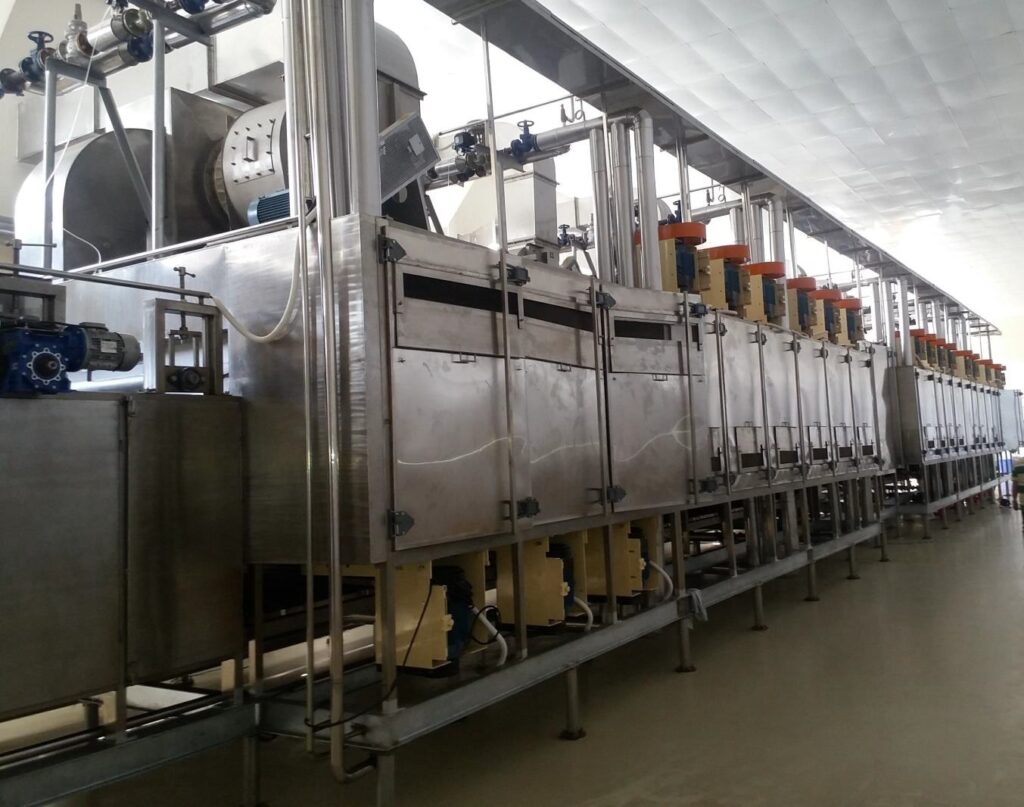
Product is spread in a relatively static layer on a moving perforated or mesh belt and conveyed through temperature- and airflow-controlled zones. Air can be directed upward, downward or in combination.
Key characteristics
- Gentle mechanical handling (no high-velocity particle collision)
- Excellent multi-zone temperature and humidity profiling
- Residence time controlled by belt speed
- Suitable for slices, flakes, pieces and materials that form a permeable bed
Vibratory Fluid Bed Dryer (VFBD)
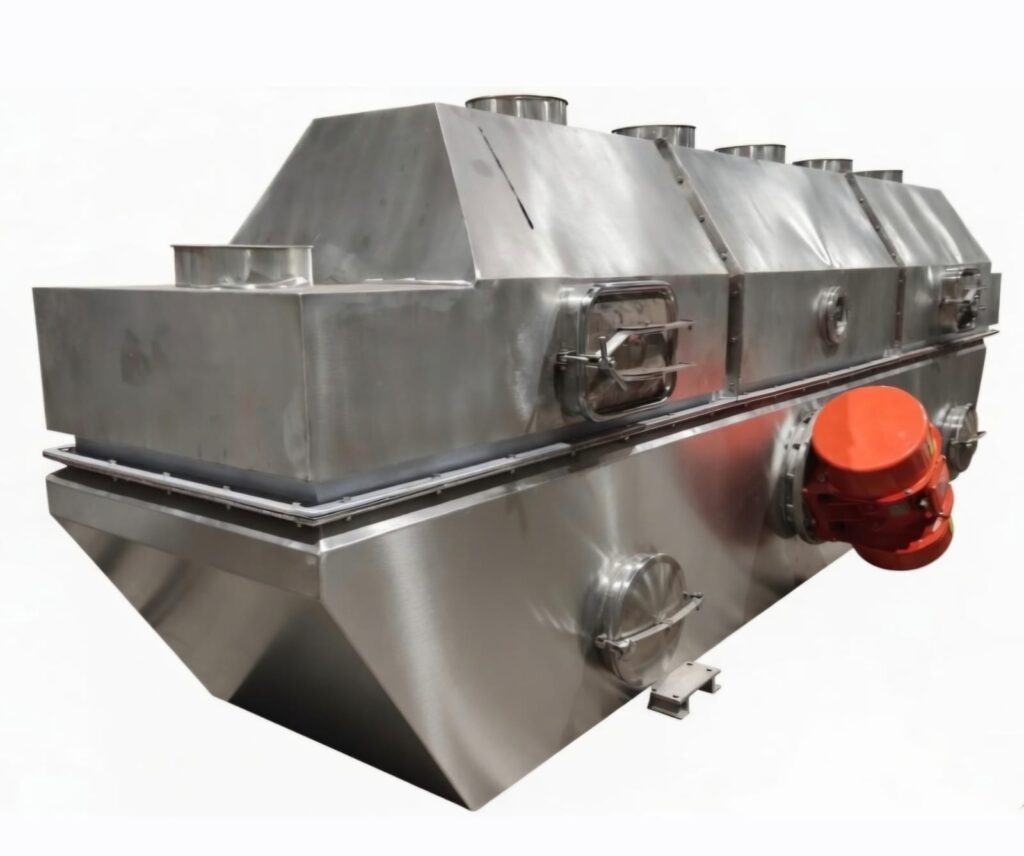
Heated air flows upward through a perforated deck while mechanical vibration conveys the product along the dryer and assists bed mobility. The combination of fluidisation and vibration improves gas–solid contact and helps move materials that are difficult to fluidise by air alone.
Key characteristics
- High gas–solid contact once the material fluidises
- Vibration reduces the air velocity needed and improves movement of moderately sticky or broad-size-distribution particles
- Residence time controlled by vibration, bed length and weirs
- Integrated drying + cooling zones are common
- Best suited to free-flowing or moderately cohesive particulate solids
3. Side-by-Side Engineering Comparison
| Decision factor | Band / Mesh-Belt Dryer | Vibratory Fluid Bed Dryer (VFBD) |
| Product movement | Conveyed as a layer on a belt | Fluidised + vibrated along a deck |
| Typical suitable feed | Slices, flakes, pieces, permeable layers, some granules | Free-flowing granules, crystals, particles that can be fluidised |
| Large irregular pieces / slices | Strong | Limited |
| Fragile particles | Excellent (very low attrition) | Strong (lower air velocity possible) |
| Moderately sticky or broad PSD particles | Good if a stable bed can be formed | Strong (vibration assists mobility) |
| Multi-zone temperature control | Excellent | Good |
| Residence-time precision | Excellent (belt speed) | Excellent (vibration + length) |
| Integrated cooling | Possible (separate or final zone) | Strong (common in same unit) |
| Footprint for equivalent capacity | Often longer | Often more compact |
| Dust / fines generation | Generally low | Depends on air velocity and particle strength |
| Best when product must retain shape | Yes | Less relevant for granules |
4. When to Choose Each Technology
Choose a band / mesh-belt dryer when:
- The feed consists of slices, dice, flakes, chips or irregular pieces that must keep their shape.
- Precise multi-zone temperature profiling is needed to protect colour, flavour or activity (typical of many food, spice, herb and vegetable applications).
- Gentle handling with minimal mechanical stress is a priority.
- The material forms a permeable layer that air can pass through effectively.
Choose a vibratory fluid-bed dryer when:
- The feed is already particulate (granules, crystals, free-flowing or moderately cohesive particles).
- High gas–solid contact and uniform residual moisture are required.
- Drying and cooling can usefully be combined in one machine.
- Vibration can improve bed movement without the need for a long conveyor.
Neither is first choice when:
- The feed is a sticky, non-permeable filter cake or paste → evaluate spin-flash, paddle or other systems.
- The feed is a robust high-volume bulk solid or mineral → evaluate rotary dryer.
- The feed is a pumpable liquid or slurry → evaluate spray drying.
5. Practical Decision Path
- Is the material in the form of slices, flakes, pieces or a layered bed that must retain shape?
→ Start with band / mesh-belt dryer. - Is the material free-flowing or moderately cohesive granules/crystals that can be fluidised?
→ Evaluate vibratory fluid-bed dryer (or conventional fluid bed). - Does the process require both primary drying of pieces and later particulate finishing?
→ Consider band dryer followed by milling + fluid-bed, or a hybrid arrangement. - Is the material a sticky cake or paste?
→ Step outside this comparison; evaluate spin-flash or contact dryers.
6. Common Selection Mistakes
- Assuming a VFBD can handle large vegetable or fruit pieces the same way a band dryer does.
- Installing a long band dryer for free-flowing granules when a more compact VFBD would give better contact and integrated cooling.
- Ignoring bed permeability — a band dryer needs air to pass through the layer; a VFBD needs the particles to fluidise.
- Comparing only capacity (kg/h) without checking particle integrity, residual-moisture uniformity or multi-zone needs.
- Overlooking the value of pilot testing with the actual feed, especially for materials that sit between “easily fluidised” and “stable layer”.
7. Data Required for Correct Selection
- Exact material and physical form (slices / flakes / granules / crystals)
- Particle-size range and bulk density
- Inlet and target residual moisture
- Maximum allowable product temperature
- Required throughput
- Whether cooling or multi-zone profiling is needed
- Available utilities and space constraints
- Hygiene, dust or emission requirements
Geographic Note
The same engineering principles apply in Indian and international plants. Food, spice, coconut and herbal processors frequently evaluate band/mesh-belt systems for shape retention and multi-zone control, while chemical and granular-product plants more often evaluate VFBD for particulate efficiency. Local utility costs, emission norms and the need for robust continuous operation influence final configuration but do not change the fundamental feed-based choice.
How GTI Dryers Approaches the Comparison
GTI Dryers designs and manufactures band/mesh-belt dryers and vibratory fluid-bed systems. The selection approach is:
- Begin with the physical form and movement requirements of the feed
- Compare the conveyor-dryer family against VFBD on the criteria that matter for the specific product
- Recommend the configuration (including possible combinations) that matches material behaviour and quality targets
- Support process-data review and representative-feed evaluation when behaviour is uncertain
Neither technology is universally superior. The correct choice is the one that reliably converts the given feed into the required product with acceptable risk and operating cost.
Frequently Asked Questions
Are band dryer and mesh-belt dryer the same thing?
They belong to the same continuous conveyor-dryer family. “Mesh belt” describes a common belt construction that allows air flow through the product layer. Functional differences are secondary to the contrast with fluid-bed systems.
Is a VFBD gentler than a band dryer?
For fluidisable granules a well-designed VFBD is gentle. For slices and irregular pieces a band dryer is usually gentler because there is no fluidisation or high particle velocity.
Can one machine replace the other?
Rarely. The movement mechanisms and ideal feed forms are different.
When should I consider a combination?
When the process involves both layered/piece drying and later particulate conditioning, or when a primary stage feeds a secondary fluid-bed cooler or finisher.
What is the most important selection question?
What is the physical form of the material as it enters the dryer, and must the product retain its shape?
Next Step
If you are comparing band/mesh-belt and vibratory fluid-bed drying for a specific product, share the feed form, particle characteristics, moisture targets and capacity. GTI can review the data and recommend the most appropriate technology for technical discussion.
Request a band / mesh-belt vs VFBD selection assessment with your process data.
Contact the GTI Technical Team:
Website: gtidryers.com
Email: mktg@gtidryers.com
Phone / WhatsApp: +91 9330077417