
Choosing the right industrial dryer is rarely a matter of comparing nameplates. The correct technology is the one that reliably removes the required amount of moisture, respects the thermal limits of the product, and delivers the needed throughput — without creating new problems of attrition, stickiness, dust or excessive energy use.
This 2026 selection guide gives process engineers and plant teams a structured way to match dryer type to three practical variables:
- Material moisture (inlet and target residual)
- Heat sensitivity (product-temperature limits)
- Capacity and scale of operation
The framework is used together with the fundamental feed-form question (liquid, cake, granules, slices or bulk solid). Moisture, temperature and capacity refine the choice; they do not replace it.
1. Start with Feed Form, Then Apply the Three Variables
Before looking at moisture numbers or capacity, answer:
- Is the feed a pumpable liquid/slurry?
- A sticky filter cake or paste?
- Free-flowing granules or crystals?
- Slices, flakes or layered pieces?
- Robust bulk solids?
Only after the technology family is narrowed do moisture, heat sensitivity and capacity decide the final configuration.
2. Matching Dryer Type to Material Moisture
Moisture has two distinct values that matter:
- Inlet moisture — how much water must be evaporated
- Target residual moisture — how dry the product must be
| Moisture situation | Technology implications |
| High inlet moisture (typically >40–50 % wet basis) + cohesive cake | Spin-flash, paddle or other systems that can accept wet cake without re-slurrying are usually preferred. Spray drying requires dilution and increases the evaporation load. |
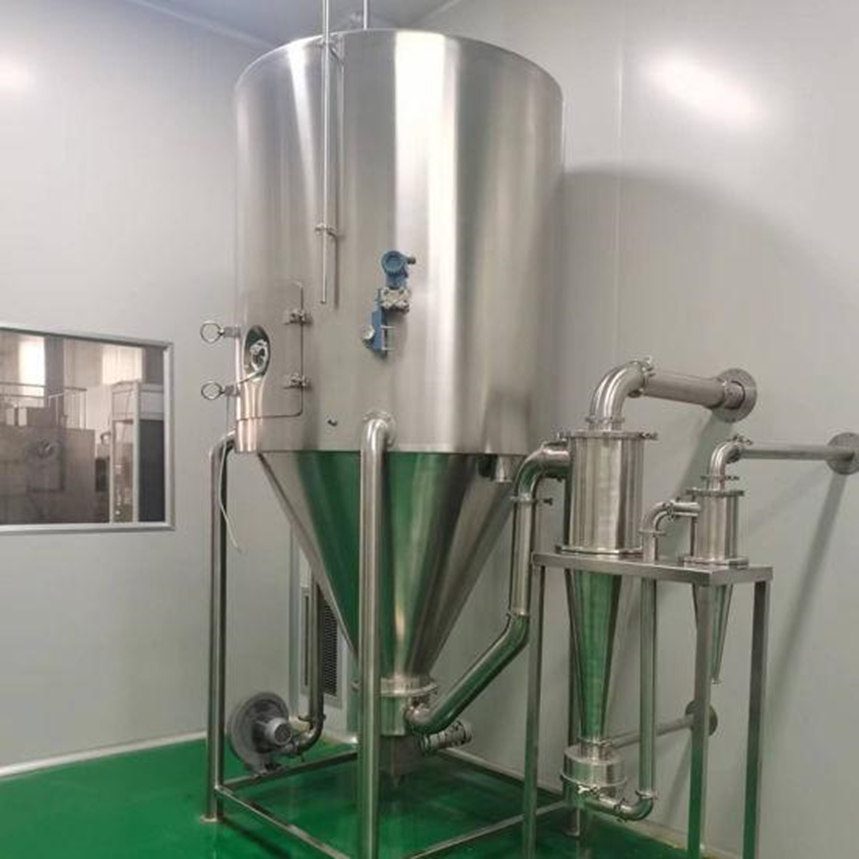
| High inlet moisture + pumpable slurry | Spray drying is often efficient because atomisation creates large surface area. Multi-stage spray + fluid bed can help reach lower residual moisture. |
| Moderate inlet moisture + free-flowing particles | Fluid-bed or vibratory fluid-bed systems provide good control of residual moisture and can integrate cooling. |
| Need for very low residual moisture | Longer residence time or staged drying (fluid bed, band, or secondary stage after flash/spray) is often required. Ultra-short residence systems alone may not reach the lowest targets. |
| Surface moisture only on already-formed particles | Conventional flash or fluid-bed finishing is frequently sufficient. |
Practical rule: Always state both inlet and target residual moisture on a consistent wet-basis or dry-basis. Ambiguous moisture figures are a leading cause of undersized or oversized dryers.
3. Matching Dryer Type to Heat Sensitivity
Heat sensitivity is defined by the maximum allowable product temperature, not the inlet gas temperature. Many materials can tolerate high inlet air temperatures because evaporative cooling keeps the product cooler until most moisture is gone.
| Heat-sensitivity level | Preferred approaches |
| High (product temperature must stay low) | Short-residence systems (spray, spin-flash, flash) with careful outlet-temperature control; vacuum or low-temperature band/fluid-bed systems; multi-zone temperature profiling. |
| Moderate | Most continuous systems can be engineered successfully if product temperature is monitored and controlled. |
| Low (robust materials) | Rotary dryers and higher-temperature fluid-bed or flash systems become attractive for capacity and energy efficiency. |
Key distinctions
- Inlet gas temperature ≠ product temperature.
- Residence time and moisture content together determine thermal exposure.
- For aroma-, colour- or activity-sensitive products (food, spices, certain chemicals), multi-zone band dryers or carefully controlled spray/fluid-bed systems are often evaluated first.
4. Matching Dryer Type to Capacity
Capacity affects both technology choice and system configuration.
| Capacity range (indicative) | Typical considerations |
| Low to medium continuous | Fluid-bed, band, spin-flash and smaller spray systems are all viable. Pilot data scales more easily. |
| High continuous throughput | Rotary dryers for bulk solids; large spray towers for liquids; multi-unit or large fluid-bed systems for particulates. |
| Very high mineral / bulk solid rates | Rotary dryers remain the workhorse for many robust materials. |
| Batch or campaign production | Tray, vacuum or smaller fluid-bed systems may be more flexible. |
Capacity alone should never override feed form or heat-sensitivity limits. A high-capacity rotary dryer is the wrong answer for delicate heat-sensitive slices, just as a small spray dryer is the wrong answer for a non-pumpable filter cake at high rate.
5. Integrated Selection Matrix (Starting Point)
| Feed form | High moisture | Heat sensitive | High capacity | Primary technologies to evaluate |
| Liquid / slurry | Yes | Yes/No | Medium–High | Spray dryer (± fluid-bed stage) |
| Sticky filter cake | Yes | Yes/No | Medium–High | Spin-flash, paddle / indirect |
| Free-flowing granules | Moderate | Yes/No | Medium–High | Fluid-bed / VFBD |
| Slices / flakes / pieces | Moderate–High | Often Yes | Medium | Band / mesh-belt dryer |
| Robust bulk solids | Variable | Usually No | High | Rotary dryer |
This matrix is a screening tool, not a final specification. Actual selection requires material data and, preferably, representative-feed evaluation.
6. Common Selection Mistakes in 2026 Projects
- Specifying only “kg/h evaporation” without stating feed form and residual-moisture target.
- Assuming high inlet-air temperature will damage the product without checking actual product temperature.
- Choosing the lowest-priced dryer that meets a capacity number while ignoring stickiness or thermal limits.
- Ignoring the need for a secondary stage (cooling, agglomeration or final moisture adjustment).
- Treating all materials in one product family as having identical drying behaviour.
7. Data Required for a Reliable 2026 Recommendation
- Exact material and physical form at dryer inlet
- Inlet moisture and target residual moisture (state the basis)
- Maximum allowable product temperature
- Required throughput (dry basis preferred)
- Particle-size or morphology requirements
- Available heat source and utilities
- Downstream process constraints
- Dust, emission, hygiene or solvent considerations
Geographic Note
The engineering principles apply globally. In Indian plants, additional practical factors include local utility costs (steam, thermic fluid, gas, biomass, electricity), CPCB/SPCB emission expectations, variable agricultural or filter-cake quality, and the preference for robust continuous systems with accessible service support. Export-oriented units may face tighter residual-moisture or documentation requirements, but the matching logic remains the same.
How GTI Dryers Applies This Framework
GTI Dryers designs and manufactures spray, spin-flash/flash, fluid-bed, vibratory fluid-bed, band/mesh-belt, rotary and related industrial drying systems. The selection approach is:
- Begin with feed form
- Overlay moisture targets, product-temperature limits and capacity
- Compare realistic technology options, including multi-stage systems where they add value
- Support process-data review and representative-feed evaluation when material behaviour is uncertain
The objective is a dryer (or dryer combination) that meets the process requirements at acceptable operating risk and cost — not the machine with the highest quoted evaporation rate.
Frequently Asked Questions
What matters more — moisture or heat sensitivity?
Both matter, but feed form comes first. Once the technology family is correct, moisture and temperature limits refine the design.
Can a short-residence dryer always protect heat-sensitive products?
Short residence time helps, but outlet temperature, moisture profile and any secondary handling still determine the actual thermal exposure.
Is higher capacity always better served by a rotary dryer?
Only for robust bulk solids that can tolerate tumbling. Capacity does not override feed form or product-integrity requirements.
Do I need pilot testing?
Recommended whenever the material is sticky, variable, heat-sensitive, or the residual-moisture specification is tight.
How should I start a discussion with a dryer supplier in 2026?
Provide feed form, inlet and target moisture, product-temperature limit and capacity. A competent supplier will first confirm the technology family.
Next Step
If you are selecting or replacing an industrial dryer, share your feed form, moisture figures, product-temperature limit and capacity. GTI can review the data and recommend the most appropriate technology or combination for technical discussion.
Request a 2026 dryer selection assessment based on your moisture, heat-sensitivity and capacity data.
Contact the GTI Technical Team:
Website: gtidryers.com
Email: mktg@gtidryers.com
Phone / WhatsApp: +91 9330077417