
Indian manufacturers in chemicals, pigments, food ingredients, pharmaceuticals, minerals and specialty powders regularly face the same decision: which continuous dryer should we buy — spray, fluid bed or flash (including spin-flash)?
The answer is almost never “the one with the highest capacity” or “the one with the lowest quoted price.” The correct choice starts with the physical state of the feed and the properties the finished product must have.
This guide explains the real differences between the three technologies, shows when each succeeds or fails, and gives Indian process teams a practical framework for selection.
1. Start with the Feed — Not the Machine Name
| Feed condition entering the dryer | First technology to evaluate | Why |
|---|---|---|
| Pumpable liquid, solution, slurry or emulsion | Spray dryer | Atomisation converts liquid into droplets that dry into powder |
| Sticky filter cake, paste or cohesive wet solid | Flash / Spin-flash dryer | Mechanical dispersion + rapid hot-air drying |
| Free-flowing granules, crystals or damp particles that can be fluidised | Fluid-bed dryer (including VFBD) | Controlled gas–solid contact in a fluidised bed |
| Already-dry powder needing only surface moisture removal | Flash or fluid-bed | Short residence time or gentle finishing |
Forcing a feed into the wrong family is the most expensive and common mistake.
2. What Each Dryer Actually Does
Spray Dryer
Liquid or slurry is atomised into fine droplets inside a hot-air chamber. Moisture evaporates in seconds and dry powder is collected in cyclones or bag filters.
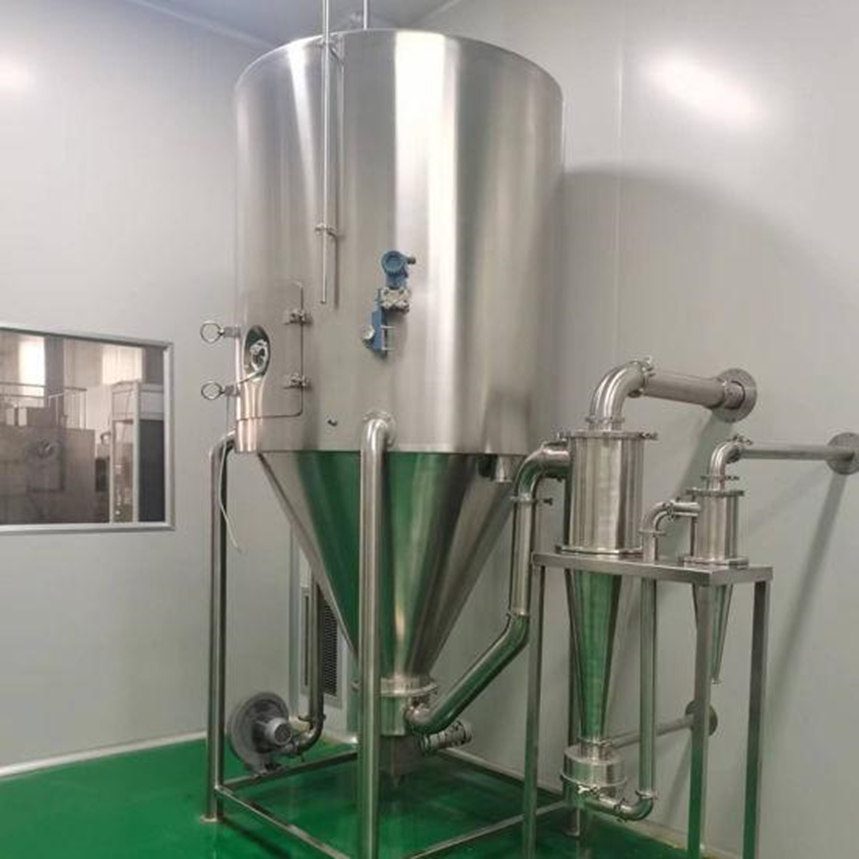
Best when
- Feed is pumpable
- Direct liquid-to-powder conversion is required
- Particle size and morphology need control
- Continuous high-volume powder production is needed
Typical Indian applications: Instant coffee/tea extracts, dairy and plant-protein powders, dyes and pigments from slurry, herbal extracts, ceramic slips, detergent powders.
Key limitations
- Cannot handle non-pumpable cakes or pastes without dilution
- Sticky feeds can cause wall deposits
- Higher capital and energy cost per kg of water evaporated when solids content is low
Fluid Bed Dryer (including Vibratory Fluid Bed – VFBD)
Hot air flows upward through a bed of particles, suspending them so that each particle is surrounded by drying gas. Residence time is controlled by bed length, air velocity and (in VFBD) vibration.
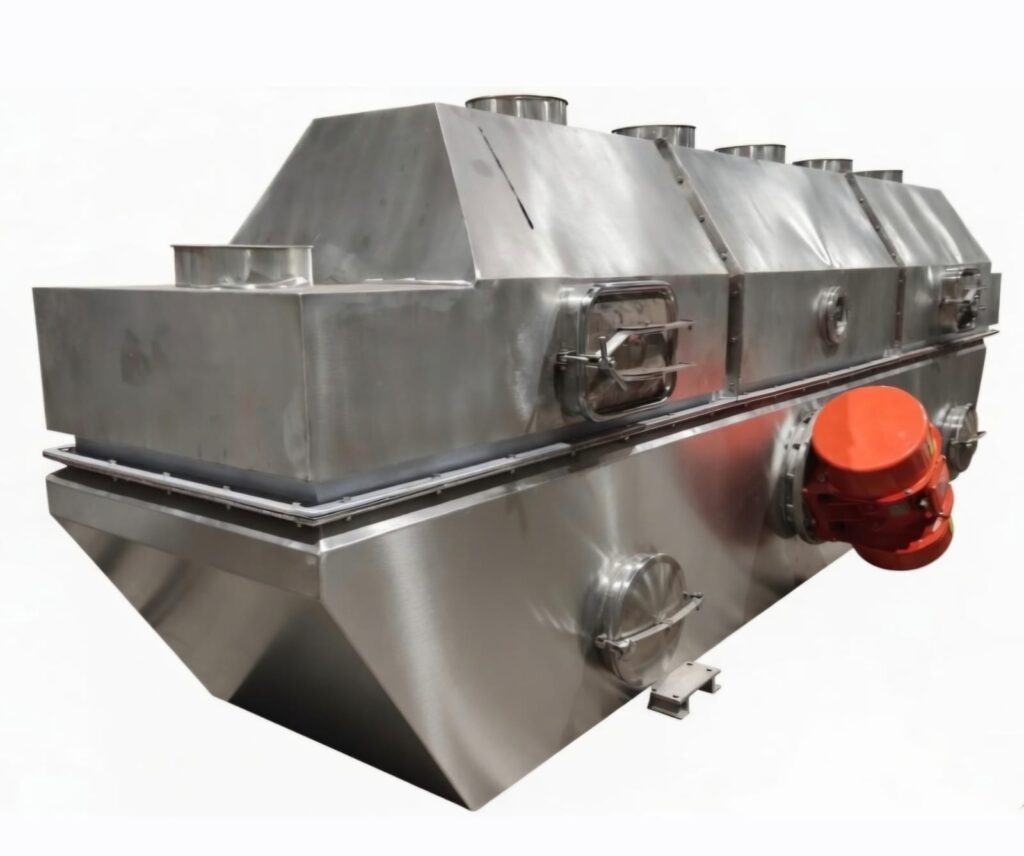
Best when
- Feed is already particulate and can be fluidised
- Uniform residual moisture and gentle handling are required
- Drying + cooling can be combined in one unit
- Fragile crystals or granules must retain integrity
Typical Indian applications: Salt and inorganic crystals, pharmaceutical granules, food granules, catalyst particles, secondary drying of spray-dried powders, cooling of free-flowing products.
Key limitations
- Cannot accept sticky cakes or liquids that will not form a permeable bed
- Very fine cohesive powders (Geldart C) may need special design or pre-conditioning
Flash Dryer / Spin-Flash Dryer
Wet material is dispersed into a high-velocity hot-air stream. Moisture evaporates in a few seconds. A spin-flash dryer adds a mechanical disperser (rotor/agitator) at the feed zone so that cohesive cakes and pastes can be broken up and dried in one step.

Best when
- Feed is a wet filter cake, paste or damp solid
- Short residence time is advantageous (heat-sensitive or to limit agglomeration)
- Compact footprint and continuous operation are required
Typical Indian applications: Pigment and dye filter cakes, precipitated silica, titanium dioxide cakes, starch, certain chemical intermediates, fine inorganic powders.
Key limitations
- Not suitable for true liquids that need atomisation
- High gas velocity can generate fines if the material is fragile
- Product temperature control is tighter than in longer-residence systems
3. Side-by-Side Comparison
| Decision factor | Spray Dryer | Fluid Bed / VFBD | Flash / Spin-Flash |
|---|---|---|---|
| Typical feed | Liquid / slurry | Free-flowing particles / granules | Wet cake / paste / damp solid |
| Residence time | Seconds | Minutes (controllable) | Seconds |
| Main strength | Liquid-to-powder conversion + particle engineering | Uniform drying + gentle handling + integrated cooling | Handling cohesive cakes with rapid drying |
| Product form | Fine or controlled powder | Preserves particle shape; can cool | Powder or de-agglomerated particles |
| Heat sensitivity | Good (evaporative cooling of droplets) | Good with temperature control | Very good (ultra-short exposure) |
| Footprint | Tall chamber | Moderate | Compact |
| Energy use | Moderate–higher (depends on solids %) | Generally efficient for particulates | High efficiency for wet cakes |
| Common failure mode | Wall deposits, poor atomisation | Channeling, inability to fluidise | Fines generation, incomplete dispersion |
| Best Indian fit | Food, dairy, extracts, slurry-based chemicals | Salt, crystals, pharma granules, food particles | Pigments, dyes, precipitated inorganics, filter cakes |
4. Practical Decision Tree for Indian Plants
- Is the feed pumpable?
- Yes → Evaluate spray dryer (and possible multi-stage spray + fluid bed).
- No → Go to step 2.
- Is the feed a sticky cake, paste or cohesive wet solid?
- Yes → Evaluate spin-flash / flash dryer.
- No → Go to step 3.
- Is the feed free-flowing granules, crystals or particles that can be fluidised?
- Yes → Evaluate fluid-bed or vibratory fluid-bed dryer.
- No → Consider paddle, rotary or other contact systems; or pre-condition the feed.
- Does the final powder specification require both primary drying and finishing/cooling?
- Yes → Consider integrated systems (spray + fluid bed, or flash + fluid bed).
5. Common Selection Mistakes Seen in Indian Projects
- Buying a spray dryer for a non-pumpable filter cake and then adding large volumes of water to make it “pumpable” — energy cost rises sharply.
- Installing a fluid-bed dryer for a sticky pigment cake that never fluidises properly.
- Choosing flash drying for fragile crystals that generate excessive fines.
- Ignoring residual-moisture and particle-size specifications until after the equipment is ordered.
- Comparing only “kg/h evaporation” without checking feed form and product quality constraints.
6. India-Specific Operating Considerations
- Utilities: Availability of steam, thermic fluid, natural gas, biomass or electricity strongly influences operating cost and preferred heating arrangement.
- Dust and emission norms: Fine powders from spray and flash systems require robust cyclone + bag-filter systems to meet CPCB and state PCB requirements.
- Space and layout: Flash and spin-flash systems often have a smaller footprint than tall spray towers — useful in existing plants.
- Pilot testing: Because Indian raw materials (especially filter cakes) vary widely, representative-feed trials remain the most reliable way to confirm technology fit.
- Local fabrication and service: Continuous availability of spares and technical support is a practical advantage for plants operating 24×7.
7. When Combinations Make Sense
Many high-performance Indian lines use more than one technology:
- Spray dryer → fluid-bed dryer/cooler for dairy, protein and instant powders (primary drying + agglomeration/finishing).
- Spin-flash → fluid-bed for fine inorganic powders that need final moisture adjustment or cooling.
- Flash → rotary or fluid-bed when a two-stage approach improves energy use or product quality.
8. Data You Should Provide for a Correct Recommendation
- Exact material and grade
- Feed form (liquid / slurry / filter cake / paste / granules)
- Inlet moisture (% wet basis)
- Target residual moisture
- Required throughput (dry basis)
- Maximum allowable product temperature
- Particle-size or morphology requirements
- Available heat source and utilities
- Dust-emission or hygiene constraints
- Whether cooling or agglomeration is needed downstream
Geographic Note
While the engineering principles are universal, Indian plants often prioritise robust continuous operation, local utility costs, emission compliance and the ability to handle variable filter-cake quality. The same decision framework applies to export-oriented units supplying Europe, the Middle East or Southeast Asia; only documentation, materials of construction and residual-moisture targets may become tighter.
How GTI Dryers Helps with the Decision
GTI Dryers designs and manufactures spray dryers, fluid-bed and vibratory fluid-bed systems, and flash/spin-flash dryers for Indian and international industries. The company’s approach is:
- Start with the actual feed form and product specification
- Compare the three technologies (and combinations) against process data
- Recommend the configuration that matches material behaviour, not just capacity
- Support pilot evaluation when material behaviour is uncertain
GTI does not claim any single dryer is universally best. The correct system is the one that reliably converts your specific feed into the required product at acceptable operating cost and risk.
Frequently Asked Questions
Which dryer is best for filter cake?
Spin-flash or flash dryers are usually the first technologies to evaluate. Spray dryers require the cake to be re-slurried; fluid beds generally cannot fluidise sticky cakes.
Can I use a spray dryer for everything?
No. Spray dryers need a pumpable feed. Non-pumpable cakes and pastes belong to flash/spin-flash or contact dryers.
Is a fluid-bed dryer gentler than flash drying?
Yes for most free-flowing granules and crystals. Flash systems use high gas velocity and short residence time; fluid beds offer longer, more controllable contact and lower mechanical stress.
Do I always need only one dryer?
Not always. Many Indian plants use spray + fluid bed or flash + fluid bed to achieve both primary drying and final moisture/particle conditioning.
What is the single most important piece of information for selection?
The physical state of the material as it enters the dryer (liquid, cake, paste or free-flowing solid) together with the target residual moisture and product form.
Next Step
If you are evaluating spray, fluid-bed or flash drying for a new or existing Indian plant, share your feed form, moisture figures, capacity and product requirements. GTI can review the data and recommend the most appropriate technology (or combination) for technical discussion.
Request a dryer-selection assessment with your process data.
Contact the GTI Technical Team:
Website: gtidryers.com
Email: mktg@gtidryers.com
Phone / WhatsApp: +91 9330077417