
Instant coffee and instant tea powders are produced by converting concentrated aqueous extracts into free-flowing, rapidly soluble powders. Spray drying is the dominant continuous technology for this conversion because it combines high throughput, controlled particle formation and relatively low operating cost compared with freeze drying.

The quality of the final powder — solubility, bulk density, flowability, residual moisture and, critically, aroma and flavour retention — is determined largely by the design and operation of the spray dryer. This page provides practical engineering considerations for spray drying coffee and tea extracts, extending GTI’s existing tea-drying and instant-tea-powder content into a focused process guide for soluble beverage powders.
The Core Process Challenge
Coffee and tea extracts contain volatile aroma compounds, soluble solids and, in many cases, components that become sticky at intermediate moisture levels. When the concentrated extract is atomized into hot air:
- Too high a temperature or too long a residence time drives off desirable volatiles and can cause thermal damage.
- Inadequate atomization produces large droplets that dry slowly, risk stickiness or create uneven particles.
- Incorrect outlet temperature or poor powder collection leads to residual moisture that causes caking or poor flow.
- Lack of agglomeration (when required) leaves a fine, dusty powder with slow dissolution.
Successful spray drying therefore balances rapid moisture removal with protection of sensory quality and achievement of the target physical properties.
Typical Process Position
Roasted/ground coffee or tea leaves → Extraction → Filtration → Concentration (evaporation) → (Optional formulation) → Spray drying → Powder separation → (Optional agglomeration) → Cooling / conditioning → Packaging
The spray dryer receives a pumpable concentrate (commonly 30–50 % solids for coffee, variable for tea) and must deliver a powder at the specified residual moisture (typically 2–5 % depending on the product) with acceptable solubility and bulk density.
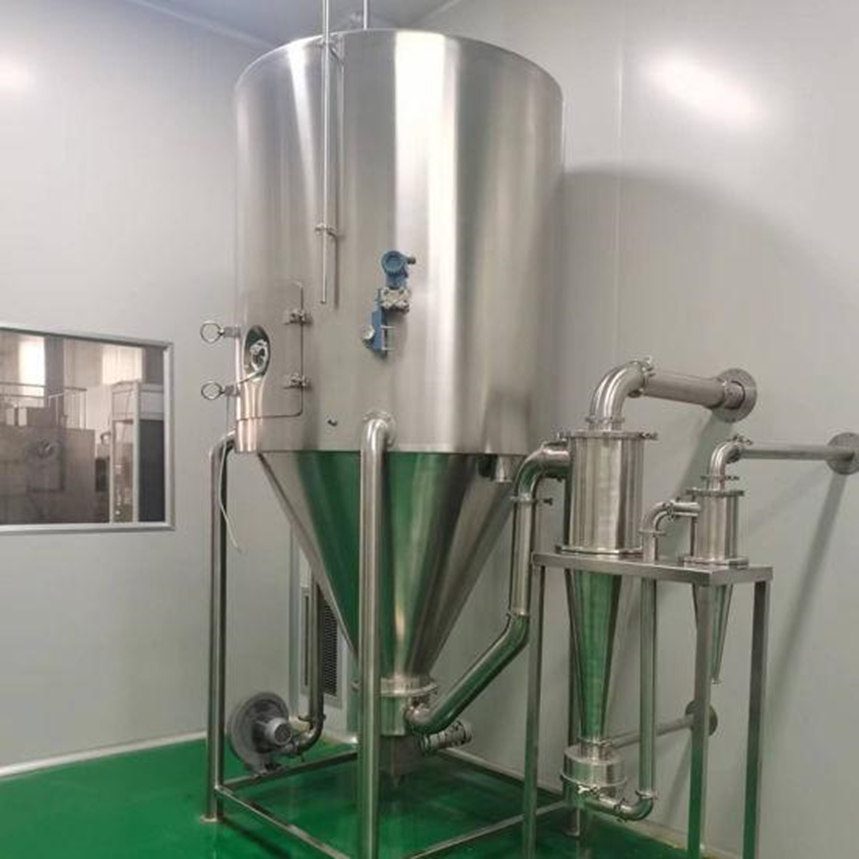
Key Spray-Drying Considerations for Coffee and Tea Extracts
1. Feed Preparation and Concentration
Higher solids content reduces the evaporation load and can improve powder properties, but viscosity and stickiness rise. The concentrate must remain pumpable and stable for atomization. Pre-concentration is almost always used for energy efficiency.
2. Atomization
The choice between rotary (centrifugal) atomizers and pressure/two-fluid nozzles affects droplet size distribution, particle morphology and dryer capacity. Uniform fine droplets promote rapid drying and better aroma retention; oversized droplets risk incomplete drying or wall deposits.
3. Inlet and Outlet Air Temperatures
Inlet temperatures are typically high (often 150–250 °C range depending on the product and dryer design) to provide the driving force for evaporation. Outlet temperature is the more critical control variable for product temperature and residual moisture. Lower outlet temperatures generally favour aroma retention but must still achieve the target moisture.
4. Chamber Design and Residence Time
Co-current flow is standard for heat-sensitive food extracts. Chamber volume and air flow must provide sufficient residence time for the largest droplets to dry without excessive thermal exposure of the powder.
5. Powder Separation and Handling
Cyclones and bag filters recover the product. Fine, hygroscopic coffee or tea powders require careful humidity control in conveying and packaging to prevent caking.
6. Optional Agglomeration
Many commercial instant coffees and some instant teas are agglomerated after primary spray drying (or in a integrated multi-stage system) to improve dissolution rate and reduce dust. This step must be designed together with the spray dryer.
7. Stickiness and Wall Deposits
Coffee and tea extracts can pass through a sticky temperature range. Proper inlet/outlet temperature selection, chamber wall cooling or air-sweep systems, and feed formulation help minimise deposits and downtime.
Common Problems and Engineering Responses
| Problem | Typical causes | Practical response |
|---|---|---|
| Poor solubility / slow dissolution | Fine, non-agglomerated powder or high residual moisture | Optimise atomization; consider agglomeration stage; verify residual moisture |
| Aroma / flavour loss | Excessive outlet temperature or long thermal exposure | Lower outlet temperature; optimise residence time; consider aroma recovery options |
| Sticky powder or wall deposits | Operating through the sticky temperature zone | Adjust temperature profile; improve chamber design or air-sweep; reformulate if needed |
| Residual moisture above target | Insufficient outlet temperature or overloaded dryer | Recalculate evaporation duty; verify air flow and temperature sensors |
| Excessive fines / dust | Over-atomization or aggressive separation | Adjust atomizer settings; improve cyclone / filter efficiency |
| Low bulk density | Very fine particles or high inlet temperature | Optimise droplet size and drying rate; consider agglomeration |
Key Data Required for Technical Assessment
- Type of extract (coffee, black tea, green tea, flavoured, etc.)
- Solids content and viscosity of the concentrate
- Target residual moisture of the powder
- Required solubility / dissolution characteristics
- Bulk-density and particle-size preferences
- Whether agglomeration is required
- Capacity (kg/h powder or evaporation rate)
- Any aroma-recovery or special formulation requirements
- Available utilities and hygiene standards
Geographic Considerations & Market Evaluation
- India — Growing instant-tea and beverage-powder sector alongside traditional tea processing; demand for reliable spray systems that deliver consistent solubility and flavour for domestic and export markets.
- Brazil & coffee-producing regions — Large soluble-coffee industry; emphasis on high-capacity continuous spray drying with aroma and yield optimisation.
- Europe, Japan & premium markets — Focus on flavour fidelity, controlled particle properties and, for some products, competition with freeze-dried alternatives.
- Southeast Asia — Expanding instant-tea and mixed-beverage powder production; cost-effective, robust spray-dryer packages.
GTI evaluates each project from the actual extract characteristics, target powder specification and capacity rather than applying a single standard configuration.
How GTI Dryers Approaches Instant Coffee and Tea Powder Drying
GTI Dryers designs industrial spray drying systems for food and beverage powders, including applications for coffee and tea extracts. The engineering approach is:
- Match atomization, temperature profile and chamber design to the concentrate’s solids content and thermal sensitivity
- Control residual moisture, particle size and bulk density to meet solubility and handling requirements
- Integrate powder separation, optional agglomeration and hygienic conveying
- Support process-data review and, where appropriate, trial evaluation
This page extends GTI’s existing tea-drying and instant-tea-powder content by providing focused spray-drying considerations that apply to both instant coffee and instant tea powder production.
Frequently Asked Questions
Is spray drying suitable for both instant coffee and instant tea?
Yes. Both are commonly produced by spray drying concentrated extracts. The exact temperature profile, atomization settings and any agglomeration step are adjusted to the specific extract and target powder properties.
How does spray drying compare with freeze drying for these products?
Spray drying offers higher continuous capacity and lower cost per kilogram. Freeze drying generally retains more aroma but is slower and more expensive. Most commercial instant coffee and instant tea is spray dried.
What residual moisture is typical?
Many instant coffee and tea powders target residual moisture in the 2–5 % range, depending on packaging and climate. The exact specification should be confirmed for each product.
Why is agglomeration often added?
Primary spray-dried powder can be fine and dusty with slower dissolution. Controlled agglomeration creates larger, more porous particles that dissolve faster and improve consumer perception.
What information does GTI need for an assessment?
Extract type and solids content, target residual moisture, solubility and bulk-density requirements, capacity, and whether agglomeration is required.
Contact the GTI Technical Team:
Website: gtidryers.com
Email: mktg@gtidryers.com
Phone / WhatsApp: +91 9330077417