
A yeast or single-cell protein (SCP) production line can perform well during fermentation and biomass recovery but still lose value during drying. The powder may become sticky, retain excess moisture, develop inconsistent particle sizes, lose functional properties, or become difficult to store and transport.
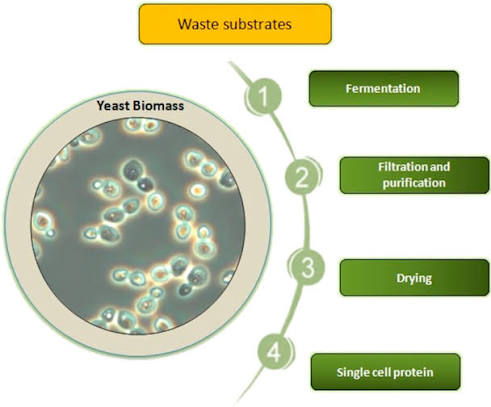
The solution is not simply to select a dryer with a higher temperature or larger capacity. The right drying system must be designed around the biomass feed condition, desired powder properties, heat sensitivity, and final food or feed application.
GTI Dryers evaluates industrial drying requirements based on the material and process conditions. For manufacturers converting microbial biomass into a stable ingredient, spray drying, fluid bed drying, or a combination of both may be worth assessing.
This guide explains how to identify the right technology, diagnose common production problems, compare drying options, and prepare a practical enquiry for an industrial yeast or single-cell protein drying system.
1. Start with the product problem, not the dryer
Before selecting equipment, define what the dried ingredient must do in its final application. Two products that both contain yeast or microbial protein may require different drying strategies.
| Product requirement | What the drying system must address |
| Nutritional yeast or inactivated yeast powder | Moisture control, powder consistency, storage stability and ingredient functionality |
| Live yeast or probiotic yeast | Cell viability, rehydration performance and storage stability |
| Yeast extract powder | Feed concentration, stickiness, solids recovery and powder handling |
| Single-cell protein from fermentation | Biomass concentration, drying load, protein quality and powder properties |
| Feed-grade microbial protein | Consistent moisture, safe handling, storage requirements and formulation compatibility |
| Granulated yeast or microbial biomass | Uniform drying, particle integrity and controlled fines generation |
| Instant or readily dispersible ingredient | Particle structure, wetting, dispersibility and agglomeration requirements |
These requirements are not interchangeable. For example, preserving live microbial cells is different from producing an inactivated protein ingredient. Drying conditions suitable for one may not deliver the desired result for the other.
Research on yeast drying confirms that process conditions can affect cell viability and product quality. Spray drying and fluid-bed drying must therefore be assessed against the intended product specification rather than selected on equipment type alone.
2. What is the difference between a yeast dryer and an SCP dryer?
A yeast dryer processes yeast-based materials, which may include fermentation biomass, concentrated yeast slurry, yeast extract or granulated yeast.
A single-cell protein dryer processes protein-rich microbial biomass produced using selected microorganisms. Depending on the production route, the feed may come from yeast, bacteria, fungi or other suitable microbial sources.
Both applications can involve high-moisture biological materials, but the feed properties and finished-product requirements may differ significantly.
Yeast drying applications
- Brewer’s yeast and other yeast biomass
- Nutritional yeast ingredients
- Yeast extract and savoury food ingredients
- Selected feed-grade yeast products
- Live or functional yeast preparations, where the process is designed to protect viability
- Granulated yeast products requiring controlled final moisture
Single-cell protein drying applications
- Fermentation-derived microbial protein
- Protein-rich biomass for animal-feed formulations
- Selected microbial ingredients for pet food
- Food-ingredient development, subject to applicable regulatory and safety requirements
- Concentrated biomass from fermentation and bioprocessing operations
The equipment selection depends on whether the feed is a thin liquid, concentrated slurry, paste, wet cake, granulated biomass or partially dried material. The process must also account for the organism, biomass composition, solids concentration and required finished-product properties.
3. Spray dryer vs fluid bed dryer: Which is right for your process?
This is the key decision for many yeast and microbial protein manufacturers.
<AsyncImage query=”industrial spray drying tower and fluidized bed dryer equipment food powder processing stainless steel industrial plant” aspectRatio=”16:9″ width=”100%”/>
Option A: Spray drying — when the feed is liquid
Spray drying is commonly evaluated when the incoming material is a pumpable liquid, suspension or concentrated slurry that needs to be converted into powder.
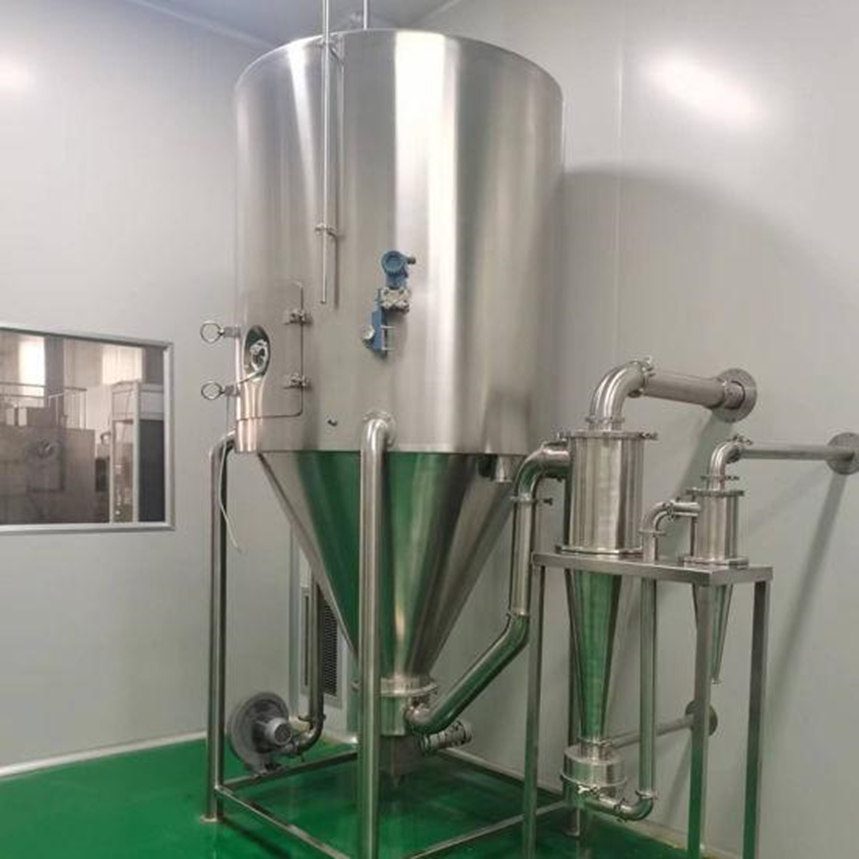
The feed is atomised into droplets inside a drying chamber. The droplets contact a hot drying medium, moisture evaporates, and the resulting particles are separated and collected.
For suitable yeast and microbial biomass feeds, spray drying can provide a continuous route from liquid feed to powder. However, the final result depends on feed preparation, atomisation, solids concentration, drying conditions and the product’s thermal sensitivity.
Spray drying may be worth evaluating when:
- The feed is a pumpable yeast or microbial biomass slurry.
- Continuous liquid-to-powder conversion is required.
- Powder particle size and handling characteristics need to be controlled.
- A liquid fermentation product must be converted into a transportable ingredient.
- The process requires a defined powder specification for food or feed manufacturing.
Potential problems to investigate:
- Sticky deposits forming on the chamber wall
- Nozzle blockage or unstable atomisation
- Excessive fine powder or poor product recovery
- Inconsistent final moisture
- Changes in protein functionality or biological viability
- High thermal energy demand or unstable operation
Spray drying is not automatically suitable for every biomass. A highly viscous feed, heat-sensitive organism or sticky formulation may require upstream conditioning, a different drying route or a multi-stage design.
Option B: Fluid bed drying — when particles need controlled finishing
A fluid bed dryer passes heated air through a bed of suitable particles, causing them to move and mix while moisture is removed.
It is often considered for granules, particles, suitable wet solids or as a downstream stage after another drying operation. The suitability depends on particle size, density, mechanical strength, moisture distribution and whether the material can be fluidised without excessive entrainment or damage.
Fluid bed drying may be worth evaluating when:
- The feed is already granular or particulate.
- A partially dried product needs final moisture reduction.
- Uniform drying and cooling are important.
- A spray-dried product requires further drying or conditioning.
- Granulated yeast or microbial material needs a controlled finishing stage.
Potential problems to investigate:
- Uneven moisture throughout the particle bed
- Poor fluidisation or channeling
- Particle breakage and excess fines
- Product entrainment in the exhaust
- Loss of viability from an unsuitable temperature-time profile
- Agglomeration that interferes with airflow
Fluid-bed drying can be appropriate for selected yeast products, but the process needs validation for the particular strain, formulation and final application.
Option C: Integrated spray drying and fluid-bed finishing
For some liquid-to-powder applications, a combined system can provide initial moisture removal in the spray dryer followed by further drying, cooling or powder conditioning in a fluid bed.
This configuration can be useful when one drying stage alone cannot deliver the required combination of moisture, particle structure, flowability and handling properties. Integrated spray and fluid-bed systems are used in industrial powder processing, although the appropriate design must be determined for each product.
| Decision factor | Spray dryer | Fluid bed dryer | Combined system |
| Typical feed | Pumpable liquid or slurry | Suitable particles, granules or wet solids | Liquid feed followed by powder finishing |
| Main role | Liquid-to-powder conversion | Drying, finishing or cooling of suitable particles | Initial drying plus final drying/conditioning |
| Key design challenge | Atomisation, stickiness and thermal exposure | Fluidisation, particle integrity and uniformity | Coordinating both stages and controlling overall energy use |
| Product characteristics | Powder size and morphology depend on feed and atomisation | Particle moisture and integrity depend on bed conditions | May offer wider control of moisture and powder properties |
| Important limitation | Not ideal for every viscous or sticky feed | Not suitable for every liquid feed or particle type | Greater process complexity and investment may be required |
Practical recommendation: if the incoming biomass is liquid, begin by evaluating spray drying. If the material is already particulate or requires final drying, assess fluid-bed drying. If the powder specification is difficult to achieve in a single stage, investigate an integrated system.
4. Troubleshooting guide: Six common drying problems
The most useful dryer enquiry begins with the production problem. The following table helps identify what should be investigated before purchasing equipment or changing operating conditions.
| Problem observed | Possible causes to investigate | Recommended next step |
| Powder sticks to the dryer wall | Feed composition, high stickiness, unsuitable solids concentration, atomisation or drying profile | Characterise the feed and review formulation, atomisation and chamber conditions |
| Final moisture varies between batches | Inconsistent feed solids, unstable feed rate, airflow variation or inadequate process control | Measure feed variability and establish a moisture-control strategy |
| Powder contains too many fines | Atomisation, particle formation, attrition, collection efficiency or unsuitable operating conditions | Review particle-size targets and the collection system |
| Product loses viability or functionality | Excessive thermal exposure, unsuitable residence time, oxidation or inadequate protective formulation | Define viability or functionality targets and validate the drying profile |
| Product forms lumps during storage | Residual moisture, hygroscopicity, cooling, packaging or storage conditions | Assess moisture, water activity where relevant, cooling and packaging |
| High energy use or poor production rate | High incoming moisture, low feed-solids concentration, heat losses or inefficient process integration | Calculate the evaporation load and review upstream dewatering and heat recovery options |
These are diagnostic starting points, not guaranteed root causes. A process review should distinguish the effects of the dryer from upstream fermentation, separation, concentration and formulation steps.
How to calculate the moisture removal requirement
Before comparing dryer capacities, estimate how much water must be removed.
For a simplified example, assume a plant processes 1,000 kg/h of wet biomass containing 80% moisture on a wet basis and targets 5% final moisture on a wet basis.
- Incoming dry solids: (1{,}000 \times 0.20 = 200) kg/h
- Final product flow: (200 \div 0.95 \approx 210.5) kg/h
- Water remaining in the product: approximately 10.5 kg/h
- Incoming water: 800 kg/h
- Approximate water removal: (800 – 10.5 = 789.5) kg/h
The theoretical mass balance therefore indicates approximately 790 kg/h of water removal.
This is an illustrative calculation, not a recommended yeast or SCP moisture specification. Actual target moisture, operating margin, evaporation capacity and product losses must be established from the material and process requirements. A heat and mass balance is also needed to estimate energy consumption and practical equipment capacity.
5. Protecting protein quality, viability and food/feed performance
Drying success cannot be judged by moisture alone. The finished powder must also meet the requirements of its intended application.
If the product contains live yeast or microorganisms
Define the required viable count, acceptable viability loss during processing, rehydration performance and stability over the intended shelf life. The organism, protective formulation and drying profile can influence survival. Published fluid-bed yeast research demonstrates that both formulation and drying conditions matter.
If the product is an inactivated protein ingredient
Focus on the specified protein quality, colour, odour, solubility or dispersibility, moisture, water activity where relevant, and storage stability. Not every product requires living cells to survive the process.
If the powder is intended for animal feed
Consider the feed formulation, dosing behaviour, storage and transport conditions, and relevant feed-safety requirements. If the ingredient is intended for pet food or a specialised feed application, its nutritional and functional specifications may differ from those for general feed.
If the powder is intended for human food
The process design should consider hygienic construction, cleanability, contamination control, allergen management where relevant, traceability and applicable food regulations. Requirements should be defined for the product and destination market rather than assumed to be identical across all food ingredients.
6. The details that determine dryer sizing
A supplier cannot reliably size a yeast or SCP dryer using only a desired output in kilograms per hour. The following data are important for a meaningful technical evaluation.
Feed properties
- Biomass type and source
- Feed form: slurry, concentrate, wet cake, paste or granules
- Feed rate and operating hours
- Solids concentration and incoming moisture
- Viscosity, density and relevant flow characteristics
- Heat sensitivity and stickiness behaviour
Finished-product requirements
- Target moisture and, where appropriate, water activity
- Powder or granule size distribution
- Bulk density, flowability and dispersibility
- Protein quality or other functional requirements
- Required viable count, if applicable
- Permitted fines, product loss and storage conditions
Plant and utility requirements
- Available thermal energy source
- Electrical power and compressed air, if required
- Exhaust handling, dust collection and emissions requirements
- Available installation space and existing upstream/downstream equipment
- Automation and instrumentation requirements
- Cleaning, hygiene and maintenance expectations
These inputs help establish whether a spray dryer, fluid bed dryer, combined system or another process route should be evaluated.
7. How GTI Dryers can approach a yeast or SCP project
GTI Dryers — Genex Tech Industries — provides industrial drying engineering for process applications. For a yeast or single-cell protein project, the sensible starting point is a feed-and-product assessment, not a promise that one standard machine will suit every biomass.
An application review can be structured around four questions:
- What enters the dryer? Identify the biomass, feed form, solids concentration and incoming moisture.
- What must come out? Define the target moisture, particle characteristics, protein functionality and viability requirements, if applicable.
- Which drying route fits? Compare spray drying, fluid-bed drying and possible multi-stage configurations against the feed and product specification.
- What must the plant deliver? Establish production rate, utilities, operating schedule, cleaning requirements and product collection needs.
The outcome should be a process-specific equipment recommendation, with assumptions and testing requirements clearly identified. If the application is new or the product is especially sensitive, representative feed testing and pilot-scale validation may be necessary before finalising the design.
For related applications, see GTI’s industrial food drying systems and review the relevant equipment range with the engineering team.
8. Frequently asked questions
Which dryer is best for yeast powder production?
Spray drying is often evaluated for pumpable yeast slurry that must be converted into powder. Fluid-bed drying may be suitable for granulated yeast, selected wet solids or final drying. The best option depends on whether the process must preserve live cells, produce inactivated biomass or manufacture a functional ingredient.
Can single-cell protein be spray dried?
Yes, spray drying is a recognised route for converting suitable microbial biomass into powder. However, feed viscosity, solids concentration, product sensitivity, particle properties and the target specification determine whether a particular spray-drying process is appropriate. <Cite refs={[“turn548158search2″,”turn548158search4”]}/>
Can spray drying and fluid-bed drying be used together?
Yes. An integrated system can combine spray drying with fluid-bed finishing, drying or cooling for suitable products. The configuration should be selected according to moisture removal, particle structure, powder handling and process economics.
How do manufacturers reduce sticky powder deposits?
Investigate feed composition, solids concentration, viscosity, atomisation, wall conditions and the drying profile. Sticky deposits can have multiple causes, so adjustments should follow feed characterisation and process review rather than an assumed universal temperature setting.
How can a manufacturer preserve live yeast during drying?
Define the required viable count and assess the organism, formulation, protective agents, drying profile and storage conditions. Validate the process with appropriate viability testing; a dryer alone cannot guarantee survival or shelf life.
Is spray drying suitable for every single-cell protein?
No. Microbial biomass varies by organism, composition, feed form and end use. Some feeds may be better suited to other drying or dewatering routes, while others may require upstream concentration or downstream finishing.
What information is needed to request a yeast or SCP dryer quotation?
Provide the feed type, feed rate, incoming moisture and solids concentration, target output moisture, desired powder properties, heat sensitivity, required viability if relevant, energy source and plant constraints. Representative feed samples and laboratory data can improve the quality of the technical assessment.
Can the same dryer be used for food-grade and feed-grade protein?
Not automatically. The product specifications, hygiene requirements, contamination controls, cleaning procedures and regulatory obligations may differ. The equipment and process must be evaluated against the intended use.
9. Request an application review for your yeast or SCP project
Are you converting fermentation biomass into a stable yeast powder or microbial protein ingredient? If your current process is struggling with sticky deposits, inconsistent moisture, poor powder recovery, excessive fines or product-quality variation, start by documenting the feed properties and the finished-product requirements.
GTI Dryers can assess the information needed to evaluate a suitable industrial drying route.
For an initial technical enquiry, share:
- Product: yeast biomass, yeast extract, microbial protein or another SCP material
- Application: human food, animal feed, pet food or industrial ingredient
- Feed rate and incoming moisture
- Feed form and solids concentration
- Target moisture and final powder or granule properties
- Viability or protein-functionality requirements
- Available heat source and plant constraints
The objective is to identify a technically appropriate process, not simply to select a machine by name or nominal capacity.
GTI Dryers — Engineered Drying Solutions from India for Global Industries.