
Engineered drying solutions for functional ingredients, optical brighteners, phosphate salts, aluminium hydroxide, enzyme powders, vitamin powders and specialty chemical materials
A specialty powder can meet its chemical composition specification and still create problems during production. It may absorb moisture during storage, form hard lumps, lose flowability, generate excessive fines or fail to deliver the required performance in the final formulation.
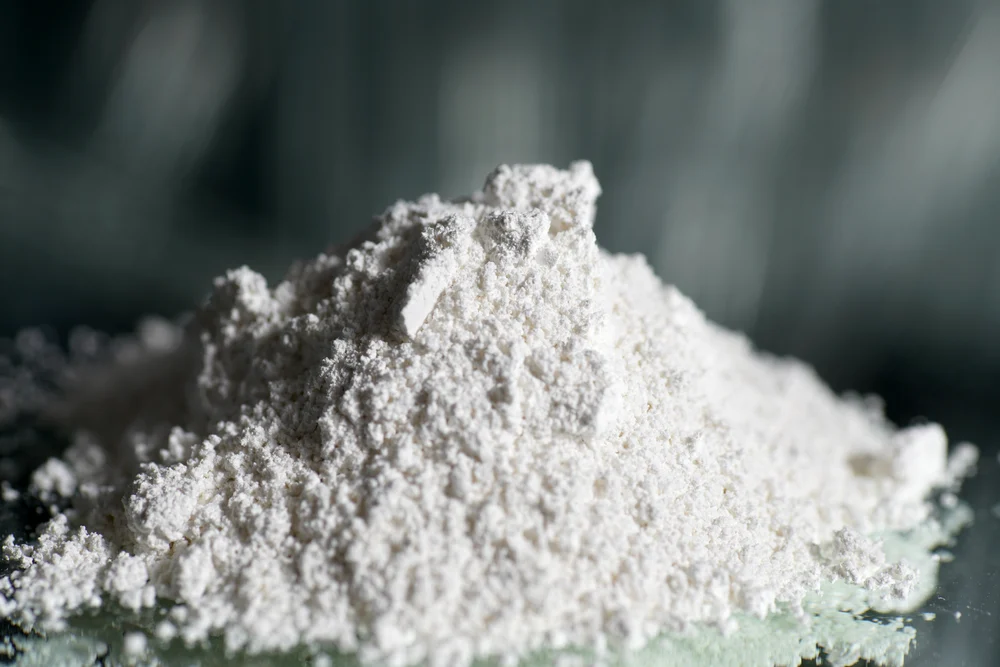
For manufacturers of functional additives, vitamins, enzymes, optical brighteners, phosphate salts, aluminium hydroxide and other high-value powders, drying is therefore more than a moisture-removal operation. It is a process step that must support the material’s intended physical and functional properties.
The challenge is that specialty powders cover a wide range of feed forms and material behaviours. A liquid solution that must be converted into powder requires a different drying approach from a wet crystalline salt, a filter cake, a free-flowing granule or a heat-sensitive enzyme preparation.
GTI Dryers evaluates industrial drying requirements based on feed characteristics, moisture-removal duty, thermal sensitivity, required particle properties and downstream processing needs. Depending on the application, the technologies to investigate may include spray drying, fluid-bed drying, rotary drying, indirect drying or a customized multi-stage arrangement.
This guide takes a powder-performance-first approach: identify the quality problem, understand the material, compare the relevant technologies and determine what information is needed to select a suitable industrial dryer.
1. The Powder Performance Brief: What Must the Dryer Deliver?
Before choosing a machine, define what the finished powder must do. This is especially important when moisture affects not only storage stability but also the powder’s behaviour in a downstream process.
| Production or quality problem | Possible consequence | What the drying assessment should examine |
| High residual moisture | Caking, storage problems or failure to meet specifications | Incoming moisture, evaporation load, residence time and final-moisture measurement |
| Uneven moisture across the product | Variable quality between batches or production runs | Feed consistency, heat distribution, material movement and process controls |
| Poor flowability | Difficult conveying, weighing, filling or blending | Moisture, particle shape, size distribution, agglomeration and bulk density |
| Excessive fines or dust | Product loss, handling difficulties and dust-control concerns | Atomization or material movement, particle strength, collection and transfer points |
| Heat-sensitive ingredients | Potential loss of activity, colour or other required properties | Product-temperature profile, residence time and suitable heat-transfer method |
| Particle-size inconsistency | Variable dispersion, dissolution or formulation behaviour | Feed preparation, atomization, granulation and classification requirements |
| Sticky deposits or wall buildup | Lower output, cleaning interruptions and unstable operation | Feed solids, viscosity, surface properties and drying conditions |
| High energy consumption | Increased operating cost per unit of product | Water-removal load, heat balance, exhaust losses and heat recovery |
| Product losses during collection | Reduced yield, particularly for fine or valuable powders | Cyclone or filter selection, containment, transfer and collection design |
These symptoms can have more than one cause. Increasing the dryer temperature may not correct poor particle formation, inconsistent feeding or unsuitable upstream processing. A proper assessment should connect the quality problem to its likely process causes.
2. Which Specialty Powders Require Different Drying Approaches?
Specialty and functional powders are not one uniform product category. Their drying requirements depend on whether the feed is a liquid, suspension, wet solid, crystal, granule or existing powder.
Functional additives and specialty ingredients
Functional additives are used to modify the performance or processing behaviour of a final product. Their requirements may include controlled moisture, consistent particle size, reliable dosing, stable flow and compatibility with a downstream formulation.
The drying assessment should identify whether the additive is supplied as a solution, slurry, wet solid or granule. The appropriate process may be different for each feed form, even when two products serve a similar purpose.
Vitamin powders
Vitamin-containing powders can have specific requirements for moisture, thermal exposure, oxidation sensitivity and formulation stability. Some vitamin products are manufactured by spray drying or other specialized processes; others may involve drying an existing wet solid or granulated preparation.
The dryer must be selected according to the actual vitamin, formulation, carrier system and required product specification. A generic temperature or moisture target should not be applied to all vitamins.
Enzyme powders
Enzymes are biological catalysts, and their functional activity can be affected by the processing conditions used to produce or dry them. For enzyme-containing liquids, spray drying may be considered where the formulation and process are suitable. Other enzyme preparations may require different drying methods.
The assessment should include the required residual moisture, activity-retention criteria, formulation, thermal exposure, and any humidity or oxidation controls required by the product.
Important: No drying technology can guarantee enzyme activity retention without application-specific evidence. Product activity should be evaluated using the relevant analytical method.
Optical brighteners
Optical brighteners are used in applications such as detergents, textiles, paper and other formulated products. Depending on the manufacturing route, the material may be present as a solution, slurry, crystal or wet solid.
The drying process should support the required chemical quality, moisture specification, particle characteristics and downstream dispersibility. Spray drying may be considered for suitable liquid feeds, while crystalline or particulate feeds may require another technology.
Phosphate salts
Phosphate salts vary in composition, hydration state, solubility and physical form. Some processes produce a solution or slurry that must be converted into powder, while others produce crystals or wet solids that require moisture removal.
Technology selection should consider the particular salt, whether water is present as surface moisture or in a defined hydrate form, the required final specification, and whether drying could alter the desired product form.
Not every phosphate product should be dried to the same moisture level or with the same process.
Aluminium hydroxide
Aluminium hydroxide can enter a drying process as a wet precipitate, filter cake or another prepared feed. The required dryer depends on the feed’s moisture, solids characteristics, desired particle properties and the intended application.
The process assessment should consider the need to remove free moisture while preserving the required product characteristics. Thermal conditions must also be appropriate for the specific grade and process; a drying duty should not be confused with a separate calcination or thermal-transformation operation.
Other high-value specialty powders
The same application-based approach applies to other fine chemicals, functional ingredients, selected salts and formulated powders. The name of the material alone is not sufficient to select a dryer. The supplier needs to know how the feed is produced, how it behaves and what the finished powder must achieve.
3. Select the Dryer According to the Feed Form
The most important technology decision is often whether the process starts with a liquid, a wet solid or an already formed particle.
A. Spray dryer: Liquid feed to powder
A spray dryer converts a suitable liquid, solution, emulsion or slurry into a powder. The liquid is atomized into droplets and brought into contact with a drying gas. As moisture evaporates, particles form and are collected from the drying chamber and exhaust-handling system.
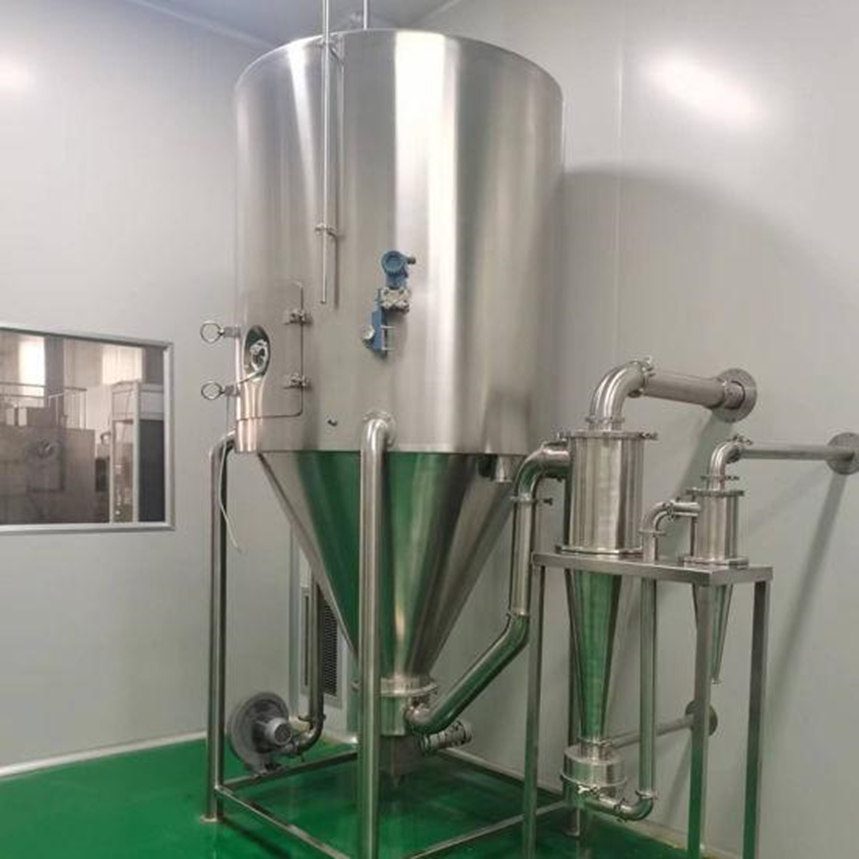
Spray drying is relevant when the manufacturing objective is to produce powder directly from a liquid feed. It can be considered for suitable functional ingredients, vitamin-containing formulations, enzyme preparations and specialty chemical solutions or suspensions. Application-specific spray-drying systems are also used for enzymes and a range of chemical products.
Evaluate spray drying when:
- The feed is a pumpable liquid, solution, suspension or slurry.
- Powder formation is part of the process objective.
- Particle-size distribution and bulk properties matter.
- The formulation can tolerate the proposed drying conditions.
- Fine-powder collection and exhaust management can be designed appropriately.
Main engineering questions
- What are the feed solids content and viscosity?
- Can the feed be atomized consistently?
- What particle-size and bulk-density targets are required?
- How sensitive is the material to temperature, oxygen or moisture?
- What collection efficiency and product-recovery arrangement are required?
Spray drying is not automatically the best option for a wet filter cake, a pre-existing powder or a crystalline solid that simply needs residual moisture removed.
B. Fluid-bed dryer: Suitable wet granules, crystals and particles
A fluid-bed dryer passes a controlled gas stream through a bed of particles. The resulting gas-solid contact supports heat and mass transfer and can provide uniform drying when the feed is suitable for fluidization.
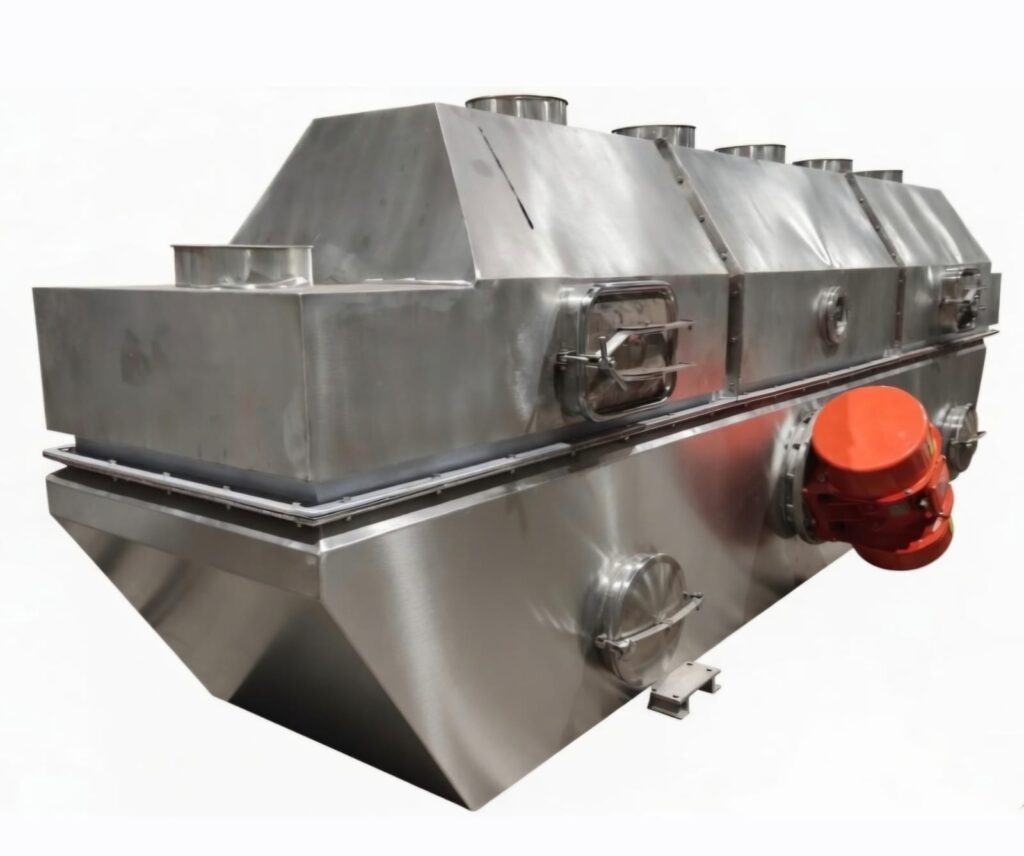
Fluid-bed systems can be considered for appropriate granules, crystals and other particulate materials, including selected chemical and functional ingredient applications.
Evaluate a fluid-bed dryer when:
- The feed has suitable particle size and flow characteristics.
- The particles can be distributed and maintained appropriately within the bed.
- Controlled moisture removal is required.
- The material can tolerate the associated particle movement.
- Cooling or conditioning may be integrated into the process.
Main engineering questions
- Does the feed fluidize consistently?
- Is the material cohesive, sticky or prone to agglomeration?
- What particle attrition or fines generation is acceptable?
- What gas conditions are needed to meet the moisture target?
- Is a separate cooling or classification step required?
Fluid-bed drying should not be assumed suitable for every fine powder, highly cohesive material or sticky filter cake. The material’s behaviour must be assessed.
C. Rotary dryer: Suitable robust solids and granules
A rotary dryer moves material through a rotating drum while transferring heat to the feed. Depending on the application, heat can be supplied through a direct-contact or indirect arrangement.
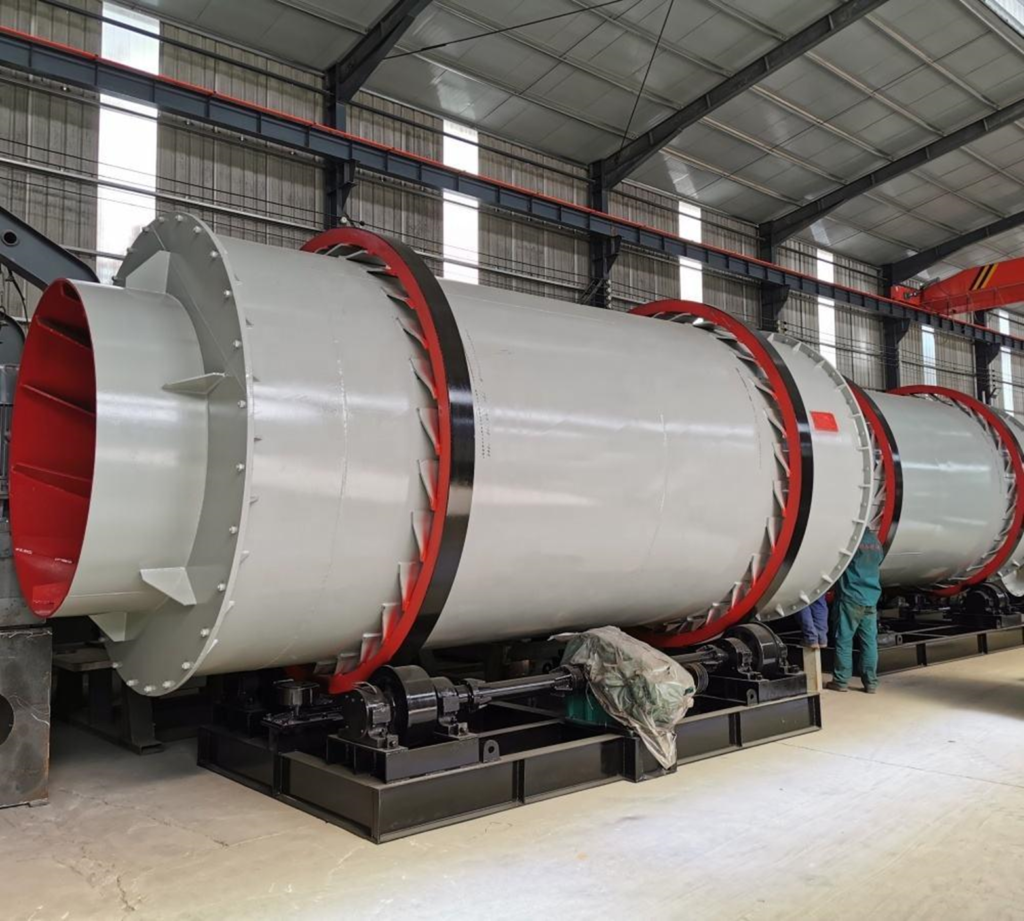
Rotary drying can be evaluated for appropriate robust solids, crystals, granules and other bulk materials where the feed can move through the drum without unacceptable degradation, agglomeration or contamination.
Evaluate a rotary dryer when:
- The feed is compatible with rotating-drum material handling.
- Continuous processing is required.
- The material tolerates the selected movement and thermal conditions.
- The required moisture-removal duty fits the proposed configuration.
- Dust collection, exhaust handling and downstream transfer can be integrated.
A rotary dryer should not be selected solely because a product is described as a chemical powder. For very fine, cohesive or heat-sensitive materials, another technology may be more suitable.
D. Indirect drying: When the heat-transfer method matters
Indirect drying transfers heat through a heated surface rather than relying entirely on direct contact between the product and hot combustion gases.
This arrangement can be considered where the process requires a particular atmosphere or limits direct contact between the product and the heating gas. Its suitability depends on the material’s heat-transfer characteristics, moisture load, required throughput, cleaning needs and the desired final product.
Indirect heating is not universally better than direct drying. It should be evaluated against the actual thermal duty and process constraints.
E. Multi-stage drying and powder conditioning
Some specialty powders may benefit from separating primary moisture removal from final drying, cooling or conditioning.
For example, an appropriate liquid feed may undergo spray drying followed by fluid-bed drying and cooling. A suitable wet granule may undergo primary drying and then controlled cooling or conditioning. These are possible process arrangements, not universal recipes.
Multi-stage systems can be useful where a single stage cannot achieve the required balance of throughput, final moisture and powder characteristics. Their benefits should be weighed against added equipment, controls, cleaning and maintenance.
4. Specialty Powder Dryer Selection Matrix
| Material or feed form | Technologies to evaluate | Key selection consideration |
| Functional additive supplied as a solution | Spray dryer | Feed chemistry, atomization and powder properties |
| Vitamin-containing liquid formulation | Spray or specialized drying system | Product stability and formulation-specific thermal limits |
| Enzyme-containing liquid feed | Spray or other suitable specialized process | Activity-retention requirements and formulation |
| Optical brightener solution or slurry | Spray dryer or suitable alternative | Product form, chemical properties and particle requirements |
| Wet phosphate crystals or granules | Fluid-bed or rotary dryer, depending on feed | Crystal integrity, moisture and hydrate specification |
| Aluminium hydroxide filter cake | Suitable solids-drying system | Cake properties, moisture load and required product form |
| Existing free-flowing chemical granules | Fluid-bed or rotary dryer | Particle behaviour, throughput and heat-transfer requirements |
| Sticky or cohesive specialty material | Specialized or indirect drying assessment | Adhesion, feed preparation and material movement |
| Liquid feed requiring controlled powder formation | Spray or multi-stage spray drying | Atomization, particle formation and powder collection |
This table is a preliminary guide, not a final equipment specification. The same chemical may require different equipment when its feed form or manufacturing route changes.
5. Troubleshooting: How to Solve Specialty Powder Drying Problems
Problem 1: The powder cakes during storage
Possible causes
- Excessive residual moisture.
- Hygroscopicity and moisture uptake from ambient air.
- Temperature differences during packaging.
- Particle-surface properties or formulation effects.
- Inadequate cooling or unsuitable packaging conditions.
What to investigate
Measure the moisture at dryer discharge and after the relevant storage or packaging interval. Review the product’s moisture-sorption behaviour, cooling conditions, packaging barrier and storage humidity.
Reducing the dryer outlet moisture may help in some cases, but it will not necessarily solve caking caused by formulation or environmental moisture uptake.
Problem 2: Powder flowability is poor
Possible causes
- Moisture-related cohesion.
- Very fine or irregular particles.
- Excessive agglomeration.
- Inconsistent particle-size distribution.
- Differences in bulk density or surface properties.
What to investigate
Define the flowability problem using suitable tests and relate it to the actual handling requirement. Review particle formation, moisture, particle-size distribution, and the transfer and storage conditions.
Where required, granulation or controlled agglomeration may be a separate process objective rather than a consequence of drying alone.
Problem 3: The product loses functional activity or quality
Possible causes
- Excessive thermal exposure.
- Unsuitable residence time.
- Oxidation or moisture-related degradation.
- Formulation instability.
- Inconsistent feed composition.
What to investigate
Identify the specific quality attribute at risk and establish a validated measurement method. Review the product-temperature history, residence time, drying atmosphere where relevant, and any post-drying exposure.
For enzymes and certain vitamins, a low final moisture reading does not by itself prove that the finished product retains the required activity or potency.
Problem 4: The powder contains too many fines
Possible causes
- Atomization or particle-formation conditions.
- Particle attrition in a fluid bed or during conveying.
- Weak agglomerates.
- Inappropriate collection or classification.
- Excessive impact at discharge or transfer points.
What to investigate
Determine where the fines are generated. Review the feed and particle-formation method, the dryer configuration, product collection and downstream handling.
For high-value materials, fines generation may also affect recovery and yield, so the complete powder-collection system should be evaluated.
Problem 5: Sticky material builds up inside the dryer
Possible causes
- Feed properties that promote adhesion.
- Inappropriate feed solids or viscosity.
- Localized wet zones.
- Unsuitable operating conditions.
- A dryer configuration that does not match the material.
What to investigate
Characterize the feed, review the thermal and moisture profile, and assess the interaction between particle formation and wall surfaces. For liquid feeds, atomization and feed formulation may be central to the problem.
A different feed preparation or drying arrangement may be needed; simply increasing the temperature can worsen deposits or product degradation.
Problem 6: Energy consumption is higher than expected
Possible causes
- Excessive incoming moisture.
- Low feed-solids concentration for a liquid feed.
- Heat losses through exhaust or equipment surfaces.
- Unstable feed rate or operating conditions.
- Poor insulation or ineffective heat recovery.
What to investigate
Establish the water-removal load and heat balance. For liquid-to-powder processes, assess whether feed concentration or upstream processing can reduce the evaporation duty. Evaluate heat recovery where technically practical.
Energy comparisons should use the same feed basis, product specification, production rate and utility assumptions.
Problem 7: Powder recovery is lower than expected
Possible causes
- Fine particles leaving with the exhaust.
- Inadequate collection-system selection.
- Leaks or poor containment.
- Product retained in the chamber or transfer equipment.
- Material losses during cleaning and packaging.
What to investigate
Review the entire powder path, from formation to collection, transfer and packaging. Cyclones, filters and other separation equipment must be selected for the actual particle characteristics and process conditions.
For high-value specialty powders, product recovery can be a significant part of the project’s operating economics.
6. The Moisture Calculation Every Dryer Buyer Should Understand
A useful starting point for estimating a dryer duty is to calculate the amount of water that must be removed.
For a feed with known wet-basis moisture:
Dry-solids flow = Wet-feed flow × (1 − Initial moisture fraction)
The final product flow at a specified wet-basis moisture is:
Final product flow = Dry-solids flow ÷ (1 − Final moisture fraction)
The approximate water-removal rate is:
Water removed = Wet-feed flow − Final product flow
For example, suppose a wet solid enters at 1,000 kg/h with 25% moisture on a wet basis and must be dried to 5% moisture on the same basis.
- Dry-solids flow: 1,000 × 0.75 = 750 kg/h.
- Final product flow: 750 ÷ 0.95 ≈ 789.5 kg/h.
- Approximate water removed: 1,000 − 789.5 ≈ 210.5 kg/h.
This is an illustrative mass balance, not a recommended operating specification for any particular specialty powder. It assumes that the dry-solids mass remains constant and that no significant other volatile material is removed.
For a liquid feed that is converted into powder, the calculation should use the actual feed solids content and account for the required finished-product composition. The evaporation duty and heat balance must then be evaluated for the chosen process.
7. Powder Quality: Moisture Is Only One Acceptance Criterion
A dryer should be specified against the required finished-product properties. Depending on the material and application, these may include:
- Residual moisture and the agreed measurement method.
- Particle-size distribution.
- Bulk density.
- Flowability and handling behaviour.
- Solubility or dispersibility, where relevant.
- Colour and appearance.
- Enzyme activity or vitamin potency, where applicable.
- Crystal form or hydration state, where relevant.
- Product recovery and fines generation.
- Stability during storage and packaging.
Not every property applies to every product. The buyer should identify the critical quality attributes for the actual grade and downstream use.
For example, a vitamin-containing powder may require a specific potency and stability profile, while a phosphate salt may require a defined chemical form and moisture specification. An enzyme preparation may require activity testing. A powder’s flowability may need to be assessed independently of its moisture level.
The design objective is to meet the product specification consistently—not simply to produce the driest possible powder.
8. Hygienic Design, Containment and Material Compatibility
Specialty powders can have high commercial value, stringent quality requirements or particular handling hazards. The equipment specification should reflect the actual material and the plant’s operational requirements.
Material of construction
The appropriate construction material depends on the product chemistry, moisture, temperature, corrosion potential, cleaning method and contamination limits. Stainless steel may be appropriate in certain applications, but the exact grade and finish should be selected from the process requirements.
Cleaning and changeover
Where a plant processes different products, assess cleaning access, retained material, changeover time and the risk of cross-contamination. The required cleaning strategy should be defined before finalizing the equipment.
Dust collection and containment
Fine powders may require enclosed transfer, suitable filtration and effective dust collection. The hazard assessment should consider whether the material is combustible, toxic, sensitizing or otherwise hazardous, as applicable.
Thermal and atmospheric controls
Some products may require controlled oxygen exposure, specific exhaust conditions or restrictions on product temperature. These requirements must be confirmed for the actual material.
Instrumentation and process control
Temperature, feed rate, airflow, pressure drop, moisture and other process variables should be monitored where they affect the specified performance. Automation can improve repeatability, but it cannot compensate for an unsuitable process configuration.
Hygienic, containment, corrosion-resistant or specialized designs should be included only where justified by the application and agreed requirements.
9. How to Choose a Specialty Powder Dryer Manufacturer in India
When comparing manufacturers, assess whether they can explain the relationship between the feed material, the drying process and the finished powder specification.
Use this checklist before requesting a quotation.
- Material understanding: Can the supplier distinguish between liquid feed, wet cake, crystals, granules and existing powder?
- Application review: Does the proposal address the actual material, formulation and intended use?
- Technology justification: Is the choice of spray, fluid-bed, rotary, indirect or multi-stage drying supported by process reasoning?
- Moisture calculation: Are the initial and final moisture specifications and measurement methods clearly defined?
- Quality requirements: Are particle size, flowability, product activity or chemical form considered where relevant?
- Energy evaluation: Is the evaporation load calculated and the energy assessment based on realistic operating conditions?
- Product recovery: Does the system include an appropriate powder-collection and transfer arrangement?
- Material compatibility: Are corrosion, contamination, cleaning and construction requirements considered?
- Safety: Are the relevant dust, chemical, thermal and exhaust hazards assessed?
- Validation: Can representative material testing or pilot evaluation be considered when process behaviour is uncertain?
- Acceptance criteria: Are performance conditions, test methods and product-quality targets agreed before finalizing the design?
A technically sound proposal should state its assumptions, identify missing data and distinguish estimated results from validated performance.
10. GTI Dryers: Application-Based Solutions for Specialty Powder Drying
GTI Dryers, from Genex Tech Industries, develops industrial drying solutions for applications where equipment selection depends on the feed, production requirements and required finished-product quality.
For specialty powders and fine chemicals, the first step is to establish the material’s physical form and the purpose of drying. A liquid vitamin formulation, a wet phosphate crystal, an enzyme-containing feed and an aluminium hydroxide filter cake should not automatically be assigned the same drying technology.
GTI Dryers can review the information supplied by the project team to help evaluate the drying duty and identify suitable equipment options for further engineering assessment. The final configuration, performance requirements and equipment scope should be based on the specific application and any necessary material testing.
What to provide for a specialty powder dryer enquiry
Prepare the following information wherever available:
- Product name: exact chemical, ingredient or formulation.
- Feed form: liquid, solution, slurry, suspension, wet cake, crystals, granules or powder.
- Wet feed rate: kg/h or tonnes/h.
- Feed solids or initial moisture: include the measurement method.
- Required final moisture: percentage by weight and test method.
- Product requirements: particle size, bulk density, flowability, activity, potency, colour or chemical form, as applicable.
- Thermal sensitivity: any established temperature or exposure limitations.
- Upstream process: precipitation, crystallization, filtration, concentration, mixing or granulation, as relevant.
- Operating schedule: hours per day and days per year.
- Available utilities: heat source, electricity, steam or other process utilities.
- Downstream process: blending, packaging, dissolution, formulation or other intended use.
- Construction and cleaning: material compatibility, cleaning procedure and changeover requirements.
- Site information: location, available space, environmental constraints and relevant safety requirements.
If some data are not available, begin with the information you have. The technical review can identify the additional measurements needed to evaluate the project.
Planning a new specialty powder line or troubleshooting an existing drying process? Contact GTI Dryers to discuss the material, moisture-removal duty and product-quality requirements.
Website: https://gtidryers.com/
11. Frequently Asked Questions
Which dryer is suitable for specialty chemical powders?
The suitable dryer depends on the feed form. Spray drying may be considered for appropriate liquids and slurries, fluid-bed drying for suitable particles and granules, and rotary or indirect drying for selected bulk solids. The final selection requires material and process information.
Can one industrial dryer process vitamins, enzymes and inorganic salts?
Not automatically. These materials can have different chemical, physical and thermal properties. A single equipment platform may be adaptable to some applications, but each product requires its own assessment of moisture, thermal exposure, material compatibility and finished-product requirements.
Is spray drying suitable for enzyme powders?
Spray drying may be suitable for certain enzyme-containing liquid feeds, depending on the formulation and process conditions. The process must be evaluated against the required activity-retention criteria, and performance should be verified with the relevant analytical tests.
Which dryer is used for optical brighteners?
The choice depends on whether the optical brightener enters the process as a solution, slurry, crystal or wet solid. Spray drying may be considered for suitable liquid feeds, while crystalline or particulate feeds may require a different drying approach.
How are phosphate salts dried?
Phosphate salts may be dried using suitable fluid-bed, rotary, spray or other systems depending on the salt, feed form, moisture condition and product specification. The required chemical form and any hydration-state requirements must be considered.
Can aluminium hydroxide filter cake be dried?
A suitable solids-drying system may be evaluated for aluminium hydroxide filter cake. The choice depends on cake properties, moisture load, throughput, required final product and the thermal conditions permitted by the process.
How can powder caking be reduced?
Start by identifying the cause. Residual moisture, hygroscopicity, particle characteristics, packaging and storage humidity can all contribute. Dryer settings should be reviewed alongside product formulation, cooling and storage conditions.
How can energy use be reduced in specialty powder drying?
Quantify the evaporation load first. Then assess feed concentration, upstream dewatering, heat losses, exhaust handling, insulation, heat recovery and process stability. Savings should be calculated against the actual product specification and operating conditions.
What information is needed to size a specialty powder dryer?
The key information includes product identity, feed form, wet feed rate, initial moisture or solids content, required final moisture, product-quality targets, thermal sensitivity, available utilities and operating schedule. Cleaning, containment and safety requirements are also important.
Does GTI Dryers provide customized industrial drying solutions?
GTI Dryers evaluates industrial drying requirements according to the application. A specialty powder project should be reviewed individually to establish technology suitability, equipment scope, process assumptions and any required material trials.
Conclusion: Design for the Powder’s Required Performance
Specialty and functional powders require more than generic moisture removal. Their drying systems must be matched to the material’s feed form, thermal sensitivity, moisture-removal duty and required finished-product properties.
Spray, fluid-bed, rotary, indirect and multi-stage drying systems each have potential applications, but they are not interchangeable. The right selection starts with the actual material and the intended process outcome.
For manufacturers of functional additives, vitamin powders, enzyme preparations, optical brighteners, phosphate salts, aluminium hydroxide and other high-value specialty powders, a structured engineering review can help identify the most suitable path toward consistent moisture control, powder quality and efficient production.
Discuss your specialty powder or fine chemical drying requirement with GTI Dryers.