
Industrial moisture-removal solutions for styrene-butadiene rubber (SBR), synthetic elastomers, rubber crumb, latex-derived materials and rubber masterbatches
Moisture control is a critical step in synthetic rubber manufacturing. Whether a plant produces styrene-butadiene rubber (SBR), other synthetic rubber grades, elastomeric crumb, rubber masterbatch or latex-derived materials, the drying process must meet the needs of the downstream operation without compromising material quality.
The challenge is that rubber materials do not all enter the dryer in the same physical form. Wet crumb from an emulsion-polymerization process behaves differently from free-flowing granules, a rubber-and-carbon-black masterbatch, or a liquid latex dispersion intended to be converted into powder. The correct equipment therefore depends on the feed condition, moisture load, material properties and required finished-product specification.
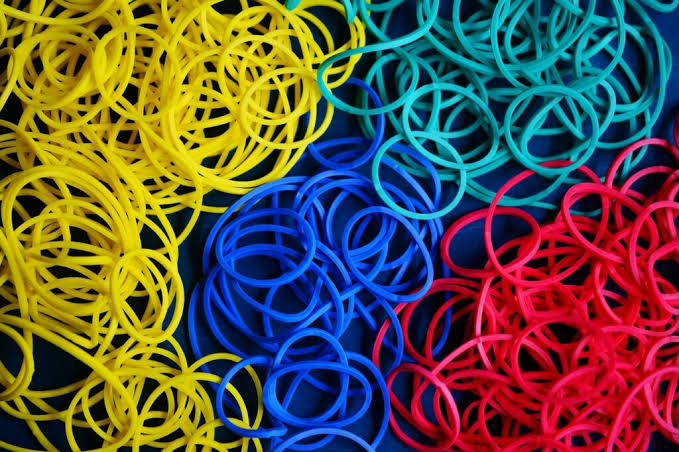
GTI Dryers evaluates industrial drying requirements through an application-based approach. Depending on the material and process, the options to investigate may include fluid-bed drying, rotary or other continuous drying systems, staged drying arrangements, and specialized solutions integrated with mechanical dewatering or upstream processing.
This guide explains how manufacturers can identify their drying problem, compare suitable technologies and prepare the technical information needed to evaluate a dryer for a new plant or an existing production line.
1. Start With the Material, Not the Machine
Before choosing a dryer, identify what the plant is actually trying to dry. This is the first step toward reducing unsuitable equipment proposals, unnecessary energy consumption and recurring product-quality problems.
| Material or process | Typical feed condition | Main drying consideration |
| SBR (styrene-butadiene rubber) crumb | Wet, coagulated elastomeric crumb | Remove residual water while controlling agglomeration and thermal exposure |
| Other synthetic rubber crumb | Wet crumb from an appropriate polymer recovery process | Account for grade-specific properties, feed moisture and crumb behaviour |
| EPDM and other elastomers | Crumb, granules or other process-dependent forms | Evaluate material movement, temperature sensitivity and product consistency |
| Rubber masterbatch crumb | Elastomer combined with carbon black or other compounding ingredients | Control moisture while considering filler distribution, pellet or crumb integrity and handling |
| Rubber granules or pellets | Particulate material with variable moisture | Assess particle size, flowability, thermal behaviour and final moisture |
| Latex-derived powder | Liquid latex or dispersion requiring conversion into powder | Evaluate spray drying or another suitable liquid-feed drying process |
| Rubber additives and selected masterbatch ingredients | Powders, granules or pellets | Select drying based on the ingredient, carrier resin or elastomer and downstream requirements |
The terms rubber, elastomer, latex and masterbatch cover different material and process categories. A supplier should confirm the feed form and the required process outcome before recommending equipment.
2. SBR and Synthetic Rubber Crumb: Where the Drying Challenge Begins
In many emulsion-polymerization routes, the polymer is recovered from an aqueous system and coagulated into crumb. The crumb may be washed, mechanically dewatered and then thermally dried before finishing, packaging or baling. Rubber crumb drying has been studied extensively because heat transfer, moisture movement and the material’s physical behaviour influence drying performance.
For plant engineers, the challenge is to remove the required amount of moisture while maintaining stable operation and the specified rubber properties.
Common production problems
High moisture after mechanical dewatering
Mechanical dewatering can remove a significant portion of the free water before thermal drying. The dryer must then remove the remaining moisture to meet the finished-product requirement.
Uneven drying
Variations in crumb size, incoming moisture, feed distribution and residence time may cause differences in final moisture.
Crumb agglomeration
Rubber crumb can behave differently from rigid mineral or salt particles. Material temperature, moisture, surface characteristics and mechanical behaviour need to be considered when assessing the risk of sticking or agglomeration.
High thermal energy consumption
Energy demand depends on the quantity of water entering the thermal stage, the required final moisture, heat-transfer efficiency, exhaust losses and the overall process arrangement.
Thermal damage or quality variation
Excessive or poorly controlled thermal exposure can create quality risks. The allowable operating conditions should be established for the specific rubber grade and process.
The engineering response
Rather than immediately increasing the dryer temperature, assess the complete drying line:
- Measure the feed rate and incoming moisture.
- Confirm the performance of the upstream mechanical dewatering stage.
- Characterize the crumb’s size, consistency and tendency to agglomerate.
- Establish the required final moisture and measurement method.
- Review heat transfer, residence time, gas distribution and exhaust conditions.
- Check whether staged drying or a different dryer configuration could improve process control.
A fluid-bed drying system has been described in technical literature for wet elastomeric crumb, including crumb containing carbon black. This does not mean that every rubber grade or crumb shape is suitable for fluidization; feed characteristics must be evaluated. Technical reference: fluid-bed drying of wet elastomeric crumb.
3. Which Dryer Is Suitable for Rubber and Elastomers?
The most appropriate dryer depends on the physical form of the feed and the process duty. A technology used to dry wet synthetic rubber crumb should not automatically be selected for liquid latex, hygroscopic additives or finished plastic pellets.
A. Fluid-bed dryer for suitable synthetic rubber crumb
A fluid-bed dryer passes a controlled gas stream through a suitable bed of particles or crumb. The gas provides heat and removes moisture as it moves through the material.
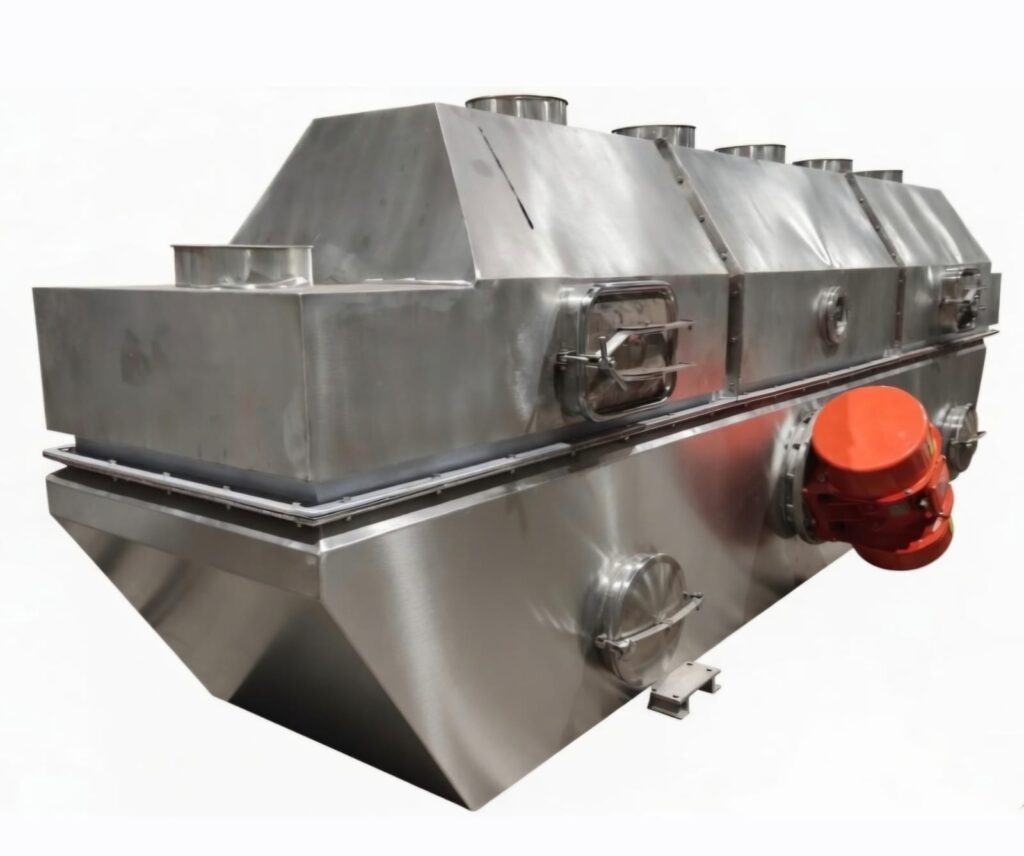
For appropriate synthetic rubber crumb, the design can be assessed for continuous moisture removal, compartmentalized operation and controlled drying conditions.
Evaluate a fluid-bed dryer when:
- The feed can be distributed and maintained appropriately within the bed.
- The material’s size, shape and mechanical properties are suitable for the selected configuration.
- Uniform exposure to the drying gas is important.
- The process requires controlled moisture removal across different stages.
- Dust or fines recovery and exhaust management can be integrated.
Key engineering checks: bed stability, pressure drop, gas distribution, entrainment, crumb agglomeration, temperature profile and final moisture.
Fluid-bed systems should not be assumed to suit highly sticky, irregular or poorly fluidizable material without testing.
B. Mechanical dewatering followed by thermal drying
For wet rubber crumb, separating mechanical water removal from thermal drying can be an important process-design consideration.
Mechanical dewatering may use suitable filtration, squeezing or other separation equipment to remove free water before the thermal stage. A dryer then removes the remaining moisture to meet the required product specification.
The advantage of this process approach is that the thermal system does not have to evaporate water that could have been removed mechanically. Whether it is beneficial depends on the incoming material, achievable mechanical dewatering performance, equipment cost and process integration.
A specialized mechanical finishing system may also be relevant for certain synthetic rubber lines. Such equipment is not interchangeable with a conventional rotary dryer or fluid bed; the process route and equipment must be evaluated together.
C. Rotary dryer for suitable rubber granules or particulate materials
A rotary dryer moves material through a rotating cylindrical drum while transferring heat to the feed. Depending on the application, the heating arrangement may be direct, indirect or otherwise customized.
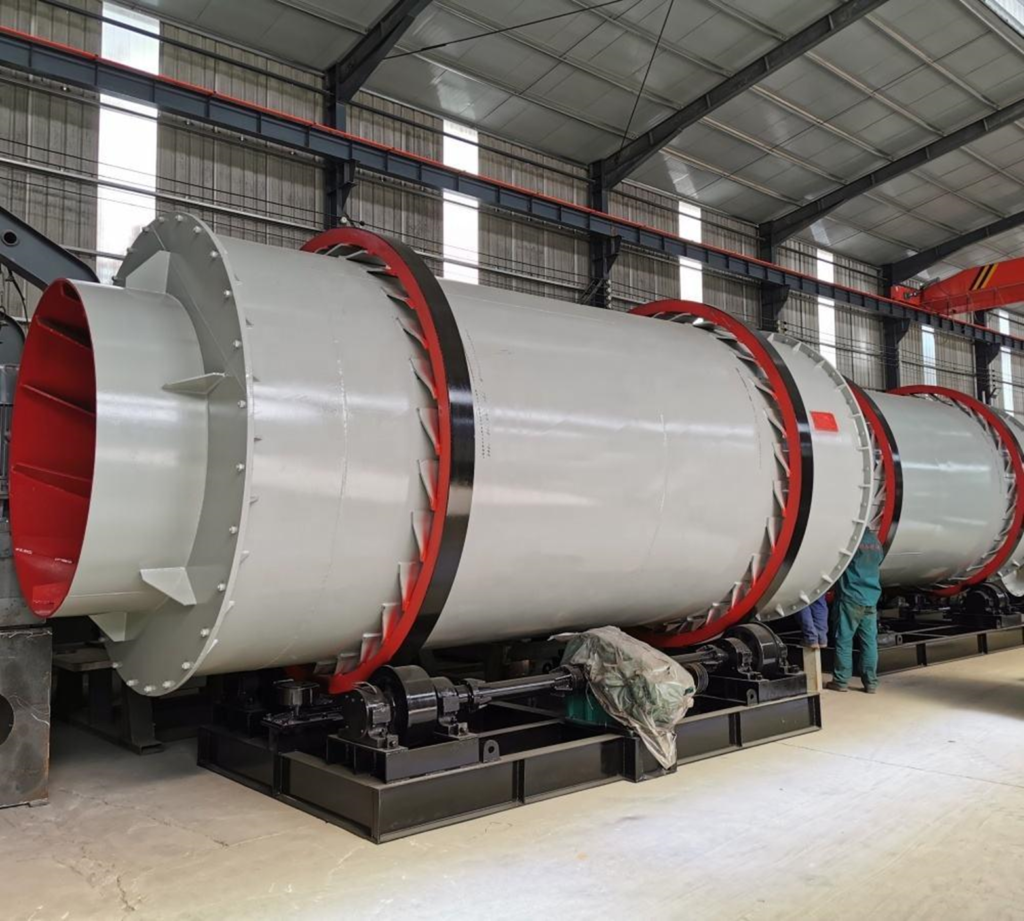
Rotary drying can be evaluated for suitable granules or particulate materials when the feed can move through the drum without unacceptable sticking, agglomeration, degradation or mechanical damage.
Evaluate a rotary dryer when:
- The feed form is compatible with rotating-drum handling.
- Continuous operation is required.
- The required residence time and moisture-removal duty can be achieved.
- The material tolerates the associated movement and heat-transfer conditions.
- Dust extraction, exhaust handling and downstream cooling can be addressed.
Important: A rotary dryer is not automatically the preferred option for soft or sticky synthetic rubber crumb. The feed’s mechanical behaviour must be reviewed before this technology is shortlisted.
D. Spray dryer for suitable latex-derived powders
Liquid latex and latex-derived materials require a different process assessment from wet rubber crumb. When the objective is to convert a suitable liquid dispersion into a powder, spray drying may be considered.
A spray dryer atomizes the liquid feed into droplets and exposes them to a drying gas. The droplets dry into particles that are collected from the exhaust stream.
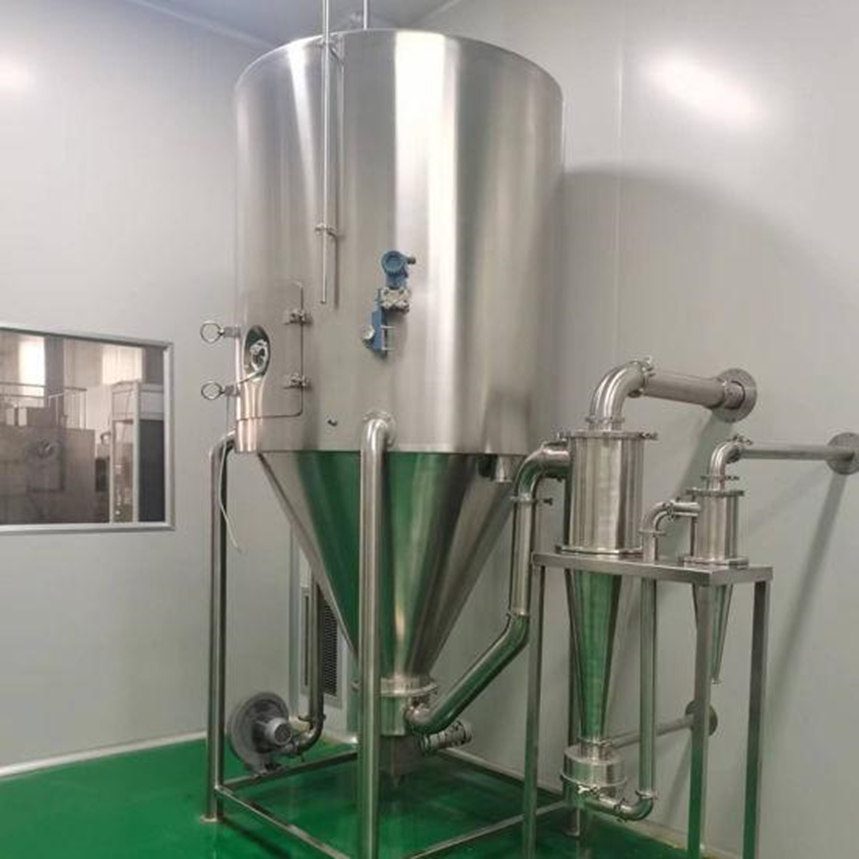
Suitability depends on the latex composition, solids content, formulation, required powder properties, thermal sensitivity, collection method and intended application. Some latex products require formulation changes or additional processing to achieve the required powder characteristics.
Do not treat a latex dispersion as ordinary rubber crumb. A spray dryer for liquid-to-powder conversion is a different process duty from a fluid-bed dryer for already-formed wet crumb.
E. Drying systems for rubber additives and masterbatch ingredients
Rubber additives and masterbatch ingredients may include fillers, pigments, processing aids and other materials used in compounding. Their drying requirements vary considerably.
Some particulate ingredients may be suitable for fluid-bed or rotary drying. Certain hygroscopic polymer resins or additives may require controlled low-dew-point air, desiccant drying or another specialized arrangement.
For a masterbatch, the drying strategy must account for the actual material being dried. Drying the carrier resin before compounding is different from drying finished masterbatch pellets or wet rubber masterbatch crumb.
The process objective should be specified first: pre-drying an ingredient, drying wet masterbatch crumb, conditioning finished pellets and converting latex into powder are separate duties.
4. Dryer Selection Matrix: Match the Technology to the Feed
| Feed condition | Technologies to evaluate | Main question before selection |
| Wet SBR or synthetic rubber crumb | Fluid-bed or specialized crumb-drying system | Can the crumb be handled without unacceptable agglomeration or damage? |
| Wet rubber masterbatch crumb | Suitable fluid-bed or specialized system | How do filler content, crumb properties and moisture affect drying? |
| Suitable rubber granules | Rotary or fluid-bed dryer | Will the material move or fluidize consistently? |
| Liquid latex or dispersion for powder production | Spray dryer or another appropriate liquid-feed process | Can the formulation produce the required powder safely and consistently? |
| Hygroscopic resin or additive | Desiccant, fluid-bed or other suitable dryer | What moisture specification and air-dew-point requirement apply? |
| Heat-sensitive or quality-critical elastomer | Specialized or staged drying approach | What product-temperature and residence-time limits must be maintained? |
This matrix is a preliminary screening guide. It is not a guarantee that a particular technology will work for a given grade.
5. Troubleshooting Guide: Solve the Problem Before Upsizing the Dryer
Problem 1: Final moisture is inconsistent
Possible causes
- Fluctuating feed rate or incoming moisture.
- Inconsistent crumb or particle size.
- Uneven distribution of material.
- Changes in gas temperature, humidity or flow.
- Variable residence time or measurement methods.
What to investigate
Compare incoming and outgoing moisture, review feed control, assess material distribution and verify the measurement method. For continuous systems, evaluate whether the dryer has sufficient control over the range of expected operating conditions.
Problem 2: Rubber crumb sticks or agglomerates
Possible causes
- Feed characteristics that encourage sticking.
- Excessive local product temperature.
- Uneven moisture distribution.
- Inappropriate gas distribution or material movement.
- Unsuitable dryer configuration for the crumb.
What to investigate
Assess the material’s condition before drying, the temperature profile, residence time and behaviour under representative process conditions. A higher heat input may not solve the underlying material-handling problem.
Problem 3: The drying stage consumes too much energy
Possible causes
- Excessive water entering the dryer.
- Inefficient upstream mechanical dewatering.
- Heat loss through exhaust or equipment surfaces.
- Poor insulation or air leakage.
- Unstable feed or inappropriate operating conditions.
What to investigate
Establish a water and energy balance. Review whether upstream dewatering can reduce the evaporation duty, whether heat recovery is practical and whether the dryer is operating within its intended process window.
Do not compare energy performance without using the same feed basis, initial moisture, final moisture and throughput.
Problem 4: Rubber properties vary after drying
Possible causes
- Inconsistent incoming material.
- Excessive thermal exposure.
- Different residence times.
- Uneven drying or agglomeration.
- Changes in downstream handling.
What to investigate
Agree on the relevant product-quality tests with the rubber manufacturer. Depending on the grade and application, these may include residual moisture, crumb condition, bulk handling characteristics and specified rubber properties.
Drying performance should be evaluated against the actual product specification, not only the outlet temperature.
Problem 5: Too many fines are generated
Possible causes
- Fragile feed particles or crumb.
- Excessive mechanical impact or abrasion.
- Inappropriate fluidization conditions.
- Damage during discharge, conveying or packaging.
What to investigate
Trace the material path through the entire line. Fines can be generated in conveyors and transfer points as well as in the dryer. The solution may require changes to handling, feed preparation, equipment configuration or operating conditions.
Problem 6: Production capacity cannot meet the target
Possible causes
- High incoming moisture.
- Feed surges or uneven feeding.
- Insufficient heat-transfer capacity.
- Residence-time limitations.
- Upstream bottlenecks or downstream restrictions.
What to investigate
Calculate the actual water evaporation load and assess each stage of the process. Increasing the nominal dryer size without understanding the bottleneck may not improve overall plant throughput.
6. How to Estimate the Moisture-Removal Duty
One of the most useful pieces of information for a dryer enquiry is the water-removal load.
For a feed with known wet-basis moisture content, the dry-solids flow can be estimated as:
Dry-solids flow = Wet-feed flow × (1 − Initial moisture fraction)
The required dried-product flow at a specified final wet-basis moisture is:
Dried-product flow = Dry-solids flow ÷ (1 − Final moisture fraction)
The water-removal rate is then:
Water removed = Wet-feed flow − Dried-product flow
These calculations assume that dry-solids mass remains constant and that the moisture percentages are expressed on a wet basis. Actual rubber processes may involve losses, volatile components or other changes, so the estimate should be checked against the real process.
Illustrative example: If a line feeds 1,000 kg/h of wet crumb at 20% moisture on a wet basis and the target is 2% moisture, the dry-solids flow is 800 kg/h. The final product flow is approximately 816.3 kg/h, and the water-removal load is approximately 183.7 kg/h.
This is a mass-balance illustration only, not a recommended operating specification for SBR or any other elastomer. The actual target moisture must come from the product requirements.
7. Energy Efficiency: Evaluate the Complete Rubber Drying Line
Thermal drying can require substantial energy, particularly when a large quantity of water must be removed. A technical review of crumb rubber drying discusses the importance of energy-efficient drying techniques and the material’s thermal and dielectric properties.
For a new installation or capacity upgrade, evaluate the following:
Upstream dewatering: Determine whether additional mechanical water removal is technically and economically practical.
Heat-transfer efficiency: Review the dryer configuration, operating range and heat-transfer limitations.
Exhaust losses: Assess whether exhaust-air heat recovery is technically feasible without creating condensation, contamination or other process problems.
Insulation: Identify avoidable heat losses from the equipment and ductwork.
Feed stability: Reduce unnecessary variation in throughput and incoming moisture where possible.
Control strategy: Monitor the variables that materially affect drying performance, such as feed rate, temperatures, airflow or pressure drop, and final moisture where measurement is practical.
Cooling and downstream integration: Consider whether dried material can be cooled and transferred efficiently without introducing avoidable handling problems.
A realistic energy assessment should compare the complete process using the same production rate, moisture specifications, operating hours and utility basis.
8. Process Safety and Product Handling
Synthetic rubber drying requires a process-specific safety review. Depending on the material, feed form and process chemistry, the relevant issues may include hot surfaces, moving equipment, airborne particles, residual process chemicals, volatile compounds and combustible-dust hazards.
A suitable project assessment should consider:
- Dust generation and containment.
- The ignition and combustible-dust characteristics of the actual material.
- Appropriate extraction, filtration and exhaust handling.
- Temperature monitoring and suitable protective controls.
- Equipment access, inspection and maintenance.
- Material compatibility and cleaning requirements.
- Applicable plant, environmental and occupational safety requirements.
Rubber crumb, carbon-black-containing masterbatch and other elastomeric materials may present different hazards. The plant should not assume that one set of dust controls is adequate for all products.
Where the material may release residual monomers, solvents or other volatile compounds, the process and exhaust system must be evaluated accordingly. The required design should follow the actual feed chemistry and a documented hazard assessment.
9. How to Choose a Rubber Dryer Manufacturer in India
When comparing dryer manufacturers, look for an engineering process that starts with the feed and the product specification—not a fixed machine model.
Use the following checklist to evaluate a potential supplier.
- Material understanding: Can the supplier distinguish SBR crumb, other elastomers, rubber masterbatch, granules and latex-derived feeds?
- Process assessment: Does the proposal account for upstream washing, coagulation, mechanical dewatering, pelletizing or other relevant stages?
- Technology justification: Can the supplier explain why fluid-bed, rotary, spray or specialized drying is being considered?
- Moisture specification: Are the initial and final moisture values and measurement methods clearly defined?
- Product quality: Are agglomeration, thermal exposure, fines and material handling included in the design discussion?
- Energy evaluation: Is the water-removal load calculated, and are energy-saving opportunities assessed realistically?
- Safety and exhaust: Are dust, residual volatiles, exhaust handling and site-specific hazards addressed?
- System integration: Does the scope include the necessary feed, discharge, conveying, cooling and collection equipment?
- Validation: Can representative material trials or a pilot assessment be considered where the material behaviour is uncertain?
- Performance criteria: Are the operating assumptions and acceptance tests agreed before the project is finalized?
For specialized rubber crumb, masterbatch or latex-derived products, representative testing may be particularly valuable because feed behaviour can differ substantially between grades and formulations.
10. GTI Dryers: Application-Based Industrial Drying Solutions
GTI Dryers, from Genex Tech Industries, develops industrial drying solutions for process applications that require equipment selection based on material characteristics, production requirements and desired product quality.
For rubber and synthetic elastomer projects, the initial technical review should establish the exact feed form and the purpose of drying. A wet SBR crumb line, a rubber masterbatch process and a latex-to-powder application may require different equipment and process arrangements.
GTI Dryers can review the information available from the project team to help assess the drying duty and identify suitable technologies for further engineering evaluation. Final equipment selection, configuration and performance commitments should be based on the actual process conditions and, where necessary, material trials.
What to provide for a rubber dryer enquiry
To help assess your project, prepare the following information:
- Material: SBR, EPDM, another synthetic rubber, masterbatch, granules or latex-derived product.
- Feed form: wet crumb, granules, pellets, powder or liquid dispersion.
- Wet feed capacity: kg/h or tonnes/h.
- Initial moisture: percentage by weight and measurement method.
- Required final moisture: percentage by weight and measurement method.
- Material characteristics: particle size, crumb size, bulk density, tendency to agglomerate and relevant thermal properties.
- Process route: washing, coagulation, mechanical dewatering, pelletizing, compounding or other upstream stages.
- Operating schedule: production hours per day and days per year.
- Utilities: available heat source, electricity, compressed air and other relevant utilities.
- Downstream requirements: cooling, conveying, baling, packaging, compounding or powder collection.
- Site requirements: location, available space, operating constraints and safety requirements.
- Quality targets: any agreed tests or specifications for the dried product.
If some values are not available, provide the known information first. The technical review can identify which additional data are needed.
Planning a new rubber drying line or trying to resolve an existing moisture problem? Contact GTI Dryers with your feed condition, capacity and moisture targets to begin an application assessment.
Website: https://gtidryers.com/
11. Frequently Asked Questions
Which dryer is suitable for SBR rubber crumb?
A fluid-bed or specialized rubber crumb drying system may be suitable for appropriate wet SBR crumb. The choice depends on feed properties, moisture load, required final moisture, thermal limits and the overall process arrangement. Mechanical dewatering may also be an important upstream step.
Can a rotary dryer be used for synthetic rubber?
A rotary dryer can be evaluated for suitable rubber granules or particulate materials. Wet or sticky synthetic rubber crumb requires a more specific assessment because material movement, agglomeration and product quality may limit the suitability of a conventional rotary configuration.
How is moisture removed from wet synthetic rubber crumb?
A common process approach is to remove a portion of the free water mechanically and then use thermal drying to reach the required residual moisture. The exact process may involve filtration, squeezing, fluid-bed drying or specialized finishing equipment depending on the material and production line.
Is a fluid-bed dryer suitable for EPDM or other elastomers?
It may be suitable for certain elastomeric crumb or particulate feeds, but suitability depends on the material’s physical properties, size, tendency to agglomerate and response to the drying gas. Testing or detailed engineering review may be necessary.
Can a dryer process rubber masterbatch containing carbon black?
Potentially, but the correct equipment depends on whether the feed is wet masterbatch crumb, finished pellets or a separate ingredient. The review should account for the elastomer, filler content, moisture, particle behaviour and required product quality.
Can synthetic rubber latex be converted into powder?
Suitable latex dispersions can be assessed for spray drying or another liquid-feed powder-production process. Formulation, solids content, thermal sensitivity and the intended powder specification affect whether the process is appropriate.
What final moisture should synthetic rubber have after drying?
There is no universal final-moisture target for all synthetic rubber grades. The specification depends on the material, process, packaging and downstream requirements. The target and measurement method should be agreed before dryer sizing.
How can energy consumption be reduced in rubber crumb drying?
Start by quantifying the water-removal load and evaluating upstream mechanical dewatering, heat-transfer efficiency, exhaust losses, insulation and feed stability. Any projected energy savings should be assessed using the actual process and operating conditions.
What information is needed to size a rubber dryer?
The most important starting data are feed type and form, wet feed rate, initial moisture, required final moisture, material characteristics, process route, heat-source availability and operating schedule. Safety and downstream handling requirements are also essential.
Does GTI Dryers offer customized rubber and elastomer drying systems?
GTI Dryers evaluates industrial drying requirements based on application needs. A rubber or elastomer project should be reviewed individually to determine the appropriate technology, equipment scope, process assumptions and any required material trials.
Conclusion: Build the Drying System Around the Elastomer
Rubber and synthetic elastomer drying is not a one-machine-fits-all application. Wet SBR crumb, other synthetic rubber granules, rubber masterbatch and latex-derived powders differ in their physical form and processing requirements.
The right solution starts by identifying the material, quantifying the water-removal load, understanding the upstream process and defining the finished-product specification. Fluid-bed, rotary, spray and specialized drying systems can each have a role when matched to the appropriate duty.
For manufacturers seeking to improve moisture consistency, reduce avoidable energy consumption, protect product quality or plan a new production line, GTI Dryers can review the available process data and help establish the next steps toward an application-specific drying solution.
Enquire with GTI Dryers about your rubber, SBR or synthetic elastomer drying requirement.